

Top Clinical Trial Technology Trends for 2025

Cut Trial Costs by Millions and Months: 5 Tech Trends to Use in 2025
The landscape of drug development is rapidly evolving, with clinical trial technology trends driving unprecedented change. These shifts are making trials faster, cheaper, and more focused on patients.
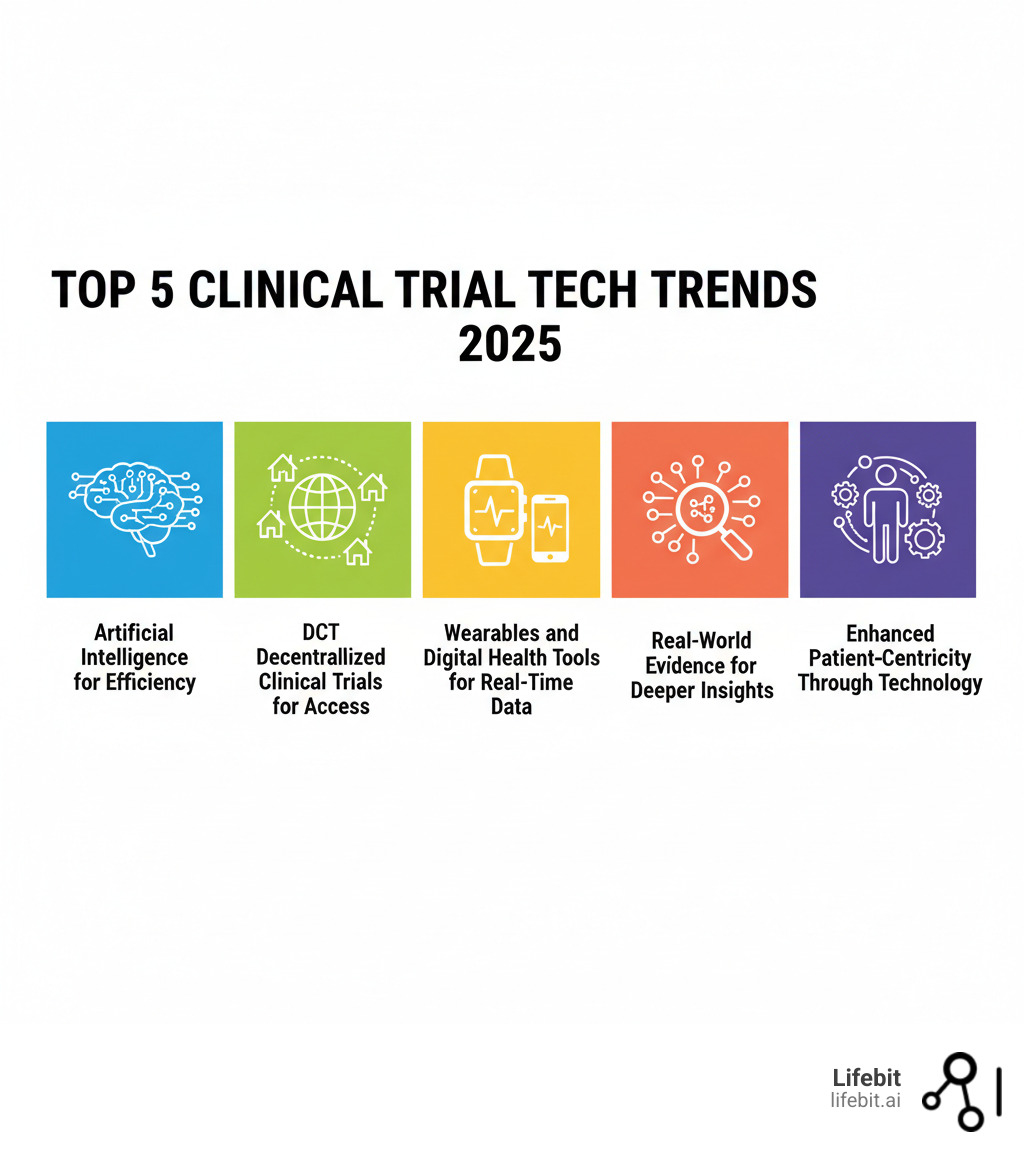
Here are the top 5 clinical trial technology trends for 2025:
- Artificial Intelligence (AI): Speeds up design, recruitment, and data analysis.
- Decentralized Clinical Trials (DCTs): Boosts patient access and retention through remote tools.
- Wearables & Digital Health Tools: Provides continuous, real-time patient data.
- Real-World Evidence (RWE): Offers deeper insights into treatment effectiveness outside trials.
- Improved Patient-Centricity: Uses technology to design trials around patient needs and diversity.
For decades, drug development has battled Eroom’s Law where the cost of bringing a new drug to market doubles roughly every nine years. Today, launching a single new medication can demand over a billion dollars and a decade of work. Half of that massive investment is eaten up by clinical trials alone. Worse, more than 80% of trials fail to enroll patients on time, leading to costly delays. Only one in seven drugs entering Phase I trials ever gets approved. This unsustainable reality means technology is no longer an option. It’s the only way forward to cut costs, accelerate timelines, and bring life-saving therapies to patients faster.
As CEO and Co-founder of Lifebit, I’ve spent over 15 years at the forefront of computational biology and health-tech entrepreneurship, deeply engaged with these clinical trial technology trends. My work leverages AI, high-performance computing, and federated data analysis to transform drug discovery and empower precision medicine in secure, compliant environments. Understanding these trends is crucial for steering the future of medical research.
Essential clinical trial technology trends terms:
AI That Cuts Enrollment from Months to Hours: Design Faster, Spend Less
The most transformative clinical trial technology trend heading into 2025 is undoubtedly artificial intelligence. AI is now delivering real results in real trials, enabling faster timelines, improved accuracy, and significant cost savings.
AI’s power lies in processing massive data sets with machine learning and Big Data analytics. This means fewer errors, faster results, and smarter decisions at every stage of a trial. From drug discovery to final analysis, AI is reshaping research.
At Lifebit, our federated AI platform harnesses this power across global biomedical data. We can generate real-time insights and accelerate research while keeping data secure and compliant. It’s not just about speed it’s about making smarter, data-driven decisions that translate directly into more successful trials.
AI Boosts Patient Recruitment No More Missed Deadlines
Patient enrollment has been the Achilles’ heel of clinical research for decades. More than 80% of clinical trials fail to enroll on time. This often doubles trial timelines, drains budgets, and delays life-saving treatments.
The problem runs deep: 11% of trial sites enroll no patients, 37% under-enroll, and only 39% hit their targets. Traditional recruitment methods can’t keep up with these industry-plaguing bottlenecks.
AI-driven patient matching is changing everything. Instead of manually combing through records for weeks or months, AI can scan millions of Electronic Health Records in real-time to identify eligible patients. The results are remarkable.
For example, at Johns Hopkins, an AI tool for a brain injury trial reduced enrollment work from days to minutes. Or consider Cedars-Sinai Heart Institute, which used an AI tool to find 16 trial participants in just one hour a process that previously took six months to find just two participants.
This precision recruitment slashes time and costs, minimizes screen failures, and gets trials back on schedule so patients can access new treatments faster.
Smarter Trial Design and Predictive Modeling with AI
After finding patients, the next challenge is trial design. Here, AI’s predictive power shines as a key clinical trial technology trend.
AI models can extract information from thousands of trial documents and evaluate how each component of a protocol affects outcomes. This allows for protocol optimizationrefining inclusion and exclusion criteria, identifying potential pitfalls before they cause delays, and streamlining complex protocols into more efficient designs.
Synthetic data simulation takes this even further. Deep learning algorithms can simulate diverse patient outcomes using synthetic data, letting us “test” various protocol scenarios virtually. We can predict patient responses, forecast study results, and identify the most promising approaches before enrolling a single real patient. This saves immense time and resources.
The predictive modeling capabilities are already proving themselves. Machine learning techniques are successfully predicting improvements in depressive symptoms for patients on antidepressants. AI models are accurately forecasting cancer treatment outcomes, including patient survival rates. By mining patient records and finding intricate patterns invisible to the human eye, AI makes individualized predictions for treatment response.
This means we can design more efficient trials, potentially reducing the number of patients needed and accelerating the overall development process without sacrificing scientific rigor.
Generative AI Makes Compliance and Inspections Effortless
The administrative burden of clinical trials is immense. Compliance documentation, regulatory inspections, and Trial Master Files create mountains of paperwork that bog down even the most efficient teams.
Generative AI is emerging as the solution. We’re now seeing automated compliance checks that can review documentation faster and more accurately than human teams. Self-analyzing Trial Master Files can preemptively flag inconsistencies or regulatory risks, turning a manual, error-prone process into a proactive, automated one.
An AI co-pilot during inspections can provide instant document retrieval and proactive risk detection, making a stressful, weeks-long process smoother and faster. This eliminates frantic searches and reduces the risk of critical omissions.
These capabilities are becoming essential as global regulatory requirements evolve. New demands for data anonymization, plain language summaries, and diversity documentation mean sponsors need adaptive strategies. AI-driven tools help maintain compliance across jurisdictions while fostering the inclusivity that regulators increasingly expect. The result is faster submissions and fewer compliance headaches.
Stop Patient Dropout Now: Use DCTs and Wearables to Expand Access
Patients want trials that fit into their lives, not the other way around. This fundamental shift is driving one of the most important clinical trial technology trends: the rapid rise of decentralized clinical trials (DCTs) and digital health tools that put patients first.
By enabling remote participation and reducing clinic visits, trials become accessible to more people. This means broader access to diverse populations and, critically, higher retention rates. Patients who don’t have to drive hours to a trial site or take time off work are far more likely to stay enrolled through completion.

Wearables and Remote Monitoring: Real-World Data, Real-Time Insights
The days of collecting data only during occasional clinic visits are fading. Wearables and digital health tools now provide a continuous, real-time window into patients’ daily lives and treatment responses.
These devices, from smartwatches to sophisticated biosensors, enable continuous data capture that provides genuine real-world evidence. Instead of guessing what happens between appointments, we can monitor patient health around the clock. This creates “next-generation digital biomarkers,” offering unprecedented visibility into adverse events, outcomes, and adherence.
The Stanford University Apple Heart Study demonstrated this power, enrolling over 400,000 participants in a virtual study using the Apple Watch to detect irregular heart rhythms a scale unimaginable with traditional models.
Real-time monitoring means we can spot protocol deviations or safety concerns much faster. If a patient’s vitals start trending the wrong way, we know immediately, not weeks later at their next appointment. This capability is changing how we think about patient safety and trial oversight.
However, wearables generate massive volumes of data. Managing, analyzing, and extracting meaningful insights from this flood of information requires robust data platforms and advanced analytics. Federated data platforms excel here, turning data streams into actionable intelligence.
It’s worth noting that alongside wearables, eConsent adoption has seen a threefold increase since 2020, starting from just 20%. This shift to digital consent processes significantly improves efficiency and makes remote participation far more practical.
Decentralized Clinical Trials (DCTs): Reach More Patients, Faster
Decentralized Clinical Trials represent a fundamental reimagining of how we conduct research. While COVID-19 accelerated their adoption, DCTs aren’t new. Pfizer conducted the first entirely virtual clinical trial back in 2011, using mobile and web-based technology to collect data without a single clinic visit.
DCTs are powerful because they meet patients where they are. By removing geographical barriers and the need for frequent site visits, these hybrid and virtual trial models can reach diverse patient populations that traditional trials couldn’t access. DCTs open the door to patients in rural areas, those with mobility challenges, or people who cannot afford to miss work.
The impact on patient retention is remarkable. When you eliminate the burden of travel and time commitments, participation becomes far more manageable. Patients can integrate trial activities into their daily routines. This convenience can be the difference between completing a trial and dropping out.
There’s also a diversity advantage. Traditional trials have struggled to include underrepresented populations, partly because trial sites cluster in certain geographic areas. DCTs break down these barriers, making it possible to build more representative study populations that better reflect the actual patients who will eventually use these treatments.
From a cost perspective, while the initial setup of a decentralized infrastructure can be complex, long-term operational costs often prove lower. Fewer site visits mean reduced overhead, and streamlined digital data collection cuts administrative burden.
However, challenges remain. Data security and privacy become even more critical when patients are participating from home. You need reliable technological infrastructure that works for all participants, regardless of their tech savvy. Navigating regulatory complexities across different regions also adds difficulty.
This is where platforms like Lifebit’s secure, federated architecture become essential. Our Trusted Research Environment is specifically designed to enable compliant research across hybrid data ecosystems, ensuring data integrity and maintaining patient trust even as trials become increasingly distributed. We’re helping sponsors overcome the logistics of DCTs while keeping data secure and meeting regulatory requirements across borders.
Patent Cliffs and New Rules: Tech That Protects Your Trials and Budget Now
The clinical trial world in 2025 faces a mix of political uncertainty, economic shifts, and changing regulations. Companies are reducing risk, and technology is the key to navigating these challenges. It helps them innovate and make smart financial decisions in an unstable market.
Meeting New Diversity and Tech Demands from Regulators
Diversity in clinical trials is critical. It’s not just about fairness it’s about good science. Without diverse trials, we can’t understand how treatments work for everyone. In 2020, 75% of trial participants were white, with only 11% Hispanic, 8% Black, and 6% Asian. This matters because one in five drugs can work differently across racial and ethnic groups. Without diversity, we risk approving drugs that are less effective or unsafe for some populations.
The FDA is pushing for more diverse trials, issuing draft guidance that asks sponsors to create diversity action plans. While the regulatory landscape continues to evolve, the scientific and moral imperative for diversity remains unchanged. Technology, especially clinical trial technology trends like AI and Decentralized Clinical Trials (DCTs), are our best tools to reach underrepresented groups. AI can pinpoint optimal recruitment sites in diverse communities, and DCTs can break down geographical barriers. Initiatives like Kroger’s clinical trial network show that the industry is still committed to making trials more inclusive, no matter what the regulatory landscape looks like. At Lifebit, our platform’s ability to analyze real-world data from diverse populations helps ensure our research benefits everyone.
Funding, Partnerships, and New Service Models
Many biopharma companies are facing “patent cliffs,” when blockbuster drug patents expire, allowing for generic competition. This pressures companies to develop new therapies and sparks M&A activity and partnerships. Fortunately, the life sciences sector is seeing a recovery in funding for early-stage biopharma, thanks to a surge in cash reserves.
To steer these financial currents, many companies are turning to Functional Service Provider (FSP) models. Instead of outsourcing an entire trial, sponsors hire experts for specific functions like data management. This approach gives sponsors greater control over how their trials are run and how funds are managed, offering more flexibility and efficiency. Sponsors can pool resources, share expertise, and quickly adopt cutting-edge technologies. Plus, with the rise of accessible cloud and SaaS solutions, even smaller and mid-sized pharma companies can directly manage their digital platforms. This shift fosters more collaborative, tech-integrated relationships and leads to smarter cost management.
After 2025: Make Rare-Disease Trials Possible and Turn RWE into Faster Approvals
Looking ahead, several clinical trial technology trends will define the next decade of clinical trials. We envision a future where trials are faster, more efficient, inclusive, and precise, leveraging advanced tools to tackle previously impossible challenges.
Rare Disease Trials: Tech Makes the Impossible, Possible
Rare disease research presents unique challenges: tiny, geographically dispersed patient pools and high investment costs. However, technology is making the impossible, possible. Forecasted sales for rare disease drugs are predicted to reach nearly $135 billion by 2027, indicating a significant focus on this area.
Technology supports these efforts by:
- Precision Recruitment: AI and advanced analytics can scour global patient registries and medical records to identify eligible patients, even for ultra-rare conditions.
- Decentralized Models: DCTs enable participation regardless of location, crucial for diseases with few affected individuals.
- Agile Data Platforms: Nimble clinical data management platforms are essential to offset the high costs associated with limited patient data. These platforms streamline data collection, analysis, and reporting, maximizing the return on investment in these critical research areas. Our platform, with its capabilities for multi-omic data analysis, is particularly well-suited to uncovering insights in rare disease cohorts.
Real-World Evidence (RWE): The New Gold Standard
Real-World Evidence (RWE) is medical evidence from data collected outside of a clinical trial, such as medical records, images, and claims. RWE has gained attention for its ability to provide novel insights on treatment impact, safety, and effectiveness. It is rapidly becoming a new gold standard that complements traditional trials.
RWE provides a deeper understanding of interventions by observing patient interactions in real-life settings, over longer periods, and with diverse groups. During the early days of the COVID-19 pandemic, RWE was critical in accelerating the roll-out of vaccines. Regulatory bodies, including the FDA, are increasingly open to considering real-world data, allowing researchers to submit anonymized RWE to complement clinical trials. This is particularly valuable for studying underrepresented populations or long-term outcomes that are difficult to capture in controlled trial settings.
Our federated AI platform, with its Real-time Evidence & Analytics Layer (R.E.A.L.), is designed to integrate and analyze RWE securely and compliantly, accelerating pharmacovigilance and generating real-time insights from diverse data sources.
Ethics in Clinical Trial Tech: Protecting Patients and Data
With more AI and digital tools in research, ethical considerations are paramount. Technological advancement must go hand-in-hand with robust patient protection.
Key ethical considerations include:
- Data Privacy and Security: The collection of vast amounts of sensitive health data necessitates stringent data protection policies and encryption. Our Trusted Research Environment (TRE) and Trusted Data Lakehouse (TDL) ensure federated governance and secure collaboration, protecting patient privacy while enabling crucial research.
- AI Bias: Algorithms can inadvertently perpetuate or amplify existing health disparities if trained on biased datasets. Ensuring algorithmic transparency and actively mitigating bias is crucial to avoid worsening inequities.
- Algorithm Transparency: Understanding how AI makes decisions is vital for trust and accountability. We must ensure that AI’s recommendations are explainable and auditable.
- Human Oversight: Human oversight and expertise remain indispensable. Researchers must guide and validate AI insights to ensure ethical use and prevent errors or AI “hallucinations.”
Navigating global compliance, especially with varying data protection regulations (like GDPR in Europe), requires sophisticated technological solutions and a strong commitment to ethical practices. By prioritizing these considerations, we can build patient trust and ensure that technology truly serves the best interests of health research.
Clinical Trial Tech FAQs: Fix Recruitment, Use Wearables, Avoid AI Risks
Navigating clinical trial technology trends can be overwhelming. Let’s break down the real impact by answering some common questions.
What s the #1 Problem Tech Is Solving in Clinical Trials?
If we had to pick just one, it would be patient recruitment and retention. This is a huge deal. Historically, getting enough patients to join and stay in a trial has been a massive hurdle. Over 80% of trials don’t meet their enrollment deadlines, which often doubles how long a trial takes. This causes costly delays and long waits for new medicines.
This is where technology, especially AI, steps in. AI can now scan millions of patient records in minutes to quickly find eligible patients who fit the trial’s specific needs. This amazing speed and precision drastically cut down those delays. It means getting life-changing treatments to patients much faster.
How Are Wearables Changing Clinical Trial Data?
Wearables are revolutionizing how we collect patient information. Instead of just getting a snapshot of a patient s health during a clinic visit, wearables gather continuous, real-world data. They’re constantly tracking things like heart rate, activity levels, or sleep patterns, right in the patient s own home.
This constant flow of data gives us a much fuller and richer picture of a patient’s health and how they’re responding to a treatment. These tools are also a huge support for decentralized trials because they reduce the need for patients to travel to clinics. This convenience has been proven in many large-scale digital health studies, making trials easier for everyone involved.
What Are the Ethical Risks of AI in Clinical Trials?
While technology brings incredible advances, it’s crucial to address the ethics. We must always protect patients and their data. Key ethical risks of AI in clinical trials include:
First, there’s algorithmic bias. If the data used to “teach” an AI system isn’t diverse enough, the AI might make unfair or inaccurate predictions for certain groups of people. This could worsen existing health disparities.
Second, data privacy is a primary concern. Clinical trials deal with incredibly sensitive personal health information. This sensitive data must be collected, stored, and analyzed with the highest security and privacy protections.
Finally, the lack of transparency in some AI decisions must be addressed. It can be hard to understand why an AI system makes a recommendation, which challenges trust.
To tackle these risks, strong governance and human oversight are absolutely critical. We need clear rules, ethical guidelines, and knowledgeable human researchers to guide and check the AI’s work. This ensures AI tools are used responsibly and ethically, with patient safety and trust as the top priority.
Act Now or Fall Behind: Adopt These Trial Tech Moves to Cut Costs and Win Faster Approvals
The clinical trial technology trends we’ve explored are reshaping drug development right now. AI is slashing recruitment times from months to hours. Decentralized trials are meeting patients where they are, removing the burden of site visits. Real-world evidence is giving us insights we could never capture in traditional settings. These are fundamental shifts in clinical research.
The stakes are high. We’re battling Eroom’s Law, where drug development costs double as timelines stretch. For the first time, we have tools powerful enough to reverse this trend. Technology adoption is mission-critical.
The future we’re building is faster, more efficient, and profoundly patient-centric. We’re designing trials that reach diverse populations and generate better evidence while cutting costs and accelerating timelines.
At Lifebit, we’ve built our federated AI platform specifically for this moment. Our Trusted Research Environment (TRE), Trusted Data Lakehouse (TDL), and Real-time Evidence & Analytics Layer (R.E.A.L.) enable secure, compliant research across global biomedical data. We’re giving biopharma companies, governments, and public health agencies the tools to conduct large-scale research without compromising on security or speed. Our platform harmonizes complex data, runs advanced AI/ML analytics, and maintains federated governance all in real-time.
This is about getting treatments to patients faster, ensuring research represents everyone, and building a future where we can tackle rare diseases and develop effective precision medicines. The barriers of cost, time, and access are finally coming down. Companies that adopt these technologies now will lead the next era of medical research.
See how a federated AI platform can future-proof your clinical trials.