
Your Health, Your Data: A Guide to the All of Us Research Program
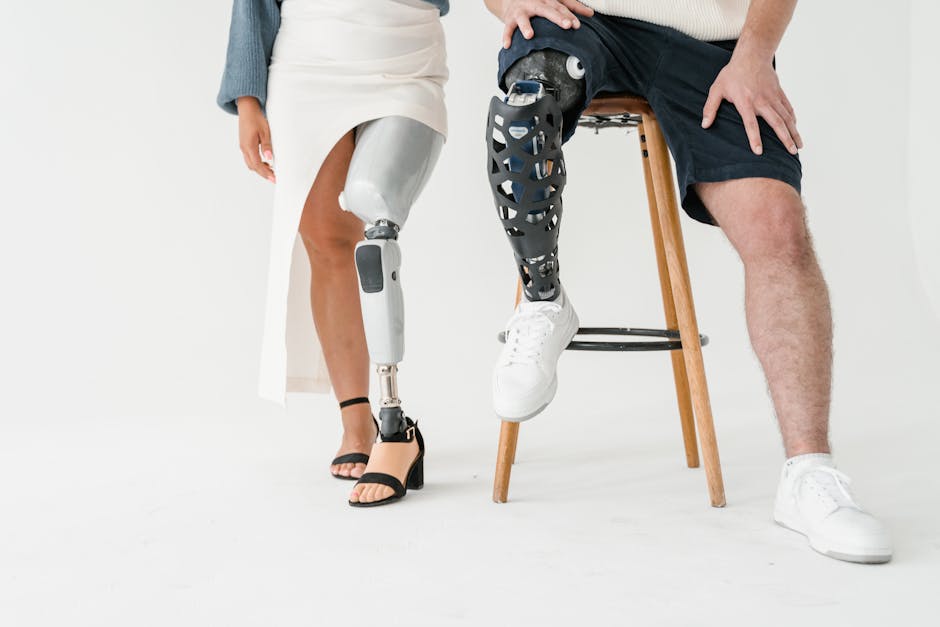
How Joining ‘All of Us’ Today Can Fix Broken Medicine for 80% of Americans Left Out of Research
Clinical research technology for all of us is changing how medical breakthroughs happen. The All of Us Research Program is a nationwide initiative by the National Institutes of Health (NIH) that partners with one million or more people across the United States to build one of the largest, most diverse health databases in history. This program uses advanced technology—including electronic consent (eConsent), health surveys, electronic health records (EHRs), wearable devices, and biosamples—to collect comprehensive health data that researchers can use to develop more personalized, effective treatments for everyone.
Here’s what you need to know:
- What it is: A massive NIH research program collecting health data from 1 million+ Americans
- Who can join: Any U.S. adult 18+ who wants to advance health research
- What you do: Create an account, consent electronically, share your EHR, complete surveys, and optionally give biosamples
- What you get: Up to $25 compensation, potential access to your DNA results, and the satisfaction of advancing medical science
- Why it matters: 80% of participants are from groups historically left out of research—finally making medicine work for all of us
For too long, healthcare has been one-size-fits-all. Most medical research excluded women, people of color, rural communities, and low-income populations. That means treatments developed from this research often don’t work as well—or at all—for most people. The All of Us program is fixing this by building a database that actually reflects the diversity of America.
More than 840,000 people have already joined. Their data is now powering over 12,375 health studies on everything from long COVID to social determinants of health to new genetic variants that improve testing accuracy.
I’m Maria Chatzou Dunford, CEO and Co-founder of Lifebit, a pioneering platform that powers secure, federated analysis of genomic and biomedical data across global healthcare systems. I’ve spent 15 years building clinical research technology for all of us that enables precision medicine at scale, and I’ve seen how platforms like All of Us are changing what’s possible in health research.
Inside the NIH ‘All of Us’ Project Turning 1 Million Americans’ Data Into Faster, Safer Treatments
The All of Us Research Program is a monumental effort by the National Institutes of Health (NIH) to transform the future of health. Its primary mission and overall objective are to accelerate health research advances and precision medicine, ensuring that healthcare becomes custom to each individual. We aim to build one of the largest, most diverse health databases in history, partnering with one million or more people across the U.S.
The program’s core values—diversity, transparency, and accessibility—guide its entire operation. We believe that to truly understand health and disease, research must reflect the rich mix of human experience. This is why we actively focus on recruiting participants from groups historically underrepresented in biomedical research, ensuring that the insights gained are relevant to all of us.
How is this different from traditional research? Historically, clinical studies often relied on limited, often homogenous, populations. This meant that findings weren’t always applicable to everyone, leading to health disparities. The All of Us program flips this script by intentionally oversampling communities that have been left out, creating a resource where diverse genetic backgrounds, lifestyles, environments, and biological makeups are central to discovery. This approach is designed to enable researchers to more precisely prevent and treat a variety of health conditions.
The program’s ambitious goals have even caught national attention, as highlighted by its feature on Good Morning America. This demonstrates the broad recognition of its potential to revolutionize health.
Your 7-Step Path to Becoming a Research Partner
Joining the All of Us Research Program is a straightforward process designed to be accessible and engaging. We want to empower you to become a partner in shaping the future of health.
Here are the steps to participate:
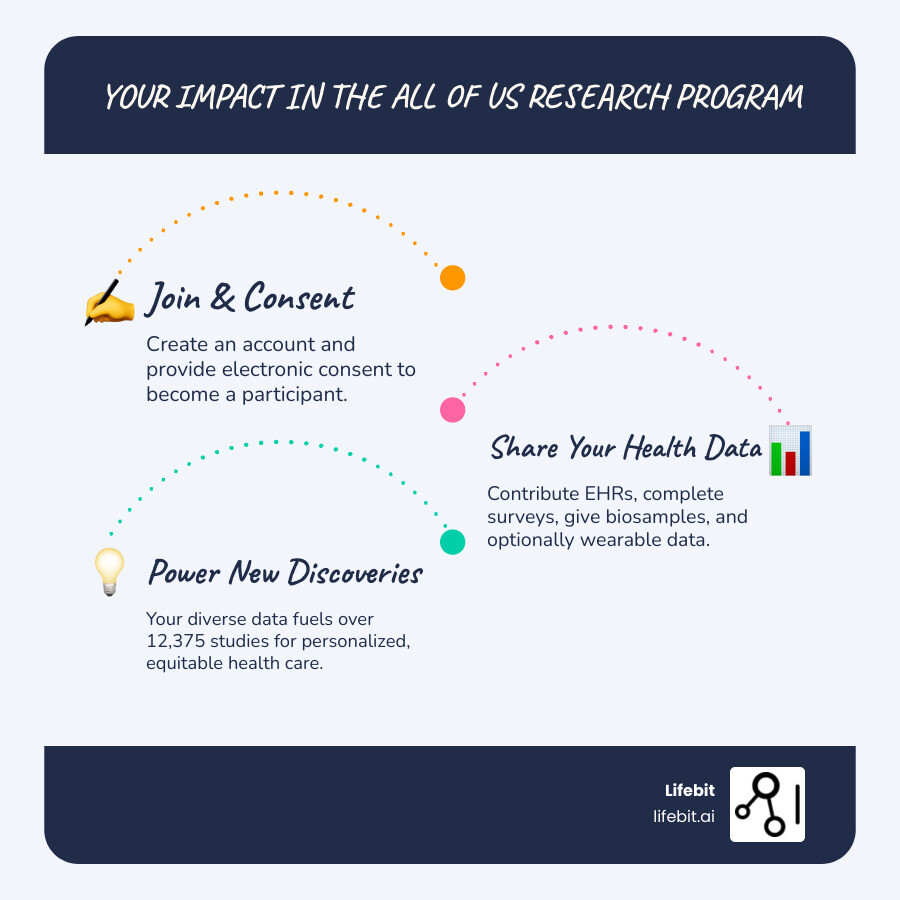
- Create an account: You can start by creating an account online using your email or phone number. This is your first step into becoming part of this historic effort.
- eConsent: We ask you to review and provide your electronic consent (eConsent) to join the program. This process is flexible, modular, and secure, ensuring you understand what you’re agreeing to. You’re more than welcome to only sign the consent to join.
- Share Electronic Health Records (EHRs): If you choose, you can agree to share your electronic health records. This crucial data provides valuable insights into your medical history. Over 560,000 participants have already authorized the sharing of their EHR data.
- Complete Surveys: You’ll be invited to answer various health surveys, including the “Basics” survey. These participant-generated health surveys cover topics like social determinants of health, overall health information, lifestyle, and medical history. We’ve collected more than 57,600 initial responses from the new social determinants of health (SDOH) survey alone.
- Give Biosamples: If invited, you may provide physical measurements and biosamples (blood, urine, saliva). This allows us to collect genomic data, which is vital for understanding how individual genetic information impacts disease. So far, we’ve collected 573,225+ samples.
- Get Compensation: As a token of our appreciation for your valuable time, participants may receive $25 compensation for their time after an in-person visit where samples or measurements are taken.
- Connect Digital Health Devices: You can also connect an array of sensor technologies, such as wearables and fitness trackers, to our participant portal. This enables the longitudinal collection of physiological and environmental data, giving researchers a real-time view of health outside clinical settings.
You can sign up today to begin your journey with the All of Us Research Program. We also offer 590+ locations where you can join in person and partner with 350+ community organizations to make participation as convenient as possible.
80% Underrepresented: How All of Us Is Fixing Research Bias
Our commitment to diversity and inclusion isn’t just a talking point; it’s fundamental to the program’s success and its core values. We understand that to achieve individualized prevention, treatment, and care, we need data from all of us.

The statistics speak for themselves:
- More than 80% of All of Us participants are from groups that have rarely been part of health research. This includes individuals from various racial and ethnic minority groups, LGBTQ+ people, low-income individuals, rural residents, and those with limited healthcare access.
- 50% of our participants identify as racial and ethnic minorities.
- A remarkable 80% belong to at least one underrepresented in biomedical research (UBR) population.
This intentional oversampling of underrepresented communities is a deliberate strategy to address health disparities. By collecting data from a broad population that reflects true diversity, we can ensure that the benefits of precision medicine are equitably accessible across racial, geographic, and socioeconomic measures. Our community partnerships and ongoing consultation with Tribal Nations are crucial to ensuring respectful engagement and inclusion of all populations.
We believe that by including everyone, we can gain novel insights into how lived experiences affect health and open up answers related to long COVID, social determinants of health, and many other health challenges. You can hear from real participants who are making a difference by sharing their voices and stories.
The Little-Known Tech Stack Quietly Powering 12,375+ Life-Saving Studies (And Protecting Your Data)
The sheer scale and ambition of the All of Us Research Program demand cutting-edge clinical research technology for all of us. This is where advanced platforms like Lifebit’s come into play, providing the secure, scalable, and intelligent infrastructure needed to manage massive, diverse data collection and foster participant engagement. Our technology ensures that the program can meet its goals of democratizing health research and accelerating precision medicine.
The Engine Room: Lifebit’s Federated AI Platform in Action
At the heart of the All of Us program’s technological infrastructure lies a sophisticated ecosystem designed for comprehensive data capture and participant interaction. Lifebit’s next-generation federated AI platform provides the robust capabilities necessary for such an undertaking.
Here’s how our technology supports the program’s ambitious goals:
- eConsent: Our platform facilitates the secure and flexible eConsent process, allowing participants to easily understand and agree to share their data, a critical first step for over 700,000 participants.
- Participant Portals and Mobile Apps: We provide intuitive participant portals and mobile apps, similar to the All of Us app, that make it easy for individuals to access information, complete surveys, and connect their digital health devices. This ensures high participant engagement and retention.
- Surveys: Our technology enables the collection and management of participant-generated health surveys, including crucial data on social determinants of health.
- EHR Data Integration: We seamlessly integrate electronic health record (EHR) data from various sources, a complex task given the diverse healthcare landscape. Our platform’s capabilities for data harmonization are essential here, ensuring that over 580,000 collected EHRs are standardized and ready for research.
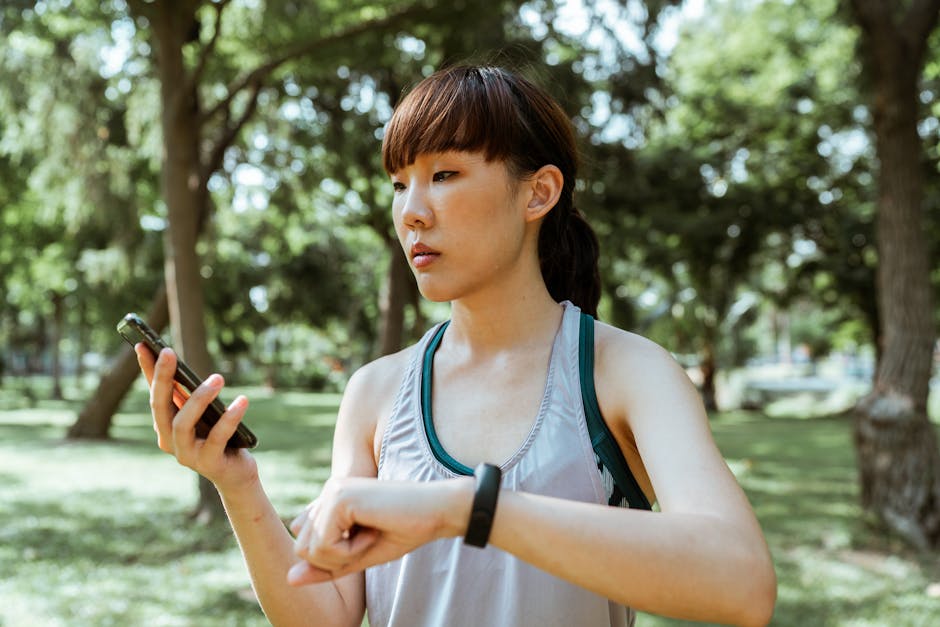
- Wearables and Fitness Trackers: Our system supports the integration of data from digital health technologies (DHTs) like wearables and fitness trackers, enabling the longitudinal collection of real-time physiological and environmental data. This provides a holistic view of participants’ health outside clinical settings.
- Biospecimen Collection: While biosamples are collected physically, our platform manages the associated data, linking it seamlessly with other data types for a complete picture.
- Lifebit’s Secure, Cloud-Based Platform: All this data resides within a secure, cloud-based environment. Our Trusted Research Environment (TRE) and Trusted Data Lakehouse (TDL) components provide a protected space for data storage and analysis. With built-in capabilities for advanced AI/ML analytics, we enable researchers to derive deeper insights from this rich dataset. Our Real-time Evidence & Analytics Layer (R.E.A.L.) also facilitates real-time insights and AI-driven safety surveillance, crucial for large-scale studies.
Our federated AI platform and its components ensure that the All of Us Research Program has the technological backbone it needs to collect, manage, and analyze vast amounts of diverse health data, ultimately powering life-changing discoveries.
Fort Knox Security: How Lifebit Guarantees Your Privacy
We understand that sharing your health data is a deeply personal decision, and participant privacy is paramount. The All of Us Research Program, supported by advanced platforms like Lifebit’s, implements rigorous measures to ensure data security and maintain participant trust. Our commitment to privacy is reflected in every aspect of our clinical research technology for all of us.
Here’s how we ensure your data is protected:
- Data Security: Our platform employs enterprise-grade security with fine-grained access controls and end-to-end encryption. This means your data is protected at every stage, from collection to analysis. We regularly test the security of our databases to guard against vulnerabilities.
- Data Anonymization and De-identification: Before any data is made available to researchers, personal details that could identify participants are removed. This process of de-identification is critical for protecting your identity while still allowing valuable research to proceed.
- Secure Cloud Platform: The All of Us data is stored on a secure, cloud-based platform. Lifebit’s federated governance capabilities ensure that data remains within its secure environment, providing compliant research and pharmacovigilance. This approach is key to enabling secure collaboration across hybrid data ecosystems, where data can be analyzed without being directly moved.
- Participant Privacy Laws: We adhere to all relevant laws and rules for keeping data safe and private, including HIPAA and GDPR compliance, where applicable. Our platform is built with a rigorous commitment to trust, security, and compliance, aligning with standards like NIST 800-171, TX-RAMP, and SOC 2 Type II.
- Researcher Training and Data Use Agreements: Researchers who wish to access the All of Us dataset must undergo extensive training and agree to strict data use rules. This ensures that only authorized individuals with a clear research purpose can access the data, and they are bound by legal agreements to protect participant privacy.
Our approach to data security and privacy is comprehensive, ensuring that while your data fuels groundbreaking research, your personal information remains safeguarded. You can learn more about our commitment to privacy by reviewing the Privacy Notice.
How Your Health Data Is Already Powering 12,375+ Studies—and the Cures You’ll Miss If You Sit Out
The immense dataset collected by the All of Us Research Program is not just stored; it’s actively used by a global community of researchers to open up new medical insights. With advanced clinical research technology for all of us at their fingertips, these scientists are changing raw data into life-changing discoveries.
The Researcher Workbench: Where Your Data Drives Real Results
The All of Us Researcher Workbench is the digital nerve center where scientific inquiry meets vast, diverse health data. This secure, cloud-based analysis platform is specifically designed to facilitate health research using the All of Us dataset.
Here’s how it empowers researchers:
- Cloud-based Analysis: The Workbench provides a powerful, scalable environment for researchers to conduct their analyses without needing to download sensitive data. This approach improves security and accessibility.
- Data Access Tiers: To balance data security and participant privacy with research utility, the All of Us Research Hub offers a tiered-data access model. This ensures that researchers gain access appropriate to their project and security clearance.
- Data Harmonization: The program collects data from various sources (EHRs, surveys, wearables, biosamples). Our technology ensures that this diverse data is harmonized and curated, making it standardized and usable for research, even when data counts may differ between tools due to privacy protection methods.
- Powerful Analysis Tools: The Workbench provides tools to enable powerful analysis of data from All of Us participants. It includes data from more than 350,000 participants and encompasses a wide variety of data types. Registered researchers can conduct multiple projects and collaborate across teams, fostering a dynamic research environment.
- 11,100+ Researchers: A thriving community of over 11,100 researchers currently use All of Us data. These individuals come from diverse backgrounds and fields, all working towards a common goal of improving health.
- Data Browser and Snapshots: Researchers can explore aggregate-level participant data through the Data Browser, which provides interactive views of EHR domains, survey responses, and physical measurements. Data Snapshots offer daily updates on participant demographics and geographic distribution, helping researchers plan their projects effectively.
Research in Action: The Breakthroughs Happening Now
The All of Us dataset, facilitated by its robust technological infrastructure, is already fueling groundbreaking research and yielding significant impacts. We’ve seen data from All of Us participants included in over 12,375 health studies.
Here’s a glimpse of the data types collected and some key research highlights:
| Data Type | Description |
|---|---|
| Surveys | Participant-reported information on health history, lifestyle, environment, social determinants of health, and more. |
| EHRs | Electronic Health Records, including demographics, visits, diagnoses, procedures, medications, lab tests, vital signs, and clinical notes. |
| Physical Measurements | Baseline measurements like height, weight, blood pressure, and heart rate. |
| Wearables | Data from connected digital health devices, such as activity trackers, providing longitudinal physiological and environmental data. |
| Genomics | Genetic data derived from biosamples (blood, urine, saliva), including whole genome sequencing and genotyping, used to understand individual predispositions and responses to treatments. |
The program is ready to help researchers open up answers related to critical public health issues:
- Long COVID Research: With health data from nearly 20,000 people who have had SARS-CoV-2, researchers are studying disease prevention, progression, and recovery, including the long-term effects of COVID-19.
- Social Determinants of Health: Novel insights are being gained into how lived experiences and environmental factors affect health, thanks to detailed social determinants of health surveys.
- Genetic Discoveries: The program has returned personalized health-related DNA results to more than 100,000 participants and identified 7,000 new genetic variants that will improve genetic testing for all.
- Novel Risk Factors: Using the dataset, researchers have identified new risk factors for conditions like retinal vein occlusion, showcasing the power of diverse data in understanding disease.
- Drug Repurposing: Scientists have used gene expression and clinical data from the program to develop methods for identifying high-priority candidates for drug repurposing, potentially accelerating the availability of new treatments.
These are just a few examples of how your data, managed and analyzed through advanced clinical research technology for all of us, is contributing to a future of more precise and equitable healthcare. You can explore more All of Us data through the Data Snapshots.
All Your Biggest Fears About Sharing Health Data—And How ‘All of Us’ Actually Handles Them
We often hear questions about the All of Us Research Program, and we’re happy to provide clear answers. Our goal is to be transparent and ensure that everyone feels informed and confident about participating.
Who Can Join?
The All of Us Research Program is open to:
- Adults 18+: Anyone aged 18 or older with decisional capacity to consent.
- U.S. Residents: Individuals who currently reside in the United States or a territory of the United States.
- All Backgrounds Welcome: We actively seek participants from all backgrounds, particularly those historically underrepresented in biomedical research. This intentional diversity is crucial for achieving the program’s goals.
There’s no cost to participate, other than your time.
Is My Data Safe?
Yes, ensuring the safety and privacy of your data is our highest priority. We implement stringent measures to protect your information:
- Personal Details Removed: Before any data is made available to researchers, personal details that could identify you are removed. This de-identification process is fundamental to safeguarding your privacy.
- Secure Database: Your data is stored on a secure, cloud-based platform, fortified with enterprise-grade security, fine-grained access controls, and end-to-end encryption. We adhere to all relevant laws and rules for keeping data safe and private.
- Strict Researcher Rules: Researchers accessing the data must undergo rigorous training and agree to strict data use rules. They are bound by legal agreements to protect participant privacy and use data responsibly.
- Regular Security Testing: Our databases and systems undergo regular security testing to ensure they remain robust against potential threats.
We are committed to maintaining your trust by upholding the highest standards of data security and privacy.
What Do I Get for Participating?
Participating in the All of Us Research Program offers several benefits:
- Advance Health Research: Your most significant contribution is helping to advance health research that can lead to better prevention, diagnosis, and treatment for everyone. You’re part of a movement to make healthcare more personalized and equitable.
- May Get DNA Results: As part of your participation, you may receive personalized health-related DNA results back in the future. This can include information about your genetic ancestry or genetic health risks.
- Learn About Findings: You can learn about the research powered by the data you’ve shared. We keep participants informed about discoveries and breakthroughs made using the All of Us dataset.
- Compensation for Samples/Measurements: If you provide physical measurements and biosamples during an in-person visit, you may receive $25 compensation for your time.
You become a valued partner in a community of people who are already making a profound difference in the future of health.
Your Medical Future Is Being Written Without You—Unless You Join ‘All of Us’ Now
The All of Us Research Program is more than a database; it’s a powerful partnership between you and science. It represents a collective leap forward, moving us from a one-size-fits-all approach to precision medicine that truly understands and addresses the unique health needs of all of us. This revolution is made possible by sophisticated clinical research technology for all of us.
With Lifebit’s secure, large-scale technology, health research is finally becoming inclusive and powerful. Our federated AI platform, with its advanced capabilities for data harmonization, AI/ML analytics, and federated governance, provides researchers with the secure, collaborative tools they need to turn your invaluable data into life-changing discoveries. From London to New York, and across the USA, UK, Israel, Singapore, Canada, Europe, and indeed, 5 continents, our commitment to enabling compliant research and AI-driven safety surveillance ensures that programs like All of Us can thrive and deliver real impact.
The future of health is being written now, and you have a vital role to play. Don’t miss this opportunity to contribute to a healthier tomorrow, for yourself, your community, and generations to come. See how Lifebit powers breakthroughs and join the movement to accelerate health research.