
How AI and Machine Learning are Teaching Old Drugs New Tricks
AI/ML Drug Discovery: Cut R&D Timelines, Reduce Failures, and Lower Costs
The landscape of pharmaceutical research is rapidly changing. AI/ML drug discovery is at the forefront of this shift, offering practical ways to make drug development faster, cheaper, and more reliable.
Here is how AI/ML is reshaping drug discovery:
- Speeds up research: Cuts the time it takes to find and validate new candidates.
- Lowers costs: Reduces the expense of traditional screening and early development.
- Improves accuracy: Strengthens predictions across target selection, efficacy, and toxicity.
- Boosts success rates: Helps avoid late-stage failures by flagging weak candidates earlier.
The traditional way of finding new medicines is slow, expensive, and often fails. The average drug can cost more than US$1 billion to develop and take more than a decade to reach the market, and most candidates never make it through clinical trials. This model needs a smarter approach.
Artificial intelligence (AI) and machine learning (ML) provide that path. These technologies help teams identify patterns in massive biomedical datasets that humans cannot reliably detect at scale, enabling better decisions earlier in the pipeline.
I am Maria Chatzou Dunford, CEO and Co-founder of Lifebit. With over 15 years in computational biology and AI, I have seen how AI/ML drug discovery can turn complex biomedical data into actionable insights. In this guide, we will explore how these technologies are teaching old drugs new tricks and reshaping the pharmaceutical pipeline.
Why the $2.5B R&D Model is Dead—And How AI/ML Drug Discovery Replaces It
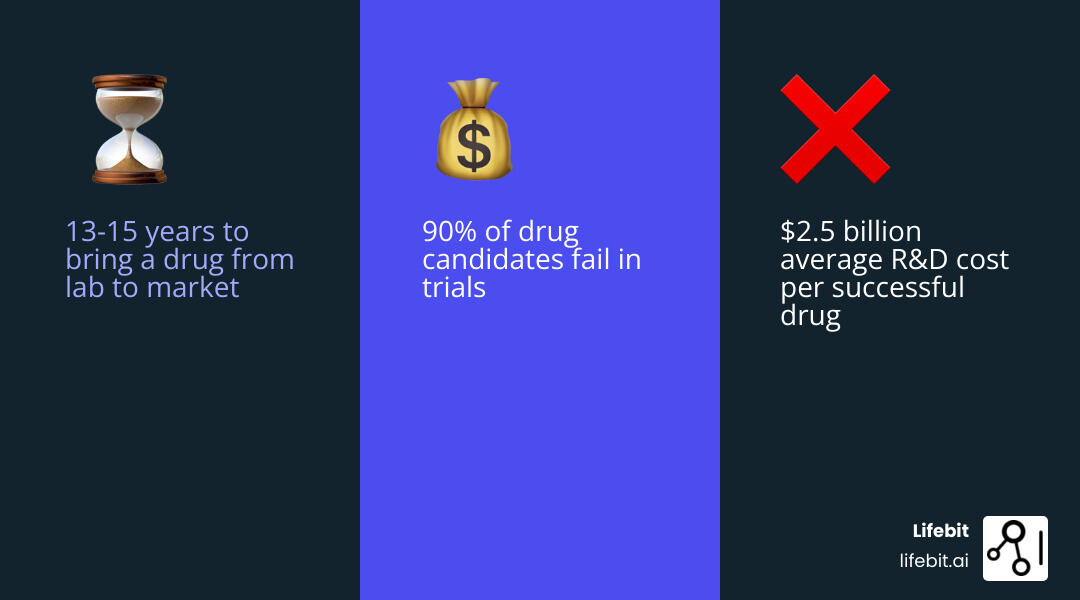
Let’s be honest: the traditional way we make medicine is a bit of a gamble. It currently takes between 13 to 15 years to get a single drug from a lab bench to a pharmacy shelf. Along the way, companies pour an average of $2.5 billion into research and development for every successful product. This figure includes the cost of the many failures that occur along the way, effectively meaning that every success must pay for dozens of expensive mistakes.
The most heartbreaking part? Approximately 90% of drug candidates fail during preclinical or clinical trials. That is a lot of wasted time, money, and hope. Even if a drug makes it to Phase I trials, less than 10% actually receive FDA approval. This high-risk, high-cost environment is what some call “Eroom’s Law”—the observation that drug discovery is becoming slower and more expensive over time, despite improvements in technology. This is the inverse of Moore’s Law, suggesting that as our tools get better, our efficiency in this specific sector has historically declined.
Traditional methods rely heavily on “high-throughput screening” (HTS), which is essentially trying to find a needle in a haystack by physically testing thousands of chemicals against a disease target. It’s manual, it’s slow, and it’s prone to human error. HTS often yields “hits” that are later found to be false positives or molecules that cannot be synthesized at scale. Scientific research on R&D costs highlights that the rising cost of innovation is one of the biggest threats to global health, as it prices out treatments for rare diseases and makes healthcare systems unsustainable.
We need a system that doesn’t just work harder, but works smarter. This is where AI/ML drug discovery steps in, shifting the paradigm from trial-and-error to “predict-and-verify.” By utilizing deep learning architectures, researchers can now model the complex interactions between drugs and biological systems with a level of granularity that was previously impossible. This transition allows for the “de-risking” of the pipeline, ensuring that by the time a compound reaches human trials, there is a much higher statistical probability of success.
Stop Wasting Millions: Slash Screening Costs by 90% with AI/ML Drug Discovery
Imagine being able to screen 72 million anticancer molecules without ever picking up a pipette. That’s exactly what AI allows us to do. By using advanced algorithms, researchers can virtually simulate how molecules will behave in the human body, a process known as virtual screening. This involves docking simulations where the computer calculates the binding affinity between a potential drug (the ligand) and its target (usually a protein receptor).
The impact on the bottom line is staggering. Research suggests that screening expenses can be reduced by up to 90% when AI is used to narrow down the pool of potential drug candidates. Instead of testing every molecule in a physical lab, we use “in silico” (computer-based) models to predict:
- Biological activity: Will this molecule actually hit the disease target with high specificity?
- Solubility and Bioavailability: Can the body absorb it, and will it reach the target tissue in a high enough concentration?
- ADMET Profiling: This stands for Absorption, Distribution, Metabolism, Excretion, and Toxicity. AI models can predict how a drug is processed by the liver and whether it will be cleared by the kidneys safely.
One AI model was able to accurately predict toxic properties more than 72% of the time with only a 4% error rate. This level of precision allows us to fail fast and fail cheap, ensuring that only the most promising candidates move into the expensive clinical trial phase. Scientific research on AI in drug development shows that these intelligent systems are no longer just experimental—they are becoming the backbone of modern medicinal chemistry.
Accelerating Target Identification with AI/ML Drug Discovery
Before you can design a drug, you need to know what you’re aiming at. This is “target identification.” Traditionally, this involves years of studying disease pathways to find a protein or gene that, if blocked or activated, could cure a disease. The challenge is that many diseases, like Alzheimer’s or various cancers, are polygenic and involve complex, overlapping pathways.
AI speeds this up by crunching multi-omic data—a massive mix of genomics (DNA), transcriptomics (RNA), proteomics (proteins), and metabolomics (metabolites). Our platforms at Lifebit help researchers harmonize this data, allowing AI to:
- Prioritize genomic mutations: Identify which genetic variants are truly causative rather than just “passengers” in a disease state.
- Uncover hidden disease pathways: Use Graph Neural Networks (GNNs) to map how proteins interact in a cell, revealing novel nodes that can be targeted by drugs.
- Identify “biomarkers”: Find specific biological signatures that can tell us early on if a treatment is working, which is crucial for designing efficient clinical trials.
By pinpointing the right target early, we avoid the “wrong target” trap that leads to so many Phase II failures, where a drug is safe but simply doesn’t work because the underlying biological hypothesis was flawed.
Real-World Success: From DDR1 to Antimicrobials
If you think this is all theoretical, think again. AI/ML drug discovery is already delivering wins in the real world:
- DDR1 Kinase Inhibitors: Deep learning was used to identify potent inhibitors for DDR1 (a target in fibrosis and cancer) in just 46 days. In the traditional world, this would have taken years of lead optimization and medicinal chemistry iterations.
- Antimicrobial Breakthroughs: Neural networks have accurately predicted the antimicrobial activity of essential oils and synthetic compounds with more than 70% accuracy, helping us stay one step ahead of antibiotic-resistant bacteria (the so-called “superbugs”).
- The Bitterness Test: In a fascinating study, an ML algorithm predicted the bitterness of molecules with an 80% match to animal taste aversion tests. This helps chemists decouple “bitter” from “toxic,” making medicines more palatable for children and improving patient compliance.
- Post-Manufacture Safety: One multitask learning model performed 4,200 drug reviews in a very short span of time, analyzing real-world evidence and electronic health records to ensure that drugs already on the market remain safe for patients and identifying potential new side effects that didn’t appear in controlled trials.
De Novo Design: How AI/ML Drug Discovery Engineers Success in 1/3 the Time
When we talk about “teaching old drugs new tricks,” we often mean drug repositioning (or repurposing). This is the practice of taking an existing drug that is already approved for one condition and finding a new use for it. This strategy is incredibly efficient because the safety profile, manufacturing process, and dosage guidelines are already established.
| Feature | De Novo Design | Drug Repositioning |
|---|---|---|
| Time to Market | 10-15 Years | 3-5 Years |
| Cost | High ($2.5B+) | Significantly Lower (up to 80% less) |
| Risk | High (90% failure) | Lower (Safety already proven in humans) |
| Data Source | Chemical Space Exploration | Transcriptomics & Clinical Data |
Drug repositioning is a massive win for rare diseases and emergencies like the COVID-19 pandemic. For example, AI helped identify Baricitinib (originally for rheumatoid arthritis) as a powerful treatment for COVID-19 by predicting its ability to reduce the “cytokine storm” associated with severe infection. Scientific research on drug repositioning resources provides a roadmap for how we can use existing chemical libraries to solve new medical mysteries.
Enhancing Compound Design with AI/ML Drug Discovery
Sometimes, we need something entirely new. This is “de novo” design. AI acts like a master architect here, using Generative Adversarial Networks (GANs) and reinforcement learning to build molecules from scratch. In a GAN, two neural networks compete: one generates new molecular structures, while the other evaluates them against a set of desired criteria (like drug-likeness or binding affinity). Over time, the generator becomes incredibly adept at creating high-quality candidates.
These models explore a “chemical space” of over 10^60 potential molecules—more than there are stars in the observable universe! Human chemists can only ever hope to explore a tiny fraction of this space. The AI can fine-tune these designs for specific properties, such as ensuring they follow “Lipinski’s Rule of Five,” which predicts whether a compound has the right physical properties to be an orally active drug in humans. In fact, 95% of molecules generated by some reinforcement learning models were found to be feasible for new drug development. We aren’t just guessing anymore; we are engineering success at the molecular level.
Fix the ‘Black Box’ Problem: De-Risk Clinical Trials with Lab-in-the-Loop AI
Despite the excitement, many pharmaceutical veterans are skeptical of AI. They call it the “black box” problem. If an AI tells you a drug will work, but can’t explain why—what the specific molecular interactions are or which biological pathway is being modulated—it’s hard to trust it with a billion-dollar clinical trial. Regulators like the FDA also require a high degree of interpretability before they will approve a new methodology.
To fix this, the industry is moving toward Explainable AI (XAI). This technology provides a “receipt” for the AI’s decision, showing which data points, genetic markers, or chemical features led to the prediction. Techniques like SHAP (SHapley Additive exPlanations) help researchers understand which atoms in a molecule contributed most to its predicted efficacy, allowing medicinal chemists to refine the structure with confidence.
Another major shift is the “lab-in-the-loop” concept. This is a virtuous cycle that bridges the gap between computational and experimental science:
- Dry Lab: AI makes a prediction about a molecule’s behavior based on existing data.
- Wet Lab: Automated robotic systems or human scientists test that specific prediction in a real-world biological assay.
- Data Loop: The results from the lab—including the “failures” where the AI was wrong—are fed back into the model.
- Refinement: The AI learns from the real-world discrepancies and updates its internal weights, making a significantly better prediction in the next iteration.
This removes the traditional wall between computer scientists and biologists, creating a unified workflow. It also helps solve data heterogeneity—the massive headache of trying to combine data from different hospitals, labs, and countries that all use different formats, standards, and terminologies. Scientific research on active machine learning suggests that this iterative, active learning approach is the only way to truly “de-risk” drug discovery and move toward a more predictable R&D model.
Stop Relying on Animal Testing: Use AI/ML Drug Discovery for 72% More Accurate Results
The way we test drugs is also getting an ethical and scientific makeover. For decades, animal models were the gold standard, yet we’ve known for a long time that mice are not humans. Many drugs that appear safe and effective in rodents fail miserably in human trials because of fundamental differences in metabolism and immune response. The FDA Modernization Act 2.0, passed in late 2022, officially opened the door for non-animal-based testing in preclinical trials, recognizing that modern technology can often provide better data.
Instead of relying solely on animal models, we can now use a suite of AI-integrated technologies:
- Organ-on-chip: These are microfluidic devices lined with living human cells that mimic the physiological environment of real organs, such as the heart, liver, or lungs. AI analyzes the sensor data from these chips to predict human organ response with high fidelity.
- 3D Bioprinting: By printing human tissue models, researchers can observe how a drug penetrates a 3D cellular structure, which is far more accurate than testing on a flat petri dish of cells.
- Digital Twins: This involves creating a virtual version of a patient, using their specific genetic and clinical data to simulate how they might respond to a drug. This allows for “in silico” clinical trials before a single human volunteer is ever dosed.
These technologies generate massive amounts of biological data, which is exactly what AI/ML is built to analyze. The result is more ethical, faster, and often more human-relevant preclinical research.
The Future Impact of AI/ML Drug Discovery on Global Health
As we look toward 2030 and beyond, the impact of AI/ML drug discovery will be felt globally. We are moving toward a world of:
- Personalized Medicine: Moving away from the “one-size-fits-all” blockbuster drug model toward treatments tailored to individual genetic and clinical profiles, which drastically reduces the risk of adverse drug reactions.
- Rapid Pandemic Response: The ability to prioritize targets and candidates in weeks rather than years when new viral or bacterial threats emerge, potentially saving millions of lives.
- Democratized Access: Lowering the astronomical development costs makes it more feasible for companies to invest in “orphan diseases” and underserved populations, including areas like women’s health and tropical diseases, which have historically been neglected by the traditional R&D model.
A major milestone for the field was the AlphaFold breakthrough by Google DeepMind, which solved the 50-year-old “protein folding problem.” By predicting the 3D structure of nearly every protein known to science, AlphaFold has provided a massive library of new targets for AI/ML systems to explore. What comes next is likely to include more agentic AI systems—autonomous AI agents that can not only predict outcomes but also help plan, prioritize, and coordinate complex experiments across global teams and diverse data environments.
AI/ML Drug Discovery FAQ: How to Save Time, Money, and Lives
How does AI/ML reduce the cost of drug discovery?
AI reduces costs by virtually screening millions of molecules in a fraction of the time it would take in a physical lab, which slashes physical lab expenses by up to 90%. Furthermore, AI improves the “quality” of candidates entering clinical trials. By identifying potential failures—such as hidden toxicity or lack of efficacy—early in the process, companies avoid spending hundreds of millions of dollars on Phase II and Phase III trials that are destined to fail. It essentially shifts the cost curve from expensive human trials to more affordable computational modeling.
What is the ‘lab-in-the-loop’ concept in pharmaceutical research?
It is an iterative process where AI predictions are tested in a physical lab (often using automation and robotics), and the resulting data—both successes and failures—is immediately used to retrain and improve the AI model. This creates a “virtuous cycle” or feedback loop that makes the drug discovery process faster and more accurate over time. It ensures that the AI remains grounded in biological reality rather than just theoretical patterns.
Can AI accurately predict drug toxicity before clinical trials?
Yes. Current AI models can predict toxic properties, such as hepatotoxicity (liver damage) or cardiotoxicity (heart damage), with over 72% accuracy and a very low error rate (around 4%). While these models do not replace clinical trials entirely, they act as a powerful filter, ensuring that only the safest compounds move forward. This reduces the reliance on animal testing and increases the safety of human volunteers in early-stage trials.
What role does ‘Big Data’ play in AI/ML drug discovery?
AI is only as good as the data it is trained on. In drug discovery, this involves “Big Data” from diverse sources: genomic sequences, chemical libraries, electronic health records, and scientific literature. The challenge is not just the volume of data, but its variety and complexity. AI/ML excels at finding non-linear relationships within these massive datasets that would be impossible for a human researcher to identify, such as how a specific genetic mutation might change a patient’s response to a specific chemical compound.
Start Your Data-Driven Era: Connect to Global Bio-Data with Lifebit
The future of medicine isn’t just about better chemicals; it’s about better data. At Lifebit, we believe that the biggest barrier to AI/ML drug discovery isn’t a lack of sophisticated algorithms—it’s the difficulty of accessing high-quality, secure, and diverse data. Most of the world’s most valuable biomedical data is locked in silos within hospitals and research institutions, protected by strict privacy laws.
Our federated AI platform allows researchers to connect to global biomedical and multi-omic data without moving it, ensuring privacy and compliance with regulations like GDPR and HIPAA. By using our Trusted Research Environment (TRE) and Trusted Data Lakehouse (TDL), biopharma companies can collaborate across five continents in real-time, training their AI models on diverse populations without ever compromising patient anonymity.
We are here to provide the R.E.A.L. (Real-time Evidence & Analytics Layer) that turns raw, fragmented data into life-saving insights. The era of “trial and error” and the $2.5 billion gamble is ending. The era of intelligent, data-driven discovery has begun. Join us in making medicine faster, safer, and more accessible for everyone.