

Demystifying Digital Health: A Complete Guide to EHR and EMR Systems
How 96% of Hospitals Cut Medical Errors and Save $2.7M Yearly with EHR Software
EHR EMR software is the backbone of modern healthcare, changing how providers, life sciences organizations, and public health agencies manage and activate patient information. Here’s what you need to know.
Quick Answer: What is EHR EMR Software?
- EMR (Electronic Medical Record): A digital patient chart for use within a single practice. It contains medical history, diagnoses, and treatments but is not easily shared.
- EHR (Electronic Health Record): A comprehensive, shareable digital record of a patient’s total health history, accessible to authorized providers across different organizations.
- Key Difference: Interoperability. EHRs are designed to move with the patient, while EMRs are typically siloed.
- Why It Matters: With 96% of U.S. hospitals sending records electronically and 65% of patients accessing their online records in 2024, these systems are vital for coordinated care and for generating the rich, real-world data needed in research and pharmacovigilance.
Over the past two decades, simple electronic charts have evolved into sophisticated platforms that drive clinical decisions, enable team collaboration, and empower patients. Yet confusion remains about what these systems do, how they differ, and why it matters for patient outcomes, public health, and precision medicine.
This distinction is critical for pharma companies, public health agencies, and providers. Understanding EHR/EMR capabilities is the difference between a siloed filing cabinet and an interoperable platform—between fragmented care and coordinated, evidence-based treatment, and between underused clinical data and real-time, AI-ready evidence.
I’m Maria Chatzou Dunford, CEO and Co-founder of Lifebit. With over 15 years in computational biology, AI, and health-tech, I’ve helped organizations open up the potential of EHR EMR software and complex biomedical data for precision medicine, drug discovery, and safety surveillance. My work focuses on breaking down data silos and enabling federated analytics across diverse healthcare datasets, from genomics to clinical records, while keeping sensitive data securely governed.
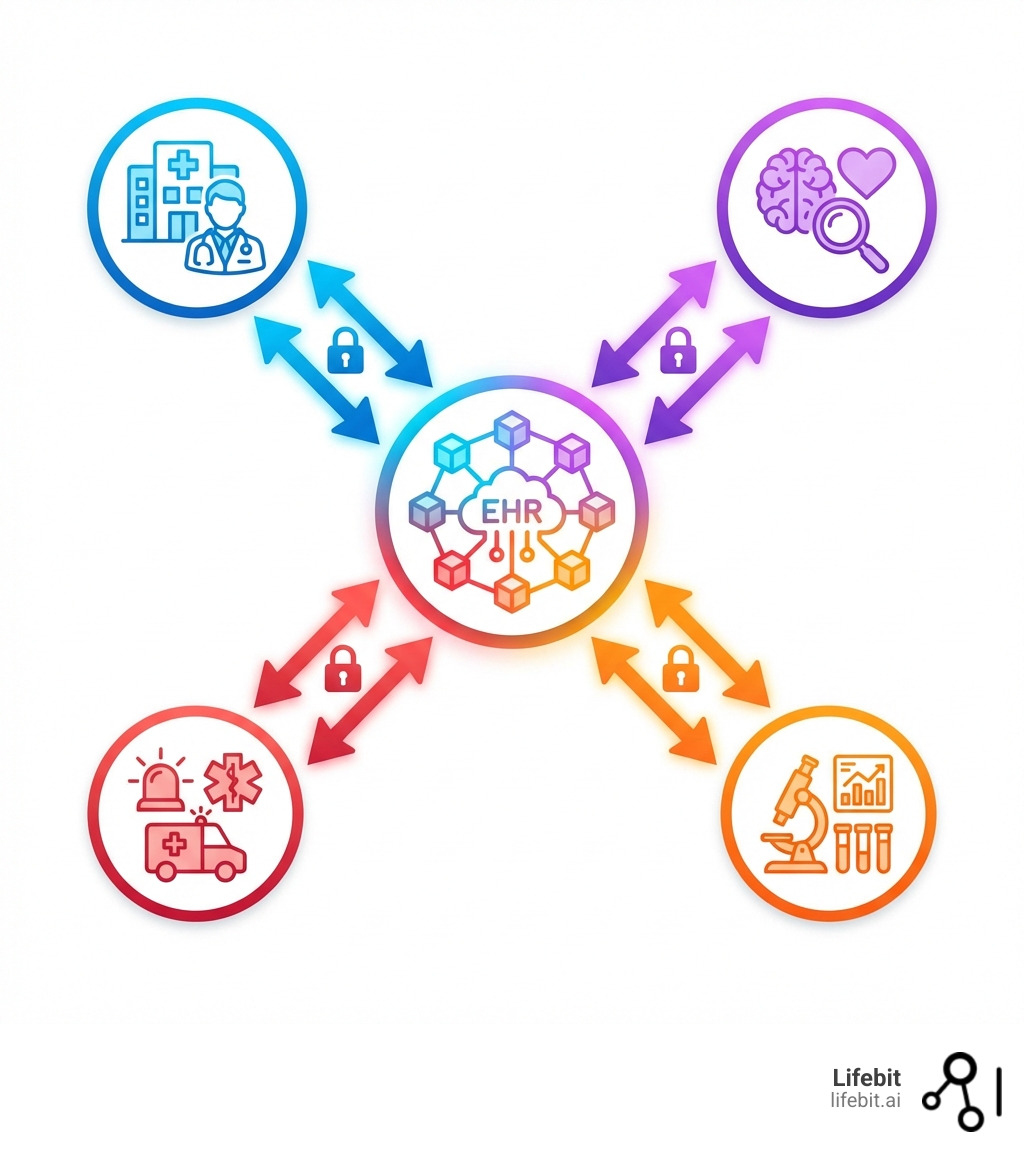
This guide demystifies EHR and EMR systems and shows how, when combined with federated AI platforms like Lifebit, they become the foundation for secure, large-scale research, real-time safety monitoring, and next-generation digital health.
The Foundational Difference: EMR vs. EHR
Though often used interchangeably, EMR and EHR represent different philosophies of patient care. While both digitize patient information, their scope and data-sharing capabilities set them apart.
What is an EMR? The Digital Filing Cabinet
An Electronic Medical Record (EMR) is a digital version of a patient’s paper chart from a single practice. EMRs were designed primarily for diagnosis and treatment within one clinic, allowing clinicians to track data over time, identify patients for preventive screenings, and monitor care quality internally.
An EMR holds a patient’s medical history, diagnoses, and test results from one provider. The main advantage is internal efficiency. However, its key limitation is scope; EMR data does not easily travel outside the practice. Sharing records with specialists often requires printing and faxing, making the process as inefficient as paper records.
What is an EHR? The Comprehensive Patient Story
An Electronic Health Record (EHR) focuses on the patient’s total health. An EHR does everything an EMR does but is built for interoperability, meaning it can be shared across multiple healthcare settings, including other providers, labs, and pharmacies.
As the Office of the National Coordinator for Health Information Technology (ONC) explains, EHRs are designed to share information with all clinicians involved in a patient’s care. This ensures a patient’s health data follows them seamlessly. Benefits include:
- Improved care coordination: All providers have access to the latest information for more coordinated care.
- Greater data accuracy: A more complete and up-to-date view of the patient’s health history is available.
- Better patient outcomes: Clinicians can make more informed decisions, especially in emergencies.
- Increased efficiency: The need for duplicate tests is reduced, and workflows are streamlined.
Today, 96% of U.S. non-federal acute care hospitals electronically send care records, underscoring the necessity of these interconnected systems.
How Interoperability Defines the Modern EHR
Interoperability is what truly distinguishes an EHR from an EMR. It is the ability of different systems to access, exchange, and use data in a coordinated manner across organizational boundaries.
This seamless data exchange is critical for:
- Reducing duplicate tests: A specialist can access recent lab results from a primary care physician’s EHR, avoiding redundant tests.
- Enhancing emergency care: An ER clinician can instantly access vital information like allergies or medications, preventing potentially fatal errors.
- Facilitating Health Information Exchange (HIE): Modern EHRs facilitate HIE through Directed Exchange, Query-based Exchange, and Consumer-mediated Exchange.
To achieve this, the industry relies on technical standards:
- Foundational Interoperability: The basic ability for one system to send data to another.
- Structural Interoperability: Defines the structure or format of data exchange. Standards like Health Level Seven (HL7) are foundational here.
- Semantic Interoperability: The highest level, where systems exchange and use information with a shared understanding. This requires standardized vocabularies like SNOMED CT and LOINC.
The American Medical Association (AMA) notes that an EHR “makes information instantly and securely available to authorized users.” Modern standards like FHIR (Fast Healthcare Interoperability Resources) are accelerating this by providing a web-based API approach, making it easier for applications to connect and share data.
Core Capabilities of Modern EHR EMR Software
Modern EHR EMR software is an integrated platform designed to optimize clinical workflows and patient management, packed with features that improve care and streamline operations.
Key Features and Functionalities
Today’s EHR systems include a suite of critical functionalities:
- Charting and Documentation: Providers digitally record patient encounters, histories, and treatment plans, often using customizable templates to streamline data capture.
- E-prescribing (eRx): Clinicians send prescriptions electronically to pharmacies, reducing handwriting errors and checking for drug interactions to improve patient safety.
- Computerized Provider Order Entry (CPOE): Medical professionals directly enter orders for medications, labs, and procedures, minimizing transcription errors and speeding up the process.
- Clinical Decision Support (CDS): Built-in tools provide evidence-based information at the point of care, such as allergy alerts or screening reminders, helping to reduce mistakes.
- Billing and Revenue Cycle Management (RCM) Integration: Many EHRs integrate with billing systems to automate claim generation from clinical documentation, improving accuracy and efficiency.
- Reporting and Analytics: Practices can extract insights from patient data to track population health trends, monitor quality metrics, and analyze operational efficiency.
Enhancing Care Coordination and Patient Outcomes
The true power of EHR EMR software is its ability to foster seamless care coordination and improve patient outcomes. When a patient’s entire care team has access to the same up-to-date information, it transforms the healthcare experience by enabling:
- Real-time data access: Clinicians can access records instantly, facilitating quicker diagnoses and timely interventions, especially in emergencies.
- Reduced medical errors: Comprehensive patient histories, medication lists, and allergy alerts drastically reduce the risk of preventable errors.
- Social Determinants of Health (SDOH) Integration: Modern EHRs now capture non-clinical factors such as housing stability and food security. This provides a 360-degree view of the patient, allowing for targeted social interventions that improve long-term health outcomes.
- Population health management: Analytics help providers identify health trends, manage chronic diseases proactively, and implement preventive care strategies.
The Role of Patient Portals in Engagement
Patient portals are a vital component of modern EHR EMR software, acting as a secure online gateway for patients to engage in their own care. In 2024, 65% of individuals nationally were offered and accessed their online medical records or patient portal.
Key portal functionalities include:
- Secure messaging with providers.
- Appointment scheduling and management.
- Access to health records, including lab results, medications, and visit notes.
- Online bill pay to simplify the financial process.
By providing patients with easy access to their health data, portals foster transparency and empower individuals to become proactive participants in their own health, aligning with the goal of patient-centered care.
The Regulatory Framework Driving EHR Adoption
The widespread adoption of EHR EMR software was significantly driven by government legislation and incentive programs designed to modernize healthcare, improve patient outcomes, and support value-based care.
How Government Legislation Spurred a Digital Revolution
The transition from paper to digital records was accelerated by landmark legislation. A pivotal moment was The American Recovery and Reinvestment Act (ARRA) of 2009. Its Health Information Technology for Economic and Clinical Health (HITECH) Act provided over $30 billion in financial incentives for providers to adopt and “meaningfully use” EHRs. The “Meaningful Use” program was rolled out in three stages:
- Stage 1 (2011-2012): Focused on basic data capture and sharing capabilities.
- Stage 2 (2014): Emphasized advanced clinical processes, including care coordination tools and patient engagement through portals.
- Stage 3 (2016): Aimed to demonstrate improved patient outcomes through the use of EHRs.
This was reinforced by the 2015 MACRA law (Medicare Access and CHIP Reauthorization Act). Through its Quality Payment Program (QPP), MACRA further incentivized providers to adopt EHRs that can communicate with other systems, reinforcing the importance of interoperability and shifting focus toward quality and value. Similar legislative pushes in the UK, Canada, and Europe have also driven EHR adoption to create more integrated national health systems.
The 21st Century Cures Act and Information Blocking
Enacted in 2016, the 21st Century Cures Act built upon the foundation of HITECH, aiming to accelerate medical product development and bring new innovations to patients faster. A key component of the Cures Act was its rules on interoperability and information blocking. Information blocking is defined as any practice that is likely to interfere with, prevent, or materially discourage the access, exchange, or use of electronic health information.
The Cures Act Final Rule mandates that healthcare providers, health IT developers, and health information exchanges provide patients with secure, electronic access to their health data at no cost, often through modern APIs. This rule effectively makes it illegal for organizations to unreasonably withhold patient data, with significant financial penalties for non-compliance. This legislation has been a major driver in forcing vendors and providers to open up their systems and empower patients with control over their own health information.
Certified EHR Technology (CEHRT) and Why It Matters
Certified Electronic Health Record Technology (CEHRT) refers to EHR systems certified by the Office of the National Coordinator for Health Information Technology (ONC) or equivalent bodies. This certification ensures the software meets specific standards for functionality, interoperability, and security, as defined by regulations like HITECH and the Cures Act.
CEHRT is important because it:
- Ensures compliance: Providers must use a CEHRT to participate in certain government programs, like the Medicare and Medicaid Promoting Interoperability Programs.
- Improves patient safety: CEHRT systems have features designed to reduce medical errors and protect patient data.
- Guarantees interoperability: A core requirement is the ability to exchange health information with other certified systems, preventing information blocking.
- Supports value-based care: CEHRT standards enable the tracking and reporting of quality metrics essential for value-based initiatives.
Supporting Value-Based Care Initiatives
EHR EMR software is an indispensable tool in the shift from fee-for-service to value-based care, which rewards providers for the quality of care they deliver, not the quantity.
EHRs support this model by:
- Tracking quality metrics: EHRs can automatically collect and report data on quality measures, which is crucial for demonstrating performance.
- Improving patient outcomes: Comprehensive data and clinical decision support help providers adhere to best practices and personalize treatment.
- Identifying care gaps: Analytics can flag patients overdue for screenings or follow-ups, allowing for proactive outreach.
- Coordinating care: Interoperability facilitates the data sharing fundamental to delivering holistic care for complex cases.
By providing the necessary data infrastructure, EHRs help healthcare organizations succeed in a value-based environment, driving both clinical and financial success.
Implementation: Choosing and Using Your System
Selecting and implementing EHR EMR software requires careful planning to steer common challenges and meet the unique needs of different medical specialties.
Considerations for Choosing an EHR System
Choosing the right EHR is critical for success. Key considerations include:
- Practice size and specialty: Many EHRs are specialty-specific, with custom workflows and templates.
- Cloud vs. on-premise: Cloud-based EHRs offer flexibility and lower upfront costs, while on-premise solutions provide more direct data control.
- Cost and ROI: Analyze the total cost of ownership (TCO), including subscription fees, implementation, and training.
- Vendor support and training: A reputable vendor provides comprehensive training and 24/7 support.
- Interoperability: How well does the EHR integrate with labs, pharmacies, and other providers’ systems?
- Vendor Landscape: Evaluating a vendor’s stability and market position is essential.
- Scalability: Ensure the system can grow with your practice.
The Selection Process and Stakeholder Buy-in
Selecting an EHR requires a multi-disciplinary committee including physicians, nurses, and billing staff. This ensures the system supports actual clinical workflows and reduces the risk of poor adoption. Engaging stakeholders early in the process helps build buy-in and ensures that the chosen system solves real-world operational challenges.
Overcoming Common Challenges and Limitations of EHR EMR Software
Despite their benefits, EHR systems present challenges that require proactive management:
- Physician burnout: Poor EHR usability is a leading cause of burnout. Excessive documentation and cumbersome interfaces can increase administrative burden.
- Workflow disruption: Implementing a new EHR disrupts established workflows. Proper change management and phased rollouts are critical.
- High implementation costs: Beyond software licenses, costs for hardware, data migration, and training can be significant.
- Data Migration Complexity: Moving patient data from a legacy system involves extracting, mapping, cleaning, and validating data to ensure clinical integrity.
- Data security risks: As repositories of sensitive data, EHRs are targets for cyberattacks. Protecting data requires robust security measures like encryption and access controls.
- Lack of true semantic interoperability: Integrating with older legacy systems can still be a hurdle, creating data silos.
Post-Implementation Optimization
Success requires ongoing optimization. Organizations should use a “Super User” model for peer support and plan for a productivity dip during the first few months. Regular reviews of system performance and user feedback help refine templates and alerts.
How EHR EMR Software Caters to Medical Specialties
Modern systems address specialty needs with custom functionalities:
- Specialty-specific templates: Oncology EHRs include chemotherapy regimens, while pediatric EHRs include growth charts.
- Unique workflows: Mental health EHRs prioritize therapy notes, while surgical EHRs focus on operative planning.
- Custom billing codes: Specialty EHRs often have relevant CPT and ICD-10 codes pre-loaded.
- Integrated device support: Cardiology EHRs might connect directly with ECG machines for direct data import.
This customization ensures EHR EMR software supports the distinct needs of each medical specialty, enhancing efficiency and care quality.
The Future of EHRs: AI, Analytics, and Beyond
The evolution of EHR EMR software is accelerating. We are entering an era where artificial intelligence (AI) and advanced analytics are changing these systems from static records into dynamic, intelligent platforms that can predict, assist, and personalize healthcare.
How AI is Being Integrated into EHR Systems
AI is rapidly becoming a practical tool for healthcare change, enhancing efficiency and improving patient care.
- AI-powered chart review and prediction: AI can quickly analyze vast patient data to summarize key information, highlight critical updates, and even predict patients at high risk for conditions like sepsis or hospital readmission based on subtle data patterns. This saves clinicians time and helps them intervene proactively.
- Generative AI and LLMs: The latest frontier involves Large Language Models (LLMs) that can synthesize thousands of pages of historical records into a concise “clinical summary” for a specialist or draft empathetic patient responses to portal inquiries, significantly reducing administrative cognitive load.
- Automated data ingestion: AI can extract clinical information from unstructured sources like faxes or scanned documents, deduplicate it, and accurately place it into the patient chart, reducing manual data entry.
- Clinical documentation improvement: AI-powered tools can listen to doctor-patient conversations and automatically generate structured clinical notes. This can save providers hours each day and ensures more comprehensive documentation.
- AI-assisted coding: AI can suggest appropriate billing codes based on clinical documentation, improving accuracy and compliance.
The Rise of “No UI” and Ambient Intelligence
One of the most exciting developments is the concept of “No UI” (No User Interface) and ambient intelligence. The goal is to move away from keyboard-centric interactions, allowing clinicians to focus entirely on the patient.
- Ambient clinical listening: This involves AI tools that discreetly listen to the natural conversation between a doctor and a patient.
- Automated SOAP notes: From these conversations, the AI automatically transforms dialogue into structured SOAP (Subjective, Objective, Assessment, Plan) notes, drastically reducing documentation time.
- Improving doctor-patient connection: By freeing clinicians from constant typing and screen-gazing, ambient intelligence allows for more natural, empathetic interactions and improved eye contact.
Future Outlook: From Records to Predictive Health Platforms
The future of EHR EMR software is to become predictive, proactive health platforms central to precision medicine and population health.
- Integration of multi-omic data: The next frontier is integrating clinical data from EHRs with multi-omic data (genomics, proteomics, metabolomics). This will power truly personalized medicine, allowing treatments to be tailored to an individual’s genetic makeup and molecular profile.
- Federated data networks: The growth of federated networks will allow secure, real-time analysis of global biomedical data without centralizing sensitive information. Instead of moving data, the analytical models are sent to the data where it resides. Only aggregated, anonymized insights are shared back, ensuring patient privacy and data security.
- Deeper Integration with Patient-Generated Health Data (PGHD): EHRs will increasingly integrate real-time data streams from wearables (like smartwatches), continuous glucose monitors, and home blood pressure cuffs. This provides a continuous, holistic view of a patient’s health outside the clinic, enabling proactive chronic disease management.
- Real-time safety surveillance: AI-driven surveillance will use federated EHR data to identify adverse drug reactions or public health threats in real-time, far faster than traditional methods.
- Shift towards preventative care: By leveraging predictive analytics on combined clinical and PGHD, EHRs will help identify at-risk individuals long before symptoms appear, enabling proactive, preventative interventions.
Conclusion: Navigating the Next Wave of Digital Health
EHR EMR software has evolved from digital filing cabinets to complex, interconnected systems reshaping modern healthcare. The key distinction is interoperability—the ability of EHRs to share a comprehensive patient story across care settings, which is vital for coordinating care and creating high-quality real-world evidence.
Modern EHRs are packed with core capabilities, from e-prescribing to patient portals, that empower both providers and patients. Government legislation and certification standards like CEHRT have driven this adoption, paving the way for value-based care models that prioritize quality over quantity.
While implementation requires careful planning to overcome challenges like cost and physician burnout, the benefits are clear, especially with systems customized for specific medical specialties and integrated into wider data ecosystems used by life sciences and public health organizations.
Looking ahead, artificial intelligence is set to revolutionize EHRs even further. AI-powered documentation and ambient intelligence will reduce administrative burdens and transform these systems into predictive health platforms. The future lies in integrating multi-omic data through federated networks, enabling real-time safety surveillance and a fundamental shift toward personalized, preventative medicine.
As these systems advance, platforms that can securely manage and analyze this complex data at scale become critical. That is where Lifebit comes in.
Lifebit provides a next-generation federated AI platform that connects to EHR EMR software and other biomedical sources without centralizing sensitive data. With components such as the Trusted Research Environment (TRE), Trusted Data Lakehouse (TDL), and R.E.A.L. (Real-time Evidence & Analytics Layer), Lifebit enables:
- Secure, compliant access to global biomedical and multi-omic data
- Automated harmonization of heterogeneous EHR and research datasets
- Advanced AI/ML analytics for discovery, outcomes research, and pharmacovigilance
- Real-time safety surveillance across hybrid, distributed data ecosystems
- Cross-border, cross-institution collaboration with robust federated governance
For biopharma, governments, and public health agencies looking to harness the full potential of EHR EMR data and beyond—without compromising privacy or compliance—exploring next-generation federated data platforms is the logical next step.
We invite you to learn more about how Lifebit is enabling this future, allowing secure, real-time access to global biomedical and multi-omic data, with built-in capabilities for harmonization, advanced AI/ML analytics, and federated governance. To find how we can help your organization open up the full potential of your health data, we encourage you to Explore advanced data platform solutions.
FAQ
Frequently asked questions about digital health and EHR/EMR systems
What is the difference between EHR and EMR?
An electronic medical record (EMR) is a digital version of a single clinician’s paper chart, used within one practice. An electronic health record (EHR) is broader: it follows the patient across multiple providers and systems, with full clinical history. In 2026 practice the terms are largely interchangeable for most buyers; the major vendors (Epic, Oracle Health, athenahealth, MEDITECH) all build EHRs, not EMRs.
How do EHR systems handle data interoperability?
Modern EHR interoperability runs on Fast Healthcare Interoperability Resources (FHIR), an HL7 standard now at version R4 and being actively rolled forward through R5. The 21st Century Cures Act and the U.S. Office of the National Coordinator (ONC) information-blocking rule require certified EHRs to expose FHIR R4 endpoints. Implementation depth varies — Epic and athenahealth have the most comprehensive coverage; smaller specialty EHRs may support only the USCDI v3 minimum.
What is digital health beyond just an EHR?
Digital health is the broader category that includes EHR systems plus connected devices (continuous glucose monitors, smartwatches), telehealth platforms, patient-facing applications, AI/ML clinical-decision-support tools, and the data infrastructure (lakehouses, TREs, federated research platforms) that connects all of these. The EHR is a system of record; digital health is the operational layer that uses that record to change care.
How is AI being used in EHR systems in 2026?
Operational AI in 2026 EHRs covers: ambient clinical documentation (Epic + Microsoft Nuance, Oracle Health), summarization of long patient histories at the point of care, AI-assisted billing-code suggestion, predictive alerts for sepsis and readmission risk, and patient-message triage assistance. The FDA, EMA, and MHRA have published guidance requiring documented training-data lineage and bias evaluation for any AI used in clinical-decision-support roles.
What data security standards apply to EHR systems?
U.S. EHRs must comply with HIPAA’s Security Rule. European systems must comply with GDPR and increasingly with EHDS provisions. Cross-cutting independent accreditations include HITRUST CSF v11 (the most rigorous health-data security standard), SOC 2 Type II, and ISO 27001. ONC-ACB certification is the minimum required for U.S. EHRs to be used in Medicare/Medicaid programs.
How do EHRs connect to research and biobank platforms?
Through FHIR R4 endpoints exposed by the EHR, an authorized research platform — Lifebit’s federated TRE, Genomics England’s Research Environment, an academic biobank — can query the EHR for cohort-discovery, harmonized observation data, or specific clinical-decision-support outputs. The federated pattern is the architectural answer to the data-residency constraints under EHDS and the contractual constraints most hospitals impose on third-party access to patient records.