

How AI is turning drug discovery into a sprint
AI-Enabled Drug Development: Cut Costs by 70% and Timelines by 90%
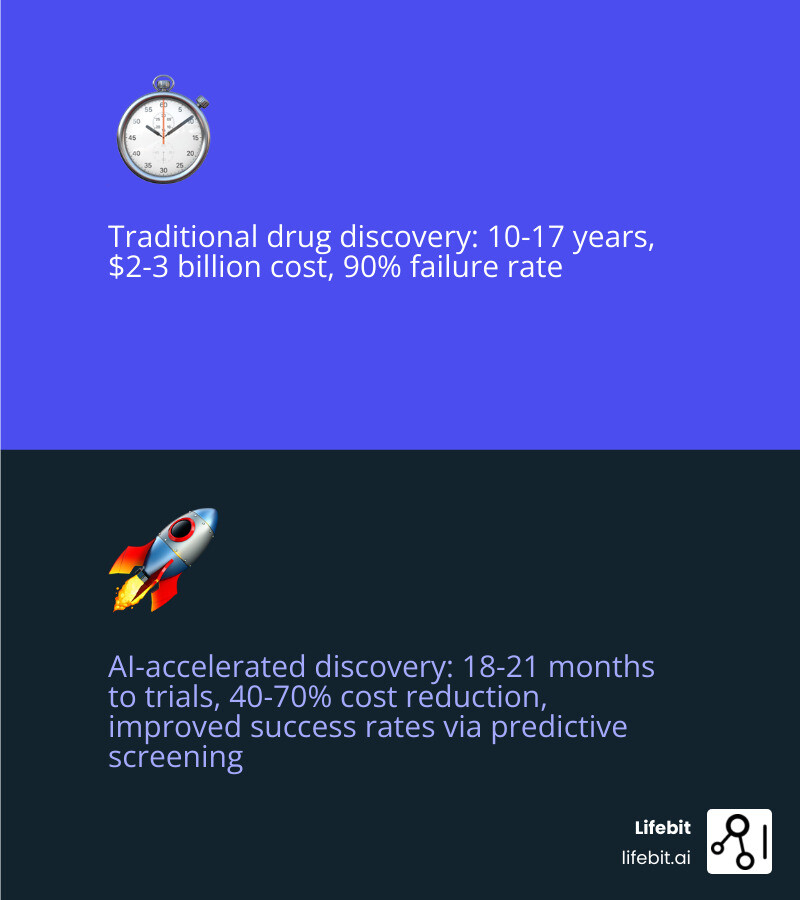
AI-enabled drug development is changing pharmaceutical research by reducing development timelines from over a decade to under two years, cutting costs from $2-3 billion to hundreds of millions, and improving success rates through predictive analytics at every stage—from target identification to clinical trials.
Key Benefits of AI-Enabled Drug Development:
- Speed: AI-discovered drugs reach clinical trials in 18-21 months vs. 10-17 years traditionally
- Cost Reduction: Potential to cut development costs by 40-70% through virtual screening and property prediction
- Higher Success Rates: Predictive models identify viable candidates earlier, reducing the 90% failure rate
- Precision: Machine learning predicts toxicity, drug interactions, and patient responses before lab testing
- Scale: AI analyzes chemical spaces of 10^60 possible molecules—impossible for human researchers
The traditional drug development model is broken. Bringing a single drug to market costs up to $3 billion and takes over a decade. Even after passing Phase I trials, candidates have only a 5% chance of FDA approval. Meanwhile, millions of patients wait for treatments that may never arrive.
AI is changing that equation. In 2024, the first fully AI-designed drug for idiopathic pulmonary fibrosis entered Phase IIa trials. Healx used AI to advance a repurposed drug to Phase II in just 18 months. Insilico Medicine generated a highly active kinase inhibitor in 21 days. These aren’t future promises—they’re real milestones happening now.
The FDA has received over 500 drug submissions with AI components since 2016, and that number is accelerating. Regulatory bodies recognize AI’s potential: the FDA and European Medicines Agency collaborated to develop 10 guiding principles for good AI practice in drug development. A 2022 study projected that heavy investment in AI could increase pharmaceutical ROI by more than 45%.
But speed and cost savings aren’t the only wins. AI enables researchers to explore chemical spaces that were previously inaccessible, predict protein structures with near-experimental accuracy (AlphaFold 3 covers 98.5% of the human proteome), and identify drug-target combinations that human intuition would miss. It’s not just faster—it’s fundamentally more powerful.
I’m Maria Chatzou Dunford, CEO and Co-founder of Lifebit, where we’ve spent 15 years building federated genomics and biomedical data platforms that power AI-enabled drug development across secure, compliant environments for pharmaceutical organizations and public sector institutions globally. My background in computational biology, AI, and high-performance computing has given me a front-row seat to how data-driven discovery is reshaping precision medicine.
Ai enabled drug development glossary:
AI-Enabled Drug Development: Predict Toxicity Before You Hit the Lab
To understand how we are turning drug discovery into a sprint, we first need to look at the machinery under the hood. In the context of the pharmaceutical industry, Artificial Intelligence (AI) is a broad term for machine-based systems that make predictions or decisions to achieve specific human-defined objectives.
Within this, Machine Learning (ML) serves as the engine, using algorithms to learn from data without being explicitly programmed for every task. Deep Learning (DL), a more advanced subset, uses multi-layered neural networks to mimic the human brain’s ability to recognize complex patterns. In our work, these technologies don’t just “process” data; they harmonize it. AI in Drug Development requires massive datasets—from public repositories to proprietary R&D records—to be cleaned and aligned so algorithms can generate meaningful insights.
A major breakthrough in this area involves SMILES-to-pharmacokinetics diffusion models. SMILES (Simplified Molecular Input Line Entry System) strings are essentially the “alphabet” of chemistry. By using generative AI models like “Imagand,” researchers can now predict how a drug will move through the body (pharmacokinetics) just by looking at its chemical string. This allows us to spot potential toxicity or heart-related side effects before a single molecule is synthesized in a lab. Furthermore, the rise of Transformer-based models—the same architecture behind ChatGPT—has allowed researchers to treat protein sequences and chemical structures as a language, enabling the prediction of biological function with unprecedented accuracy.
Molecular Representation and Property Prediction
How do we teach a computer to “see” a molecule? We use molecular representation. This involves converting physical structures into digital formats like SMILES strings or molecular fingerprints—bit-string representations of a molecule’s features. Modern approaches have moved beyond simple strings to Graph Neural Networks (GNNs), which represent molecules as mathematical graphs where atoms are nodes and bonds are edges. This allows the AI to understand the 3D spatial relationships and electronic properties that dictate how a drug interacts with a human cell.
Predicting ADMET (Absorption, Distribution, Metabolism, Excretion, and Toxicity) properties is the “make or break” stage of discovery. Traditionally, this required expensive in vitro and in vivo testing, often leading to late-stage failures that cost companies billions. With AI-enabled drug development, we use GNNs and Reinforcement Learning to automatically extract molecular features, allowing us to screen the “chemical space”—estimated at a staggering 10^60 to 10^100 possible small molecules—in a fraction of the time. This virtual screening acts as a filter, ensuring that only the most promising 0.1% of molecules ever reach a physical laboratory.
| Feature | Legacy Manual Screening | AI-Driven Property Screening |
|---|---|---|
| Throughput | Thousands of molecules per year | Millions of molecules per week |
| Cost per Compound | High (requires physical synthesis) | Low (virtual simulation) |
| Accuracy | High, but limited by sample size | High, approximating experimental methods |
| Toxicity Prediction | Late-stage (often in animal trials) | Early-stage (pre-synthesis) |
| Data Integration | Siloed experimental results | Unified multi-omic datasets |
Target Discovery and Protein Structure Prediction
The second pillar is finding the right “lock” for our “key.” This is target identification. We use systems biology approaches to map the complex interactions within human cells. By building causal inference networks from multi-omics data—integrating genomics, transcriptomics, and proteomics—we can identify which genes or proteins are actually driving a disease rather than just being “bystanders” to the pathology.
The biggest game-changer here has been the leap in protein structure prediction. For 50 years, predicting how a protein folds based solely on its amino acid sequence was one of biology’s “grand challenges.” Today, AlphaFold 3 breakthroughs have allowed for the prediction of 98.5% of the human proteome. When we know the exact shape of a protein target, including its hidden binding pockets, we can design drugs that fit it perfectly, like a key in a lock. This precision significantly reduces the “off-target” effects that lead to clinical trial failures and dangerous side effects.
AI-Enabled Drug Development: Find Validated Targets in Just 21 Days
The journey of Drug Discovery and Development is often compared to finding a needle in a haystack—except the haystack is the size of a galaxy. AI acts as a high-powered magnet, pulling viable candidates from a sea of noise.
The lifecycle begins with AI-powered target identification. Instead of guessing which protein to target based on limited literature, we use platforms like PandaOmics to prioritize novel targets for conditions like idiopathic pulmonary fibrosis (IPF) or complex cancers. Once a target is validated, we move to lead optimization. This is where we refine chemical “hits” into potent drug candidates by adjusting their molecular weight, solubility, and binding affinity.
Using molecular docking—simulating how a drug binds to its target at the atomic level—AI can replace slow, high-throughput physical screening (HTS). In traditional HTS, robots test thousands of physical compounds against a biological assay. In the AI-enabled model, we can virtually “test” millions of candidates in days. This transition from “wet lab” (physical experiments) to “dry lab” (digital simulations) is what turns the decade-long marathon into a sprint. Furthermore, AI-driven “retrosynthesis” tools help chemists determine the most efficient way to manufacture these molecules, predicting the chemical reactions needed to build the drug from scratch.
Breakthroughs in AI-Enabled Drug Development Clinical Phases
We are now seeing the fruits of this labor in human trials. One of the most significant AI-discovered clinical milestones occurred when an AI-generated TNIK inhibitor for IPF reached Phase 2a trials. This wasn’t just a win for speed; it was a win for safety and efficacy, as the molecule was designed to be highly selective, minimizing the risk of interacting with other essential proteins.
Other examples include:
- Rare Diseases: Healx used AI to identify new uses for HLX-0201, advancing it to Phase II trials for Fragile X syndrome in just 18 months. This process, known as drug repurposing, uses AI to find new therapeutic indications for drugs that have already been proven safe in humans.
- Genetic Disorders: Deep Genomics identified novel targets and oligonucleotide candidates for Wilson’s disease within an 18-month window, a process that typically takes 5-7 years.
- Speed Challenges: Insilico Medicine generated a highly active DDR1 kinase inhibitor in a record-breaking 21 days, demonstrating that the “hit-to-lead” phase can be compressed by over 90%.
- Oncology: Exscientia developed the first AI-designed molecule to enter human clinical trials for immuno-oncology, focusing on the A2a receptor to help the immune system attack tumors more effectively.
These successes prove that AI-powered drug discovery is no longer theoretical. It is delivering candidates that are more likely to succeed because they were selected based on vast amounts of real-world evidence and genomic data, rather than trial-and-error.
Small Molecule Design and Synthetic Route Planning
Designing a molecule is one thing; making it is another. AI is now tackling “retrosynthesis”—working backward from a desired molecule to figure out the easiest chemical steps to create it. This is particularly vital for complex small molecules that are difficult to synthesize in a cost-effective manner.
Generative models, such as Generative Adversarial Networks (GANs) and Variational Autoencoders (VAEs), don’t just search existing databases; they “dream up” entirely new molecules with the exact properties we need. These models are trained on the rules of chemistry so they don’t propose “impossible” molecules. Systems like the “Chemputer” can then report standardized procedures for chemical synthesis, ensuring that the transition from a digital design to a physical pill is seamless and reproducible. This integration of end-to-end drug discovery is reducing the bottlenecks that have plagued organic chemistry for decades, allowing for a continuous loop of design, synthesis, and testing.
AI-Enabled Drug Development: How to Pass FDA Review Faster
Despite the excitement, ai enabled drug development faces significant hurdles. The most pressing is data quality. If an AI is trained on biased, noisy, or incomplete data, its predictions will be flawed. In the pharmaceutical world, this is known as the “reproducibility crisis,” where experimental results cannot be replicated. Furthermore, the “black box” nature of some deep learning models makes it difficult for human scientists and regulators to understand why a certain molecule was chosen or why a specific toxicity was predicted.
To address this, the industry is moving toward “Explainable AI” (XAI). XAI techniques allow researchers to see which parts of a molecule contributed to a specific prediction, providing a rationale that can be reviewed by toxicologists and the FDA. We also focus on federated governance. Lifebit’s platform allows researchers to access sensitive biomedical data where it resides—whether in a hospital in London or a genomic lab in Tokyo—ensuring privacy and security while providing the scale needed for accurate AI training. This “data-to-the-algorithm” approach solves the problem of data silos and intellectual property concerns, as the raw data never leaves its secure environment.
Regulatory bodies are also stepping up to provide a clear framework for AI integration. The FDA’s Center for Drug Evaluation and Research (CDER) has seen a massive surge in AI-related submissions, ranging from drug discovery to clinical trial optimization. To handle this, they established the CDER AI Council in 2024. FDA regulatory workshops are now common, as the industry works with the FDA and EMA to implement the “10 guiding principles” for good AI practice. These principles include:
- Multi-disciplinary Expertise: Ensuring AI models are developed by teams of data scientists, biologists, and clinicians.
- Data Quality and Integrity: Rigorous standards for the data used to train and test models.
- Model Robustness: Ensuring the AI performs consistently across different patient populations.
- Transparency: Providing clear documentation on model architecture and training sets.
These principles ensure that AI is used responsibly to evaluate drug safety and effectiveness without compromising patient protection. By adhering to these standards, companies can reduce the risk of “Refusal to File” letters and move through the regulatory pipeline with greater confidence.
AI-Enabled Drug Development: Boost Pharma ROI by More Than 45%
The ultimate impact of AI will be measured in lives saved and industry sustainability. For decades, the pharmaceutical industry has been plagued by “Eroom’s Law” (Moore’s Law spelled backward), which observes that the cost of developing a new drug doubles every nine years. AI is the first technology with the potential to reverse this trend. A 2022 study concluded that heavy investment in AI could lead to a return on investment (ROI) increase of more than 45% for the pharmaceutical industry. This isn’t just about profit; it’s about making the development of drugs for rare diseases—which affect small patient populations—economically viable.
The future lies in personalized medicine. By using multi-omics data, we can design treatments custom to an individual’s unique biological makeup. This is particularly transformative in oncology, where “precision oncology” allows doctors to select the drug that matches the specific genetic mutations of a patient’s tumor. Real-time insights from Digital Health Technologies (DHTs), such as wearable sensors and mobile apps, combined with Real-World Data (RWD) from electronic health records, will allow for “pharmacovigilance 2.0.” In this new era, we can monitor drug safety and efficacy in the real world across millions of people, not just in the controlled, artificial environment of a clinical trial.
Furthermore, AI is enabling the creation of “Digital Twins”—virtual representations of patients that can be used to simulate clinical trials before they happen. This allows researchers to optimize trial protocols, select the best dosages, and even predict which patients are most likely to drop out of a study. We are moving toward a world of “population health,” where the Ultimate AI Drug Discovery tools allow us to predict disease outbreaks and develop vaccines or treatments before they become global crises. The integration of Quantum Computing in the coming decade promises to further accelerate this, allowing for the simulation of complex molecular interactions that are currently beyond the reach of even the most powerful supercomputers.
AI-Enabled Drug Development: Your Questions on Cost and Speed Answered
How does AI-enabled drug development improve clinical success rates?
Traditionally, 90% of drug candidates fail during clinical trials, often due to unforeseen toxicity or lack of efficacy in humans. AI improves these odds by using predictive modeling to identify safety issues and efficacy signals much earlier in the process. By using patient stratification—grouping patients by their genomic biomarkers and clinical history—we can ensure that clinical trials are testing the drug on the specific sub-populations most likely to respond. This precision medicine approach raises the success rate far above the current 5% market reach for Phase I candidates.
How much does AI reduce drug discovery costs?
AI has the potential to save up to $2 billion per successful drug brought to market. These savings come from multiple stages: replacing physical high-throughput screening with virtual screening, reducing the number of failed clinical trials, and using AI for “repurposing” (finding new uses for existing, already-approved drugs). By streamlining these workflows, companies can advance candidates to Phase II in as little as 18 months. This resource optimization significantly increases ROI and allows smaller biotech firms to compete with “Big Pharma” by reducing the capital required to start a discovery program.
Is the FDA currently approving AI-generated drug candidates?
While the FDA has not yet “approved” a drug entirely designed by AI in isolation, they have reviewed over 500 submissions with AI components across the drug lifecycle. The FDA is actively supporting regulatory decision-making through its 10 guiding principles and draft guidances issued in 2024 and 2025. We are currently in a transition period where AI is becoming a standard part of the toolkit used to prove a drug’s safety and quality. The first wave of fully AI-designed drugs is currently in Phase II and Phase III trials; their approval will mark a historic turning point in medicine.
What is the role of federated learning in AI drug development?
Federated learning allows AI models to be trained on data from multiple institutions (like different hospitals or pharma companies) without the data ever being shared or moved. This is crucial for drug development because it protects patient privacy and keeps proprietary research data secure. It allows for the creation of much larger and more diverse training datasets, which leads to more accurate and less biased AI models, ultimately resulting in safer drugs for a wider range of ethnicities and demographics.
AI-Enabled Drug Development: Start Your High-Speed Discovery Sprint
The shift toward ai enabled drug development is not just a trend; it is a necessary evolution. As the chemical and biological spaces we explore become more complex, the limitations of human intuition become more apparent.
At Lifebit, we are proud to provide the federated AI platform that makes this possible. Our Trusted Research Environment (TRE) and Trusted Data Lakehouse (TDL) ensure that researchers can access global multi-omic data securely and in real-time. With our R.E.A.L. (Real-time Evidence & Analytics Layer), we are helping the world’s leading pharmaceutical organizations turn the grueling marathon of drug discovery into a high-speed sprint toward a healthier future.
The tools are here. The data is ready. It’s time to build the next generation of therapeutics.
Ready to accelerate your discovery pipeline?