

How Digital Biomarkers are Finding the Right Patients Faster
Why Clinical Trials Are Stuck — And How Digital Biomarkers Break the Bottleneck
Digital biomarkers for clinical trials recruitment are transforming how sponsors identify, screen, and enroll patients by replacing intermittent clinic visits with continuous, objective data from wearables, smartphones, and sensors. Here’s what you need to know:
| Traditional Recruitment Challenge | Digital Biomarker Solution |
|---|---|
| 80% of trials face recruitment delays lasting 1–6 months | Remote monitoring enables enrollment from anywhere, reducing site visit burden |
| High dropout rates (30%) due to frequent clinic visits | Passive data collection improves retention by fitting into patients’ daily lives |
| Limited diversity in trial populations | Decentralized design expands access to underrepresented groups |
| Small sample sizes require large, costly cohorts | High-frequency data can reduce required sample sizes by up to 73% |
| Subjective, intermittent measurements miss disease fluctuations | Continuous digital biomarkers capture real-time, objective health signals |
Why it matters: Clinical trials today operate at a breaking point. Most struggle to recruit enough participants on time, and when they do, retention is poor. Traditional endpoints—measured during infrequent clinic visits—miss the day-to-day reality of disease progression. Digital biomarkers change the game by generating continuous, objective data from devices patients already use, enabling faster enrollment, better engagement, and more sensitive detection of treatment effects.
Apple’s ResearchKit mPower study attracted over 70,000 participants in just seven months. Merck’s WATCH-PD study for Parkinson’s disease used composite digital biomarkers to achieve a twofold larger effect size than traditional scales, enabling trials with 73% fewer patients. Bellerophon Therapeutics reduced their Phase 3 trial sample size by 53%—from 300 to 140 patients—and sped completion by 18 months using wearable-derived physical activity data endorsed by the FDA as the sole primary endpoint.
As CEO and Co-founder of Lifebit, I’ve spent over 15 years building platforms that unlock the power of genomic and biomedical data for precision medicine. Throughout this work, I’ve seen how digital biomarkers for clinical trials recruitment enable pharma and public sector organizations to identify eligible patients faster, access diverse populations remotely, and generate real-world evidence at scale. This guide will walk you through how digital biomarkers are solving the enrollment crisis, what technologies power them, and how to deploy them in compliant, federated environments.
Basic digital biomarkers for clinical trials recruitment glossary:
- AI clinical trial recruitment
- digital clinical trial recruitment
- clinical trial recruitment strategies
Traditional Endpoints vs. Digital Biomarkers: Why the Old Way is Failing
For decades, clinical trials have relied on “snapshots”—episodic measurements taken during a patient’s visit to a clinic. These traditional clinical endpoints often involve subjective surveys (like the Hamilton Depression Rating Scale) or brief physical tests (like a 6-minute walk test). While these have been the gold standard for a century, they are increasingly viewed as insufficient for the complexities of modern precision medicine.
The problem? These snapshots are prone to several systemic biases. First is the “white coat syndrome,” where a patient’s physiological readings (like blood pressure or heart rate) spike simply because they are in a clinical environment. Second is the “Hawthorne Effect,” where participants alter their behavior because they know they are being observed. Third is recall bias; when a clinician asks a patient how they felt over the last two weeks, the patient often over-emphasizes their most recent symptoms or forgets subtle but critical fluctuations.
Furthermore, traditional endpoints lack “ecological validity.” A 6-minute walk test performed in a sterile, flat hospital corridor does not reflect a patient’s ability to navigate their own home, climb stairs, or walk to a grocery store. This discrepancy often leads to drugs that show statistical significance in a lab but fail to provide meaningful quality-of-life improvements in the real world. Traditional endpoints fail to capture the nuanced, day-to-day fluctuations of chronic conditions, such as the “on/off” cycles in Parkinson’s or the nocturnal cough patterns in asthma. This is where digital biomarkers step in.
| Feature | Traditional Endpoints | Digital Biomarkers |
|---|---|---|
| Data Frequency | Episodic (weeks/months apart) | Continuous or high-frequency |
| Setting | Clinical/Hospital | Real-world (home, work, sleep) |
| Objectivity | Often subjective (patient/clinician reported) | Objective (sensor-based) |
| Sensitivity | Low (misses subtle changes) | High (detects human-undetectable patterns) |
| Patient Burden | High (travel and time required) | Low (passive background monitoring) |
| Contextual Data | None (isolated measurement) | High (includes environmental/behavioral context) |
| Data Volume | Kilobytes per patient | Terabytes per patient |
Digital biomarkers are objective, quantifiable physiological and behavioral data collected via digital health technologies (DHTs). Think of them as a “movie” of a patient’s health rather than a blurry Polaroid. By capturing patient-generated health data in real-time, we can identify eligible participants based on their actual functional status—such as gait speed, sleep architecture, or tremor frequency—rather than just their ability to remember how they felt three weeks ago. This shift from “subjective recall” to “objective reality” is the cornerstone of modernizing recruitment and ensuring that the patients entering a trial are the ones most likely to benefit from the intervention.
How Digital Biomarkers for Clinical Trials Recruitment Solve the Enrollment Crisis
The “enrollment crisis” is the single biggest hurdle in drug development. Approximately 80% of clinical trials are delayed due to recruitment issues, costing sponsors between $600,000 and $8 million every single day the trial is stalled. By integrating digital biomarkers for clinical trials recruitment, we can fundamentally shift how we find and qualify participants.
The Recruitment Funnel and Digital Filtering
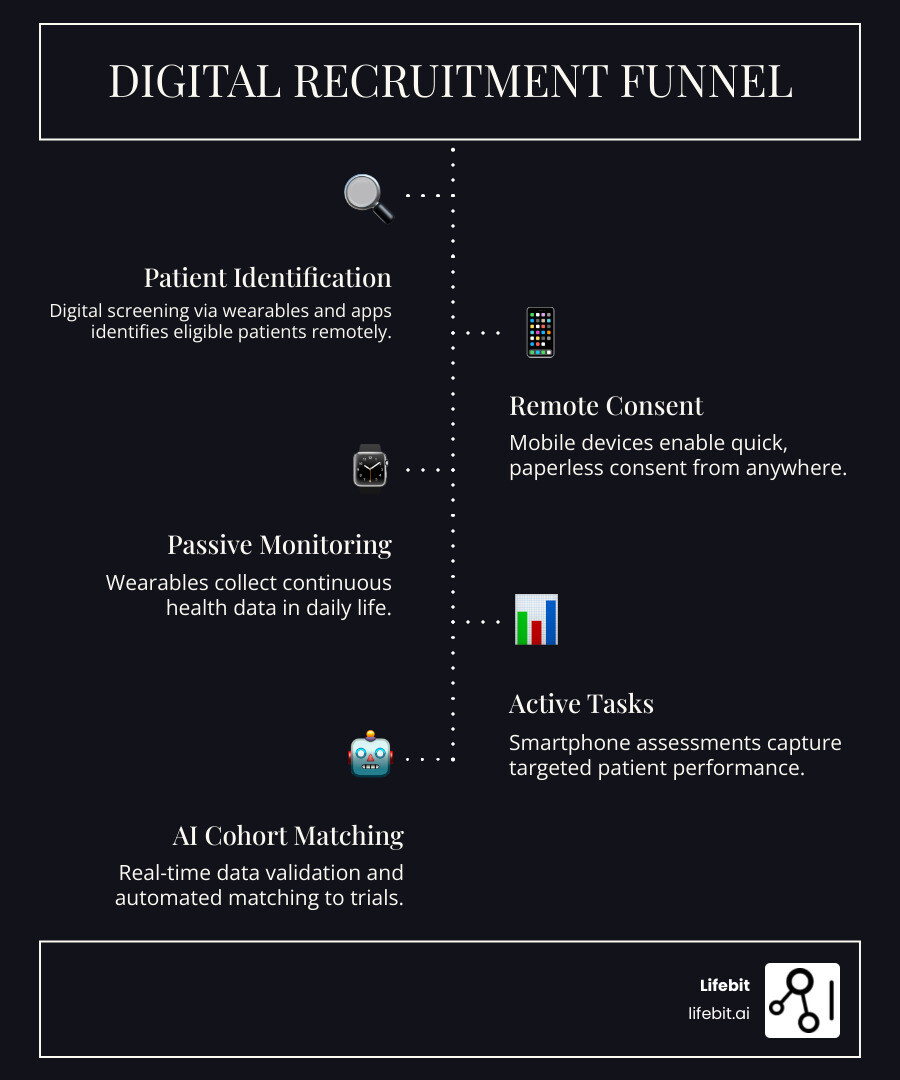
In a traditional trial, the recruitment funnel is leaky. Thousands of patients might be aware of a trial, but the “screen failure” rate is often as high as 70-90% because patients don’t meet the strict inclusion/exclusion criteria once they arrive at the site. This represents a massive waste of resources for both the site and the patient. Digital biomarkers allow for “pre-screening” in the real world. Instead of waiting for patients to walk into a specific hospital in London or New York, we can use digital screening tools to reach them anywhere.
Technologies like Apple’s ResearchKit have demonstrated this scale, with the mPower Parkinson’s study enrolling 70,000 people in record time. By using a smartphone’s accelerometer to measure finger-tapping speed or gait balance before a patient ever visits a site, sponsors can ensure that only those with the specific phenotype required for the study are moved forward. This “recruitment enrichment” ensures that the patients enrolled are the ones truly aligned with the study’s goals, drastically reducing the cost per enrolled patient. It transforms the recruitment process from a wide, inefficient net into a precision-guided search.
The ROI of Digital Biomarkers for Clinical Trials Recruitment
The financial and operational benefits are no longer theoretical. The Capgemini 2023 report highlights that digital biomarkers are a “quiet revolution” poised to transform trial efficiency.
A standout example is Bellerophon Therapeutics. In their REBUILD study for pulmonary fibrosis, they used wearable-measured Moderate to Vigorous Physical Activity (MVPA) as a primary endpoint. This digital approach allowed them to:
- Reduce sample size from 300 to 140 patients (a 53% reduction) because the digital data was so much more precise than a standard walk test. This precision comes from the ability to average thousands of data points over weeks, rather than relying on a single, high-variance measurement.
- Accelerate completion by a staggering 18 months, saving tens of millions in operational overhead and bringing the therapy to market significantly faster.
- Gain FDA endorsement for a digital endpoint as the sole primary measure in a pivotal trial, setting a massive regulatory precedent that other sponsors are now following.
Scaling Diversity and Geographic Decentralization
Diversity in clinical trials isn’t just an ethical requirement; it’s a scientific necessity. Historically, trials have been criticized for race, sex, and age-based disparities, often because sites are located in affluent, urban areas. Digital biomarkers enable Decentralized Clinical Trials (DCTs), removing the geographic and socio-economic barriers that prevent underrepresented groups from participating.
By allowing remote recruitment and monitoring, we can include participants from rural areas or those who cannot afford the time and cost of traveling to major medical centers. This “bring-your-own-device” (BYOD) model meets patients where they are, using the smartphones and wearables they already own to collect high-fidelity data. This not only improves the generalizability of the trial results but also speeds up recruitment by tapping into a global pool of participants rather than a local one. Furthermore, digital tools can be localized into multiple languages and adapted for different cultural contexts, further lowering the barrier to entry for diverse populations.
Active vs. Passive Technologies: Capturing High-Fidelity Patient Data
To optimize digital biomarkers for clinical trials recruitment, we must understand the two primary ways data is captured and how they contribute to a holistic “digital phenotype.”
Active Digital Biomarkers: These require the participant to perform a specific task at a specific time. For example, a patient might complete a 30-second cognitive game on their phone to measure executive function or record a voice sample to detect early signs of vocal cord tremors in ALS. Cambridge Cognition’s 2-Back task, used in a Takeda study for Major Depressive Disorder, achieved over 95% adherence because the tasks were short, engaging, and integrated into the patient’s routine. Active tasks are excellent for creating “stress tests” for specific biological systems, providing a clear signal of functional capacity.
Passive Digital Biomarkers: These are collected in the background without any effort from the patient. Examples include continuous heart rate variability (HRV) monitoring via a smartwatch, GPS-based mobility tracking to measure “life space” (how far a person travels from home), or typing speed and cadence on a smartphone keyboard to detect cognitive decline. Passive data is the ultimate tool for retention because it places zero burden on the patient. It captures the “unfiltered” reality of a patient’s life, including sleep quality and social interaction patterns, which are often the first things to change when a treatment is working.
The V3 Validation Framework
For digital biomarkers to be used in recruitment and as endpoints, they must pass the “V3 Framework” (Verification, Analytical Validation, and Clinical Validation). This framework is essential for moving beyond “wellness” data into “medical-grade” evidence.
- Verification: Does the sensor work? This involves bench testing to ensure the hardware (e.g., an optical heart rate sensor) accurately captures the raw signal it is designed to measure.
- Analytical Validation: Does the algorithm correctly interpret the sensor data? For instance, does the algorithm correctly identify a “step” from raw accelerometer data across different walking speeds and surfaces? This step ensures the software is as reliable as the hardware.
- Clinical Validation: Does the digital measure correlate with a clinical state? This is the most critical step, proving that a change in the digital biomarker (e.g., a decrease in nocturnal scratching measured by a wrist-worn sensor) actually reflects a change in the patient’s disease state (e.g., atopic dermatitis severity).
This rigorous framework, championed by the Digital Medicine Society (DiMe), ensures that the data used to recruit and monitor patients is as robust as any lab test or imaging study.
Regulatory Pathways and the Shift to Primary Endpoints
Regulators like the FDA and EMA are moving quickly to support this shift. We are seeing a transition from exploratory digital endpoints to qualified primary endpoints. Key regulatory milestones include:
- EMA Qualification: The European Medicines Agency accepted stride velocity (SV95C) as a digital endpoint for Duchenne Muscular Dystrophy (DMD), allowing it to be used to measure drug efficacy in Phase 3 trials. This was a landmark decision that proved digital measures could meet the highest level of regulatory scrutiny.
- FDA Digital Health Center of Excellence: This group provides pathways for the qualification of DHTs, ensuring that digital measures are as robust as traditional ones. They have released specific guidance on the use of sensors in clinical trials, emphasizing the need for “fit-for-purpose” technology and clear data management plans.
- ICH E6(R3): This updated guideline focuses on risk-based quality management and the integration of digital technology to improve trial integrity and patient safety. It encourages the use of digital tools to enhance the reliability of trial data and reduce the reliance on manual data entry.
Optimizing Outcomes with Combined Digital Biomarkers
The true power of digital biomarkers for clinical trials recruitment lies in their ability to create a “digital phenotype.” By combining active and passive data, we can detect disease progression with much higher sensitivity than any single test. In Parkinson’s disease, Merck’s WATCH-PD study showed that a composite digital biomarker had a progression-tracking effect size more than twice as large as the traditional MDS-UPDRS scale. This allowed researchers to demonstrate a disease-modifying effect with 73% fewer patients. When recruitment is targeted at patients whose digital phenotypes show they are in the early stages of a disease, the “signal-to-noise” ratio in the trial improves dramatically, reducing the risk of late-stage failure and ensuring that the right therapy reaches the right patient at the right time.
Frequently Asked Questions about Digital Recruitment Tools
How do digital biomarkers reduce sample sizes in clinical trials?
Digital biomarkers provide continuous, high-frequency data, which reduces the “noise” and variance found in episodic measurements. In statistical terms, by increasing the number of data points per patient and using more precise, objective measurements, the standard deviation of the data decreases. This allows researchers to achieve the same statistical power with significantly fewer participants. For example, simulations in Alzheimer’s research show that high-frequency in-home monitoring can reduce the required sample size by up to 50% compared to quarterly clinic visits. This efficiency is a game-changer for rare diseases where the total patient population is small.
Are digital biomarkers currently accepted by the FDA and EMA?
Yes, but the level of acceptance depends on the “Context of Use” (COU). Some digital biomarkers are already endorsed as primary endpoints (like Bellerophon’s MVPA or SV95C for DMD), while others are currently used as secondary or exploratory endpoints. Both the FDA and EMA have established formal qualification programs to help sponsors move digital measures into the “regulatory-grade” category. The key is proving that the digital measure is clinically meaningful to the patient’s life and that the technology used is “fit-for-purpose.”
Can digital biomarkers improve patient retention and engagement?
Absolutely. One of the primary reasons for trial dropout (which averages 30% across the industry) is the “patient burden”—the time and effort required to travel to sites. Digital biomarkers enable remote monitoring, which fits into the patient’s daily life. Passive monitoring is particularly effective here, as it collects data without requiring any active effort. When trials are less intrusive and more patient-centric, participants are more likely to remain enrolled until completion, leading to cleaner data and faster trial timelines.
What are the data privacy implications of using digital biomarkers?
Data privacy is a critical concern, as digital biomarkers often involve sensitive behavioral and physiological data. To address this, modern platforms use techniques like data anonymization, end-to-end encryption, and federated learning. Federated learning allows AI models to be trained on data without the data ever leaving the patient’s device or a secure local environment (Trusted Research Environment). This ensures compliance with strict regulations like GDPR in Europe and HIPAA in the United States, maintaining patient trust while enabling high-level scientific research.
How do digital biomarkers help in rare disease recruitment?
In rare diseases, patients are often geographically dispersed, making it nearly impossible for them to visit a central trial site. Digital biomarkers allow for “site-less” or decentralized recruitment, enabling patients from anywhere in the world to participate. Furthermore, because rare diseases often have subtle, fluctuating symptoms that are difficult to capture in a 20-minute clinic visit, continuous digital monitoring is often the only way to capture the true efficacy of a new treatment and provide the evidence needed for regulatory approval.
What is the difference between a Digital Biomarker and a Digital Endpoint?
A digital biomarker is the characteristic being measured (e.g., heart rate variability), while a digital endpoint is the specific result used to assess the effect of an intervention in a clinical trial (e.g., the change in mean heart rate variability over 12 weeks). All digital endpoints are derived from digital biomarkers, but not all biomarkers become endpoints. The transition from biomarker to endpoint requires rigorous clinical validation and regulatory acceptance within a specific context of use.
Conclusion: The Future of Recruitment is Federated and Digital
The “quiet revolution” of digital biomarkers is no longer a secret. It is the primary solution to the unsustainable costs and timelines of traditional clinical trials. By leveraging digital biomarkers for clinical trials recruitment, we can find the right patients faster, keep them engaged longer, and prove drug efficacy with smaller, more diverse cohorts. This is not just an incremental improvement; it is a fundamental redesign of how medical evidence is generated.
At Lifebit, we believe the future of precision medicine depends on the secure, real-time integration of this digital data with multi-omic and real-world data. The volume of data generated by continuous sensors is massive, requiring advanced computational infrastructure. Our federated AI platform provides the Trusted Research Environment (TRE) necessary to handle these datasets without compromising patient privacy. By bringing the analysis to the data, rather than moving the data to the analysis, we enable global collaboration on a scale previously thought impossible.
Whether you are looking to discover new biomarkers or optimize your next decentralized clinical trial, the integration of digital health technologies is no longer optional—it is the new standard for clinical research. The transition from snapshots to continuous data is the key to unlocking the next generation of life-saving therapies.
Ready to break the recruitment bottleneck?