

Real-Time Health Data Insights for Modern Care
Why Real-Time Health Data Insights Are Changing Modern Healthcare
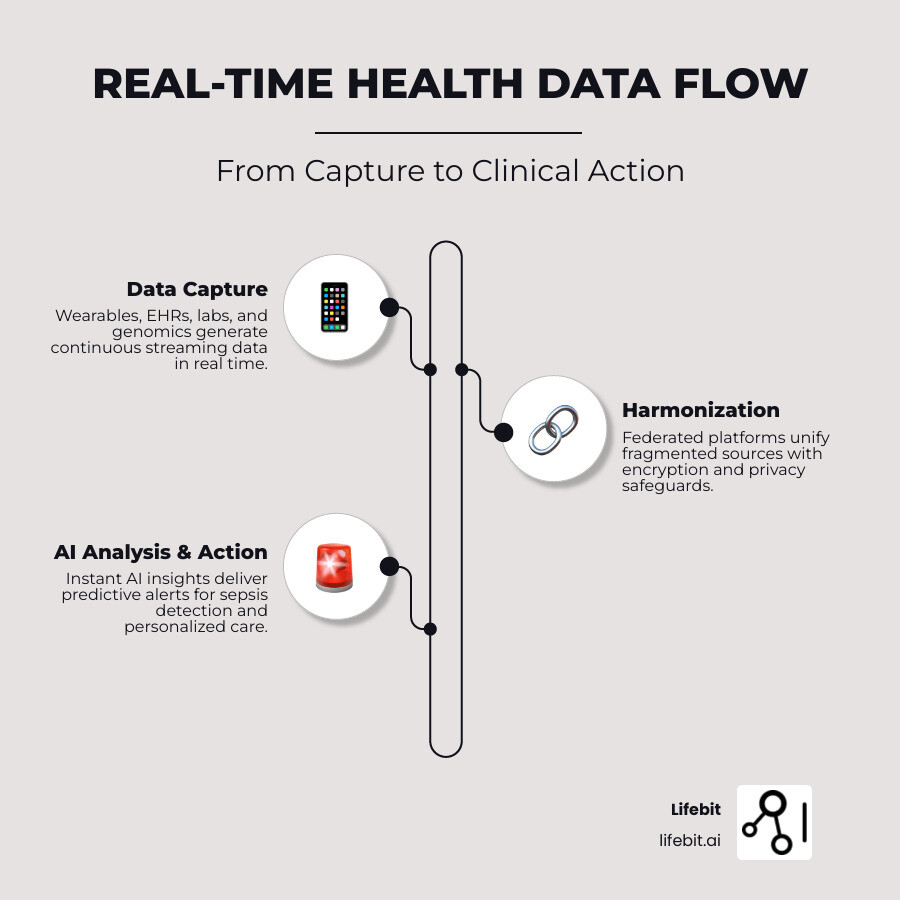
Real-time health data insights are changing healthcare from a reactive discipline to a proactive science. These insights analyze patient information as it’s generated—from electronic health records, wearables, lab systems, and medical devices—enabling clinicians to make faster, more informed decisions at the point of care. In the traditional model, medical data was treated like a historical record—a ledger of what had already occurred. Today, we treat data as a living, breathing entity that provides a continuous pulse on patient health, hospital operations, and global disease trends.
What you need to know about real-time health data insights:
- Speed matters: Real-time systems process streaming data instantly, delivering alerts and predictions within seconds or minutes—not days or weeks after the fact. This “low-latency” approach is critical in acute care settings where every second counts.
- Multiple data sources: Insights combine EHR records, wearable biometrics, genomics, imaging, and basics data into a unified view. This multi-modal approach ensures that clinicians aren’t looking at a single symptom in isolation but rather the whole patient context.
- Proven impact: Healthcare systems report 32% improvement in sepsis detection, 32% reduction in readmissions, and 80% increase in care gap closure. These aren’t just theoretical gains; they represent thousands of lives saved and billions in reduced operational costs.
- Key challenge: Data fragmentation across siloed systems remains the biggest barrier—not collection itself. The average hospital uses 16 different EHR platforms across its network, making interoperability the primary technical hurdle.
- Privacy first: Federated architectures, de-identification, encryption, and role-based access protect patient data while enabling collaboration. By bringing the analysis to the data rather than moving the data to the analysis, we can maintain the highest standards of patient confidentiality.
Healthcare generates approximately 50 petabytes of data annually, yet only 28.19% of medical facilities perform real-time analysis to support operations. This staggering volume of data includes everything from high-resolution medical imaging and continuous heart rate monitoring to complex genomic sequences. The gap between data collection and actionable insight costs lives and resources every day. When data sits idle in a database, it is a missed opportunity for intervention.
Traditional analytics look backward. Real-time systems look forward. Instead of reviewing what happened last month, clinicians receive alerts about sepsis risk hours before symptoms appear. Instead of discovering medication conflicts after discharge, pharmacogenomics checks flag dangerous interactions before the prescription is written. This shift is particularly vital in the management of chronic diseases, where subtle changes in a patient’s daily biometrics can signal a flare-up or complication long before the patient feels the need to call their doctor.
This shift requires unifying fragmented data streams, deploying AI models that learn from patterns humans can’t see, and implementing platforms that scale across hospitals, research networks, and regulatory boundaries—all while maintaining strict compliance with HIPAA, GDPR, and other privacy standards. It involves a fundamental redesign of the clinical workflow, ensuring that insights are delivered directly into the hands of the people who need them, at the exact moment they can make a difference.
As CEO and Co-founder of Lifebit, I’ve spent over 15 years building federated platforms that enable secure, compliant real-time health data insights across 187M+ patient records in 36+ countries. Our work with global pharma companies, public health agencies, and research institutions has shown that real-time analytics don’t just improve care—they fundamentally change what’s possible in medicine. We are moving toward a future where “precision medicine” isn’t just a buzzword, but a standard of care powered by the continuous flow of information.
Basic Real-time health data insights vocab:
Stop Waiting for Hindsight: What Real-Time Health Data Insights Actually Are
If you have ever been frustrated by the “wait and see” approach in medicine, you are not alone. Traditional health data analysis is like looking at a bank statement from three weeks ago to see if you can afford lunch today. It tells you what happened, but it doesn’t help you in the moment. In a clinical setting, this delay can be the difference between a routine recovery and a catastrophic event.
Real-time health data insights are different. They represent the immediate processing and analysis of healthcare data as it is generated. This allows us to move from hindsight (what happened?) to foresight (what is about to happen?). This transition is powered by advanced computational techniques that can handle the “velocity” of modern medical information.
In real-time healthcare analytics, data is treated as a flow, not a stock. We use “streaming analytics” to process information from thousands of sources simultaneously. This is the cornerstone of scientific research on big healthcare data, where the goal is to create value from the 7 V’s of Big Data:
- Volume: The sheer amount of data generated (petabytes per year).
- Velocity: The speed at which data is created and must be processed.
- Variety: The different types of data (structured EHR, unstructured notes, images, omics).
- Variability: The inconsistency of data flows over time.
- Veracity: The accuracy and trustworthiness of the data.
- Visualization: The ability to present complex data in an understandable way for clinicians.
- Value: The ultimate goal—turning data into better patient outcomes.
The Shift from Hindsight to Real-Time Health Data Insights
The difference between traditional analysis and real-time insights is the difference between an autopsy and a life-saving intervention. Traditional methods rely on “batch processing,” where data is collected over a period (like a month), cleaned, and then analyzed. By the time the report reaches a hospital administrator, the patients described in that report have already been discharged or, in worse cases, have suffered avoidable complications.
| Feature | Traditional Health Data Analysis | Real-Time Health Data Insights |
|---|---|---|
| Data Nature | Static, historical “snapshots” | Continuous, live “streams” |
| Latency | Days, weeks, or months | Seconds to minutes |
| Primary Goal | Reporting and retrospective auditing | Prediction and immediate intervention |
| Action | Reactive (treating the event) | Proactive (preventing the event) |
| Source | Mostly structured EHR data | Multi-modal (Wearables, IoT, EHR, Omics) |
| Infrastructure | On-premise legacy servers | Cloud-native, federated architectures |
By integrating predictive modeling directly into the clinical workflow, we can flag individuals at risk of adverse events before they occur. For example, instead of waiting for a patient to crash, AI-powered predictive models analyze labs, vitals, and genetics in real-time to flag a 78% probability of sepsis. This allows the medical team to act while the window for successful treatment is still wide open. Furthermore, real-time insights allow for “dynamic resource allocation,” where a hospital can predict an influx of ER patients based on local health trends or environmental factors, ensuring that staffing levels are optimized before the surge hits.
50 Petabytes of Potential: Where Your Live Medical Data is Hiding
We are currently drowning in data but starving for insights. The healthcare industry is projected to reach a market value of $64.49 billion by 2025, largely driven by the need to manage the massive influx of information. But where is this data coming from? It is no longer confined to the doctor’s handwritten notes or a simple spreadsheet.

To get true real-time health data insights, we must look beyond the four walls of the hospital. Primary sources include:
- EHR Telemetry: Real-time streams from Electronic Health Records (like Epic or Cerner) that track patient intake, medication administration, and hospital capacity. This provides the operational backbone of the facility.
- Medical IoT (IoMT): Bedside monitors, infusion pumps, and ventilators that provide a constant pulse of a patient’s physiological state. These devices generate high-frequency data that can detect subtle arrhythmias or respiratory distress long before a manual check.
- Multi-omics: Genomic, proteomic, and metabolomic data that, when integrated with clinical streams, open up precision medicine. For instance, knowing a patient’s genetic predisposition to certain drug toxicities in real-time can prevent adverse reactions.
- Person-Generated Health Data (PGHD): Information coming directly from the patient’s daily life, including nutrition apps, digital scales, and mental health tracking tools.
Generating real-time patient insights requires us to unify these fragmented sources into a “single source of truth.” This is where many organizations struggle, as data is often trapped in legacy systems that don’t talk to each other. The challenge is not just technical but also semantic—ensuring that a “heart rate” recorded on a Garmin watch means the same thing to an AI model as a “heart rate” recorded on a hospital-grade Philips monitor.
Using Wearables for Real-Time Health Data Insights
Wearables are the “secret weapon” of modern healthcare. They provide a window into the 99% of a patient’s life that happens outside the clinic. Our platforms can now connect with and aggregate data from over 500 wearables, medical devices, and health apps—including Apple Health, Garmin, Fitbit, and Oura.
These devices provide continuous monitoring of:
- Vital signs: Heart rate, blood oxygen (SpO2), and respiratory rate.
- Biometric trends: Sleep patterns (REM vs. deep sleep), stress biomarkers (Heart Rate Variability), and activity levels.
- Early warning signs: For instance, a 12-year-old girl’s Apple Watch recently detected an abnormally high heart rate while she was resting, which led to the early diagnosis of a rare tumor. Without that real-time alert, the diagnosis might have come months later, after the tumor had metastasized.
By using person-generated data, we can also address health disparities. The American Life in Realtime (ALiR) dataset is a great example of how we use wearable data from diverse populations to ensure that AI models aren’t biased against marginalized groups. Since social and environmental determinants (SDOH)—such as air quality, zip code, and access to fresh food—account for 60–80% of health risks, capturing this “real-life” data is essential for equitable care. Real-time insights allow us to see how a heatwave in a specific neighborhood is affecting the respiratory health of elderly patients in real-time, allowing for targeted public health interventions.
Save Lives, Not Just Dollars: The Massive Payoff of Instant Analytics
The benefits of leveraging real-time health data insights extend across the entire healthcare ecosystem. For patients, it means safer care; for providers, it means less burnout; and for payers, it means lower costs. The economic argument for real-time data is just as compelling as the clinical one. By preventing a single ICU admission through early sepsis detection, a hospital can save upwards of $30,000 per patient.
- Patient Safety: AI-powered models can improve sepsis detection rates by up to 32%. Considering sepsis claims 350,000 adult lives annually in the U.S., this is a staggering impact. Real-time monitoring also reduces “alarm fatigue” by using AI to filter out false positives, ensuring that when an alarm sounds, it truly matters.
- Operational Efficiency: Hospitals can use real-time data to predict admission surges 90 minutes in advance, allowing them to coordinate staff and beds more effectively. This reduces wait times in the Emergency Department and ensures that high-acuity patients get a bed immediately.
- Research Acceleration: Real-time evidence generation allows life sciences organizations to track treatment efficacy and safety in the real world, rather than just in controlled trials. This is known as Real-World Evidence (RWE), and it is becoming a cornerstone of FDA and EMA drug approvals.
Driving Personalized Medicine and Proactive Care
We are moving away from the “one-size-fits-all” model of medicine, which has dominated the last century. Real-time insights enable true precision medicine by checking a patient’s genetic variants before a drug is even prescribed. This is particularly important in oncology, where the molecular profile of a tumor can change over time. Real-time liquid biopsies combined with clinical data allow doctors to adjust chemotherapy doses on the fly.
For example, in real-time pharmacovigilance, we can monitor for adverse drug reactions (ADRs) as they happen across a global population. If a patient’s wearable data shows a sudden spike in heart rate or a drop in sleep quality after starting a new medication, the system can flag this immediately to the provider, preventing a potential emergency. In rare disease cases, our analytics have helped identify 95 times more undiagnosed patients by spotting subtle patterns in EHR data—such as specific combinations of lab results and specialist visits—that humans might miss. This “digital phenotyping” is only possible when you have the computational power to analyze millions of data points in real-time.
Fix Your Data Fragmentation Before It Kills Your Progress
Implementing a real-time strategy isn’t just about buying a new piece of software; it’s about overcoming significant technical and ethical problems. The biggest barrier is data fragmentation. Most health data is siloed, unstandardized, and protected by strict (but necessary) privacy laws like HIPAA and GDPR. If your data is stuck in a format that other systems can’t read, it is effectively useless for real-time insights.
To succeed, organizations must focus on three pillars:
- Data Integrity: Ensuring the data is accurate, clean, and reliable. Real-time AI is only as good as the data feeding it; “garbage in, garbage out” is a literal threat to patient safety.
- Privacy and Security: Using de-identification and end-to-end encryption. In a real-time environment, data is constantly in motion, which requires robust “data-in-transit” security protocols.
- Standardization: Adopting global standards like FHIR (Fast Healthcare Interoperability Resources) and OMOP (Observational Medical Outcomes Partnership) to ensure different systems can speak the same language. FHIR, in particular, has become the gold standard for exchanging electronic health records via APIs.
For a deeper dive into these requirements, check out our real-time pharmacovigilance complete guide.
Technical Integration and Data Harmonization
At Lifebit, we believe the future of health data is federated. Instead of moving sensitive patient data to a central server—which creates massive security risks and regulatory headaches—we bring the analytics to the data. This is a paradigm shift in how we think about data ownership and research. The data stays behind the hospital’s firewall, and only the mathematical models or aggregated results are shared.
Our “AI-enabled federated architecture” allows researchers in London to collaborate with clinicians in Singapore or New York without the data ever leaving its original, secure location. This approach uses:
- API Connectivity: To link over 500 disparate data sources, from legacy hospital databases to modern cloud apps.
- Cloud-Native Infrastructure: Using tools like Microsoft Azure, AWS, or Google Cloud for horizontal scaling, ensuring the system can handle millions of concurrent data streams.
- Trusted Research Environments (TREs): Secure workspaces where data can be analyzed without being copied or tampered with. TREs provide a “glass room” where researchers can see and analyze data, but they cannot take the raw data out of the room.
By harmonizing multi-modal data (genomics, EHR, imaging), we create “analysis-ready” datasets that accelerate discovery by up to 60%. This means a pharmaceutical company can identify a potential drug target in months rather than years, simply because they have real-time access to a global, federated network of patient data.
Frequently Asked Questions about Real-Time Monitoring
What is the difference between real-time insights and a standard EHR?
Think of an EHR as a digital filing cabinet. It stores information but doesn’t “think” about it. It is a passive repository. A real-time insights platform is the engine that sits on top of that cabinet. It analyzes the data as it’s being filed, combines it with other sources like your smartwatch or genomic profile, and sends an alert if it sees a problem—like a 78% probability of a heart event—before the doctor even opens the file. It turns a passive record into an active participant in care.
How is patient privacy protected during constant data analysis?
We use a “security-by-design” approach. This includes data de-identification (removing names, social security numbers, and addresses), end-to-end encryption, and role-based access controls. Most importantly, through federated learning, the raw data stays behind the hospital’s firewall. Only the “insights” or the trained AI models travel between institutions. This ensures total compliance with GDPR, HIPAA, and local data sovereignty laws, as the data never actually crosses borders.
How quickly can a healthcare system see results from real-time analytics?
While full enterprise-wide implementation can take time, “quick wins” are possible within weeks. For example, deploying a sepsis detection model in a single ICU can show measurable improvements in patient outcomes within months. As more data sources (like wearables and genomics) are integrated, the ROI grows exponentially through reduced readmissions, optimized hospital capacity, and more efficient clinical trials. Most systems see a full return on investment within 18 to 24 months.
Can real-time insights help with health equity?
Yes. By incorporating Social Determinants of Health (SDOH) and data from diverse wearable users, real-time platforms can identify populations that are being underserved. For example, if real-time data shows that patients in a specific zip code are experiencing higher rates of asthma complications during a pollution spike, health systems can proactively send mobile clinics or distribute preventative medications to that specific area, rather than waiting for those patients to show up in the ER.
2026 Strategy: Secure Your Future with Real-Time Data
The future of healthcare is happening in real-time. We are moving toward a world where the hospital comes to the patient, rather than the patient waiting for the hospital. By 2026, the organizations that thrive will be those that have moved from “collecting” data to “acting” on it instantly. The competitive advantage in healthcare is shifting from who has the most data to who can generate the fastest insights from that data.
At Lifebit, our mission is to make this transition seamless and secure. Our federated AI platform, featuring the R.E.A.L. (Real-time Evidence & Analytics Layer), provides the infrastructure needed for large-scale, compliant research and pharmacovigilance. We provide the “connective tissue” that allows disparate health systems to function as a single, intelligent network. Whether you are a government agency in the UK, a pharma giant in the USA, or a research institute in Singapore, we help you open up the value of your data without compromising on privacy.
The technology is here. The data is available. The only question is: are you ready to stop looking at the past and start seeing the future of your patients’ health? The transition to real-time health data insights is not just a technical upgrade; it is a moral imperative to provide the best possible care with the tools we have available today.