

How AI is Finally Fixing the Multi-Omics Data Mess

AI-Driven Omics Harmonization: Stop Wasting 80% of Research Time
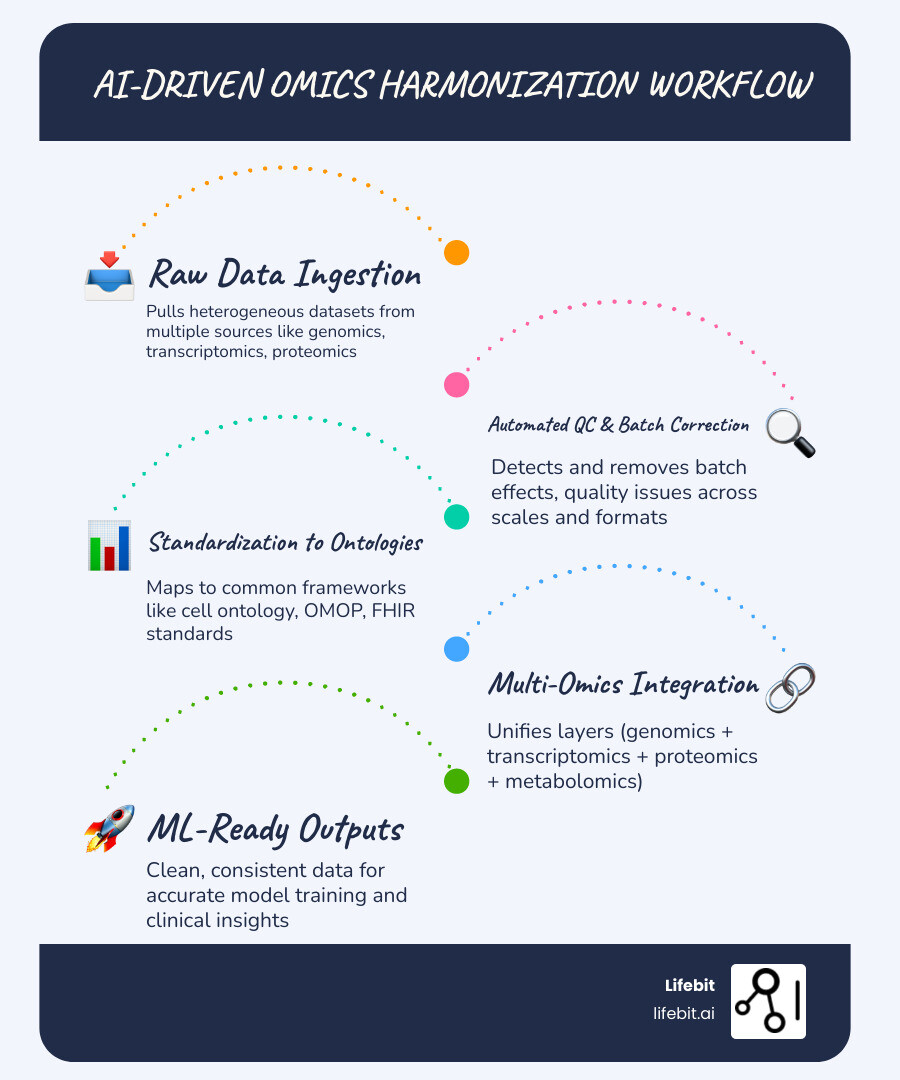
AI-driven omics harmonization is the automated process of standardizing, integrating, and cleaning heterogeneous biological datasets—genomics, transcriptomics, proteomics, metabolomics—using artificial intelligence. It solves the biggest bottleneck in biomedical research: turning fragmented, inconsistent data into reliable inputs for machine learning and clinical insights.
What AI-Driven Omics Harmonization Does:
- Automates data standardization across varying formats, scales, and quality levels
- Corrects batch effects that obscure biological signals in multi-institutional studies
- Integrates diverse omics layers (genomics, transcriptomics, proteomics, metabolomics) into unified frameworks
- Enables machine learning by providing consistent, high-quality training data
- Accelerates discovery by reducing manual curation time from months to days
The problem is urgent. Research teams spend up to 80% of their time wrangling data instead of generating insights. Inconsistent cell type annotations, missing metadata, and batch effects from different sequencing platforms make it nearly impossible to combine datasets. Machine learning models trained on messy data produce unreliable predictions, delaying drug discovery or causing trial failures.
AI changes this. Platforms now curate over 5,000 samples per week with more than 98% accuracy, process over 1 terabyte of biomedical data weekly, and harmonize 26+ data types into standardized frameworks. For difficult early-detection tasks in cancer, integrated multi-omics classifiers report AUCs around 0.81–0.87—performance only possible when AI harmonization removes technical noise and preserves biological signals.
I’m Maria Chatzou Dunford, CEO and Co-founder of Lifebit, where we’ve built federated data platforms that power ai-driven omics harmonization for pharmaceutical organizations and public sector institutions worldwide. Over 15 years, I’ve contributed to breakthrough tools like Nextflow and led teams that transform genomic data chaos into actionable precision medicine insights.
AI-Driven Omics Harmonization: Fix Dirty Data and Prevent Trial Failures
In the high-stakes world of drug discovery, data is the fuel, but “dirty” fuel destroys engines. We often see brilliant research teams struggling because their datasets look like a linguistic Tower of Babel. One lab records a gene expression value in one format; another uses a different scale; a third omits critical metadata entirely. This fragmentation and inconsistency severely limit the effectiveness of machine learning (ML) models, leading to what many call the “reproducibility crisis” in bioinformatics.
At Lifebit, we believe the “data mess” isn’t just an inconvenience—it’s a scientific barrier. When we apply ai-driven omics harmonization, we aren’t just cleaning spreadsheets. We are correcting for “batch effects”—technical variations introduced by different lab equipments, reagents, or even the time of day a sample was processed. These effects can trick an AI into seeing a “cure” where there is only a difference in sequencing machines. By creating standardized biological frameworks, we ensure that the patterns your ML models find are rooted in biology, not technical noise.
The Technical Hurdles of Multi-Omics Integration
The “Data Deluge” is real. Modern oncology, for instance, generates petabyte-scale data from NGS, mass spectrometry, and digital pathology. However, integrating these heterogeneous datasets remains a nightmare due to several core challenges:
- Varying Scales and Distributions: Transcriptomics measures thousands of RNA transcripts with high dynamic ranges, while metabolomics may track hundreds of small molecules with vastly different chemical properties. Harmonizing these requires sophisticated normalization techniques like quantile normalization or ComBat-seq to ensure one data layer doesn’t statistically overwhelm another.
- Metadata Fragmentation and Semantic Drift: Clinical integration is often blocked because patient records aren’t mapped to the same controlled vocabularies. A “Stage II Tumor” in one hospital might be coded differently in another, making cross-institutional meta-analysis impossible without automated semantic mapping.
- The Missing Value Problem: Biological datasets are notoriously sparse. Missing values in clinical cohorts—sometimes exceeding 30% in metabolomics due to detection limits—can lead to biased results. Advanced AI imputation methods, such as GAIN (Generative Adversarial Imputation Nets), are now used to fill these gaps without introducing artificial signals.
Why Harmonization Is Critical for Machine Learning Accuracy
If you want an ML model with high predictive power, you need consistency. Poor data quality leads to unreliable predictions that can cause clinical trial failures, costing billions. For example, a breast cancer recurrence model’s accuracy (AUC) can drop from a stellar 0.92 to a useless 0.68 when moved to a new institution simply because of batch effects. This is known as “model decay” or “distribution shift.”
Using advanced batch effect adjustment and AI-driven normalization, we can maintain model reliability across diverse populations. This ensures that feature engineering—the process of selecting which biological markers matter most—is based on high-quality, harmonized training data. Without this foundation, even the most sophisticated neural network will suffer from “garbage in, garbage out,” identifying spurious correlations that fail to validate in the real world.
AI-Driven Omics Harmonization: Process 5,000 Samples Weekly with 98% Accuracy
Manual data curation is the “silent killer” of research budgets. Traditionally, Subject Matter Experts (SMEs) could only audit about 400 samples per week, a pace that is laughably slow in the era of population-scale genomics. Our hybrid AI-human approach shatters that ceiling. By using AI-assisted curation, we can process over 5,000 samples per week with more than 98% accuracy, allowing researchers to focus on hypothesis testing rather than data cleaning.
Our infrastructure is built for the heavy lifting of modern biology, processing more than 1 TB of biomedical data every week. Whether you are dealing with genomics, proteomics, or any of the 26+ supported data types, our automated pipelines transform raw chaos into research-ready information. This scalability is essential for projects like the UK Biobank or the All of Us Research Program, where the sheer volume of data exceeds human capacity.
Using AI and LLMs for Omics Harmonization
One of the most exciting breakthroughs we’ve implemented is the use of Large Language Models (LLMs) like GPT-4 and specialized Bio-LLMs for cell type annotation and metadata extraction.
In the past, naming a cell “T-cell” vs “T cell” or “CD8+ Lymphocyte” would break a database query. Now, we use semantic embedding and Natural Language Processing (NLP) to map inconsistent names to standardized Cell Ontologies. This “Two-Step” AI strategy involves:
- Step 1: Descriptive Generation: The AI analyzes the raw metadata and gene expression profiles to generate a detailed biological description of the sample.
- Step 2: Ontology Mapping: These descriptions are converted into vector embeddings and mapped to the closest match in a gold-standard ontology (like CL or UBERON).
This approach achieves a 74% full agreement with expert-curated gold standards, far outperforming traditional keyword matching which often hovers around 40%. It allows for the automated harmonization of single-cell RNA-seq data across hundreds of different studies simultaneously.
Lifebit’s Scalable Infrastructure for Global Biomedical Data
We don’t just provide a tool; we provide a Trusted Data Lakehouse (TDL). Our platform connects discovery to development by enriching metadata and scaling data pipelines for high-throughput bioinformatics. By using standardized frameworks like OMOP (Observational Medical Outcomes Partnership) and FHIR (Fast Healthcare Interoperability Resources), we ensure that your data isn’t just clean—it’s interoperable across the entire global research ecosystem. This means a researcher in London can seamlessly query harmonized data from a cohort in Tokyo, accelerating the pace of global health innovation.
AI-Driven Omics Harmonization: Achieve 0.87 AUC in Early Cancer Detection
The proof is in the results. During the COVID-19 pandemic, the need for harmonized clinical and genomic data was a matter of global survival. AI-driven models used these harmonized sets to identify new drug candidates and improve trial outcomes in record time, demonstrating that when data is unified, science moves at light speed.
In oncology, the impact is equally transformative. Integrated multi-omics classifiers now report AUCs of 0.81–0.87 for difficult early-detection tasks, such as identifying pancreatic cancer from liquid biopsies. These scores represent a significant leap over single-modality tests.
| Task | Data Type | AUC Score | Significance |
|---|---|---|---|
| Pan-cancer Classification | Multi-omics (GNN) | 0.92 | High precision across 33 cancer types |
| Early Cancer Detection | Harmonized Multi-omics | 0.81–0.87 | Critical for asymptomatic screening |
| Leukemia Subtyping | 17-feature ML Model | 0.97 (Accuracy) | Enables rapid treatment selection |
Discovering Therapeutic Targets with Explainable AI (XAI)
We use Explainable AI (XAI) to pull back the curtain on the “black box” of machine learning. In drug discovery, knowing that a molecule works is not enough; you must know why. By using techniques like SHAP (SHapley Additive exPlanations) and LIME (Local Interpretable Model-agnostic Explanations), we can identify exactly which features—such as specific metabolic markers or gene mutations—are driving a drug response.
This provides the mechanistic insights needed for drug repurposing. For instance, if an AI identifies that a specific inflammatory pathway is the primary driver for both rheumatoid arthritis and a subset of cardiovascular patients, researchers can quickly pivot existing medications to new therapeutic areas. This “mechanism-first” approach reduces the risk of late-stage clinical failure by ensuring the drug target is biologically relevant to the patient population.
Integrating Diverse Omics Layers for Novel Biomarkers
True precision medicine requires looking at the whole picture. Integrating genomics, transcriptomics, proteomics, and metabolomics allows us to uncover biomarkers that are invisible in single-layer analysis. For example, while a genomic SNP (Single Nucleotide Polymorphism) might suggest a genetic risk, the transcriptomic and proteomic layers confirm if that risk is actually being expressed as a functional disease state. Harmonization ensures these layers are perfectly aligned, allowing AI to detect the subtle “cross-talk” between molecules that signals the earliest stages of disease.
AI-Driven Omics Harmonization: Securely Connect Global Data Without Moving It
The future of research is federated. We are moving away from the risky, slow, and expensive process of moving massive datasets across borders. Instead, our “federated learning” approach brings the model to the data. This preserves privacy and sovereignty while allowing for massive-scale meta-analyses that were previously impossible due to GDPR, HIPAA, or national security regulations.
Recent breakthroughs in Federated Harmony show that we can achieve integration performance identical to centralized methods (Adjusted Rand Index >0.95) without ever sharing raw patient data. This is how we build a truly global, secure research network where data stays behind the firewall of the hospital or institution that owns it, yet contributes to global scientific progress.
Privacy-Preserving Computation and Data Sovereignty
In a federated ecosystem, ai-driven omics harmonization happens locally at each node. Our platform automates this process, ensuring that before any model training begins, the local data is standardized to the global schema. We utilize several layers of security:
- Differential Privacy: Adding mathematical “noise” to the results to ensure no individual patient can be identified.
- Homomorphic Encryption: Allowing computations to be performed on encrypted data without ever needing to decrypt it.
- Blockchain Audit Trails: Providing a transparent, immutable record of who accessed what data and for what purpose.
What’s Next: Emerging Technologies in Omics Harmonization
We are already looking toward the next frontier of biological data integration:
- Spatial Omics: Understanding not just what is in a cell, but where that cell is located in a tissue. This adds a 3D coordinate system to our harmonization challenges, requiring AI to align image data with molecular profiles.
- Quantum Computing: As datasets grow into the exabyte range, classical computers will struggle. Quantum algorithms offer the potential to accelerate drug docking and molecular simulations from months to days.
- Real-Time Analytics: Using our R.E.A.L. (Real-time Evidence & Analytics Layer) for instant insights into patient safety and drug efficacy during live clinical trials, allowing for adaptive trial designs that can save time and lives.
AI-Driven Omics Harmonization: Your Top Questions Answered
What is data harmonization in multi-omics?
It is the process of standardizing diverse biological data types (DNA, RNA, proteins, metabolites) into a unified format. This involves cleaning, normalizing for batch effects, and mapping metadata to standard ontologies (like SNOMED-CT or LOINC) so that different datasets can be analyzed together as a single, cohesive cohort.
How does explainable AI (XAI) help in drug discovery?
XAI provides transparency. Instead of just getting a “yes/no” prediction regarding drug efficacy, XAI tells researchers why a model made a choice. It highlights the specific genes or proteins that influenced the prediction, helping identify biological targets for new drugs and explaining why certain patient subgroups might not respond to a treatment.
Why is harmonization lagging in cardiovascular research?
While oncology has embraced multi-omics due to the clear genetic drivers of cancer, cardiology has historically focused more on imaging and physiological markers. Only about 1% of XAI publications focus on cardiology, highlighting a massive opportunity for ai-driven omics harmonization to uncover new therapeutic targets for heart disease by integrating genomic risk scores with proteomic markers of inflammation.
Can AI harmonization handle legacy data?
Yes. One of the primary strengths of AI-driven approaches is their ability to “rescue” legacy data. By using NLP to parse old PDF reports and mapping them to modern digital formats, we can integrate decades of historical research into modern ML pipelines, significantly increasing the power of longitudinal studies.
What are the costs of not harmonizing data?
The costs are both financial and human. Research teams spend up to 80% of their time on manual data prep, which translates to millions of dollars in wasted salary. More importantly, unharmonized data leads to missed biological signals, potentially delaying the discovery of life-saving treatments by years.
Is federated harmonization as accurate as centralized harmonization?
Yes. Peer-reviewed studies have shown that federated approaches, when combined with robust AI-driven standardization at the local level, achieve results that are statistically indistinguishable from centralized data pooling, while offering far superior data security and compliance.
AI-Driven Omics Harmonization: End Data Chaos and Start Curing Diseases
The “data mess” has held back precision medicine for too long. We have the technology to sequence a human genome in hours, yet it takes months to clean the resulting data. At Lifebit, we are ending this chaos. Our federated AI platform—featuring the Trusted Research Environment (TRE) and Trusted Data Lakehouse (TDL)—provides the secure, scalable, and automated infrastructure needed to turn fragmented data into life-saving insights.
By automating the most tedious parts of the research workflow, we empower scientists to do what they do best: innovate. Our platform doesn’t just store data; it enriches it, making it “AI-ready” from the moment it is ingested. This transition from data-wrangling to data-driven discovery is the key to the next generation of medical breakthroughs.
Whether you are in biopharma, government, or public health, our federated AI platform is built to help you collaborate securely and discover faster. We are moving toward a future where every piece of biological data, no matter where it was generated, can contribute to a global understanding of human health. Let’s stop wrangling data and start curing diseases. The tools are here; the data is ready. It’s time to unlock the full potential of the omics revolution.