

How Real-Time AI Insights Make You the Smartest Person in the Room
Why Real-Time AI Insights Give You an Unfair Advantage
Real-time AI insights are the ability to analyze data and act on it as it’s generated — not hours or days later. Here’s what that means in practice:
| What You Get | Why It Matters |
|---|---|
| Instant anomaly detection | Catch fraud, safety signals, or failures before they escalate |
| Live predictive analytics | Forecast outcomes while there’s still time to change them |
| Natural language data queries | Any team member can ask questions without writing SQL |
| Automated decision triggers | AI acts on patterns without waiting for a human to notice |
| Continuous model refinement | Insights improve automatically as new data flows in |
Most organizations are still making decisions on yesterday’s data. Batch processing pipelines collect data, process it overnight, and deliver reports the next morning — by which time the moment has passed. A drug safety signal spotted 12 hours late. A fraud pattern flagged after the transaction cleared. A patient complication missed during a shift.
The gap between data generated and insight delivered is where value dies.
That’s changing fast. Seventy-five percent of businesses have now invested in AI analytics, and 80% of those organizations report direct revenue growth as a result. The companies pulling ahead aren’t just collecting more data — they’re acting on it faster.
For pharma companies, public health agencies, and regulatory bodies, this shift isn’t just a competitive edge. It’s a patient safety imperative.
I’m Maria Chatzou Dunford, CEO and Co-founder of Lifebit and a computational biology researcher with over 15 years building AI and high-performance computing systems for biomedical data — and real-time AI insights sit at the core of everything we do to accelerate compliant, federated research. In this guide, I’ll walk you through exactly how real-time AI works, where it delivers the most impact, and how organizations like yours can implement it without compromising security or governance.
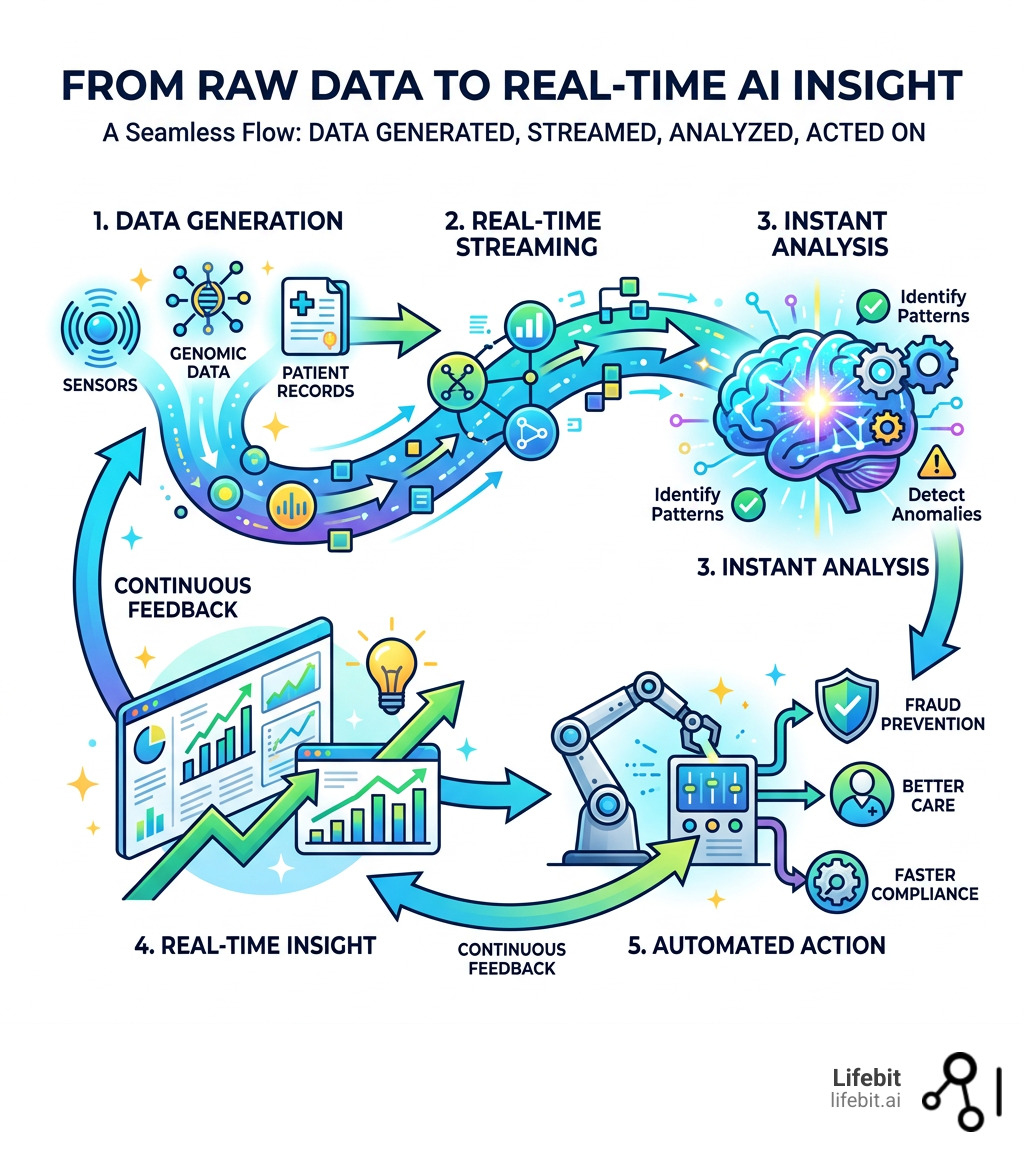
Quick real-time ai insights definitions:
The Shift to Real-Time AI Insights: Why Batch Processing is Failing
For decades, the standard for business intelligence was “batch processing.” You’d collect data all day, run a massive job at midnight, and hope the report on your desk at 9:00 AM still mattered. But in a world that moves at the speed of a fiber-optic cable, “yesterday’s news” is a liability. The fundamental flaw of batch processing is that it treats data as a static resource to be mined later, rather than a living stream to be navigated now.
The Data Value Decay Curve
The value of data is not constant; it decays over time. In many high-frequency environments, the utility of a data point drops by 90% within the first few minutes of its creation. For example, a sensor reading indicating a pressure spike in a chemical reactor is invaluable at second zero, but merely a forensic artifact after ten minutes. Real-time AI insights capture value at the peak of this curve.
The problem is latency. When data sits idle, its value evaporates. We’ve seen that 80% of organizations report revenue growth from real-time data, primarily because they can pivot before a trend becomes a crisis.
| Feature | Traditional Batch Analytics | Real-Time AI Insights |
|---|---|---|
| Data Freshness | Hours to days old | Milliseconds to minutes old |
| Processing | Periodic, scheduled bursts | Continuous stream processing |
| Action | Reactive (what happened?) | Proactive (what is happening now?) |
| User Input | Rigid SQL queries | Natural language conversations |
| Model Updates | Manual retraining | AutoML systems for continuous model refinement |
| Infrastructure | Data Warehouses (Snowflake/BigQuery) | Stream Processors (Kafka/Flink) |
Why Timing is Everything for Real-Time AI Insights
In high-stakes industries like healthcare and finance, the “decision window”—the time you have to make an impactful choice—is often measured in seconds. Market volatility can wipe out margins in minutes, and a sudden spike in adverse drug reactions requires immediate intervention. If your AI model takes four hours to ingest and process a new batch of clinical trial data, you are effectively flying blind during the most critical moments of a study.
Research shows that 56% of early adopters exceeded goals via timely insights. These organizations aren’t just lucky; they are agile. By shrinking the time between an event occurring and an AI agent flagging it, they can maintain operational agility that “batch” competitors simply can’t match. At Lifebit, we see this daily in pharmacovigilance, where waiting for a weekly report could mean missing a critical safety signal that affects thousands of patients. The ability to detect a signal in real-time allows for immediate protocol adjustments, potentially saving lives and preventing regulatory shutdowns.
Moving Beyond Static Dashboards
We’ve all seen them: rows of colorful charts that look great but tell you nothing about what to do next. Static dashboards are the “museums” of data—they show you the past. Real-time AI insights transform these into dynamic decision engines. Traditional dashboards require a human to look at a graph, interpret the trend, and then decide on an action. This human-in-the-loop creates a bottleneck.
Modern platforms leverage AI-driven insights to provide narrative storytelling. Instead of a line graph trending down, the AI tells you: “Sales are dropping in the Northeast due to a logistics delay; reroute inventory from the Midwest now to save $50k.” This automated discovery moves the burden of analysis from the human to the machine, allowing your team to focus on execution. It shifts the paradigm from “What does this data mean?” to “The data says we should do this—do you agree?”
The Tech Stack Powering Instant Intelligence
How do we actually achieve this “instant” intelligence? It isn’t magic; it’s a sophisticated orchestration of edge computing, automated machine learning (AutoML), and high-speed data pipelines. To build a system capable of delivering real-time AI insights, organizations must move away from monolithic architectures toward event-driven designs.
The Role of Edge Computing and Fog Architectures
The secret sauce is often edge computing. By shifting data processing to the source—like a medical device, a retail sensor, or a manufacturing plant floor—we reduce the latency caused by sending massive files to a central cloud. In a traditional setup, data travels from the sensor to a gateway, then to a regional data center, and finally to the central cloud for processing. This “round trip” can take hundreds of milliseconds—too slow for autonomous systems.
When you combine edge processing with AutoML systems for continuous model refinement, the AI actually gets smarter as the data flows, adjusting its predictions based on the very latest environment variables. This creates a feedback loop where the model is constantly calibrated against reality, rather than relying on a version of reality that was captured during the last training cycle six months ago.
How NLP and Anomaly Detection Enable Real-Time AI Insights
One of the biggest barriers to data-driven decision-making has always been the “skills gap.” Not everyone can write complex SQL queries or understand Python-based data visualizations. However, everyone can ask a question.
Natural Language Processing (NLP) allows for voice-activated dashboards and chat-based interfaces. Imagine asking, “Which patient cohorts are showing unexpected symptoms today?” and getting an instant, visualized answer. This democratization of data means that a floor nurse or a warehouse manager can access the same level of insight as a data scientist. Furthermore, features like the Real-time Assist API for live interactions enable AI to listen to live conversations—such as a telehealth call—and provide instant pattern recognition or compliance alerts to the practitioner. This isn’t just about recording data; it’s about the AI acting as a co-pilot in real-time.
Integrating Streaming Data with AI Agents
To make real-time AI insights work at scale, you need an event-driven architecture. This typically involves tools like Apache Flink and Kafka, which act as high-speed “conveyor belts” for data. These tools allow for “windowing,” where the AI looks at small slices of time (e.g., the last 5 seconds of data) to identify patterns.
Instead of storing data first and analyzing it later, AI agents sit directly on these streams. They “watch” the data as it flies by, performing low-latency processing to spot trends the moment they emerge. This is often coupled with Vector Databases, which allow the AI to compare incoming real-time data against millions of historical records in milliseconds to find similarities. For more on how this fits into a broader strategy, check out our more info about advanced analytics.
High-Impact Use Cases Across Global Industries
The impact of real-time AI insights is visible across almost every sector, but a few are leading the charge by turning data into a massive revenue and safety lever. The common thread among these leaders is the transition from reactive monitoring to proactive intervention.
Retail and E-Commerce: The 30% Conversion Lift
In retail, hyper-personalization is the new gold standard. By analyzing customer behavior in the moment—what they click, how long they hover, what they have in their cart—retailers see a sales conversion lift of 30%. If a customer lingers on a product page but doesn’t buy, the AI can trigger a personalized offer or a real-time chat agent to close the deal. This is “in-session” marketing, and it is only possible with real-time AI insights that can process clickstream data instantly.
Finance: Millisecond Fraud Prevention
In the financial sector, fraud detection happens in milliseconds. AI agents analyze 3.5 billion daily transactions globally, spotting anomalies that deviate from a user’s typical pattern before the “approve” button is even pressed. If a card is swiped in London and then again in New York ten minutes later, the AI flags the impossibility and blocks the transaction instantly. This saves billions in losses and protects consumer trust.
Healthcare: Predicting the Unpredictable
This is where we at Lifebit focus our expertise. Real-time Healthcare Analytics allow hospitals to monitor vitals and predict complications like sepsis hours before they become life-threatening. Sepsis is a leading cause of hospital deaths, and every hour of delay in treatment increases mortality risk by nearly 8%. Real-time AI monitors heart rate, blood pressure, and lab results continuously, alerting doctors to the earliest signs of physiological distress.
Transforming Patient Outcomes with Real-Time AI Insights
In drug development and public health, timing saves lives. Traditional safety monitoring often relies on retrospective studies that take months. With real-time AI insights, we enable Real-time Pharmacovigilance, where safety signals are detected from live electronic health records and clinical trial data instantly. This allows pharmaceutical companies to identify rare side effects much earlier in the drug lifecycle.
Using Real-time Patient Insights, researchers can also monitor multi-omic data—genomics, proteomics, and more—to see how different populations react to treatments in real-time. This allows for “adaptive” clinical trials that can be adjusted on the fly. If a specific genetic subgroup is responding exceptionally well to a drug, the trial can be expanded for that group immediately, significantly speeding up the time it takes to get life-saving drugs to market.
Manufacturing and Industry 4.0
In the manufacturing sector, real-time AI insights drive “Predictive Maintenance.” By analyzing vibration and temperature data from factory machinery, AI can predict a component failure before it happens. This prevents costly unplanned downtime, which can cost large manufacturers up to $532,000 per hour. Instead of fixing a machine after it breaks, the AI schedules maintenance during a planned lull, optimizing the entire supply chain.
Smart Cities and Public Safety
Governments are also getting smarter. Smart city initiatives use real-time data to optimize traffic flow, reducing congestion and carbon emissions. In public safety, AI-powered predictive analytics for government help emergency services respond faster. For example, AI can analyze surveillance footage or sensor data to detect a hazard, like a fire or a traffic accident, and dispatch help before a single 911 call is placed. In some cities, real-time AI is even used to optimize the energy grid, shifting power loads in response to real-time demand spikes to prevent blackouts.
Overcoming Implementation Hurdles and Infrastructure Gaps
If real-time AI insights are so great, why isn’t everyone doing it? The truth is, it’s hard. Organizations face significant challenges with data quality, legacy systems, and a massive skills gap. Many companies are still struggling with “data silos,” where information is trapped in different departments and cannot be streamed into a central AI engine.
The Data Quality Paradox
In real-time systems, you don’t have the luxury of a 24-hour cleaning cycle. If the data coming in is “dirty”—missing values, incorrect formats, or sensor noise—the AI will produce “dirty” insights. This requires the implementation of real-time data validation layers that can clean and normalize data on the fly.
There’s also the “sticker shock.” Implementation costs ranging from $6,000 to $300,000 can be a barrier for smaller firms. However, when you consider that data-driven companies grow 10-15% faster than their peers, the ROI becomes clear. The real cost is the “cost of inaction”—the revenue lost while your competitors are acting on insights you haven’t even seen yet.
Scaling Securely with Federated Architectures
For organizations handling sensitive data—like those in the UK, USA, or Europe—privacy is the biggest hurdle. You can’t just move all your patient or customer data into a central cloud for analysis; it’s illegal and risky. This is particularly true in the wake of strict regulations like the EU’s AI Act and the ongoing evolution of GDPR.
This is where federated architectures come in. Instead of moving the data to the AI, we move the AI to the data. This enables Real-time Evidence Generation across different locations (like hospitals in Singapore and labs in Canada) without the data ever leaving its secure home. The AI model travels to each site, learns from the local data, and then shares only the “learned insights” (not the raw data) with a central coordinator. It’s the only way to achieve global real-time AI insights while remaining 100% compliant with local regulations like GDPR or HIPAA.
Bridging the AI Skills Gap
You don’t need a PhD in data science to be the smartest person in the room. As Accenture research on data value points out, data has zero value until you can pull out the stories hidden inside. The bottleneck is often not the technology, but the human ability to interpret and act on it.
To bridge the gap, we recommend:
- Internal Upskilling: Training your existing subject matter experts (doctors, engineers, marketers) to use low-code AI tools rather than trying to teach data scientists the nuances of biology or mechanical engineering.
- Cross-functional Teams: Blending technical engineers with business leaders who understand the “why” behind the data. This ensures that the real-time insights being generated are actually aligned with business goals.
- Agentic Tools: Using AI agents that handle the “heavy lifting” of data cleaning and SQL generation, so your team can focus on making decisions. These agents act as an intermediary, translating complex data streams into actionable business language.
Frequently Asked Questions about Real-Time AI
What is the difference between real-time and traditional analytics?
Traditional analytics (batch) looks at historical data to tell you what happened. Real-time analytics looks at streaming data to tell you what is happening right now and what is likely to happen in the next few minutes.
How does edge computing improve AI insight speed?
Edge computing processes data locally (on the device or a nearby server) rather than sending it to a distant data center. This eliminates the “round-trip” time, allowing for split-second decisions in things like autonomous vehicles or surgical robots.
Can non-technical teams access real-time AI insights?
Absolutely. Modern platforms use NLP and “Genie” agents that allow users to ask questions in plain English (or any supported language). You no longer need to wait for a data analyst to build a report; you can generate your own insights in seconds.
Conclusion: The Future is Agentic and Federated
The era of “waiting for the report” is over. As we move toward 2026, the winners will be those who embrace agentic analytics—where AI doesn’t just show you a chart, but actively helps you build, explore, and execute your strategy.
At Lifebit, we believe the future of these insights must be federated. By enabling secure, real-time access to global biomedical data without compromising privacy, we are helping researchers across 5 continents solve the world’s most complex health challenges. Whether you are in New York, London, or Singapore, the goal is the same: to have the right insight at the right moment to make the best possible decision.
Stop looking at the past. Start acting on the present.
CTA: Experience the Lifebit Federated Biomedical Data Platform