

AI Powered Drug Target Discovery: How Machine Learning Is Cutting Years Off Pipeline Development
Updated for 2026
AI-powered drug target discovery in 2026 is dominated by genomic + transcriptomic foundation models (Geneformer, scGPT, ESM3) running against population-scale biobank data (UK Biobank, FinnGen, Genomics England, All of Us) plus single-cell atlases (HCA, Tabula Sapiens). The bottleneck has shifted from model performance to harmonized data substrate — federated TREs that link genomic, single-cell, and clinical phenotypic data are the production layer.
The drug discovery industry has a target problem. Not a shortage of potential targets—quite the opposite. We’re drowning in biological data that could point to thousands of promising drug targets, yet traditional discovery methods still take 4-6 years just to identify and validate a single target. And here’s the painful part: 90% of those carefully selected targets fail anyway, often not until Phase II or Phase III trials, after hundreds of millions have been spent.
This isn’t a science problem. It’s a data problem.
Researchers aren’t lacking hypotheses about which proteins, genes, or pathways might drive disease. They’re lacking the ability to connect the dots across fragmented datasets fast enough to matter. Genomic data sits in one system. Clinical records live in another. Published research exists in millions of scattered papers. Proteomic data hides in yet another silo. By the time a team manually pieces together evidence from these sources, competitors have moved on, patents have been filed, and months have evaporated.
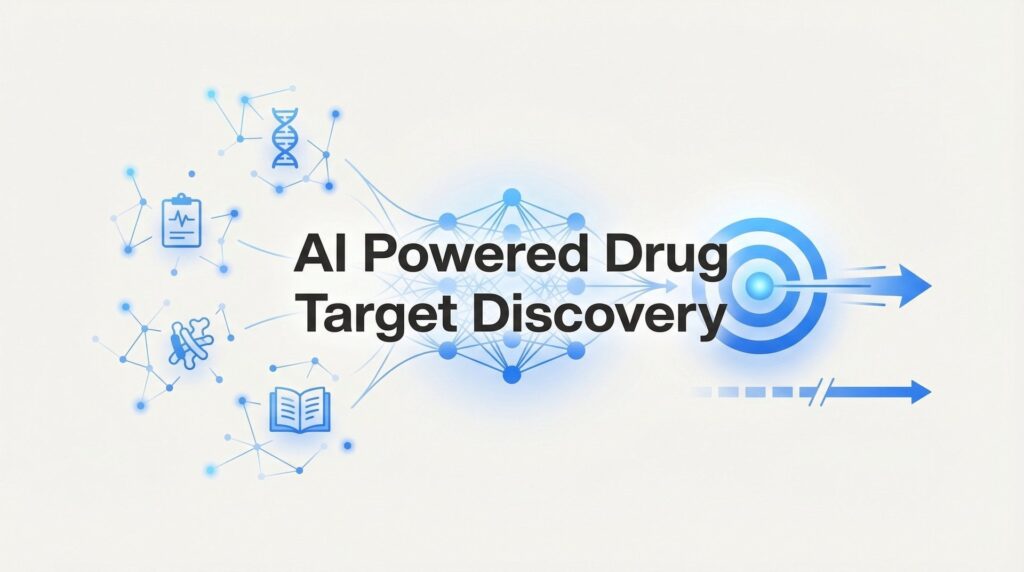
AI powered drug target discovery changes this equation entirely. Instead of hypothesis-driven target identification—where researchers start with an educated guess and spend years validating it—AI enables data-driven discovery at scale. Machine learning models can analyze millions of data points across genomic, transcriptomic, proteomic, and clinical datasets simultaneously, surfacing target-disease associations that would take human researchers years to find, if they found them at all.
But here’s what most articles about AI in drug discovery won’t tell you: the algorithm is the easy part. The hard part—the part that determines whether your AI initiative succeeds or joins the graveyard of failed pilots—is the infrastructure underneath. Specifically, whether you can access, harmonize, and analyze sensitive multi-omics data without violating compliance requirements or spending 18 months building custom pipelines.
This article explains exactly how AI accelerates target discovery, what infrastructure makes it work, and why most organizations still struggle to implement it successfully. If your team is still spending months on target identification, the bottleneck probably isn’t your science. It’s your data infrastructure.
The Target Discovery Bottleneck: Why Sequential Methods Can’t Keep Pace
Traditional target discovery follows a predictable, painfully slow pattern. A researcher forms a hypothesis about a protein or gene that might be involved in disease progression. They conduct a literature review, manually reading through hundreds or thousands of papers to gather supporting evidence. They look at expression data from a limited set of samples. They validate in cell lines, then animal models. Each step is sequential. Each step takes months.
The process isn’t slow because researchers are inefficient. It’s slow because human analysis is inherently limited in scope. A research team can realistically evaluate a handful of target candidates at a time. They can read maybe a few hundred relevant papers. They can analyze datasets from their own institution, or perhaps a few collaborating sites if data sharing agreements are in place.
Meanwhile, the actual volume of relevant data has exploded. Genomic databases contain information on millions of patients. Proteomic studies generate terabytes of interaction data. Medical literature publishes thousands of relevant papers every month. Clinical records capture real-world disease progression and treatment response across diverse populations. All of this data contains signals about which targets matter, which pathways are truly disease-critical, and which interventions might actually work in humans.
But here’s the problem: this data lives in incompatible silos. Genomic data uses different identifiers and formats than clinical data. Proteomic databases don’t talk to transcriptomic repositories. Published research exists as unstructured text that requires manual extraction. Even within a single organization, data often fragments across departments, systems, and access controls.
The result? Researchers can only analyze a tiny fraction of available evidence. They make target decisions based on incomplete information because complete information is functionally inaccessible. They pursue targets that look promising in limited datasets but fail when exposed to broader biological reality in later-stage trials.
This is why most drugs fail in Phase II and Phase III. The target-disease link was weak from the start, but the discovery process lacked the data integration capability to detect that weakness early. By the time the target fails, years of work and hundreds of millions of dollars have been invested in a fundamentally flawed premise. Understanding the current challenges of drug discovery helps explain why these failures persist across the industry.
The cost isn’t just financial. Every failed target represents patients who didn’t get effective treatments. It represents scientific talent focused on dead ends instead of promising directions. It represents competitive advantages lost to organizations that identified better targets faster.
How AI Transforms Target Identification: Pattern Recognition at Scale
AI powered drug target discovery operates on a fundamentally different principle than traditional methods. Instead of starting with a hypothesis and gathering evidence to support it, AI starts with comprehensive data and identifies patterns that suggest target-disease associations worth investigating.
Machine learning models excel at exactly the kind of analysis that overwhelms human researchers: finding subtle correlations across massive, multi-dimensional datasets. A supervised learning model can analyze genomic data, gene expression profiles, protein interaction networks, and clinical outcomes simultaneously—processing millions of data points to identify which molecular changes consistently associate with disease progression or treatment response.
These aren’t simple correlations. Modern AI approaches use sophisticated architectures designed specifically for biological data. Graph neural networks, for instance, map protein-protein interactions and pathway relationships as interconnected networks rather than isolated data points. This allows the model to understand not just whether a protein is expressed differently in disease, but how that protein fits into broader biological systems, what other proteins it interacts with, and whether targeting it would likely cause off-target effects.
The implications are significant. A target that looks promising in isolation might sit at a critical node in multiple pathways, making it undruggable due to toxicity risks. Or a target that seems minor in expression studies might play a rate-limiting role in a disease pathway, making it highly effective despite modest expression changes. Graph-based AI models can identify these nuances by analyzing the entire biological context, not just individual data points.
Natural language processing adds another dimension by extracting target evidence from unstructured text. NLP models can read through millions of published papers, patents, and clinical notes in hours, identifying mentions of target candidates, their biological functions, their associations with specific diseases, and existing evidence for or against their druggability. This isn’t keyword searching—modern NLP understands context, recognizes synonyms and related concepts, and can even identify contradictory evidence that suggests a target might be riskier than initial data implies.
Think about what this means in practice. A traditional literature review might cover 200-300 papers over several weeks. An NLP model can analyze the entire corpus of biomedical literature—tens of millions of papers—and surface relevant evidence in hours. It can identify emerging patterns before they become obvious to human researchers. It can flag safety signals buried in obscure case reports that manual review would never find.
Multi-omics integration takes this further by combining genomic, transcriptomic, proteomic, and metabolomic data into unified models. Disease doesn’t respect the boundaries between data types. A genetic variant might alter protein expression, which changes metabolic pathway activity, which manifests as clinical symptoms. AI models that integrate across omics layers can trace these causal chains, identifying which molecular changes are drivers versus passengers in disease progression. This capability is central to how AI-driven drug discovery is reshaping pharmaceutical research.
The result is target identification that’s both faster and more accurate than traditional methods. Faster because AI can analyze in hours what would take human researchers months. More accurate because AI can incorporate far more evidence—across more data types, from more sources—than any manual process could access.
But here’s the critical caveat: AI is only as good as the data it can access. An AI model trained on limited, biased, or poorly harmonized data will produce limited, biased, or unreliable predictions. This is why the infrastructure discussion matters more than the algorithm discussion.
The Data Infrastructure That Makes AI Target Discovery Work
Most AI target discovery initiatives fail at the data layer, not the algorithm layer. Organizations invest in sophisticated machine learning models, hire talented data scientists, and launch ambitious pilots. Then they hit the wall: their AI can’t access the data it needs, or the data exists in incompatible formats that require months of manual curation before analysis can begin.
The fundamental requirement for effective AI powered drug target discovery is harmonized, multi-omics data at scale. “Harmonized” means different data types use consistent identifiers, ontologies, and formats so they can be analyzed together. “Multi-omics” means genomic, transcriptomic, proteomic, metabolomic, and clinical data are integrated. “At scale” means enough samples across diverse populations to train robust models that generalize beyond narrow cohorts.
This is harder than it sounds. A genomic dataset might use Ensembl gene identifiers. A clinical dataset uses ICD-10 diagnosis codes. A proteomic dataset references UniProt IDs. Even the same data type from different sources often uses incompatible formats. Merging these datasets requires mapping identifiers across systems, standardizing terminology, resolving conflicts when different sources provide contradictory information, and maintaining provenance so you can trace any finding back to its source data.
Data harmonization is unglamorous work. It doesn’t involve cutting-edge algorithms or impressive visualizations. It’s the tedious process of converting disparate data formats to common standards like OMOP for clinical data or CDISC for research data. It’s building pipelines that automatically detect and correct formatting inconsistencies. It’s creating master ontologies that map terms across vocabularies.
But it’s also the prerequisite that determines whether AI succeeds or fails. An AI model trained on harmonized data can identify genuine biological patterns. The same model trained on messy, inconsistent data will learn artifacts of data collection rather than biology. Garbage in, garbage out—except with AI, the garbage out looks convincing because it comes with confidence scores and statistical significance.
The second infrastructure challenge is data access, particularly for sensitive patient data. The most valuable datasets for target discovery—those linking genomic variants to clinical outcomes in real patients—are also the most restricted. HIPAA in the US, GDPR in Europe, and similar regulations worldwide create legal barriers to moving patient data across institutional boundaries or into cloud environments where AI models typically run.
Traditional approaches try to solve this by centralizing data: bring everything to one place, then run AI on the combined dataset. This creates massive compliance, security, and governance challenges. It requires data sharing agreements between institutions. It raises questions about who owns the data, who controls access, and what happens if there’s a breach. For many organizations, these barriers are insurmountable, which is why promising AI initiatives stall in legal review.
Federated architectures offer an alternative. Instead of moving data to the AI, federated learning brings AI to the data. The model trains locally at each institution on that institution’s data, then shares only the learned parameters—not the underlying patient information—with a central coordinator. This allows AI to learn from multi-institutional datasets without any patient data leaving its source institution.
The compliance advantages are significant. Each institution maintains full control over its data. Patient information never crosses institutional boundaries. Privacy regulations are satisfied because no identifiable data is shared. Yet the AI model still benefits from the statistical power of combined datasets across multiple sites. Organizations exploring cloud AI platforms for drug discovery are increasingly adopting these federated approaches.
For AI powered drug target discovery specifically, federated approaches enable analysis across the diverse populations needed for robust target validation. A target that looks promising in one demographic might show safety signals in another. A pathway that’s disease-critical in one genetic background might be less relevant in others. Federated AI can identify these nuances by learning from diverse cohorts without requiring centralized data pooling.
The third infrastructure element is computational environment. AI models for target discovery require significant compute resources, specialized libraries, and often GPU acceleration. They need to run in environments that meet security and compliance requirements for handling sensitive data. And they need to integrate with existing bioinformatics tools and workflows that researchers already use.
This is where the build versus buy decision becomes critical. Building custom infrastructure means 18-24 months of development time, ongoing maintenance burden, and the risk that your architecture becomes obsolete as AI methods evolve. Purpose-built platforms designed for secure, compliant AI analysis of biomedical data can deploy in weeks, include built-in harmonization pipelines, and handle the compliance complexity without custom development.
From Target to Validation: Accelerating the Proof Cycle
Identifying potential targets is only the first step. The real value of AI powered drug target discovery comes in how it accelerates the entire validation cycle—the process of proving that a computationally identified target is actually worth pursuing in the lab and clinic.
AI doesn’t just generate a list of target candidates. It prioritizes them based on multiple criteria that traditionally required separate, time-consuming analyses. Druggability prediction models assess whether a target protein has structural features that make it amenable to small molecule or biologic drug development. Some proteins lack binding pockets suitable for small molecules. Others are structurally unstable or lack surface features for antibody binding. AI models trained on known druggable targets can predict these characteristics for novel candidates, filtering out undruggable targets before resources are committed.
Safety signal detection happens in parallel. AI models can scan existing literature, adverse event databases, and clinical records for evidence that targeting a particular protein might cause toxicity. If the target plays essential roles in healthy tissues, or if it’s part of pathways associated with serious side effects in other contexts, the AI flags these risks early. This prevents the costly scenario where a target advances through years of development only to fail in clinical trials due to safety issues that were predictable from existing data.
Competitive landscape analysis adds another layer of prioritization. An AI model can identify which targets are already being pursued by competitors, what stage their programs are in, and whether there’s freedom to operate from a patent perspective. There’s little value in identifying a promising target if three competitors are already in Phase II trials targeting the same protein. AI-powered patent and publication analysis surfaces this competitive intelligence automatically, helping organizations focus on targets where they can establish differentiation.
In silico validation reduces the need for extensive wet lab experiments by computationally testing hypotheses before committing lab resources. If AI predicts a target-disease association, in silico models can simulate what happens when that target is modulated—predicting effects on pathway activity, gene expression changes, and potential phenotypic outcomes. These predictions aren’t perfect, but they’re fast and cheap compared to cell culture experiments. They filter out low-probability candidates so lab work focuses on the most promising targets.
The integration with real-world clinical data is where AI validation becomes particularly powerful. Traditional target validation relies heavily on cell lines and animal models. But cell lines don’t capture the complexity of human disease in diverse populations, and animal models famously fail to predict human outcomes. What works in mice often fails in humans. Understanding how AI enables target validation in drug discovery reveals why computational approaches are becoming essential.
AI models can validate targets against actual patient outcomes by analyzing clinical datasets that link molecular features to treatment response and disease progression. If a target shows consistent association with clinical outcomes across multiple patient cohorts—if patients with certain molecular profiles involving that target respond differently to treatment or experience different disease trajectories—that’s validation in human data, not proxy models.
This doesn’t replace experimental validation. You still need to prove causality in controlled experiments. But it dramatically reduces the number of targets that need experimental follow-up by pre-filtering based on real-world evidence. Instead of validating 50 computationally identified targets in the lab, you validate the 5 that show the strongest signal in human clinical data.
The time savings compound. Traditional target validation might take 18-24 months from initial identification to validated target ready for drug development. AI-accelerated validation—with in silico screening, automated literature analysis, and real-world data validation—can compress this to 3-6 months. That’s not a marginal improvement. That’s the difference between being first to market or watching competitors capture the opportunity.
Implementation Realities: What Stops Organizations from Succeeding
If AI powered drug target discovery offers such clear advantages, why do so many implementations fail? The answer, repeatedly, comes down to data access problems rather than algorithm limitations.
Most organizations launch AI initiatives with enthusiasm and significant investment. They hire data scientists. They license machine learning platforms. They identify use cases. Then they discover that their AI team can’t access the data needed to train and validate models. Genomic data is in one system with restricted access. Clinical data is in another system with different access controls. External datasets require data use agreements that take months to negotiate. By the time data access is sorted out, momentum has been lost and stakeholders have moved on.
The compliance layer creates additional friction. HIPAA, GDPR, and institutional review board requirements aren’t suggestions—they’re legal obligations with serious consequences for violations. But many AI platforms weren’t designed with these requirements in mind. They assume data can be freely copied to cloud environments. They lack the audit trails and access controls that compliance requires. They don’t support the data minimization principles that privacy regulations mandate. Examining the AI challenges in research and drug discovery helps organizations anticipate these obstacles.
Organizations face a choice: compromise on compliance (unacceptable) or spend months customizing their AI infrastructure to meet regulatory requirements (expensive and time-consuming). Many pilots stall at exactly this point. The AI team has promising results on limited test data, but can’t get approval to analyze the full, sensitive datasets where real value lies.
Cross-institutional collaboration amplifies these challenges. The most valuable AI models for target discovery learn from diverse datasets across multiple institutions. But getting competing academic medical centers or pharmaceutical companies to share data is organizationally complex even before you add technical and legal barriers. Data sharing agreements require legal review. Data transfer mechanisms need to meet security standards. Governance frameworks must define who controls what and how IP will be handled.
These aren’t technical problems that better algorithms can solve. They’re organizational, legal, and infrastructure problems that determine whether AI initiatives can access the data they need to succeed.
The build versus buy decision becomes critical here. Building custom AI infrastructure for target discovery means not just developing machine learning models, but also building secure data environments, implementing compliance controls, creating data harmonization pipelines, establishing governance frameworks, and maintaining all of this as regulations and technologies evolve. Organizations that choose this path typically face 18-24 month timelines before their infrastructure is production-ready.
Purpose-built platforms designed specifically for secure, compliant analysis of biomedical data offer an alternative. These platforms include built-in compliance controls, pre-configured secure environments, automated harmonization pipelines, and federated architectures that enable multi-institutional analysis without data movement. Deployment time drops from months to weeks because the infrastructure complexity is handled by the platform rather than custom development. Evaluating the leading drug discovery platforms can help organizations identify solutions that match their needs.
The difference isn’t just speed to deployment. It’s also ongoing maintenance burden. AI methods evolve rapidly. Compliance requirements change. Security threats emerge. Organizations that build custom infrastructure must continuously invest in keeping that infrastructure current. Platform approaches shift this burden to the vendor, allowing internal teams to focus on scientific questions rather than infrastructure maintenance.
The final implementation reality: many organizations measure the wrong success metrics. They track number of AI predictions generated, or model accuracy on test datasets, or publications produced. These metrics miss the point. The goal isn’t to generate predictions—it’s to reduce time-to-validated-target and increase the success rate of targets that advance to development. If your AI generates thousands of target predictions but none of them validate in follow-up experiments, the AI has failed regardless of its technical accuracy metrics.
Building an AI-Ready Target Discovery Program That Delivers Results
If you’re building or revitalizing an AI-powered target discovery program, start with data infrastructure—not algorithms. The organizations succeeding in this space invested in harmonization and governance before deploying sophisticated models. They solved the data access problem first, then applied AI to the accessible, harmonized data.
This means beginning with an honest assessment of your current data landscape. What multi-omics datasets do you have access to? What format are they in? How consistent are identifiers and ontologies across datasets? What are the compliance requirements for each data type? Where are the gaps—what data would be valuable but isn’t currently accessible?
Data harmonization comes next. This isn’t glamorous work, but it’s foundational. Convert clinical data to OMOP or similar common data models. Standardize genomic annotations. Map protein identifiers across databases. Build automated pipelines that detect and correct formatting inconsistencies as new data arrives. Create master ontologies that bridge different terminologies.
Governance frameworks must be established before analysis begins. Who has access to what data? How is access audited? What are the approved use cases? How are results validated before they’re acted upon? How is IP handled when insights emerge from multi-institutional data? These questions have organizational and legal implications that need clear answers before AI models start generating findings.
Platform selection should prioritize solving the data access problem, not just the algorithm problem. Evaluate platforms based on their ability to access and harmonize diverse data sources, maintain compliance with relevant regulations, enable federated analysis across institutions, integrate with existing bioinformatics workflows, and deploy quickly without extensive custom development.
Organizations that choose platforms designed specifically for secure biomedical data analysis—platforms that include built-in compliance controls, automated harmonization, and federated capabilities—can deploy in weeks rather than months. They avoid the build versus buy trap where custom development consumes resources that could be focused on scientific discovery. A comprehensive AI drug discovery software guide can help teams evaluate their options systematically.
Measure success by outcomes that matter: time from target identification to validated target, success rate of AI-identified targets in experimental validation, competitive advantage gained by faster target discovery, and ultimately, progression of AI-discovered targets into development pipelines. These metrics connect AI initiatives to business value rather than technical metrics that look impressive but don’t drive decisions.
Start with focused use cases rather than trying to solve everything at once. Identify a specific disease area or target class where you have good data coverage and clear validation pathways. Prove value there before expanding. Learn what works in your organizational context before scaling.
Build cross-functional teams that include data scientists, biologists, clinicians, and compliance experts from the start. AI target discovery isn’t a pure data science problem—it requires domain expertise to formulate the right questions, interpret results in biological context, design appropriate validation experiments, and navigate regulatory requirements. Teams that silo these functions struggle. Teams that integrate them succeed.
The Infrastructure Advantage: Why Data Beats Algorithms
AI powered drug target discovery isn’t about replacing scientists with algorithms. It’s about giving researchers access to evidence at scale—enabling them to analyze more data, from more sources, faster than traditional methods allow. The AI doesn’t make the scientific decisions. It surfaces patterns and evidence that inform better human decision-making.
The organizations winning this race aren’t necessarily those with the most sophisticated machine learning models. They’re the ones who solved data harmonization and secure access first. They built infrastructure that enables their AI to learn from diverse, comprehensive datasets while maintaining compliance with privacy regulations. They created environments where data scientists and domain experts can collaborate effectively.
This infrastructure advantage compounds over time. Organizations with mature data infrastructure can rapidly deploy new AI approaches as methods evolve. They can quickly test hypotheses by analyzing existing harmonized data rather than spending months on data preparation for each new question. They can collaborate across institutions because their federated architecture makes data sharing legally and technically feasible. The future of drug development belongs to organizations that master this infrastructure challenge.
Organizations still struggling with siloed, unharmonized data face the opposite dynamic. Each new AI initiative requires months of data preparation. Promising approaches can’t be tested because necessary data isn’t accessible. Collaboration opportunities are missed because data sharing is too complex. The gap between leaders and laggards widens with each passing quarter.
If your team is still spending months on target identification, if your validation cycles stretch across years, if promising targets consistently fail in later-stage development, the bottleneck probably isn’t your science. It’s your infrastructure. You have talented researchers with good hypotheses. What you lack is the data infrastructure to test those hypotheses at scale, to validate targets against comprehensive evidence, to move at the speed that modern drug discovery demands.
The good news: this is solvable. Data infrastructure challenges have known solutions. Platforms exist that handle harmonization, compliance, and federated analysis. The technology isn’t the barrier—organizational commitment to solving the infrastructure problem first is what separates organizations that succeed from those that launch pilots that never reach production.
The question isn’t whether AI will transform drug target discovery—that transformation is already happening. The question is whether your organization will be among those driving that transformation or watching from the sidelines while competitors move faster. The answer depends less on your algorithms than on whether you’re willing to invest in the unglamorous infrastructure work that makes those algorithms effective.
Ready to accelerate your target discovery program with infrastructure built for AI-powered biomedical research? Get-Started for Free and see how purpose-built platforms can compress 18-month infrastructure projects into weeks of deployment time.