

9 Best Genomic Research Collaboration Tools in 2026
Genomic research generates petabytes of sensitive data that must be shared across institutions, borders, and regulatory frameworks—without compromising security or compliance. The challenge: most collaboration tools weren’t built for genomics. They either move data (creating compliance nightmares) or lock it down so tightly that collaboration becomes impossible.
This guide cuts through the noise. We evaluated collaboration platforms based on what actually matters: data security, regulatory compliance (HIPAA, GDPR, FedRAMP), analysis capabilities, and real-world scalability. Whether you’re coordinating a national precision medicine initiative or running multi-site biopharma studies, these tools represent the best options available today.
1. Lifebit Federated Data Platform
Best for: Multi-institutional genomic research requiring strict data sovereignty and regulatory compliance
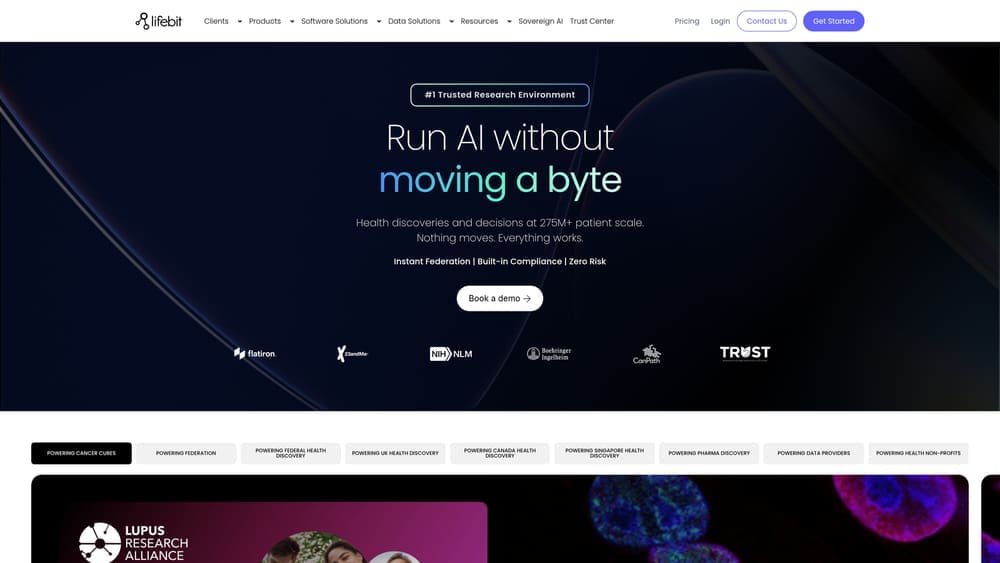
Lifebit Federated Data Platform enables secure genomic collaboration without moving sensitive data across institutional boundaries.
Where This Tool Shines
The platform’s federated architecture solves the fundamental tension in genomic collaboration: you need to analyze data together, but regulations prevent you from centralizing it. Instead of moving data to the analysis, Lifebit brings the analysis to the data.
Trusted by NIH, Genomics England, and Singapore’s Ministry of Health to manage over 275 million records, the platform handles national-scale precision medicine programs where data movement isn’t just impractical—it’s legally impossible.
Key Features
Federated Analysis: Query and analyze data across institutions without transferring it, maintaining compliance while enabling collaboration.
Trusted Data Factory: AI-powered harmonization that standardizes heterogeneous datasets in 48 hours instead of the typical 12-month manual process.
Built-In Compliance: FedRAMP, HIPAA, GDPR, and ISO 27001 certifications included from day one, eliminating months of security review.
Your Cloud Deployment: Deploy within your own cloud infrastructure with full control—no vendor lock-in or data custody concerns.
AI-Automated Airlock: First-of-its-kind governance system that automates secure data export approvals while maintaining audit trails.
Best For
Government health agencies building national genomic programs, biopharma R&D teams coordinating multi-site clinical trials, academic consortia managing regulated patient data across institutions, and any organization where data sovereignty requirements make traditional collaboration platforms non-viable.
Pricing
Enterprise pricing with custom deployment options. Contact Lifebit directly for quotes based on data volume and infrastructure requirements.
2. DNAnexus
Best for: Cloud-based genomic data management with strong audit trails and multi-organization collaboration
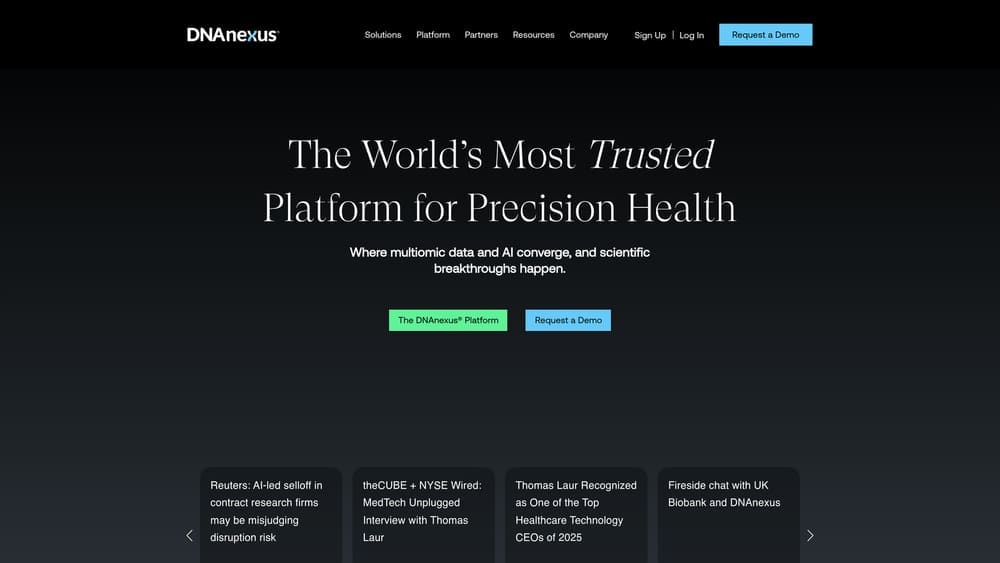
DNAnexus is a cloud platform for genomic data management, analysis, and secure collaboration across organizations.
Where This Tool Shines
DNAnexus excels at managing the complete lifecycle of genomic data in regulated environments. The platform’s strength lies in its granular permission controls and comprehensive audit logging—critical for pharma and clinical research organizations navigating FDA submissions.
The Apollo real-world evidence platform integration sets DNAnexus apart for translational research teams connecting genomic data with clinical outcomes at scale.
Key Features
Secure Project Sharing: Create collaborative workspaces with precise control over who accesses what data and when.
Workflow Flexibility: Support for both pre-built analysis pipelines and custom workflows tailored to specific research needs.
Multi-Cloud Deployment: Run on AWS or Azure depending on your organization’s cloud strategy and data residency requirements.
Comprehensive Audit Trails: Every data access and analysis action is logged for regulatory compliance and security reviews.
Apollo Integration: Connect genomic findings with real-world evidence for translational research and clinical development.
Best For
Biopharma companies managing clinical trial data, translational research teams connecting genomics with patient outcomes, and organizations requiring detailed audit trails for regulatory submissions.
Pricing
Usage-based pricing model with costs tied to compute and storage consumption. Enterprise tiers available with volume discounts and dedicated support.
3. Seven Bridges Platform
Best for: Large-scale government genomics projects and pediatric research consortia
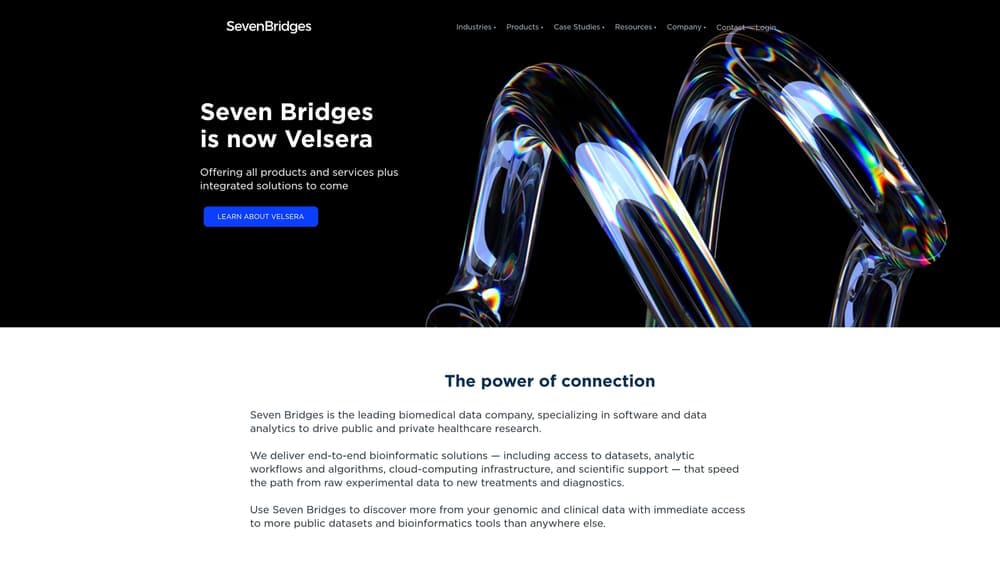
Seven Bridges Platform is a biomedical data analysis platform powering major government and consortium genomics initiatives.
Where This Tool Shines
Seven Bridges has become the infrastructure backbone for several NIH Cloud Platforms, including BioData Catalyst for heart, lung, and blood research. This track record with government-scale projects means the platform handles the complexity of multi-institutional collaboration with thousands of users.
The CAVATICA platform—Seven Bridges’ pediatric research variant—demonstrates their specialization in sensitive population research where data protection requirements are even more stringent.
Key Features
NIH Cloud Platform Integration: Powers BioData Catalyst and other NIH initiatives, providing proven scalability for national research programs.
CAVATICA Pediatric Platform: Specialized environment for collaborative pediatric genomics research with enhanced privacy controls.
Workflow Language Support: Native support for Common Workflow Language (CWL) and Nextflow ensures pipeline portability and reproducibility.
FAIR Data Principles: Built-in support for Findable, Accessible, Interoperable, and Reusable data standards.
Granular Permissions: Collaborative workspaces with fine-grained access controls for complex multi-institutional governance structures.
Best For
Government health agencies running national genomic initiatives, academic consortia coordinating large-scale studies, pediatric research networks, and institutions participating in NIH-funded collaborative projects.
Pricing
Usage-based pricing with specialized tiers for government and academic institutions. Volume discounts available for large consortia.
4. Terra by Broad Institute
Best for: Academic research teams prioritizing reproducibility and open-source workflows
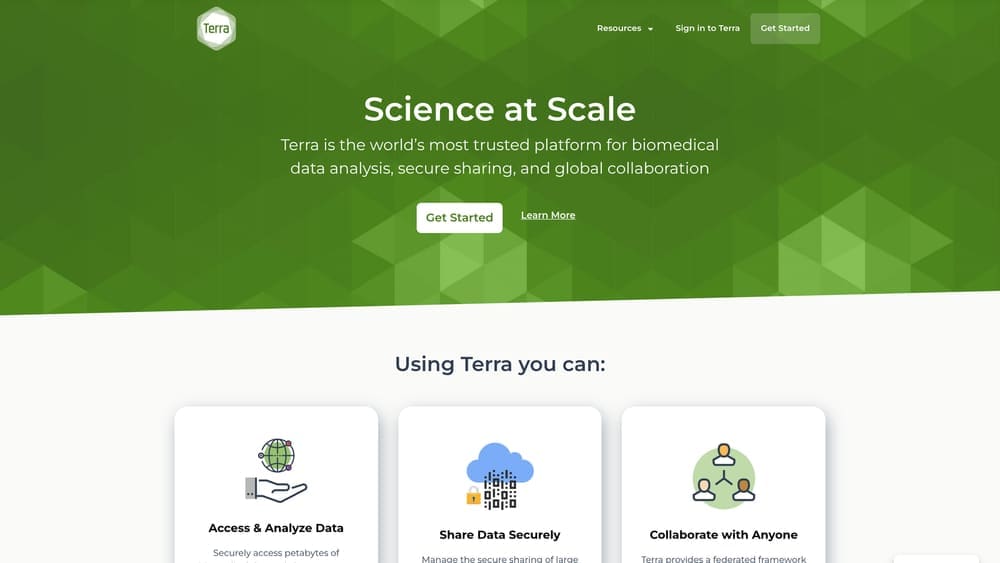
Terra is an open-source, cloud-native platform for biomedical research collaboration built on Google Cloud infrastructure.
Where This Tool Shines
Terra’s workspace cloning capability makes it exceptionally strong for reproducible research. Publish your analysis workspace alongside your paper, and other researchers can clone it entirely—data, code, compute environment, and all. This eliminates the “works on my machine” problem that plagues genomic research.
Integration with major NIH datasets through AnVIL means you can start analyzing TOPMed, TCGA, or other consortium data immediately without managing your own copies.
Key Features
Workspace Cloning: Share complete analysis environments—data, code, and configurations—for perfect reproducibility.
NIH Dataset Integration: Direct access to AnVIL, TCGA, and other major genomic datasets without data transfer or storage costs.
WDL Workflow Support: Workflow Description Language enables portable, scalable analysis pipelines.
Jupyter Notebook Collaboration: Real-time collaborative analysis using familiar notebook interfaces.
Open-Source Foundation: Community-driven development with commercial support options available when needed.
Best For
Academic research groups prioritizing cost efficiency and reproducibility, teams analyzing NIH consortium data, researchers publishing methods that others need to reproduce, and institutions comfortable with Google Cloud infrastructure.
Pricing
Pay-as-you-go model where you only pay for Google Cloud compute and storage costs. The Terra platform itself is free to use.
5. Illumina Connected Analytics
Best for: Enterprise genomics programs tightly integrated with Illumina sequencing infrastructure
Illumina Connected Analytics is an enterprise analytics platform integrating Illumina sequencing with multi-site collaboration capabilities.
Where This Tool Shines
If your genomic pipeline starts with Illumina sequencers, Connected Analytics eliminates the integration headaches. Data flows directly from instrument to analysis without manual transfers or format conversions. The DRAGEN pipelines deliver clinical-grade variant calling at speeds that make same-day genomic diagnoses feasible.
For healthcare systems running clinical genomics programs across multiple sites, the multi-site data aggregation capabilities provide a unified view while maintaining local data control.
Key Features
Native Illumina Integration: Seamless data flow from Illumina sequencers eliminates manual transfer steps and format conversion errors.
DRAGEN Pipelines: Hardware-accelerated analysis delivers clinical-grade variant calling in hours instead of days.
Multi-Site Aggregation: Combine data from distributed sequencing facilities while maintaining local governance and control.
Clinical Variant Interpretation: Enterprise-grade tools for clinical reporting and variant classification.
Compliance and Security: Built for clinical environments with comprehensive audit trails and security controls.
Best For
Healthcare systems with Illumina sequencing infrastructure, clinical genomics laboratories requiring rapid turnaround, multi-hospital networks coordinating genomic medicine programs, and organizations prioritizing clinical-grade analysis pipelines.
Pricing
Enterprise licensing model with pricing based on sequencing volume and number of sites. Contact Illumina for customized quotes.
6. BaseSpace Sequence Hub
Best for: Smaller research teams using Illumina sequencers who need simple collaboration
BaseSpace Sequence Hub is a cloud platform for sequencing data storage, analysis, and sharing optimized for Illumina workflows.
Where This Tool Shines
BaseSpace makes genomic collaboration accessible for teams that don’t need enterprise complexity. The direct upload from Illumina instruments means your sequencing run automatically appears in the cloud—no IT infrastructure required. The free tier lets smaller labs get started without upfront investment.
The app marketplace democratizes access to analysis tools. Instead of installing and maintaining bioinformatics software, you simply select the app you need and run it on your data.
Key Features
Direct Instrument Upload: Sequencing runs automatically transfer to the cloud as they complete.
Simple Project Sharing: Share datasets and analysis results with collaborators using straightforward permission controls.
App Marketplace: Access hundreds of analysis applications without installing or maintaining software.
Free Tier: Get started with no upfront costs for smaller projects and datasets.
LIMS Integration: Connect with BaseSpace Clarity LIMS for end-to-end sample and data tracking.
Best For
Small to mid-sized research labs with Illumina sequencers, teams without dedicated bioinformatics infrastructure, collaborative projects requiring simple data sharing, and groups wanting to test cloud genomics before enterprise commitments.
Pricing
Free tier available with storage and compute limits. Professional and Enterprise tiers scale with usage and add advanced features.
7. Nextflow Tower
Best for: Distributed bioinformatics teams running complex workflows across multiple compute environments
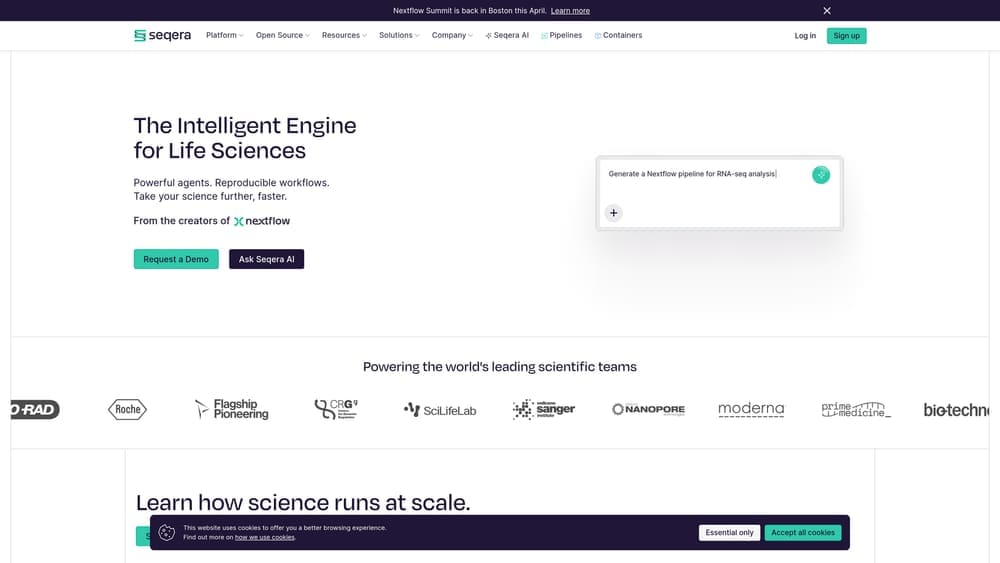
Nextflow Tower is a workflow orchestration platform enabling distributed bioinformatics pipeline collaboration.
Where This Tool Shines
Tower solves the orchestration challenge when your team runs pipelines across different cloud providers, HPC clusters, and local infrastructure. The centralized monitoring dashboard gives you visibility into every pipeline run regardless of where it’s executing—critical when coordinating analysis across institutional boundaries.
Integration with nf-core community pipelines means you inherit best-practice workflows maintained by the bioinformatics community rather than building everything from scratch.
Key Features
Centralized Pipeline Monitoring: Track all workflow executions across distributed compute environments from a single dashboard.
Team Workspaces: Shared environments where teams collaborate on pipeline development and execution.
Multi-Cloud Execution: Run the same pipeline on AWS, GCP, Azure, HPC clusters, or local infrastructure without modification.
Pipeline Sharing: Version control and share Nextflow pipelines across your organization.
nf-core Integration: Access community-maintained, best-practice bioinformatics workflows.
Best For
Bioinformatics teams managing complex workflows, organizations using multiple compute environments, groups adopting Nextflow as a standard, and teams wanting to leverage community-developed pipelines.
Pricing
Free community tier for individual use. Pro and Enterprise tiers add team collaboration, advanced monitoring, and priority support.
8. Galaxy Project
Best for: Academic institutions prioritizing accessibility and training alongside research
Galaxy Project is an open-source, web-based platform for accessible genomic analysis and workflow sharing.
Where This Tool Shines
Galaxy’s no-code interface makes genomic analysis accessible to researchers without programming expertise. This democratization of bioinformatics is particularly valuable in academic settings where wet-lab scientists need to analyze their own data without waiting for bioinformatics support.
The published workflows and shared histories create a natural collaboration model. Publish your analysis alongside your paper, and others can reproduce it exactly using the shared Galaxy history.
Key Features
No-Code Interface: Point-and-click genomic analysis accessible to researchers without programming backgrounds.
Published Workflows: Share complete analysis workflows that others can reuse and adapt for their research.
Community Tool Repository: Access thousands of bioinformatics tools integrated into the platform.
Built-In Training: Extensive training materials and tutorials integrated directly into the platform.
Flexible Deployment: Use public Galaxy servers or deploy your own instance for sensitive data.
Best For
Academic institutions training the next generation of genomic researchers, labs without dedicated bioinformatics staff, educational programs teaching genomic analysis, and projects prioritizing open science and reproducibility.
Pricing
Completely free and open-source. Public servers available at no cost. Self-hosting incurs only infrastructure costs.
9. Benchling
Best for: R&D teams integrating genomic analysis with molecular biology workflows
Benchling is an R&D cloud platform combining molecular biology tools with collaborative research notebooks.
Where This Tool Shines
Benchling bridges the gap between genomic data and wet-lab work. The electronic lab notebook captures the experimental context around your sequencing data—what constructs you designed, which samples you sequenced, and why. This integration is particularly valuable for synthetic biology and gene editing workflows where genomic analysis is one piece of a larger R&D process.
The registry system for biological samples and constructs provides the data infrastructure that genomic research platforms typically lack—tracking physical materials alongside digital data.
Key Features
Real-Time Lab Notebooks: Collaborative electronic notebooks that capture experimental context around genomic data.
Sequence Design Tools: Design and annotate sequences, primers, and constructs directly in the platform.
Biological Registry: Track samples, plasmids, cell lines, and other physical materials alongside genomic data.
API Integrations: Connect with external analysis platforms to incorporate genomic workflows.
Regulatory Audit Trails: Comprehensive logging for GLP/GMP compliance in regulated R&D environments.
Best For
Biotech R&D teams working across computational and wet-lab domains, synthetic biology groups designing genetic constructs, gene editing programs tracking constructs and outcomes, and regulated environments requiring integrated data and sample tracking.
Pricing
Free tier available for academic users. Enterprise pricing for commercial organizations based on user count and feature requirements.
Making the Right Choice
Your ideal collaboration platform depends on your specific constraints and priorities.
For government agencies and large consortia where data sovereignty is non-negotiable, Lifebit’s federated architecture and Terra’s NIH dataset integration stand out. If you’re building a national precision medicine program, you need a platform designed for that scale from day one.
Biopharma teams should prioritize DNAnexus or Illumina Connected Analytics—both deliver the audit trails and compliance features that regulatory submissions demand. Seven Bridges is the proven choice if you’re working within NIH-funded initiatives.
Academic institutions balancing cost with capability will find Terra and Galaxy most compelling. Terra provides enterprise-grade infrastructure at pay-as-you-go pricing, while Galaxy eliminates costs entirely for teams comfortable with open-source platforms.
If your infrastructure is already built on Illumina sequencers, BaseSpace Sequence Hub (for smaller teams) or Connected Analytics (for enterprise) eliminate integration complexity. For distributed teams coordinating complex workflows, Nextflow Tower provides the orchestration layer that other platforms lack.
The genomic collaboration challenge isn’t going away—data volumes continue to grow, regulations continue to tighten, and research increasingly requires coordination across institutional boundaries. The platforms that succeed are those that enable collaboration without compromise on security, compliance, or scientific rigor.
Ready to see how federated collaboration works at scale? Get started for free with Lifebit and experience how analyzing data where it lives changes what’s possible in multi-institutional genomic research.