

How to Reduce Time to Harmonize Clinical Data: A 5-Step Framework
Your research team just spent nine months harmonizing clinical data from three hospital systems. By the time the dataset was ready, two competitors published similar findings, your principal investigator moved to another institution, and half your budget evaporated on data wrangling overhead. Sound familiar?
Clinical data harmonization has become the silent killer of research timelines. While breakthrough discoveries wait in incompatible data formats, teams burn months on manual mapping, stakeholder approvals, and quality validation loops. The cost isn’t measured in spreadsheets—it’s measured in delayed treatments, missed market windows, and talented researchers doing data janitor work instead of actual science.
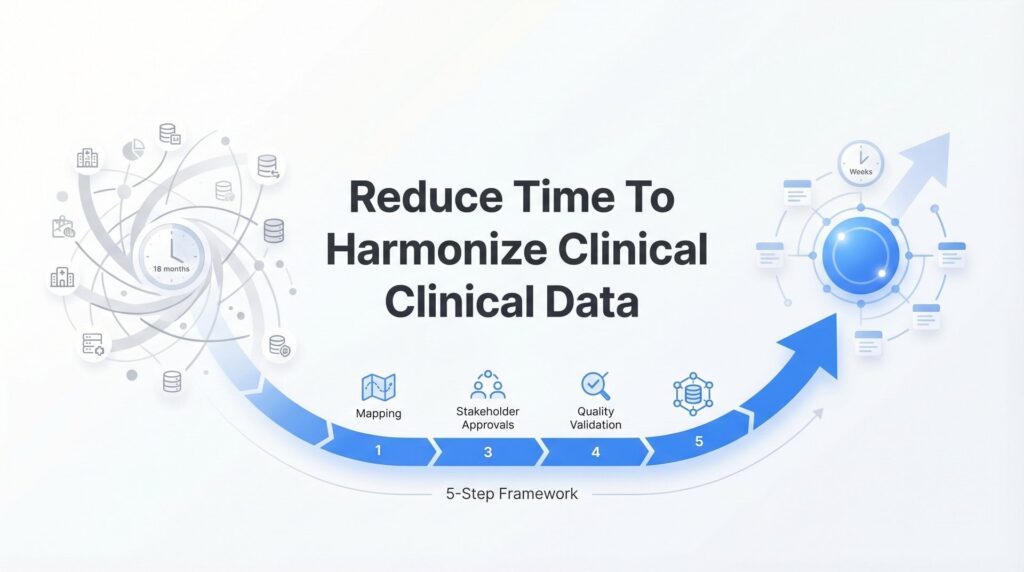
Here’s the reality: organizations managing hundreds of millions of patient records have compressed harmonization timelines from 12-18 months down to weeks. Not by working harder. By eliminating the structural inefficiencies that make the process slow in the first place.
This guide walks you through the exact five-step framework these organizations use. Whether you’re managing multi-site clinical trials, integrating real-world evidence from disparate EHR systems, or building a national precision medicine program, these steps apply. No theoretical fluff. Just the actionable process that works at scale while maintaining compliance.
Step 1: Audit Your Current Data Landscape and Identify Bottlenecks
You can’t fix what you can’t see. Before touching a single data pipeline, map your entire landscape with brutal honesty.
Start by documenting every data source. EHR systems, laboratory information systems, imaging repositories, genomics databases, claims data—write down the format, update frequency, and who owns it. Most organizations discover they’re dealing with 3-5 times more data sources than leadership realizes.
Next, identify your three biggest time sinks. In nearly every harmonization project, the same culprits appear: manual mapping between coding systems, stakeholder approval chains, and quality validation loops. Track how long each step actually takes, not how long it should take. The gap between perception and reality is usually shocking.
Calculate your current cost-per-harmonized-record. Take your total harmonization budget, divide by the number of patient records successfully integrated, and prepare for an uncomfortable conversation. This baseline metric becomes your north star for measuring improvement.
Flag compliance requirements early. HIPAA, GDPR, FedRAMP, or jurisdiction-specific regulations aren’t obstacles to route around—they’re architectural constraints that shape every downstream decision. Discovering compliance requirements after you’ve designed your pipeline means starting over. Understanding clinical data governance principles from the outset prevents costly redesigns later.
The audit reveals where time actually disappears. One national health program discovered that 40% of their timeline vanished in email chains seeking data dictionary clarifications. Another found that three different teams were independently mapping the same source systems because nobody documented the first attempt.
Document everything in a single source of truth. Spreadsheets work. Specialized tools work better. What doesn’t work is tribal knowledge living in someone’s head, waiting to walk out the door during the next reorganization.
Step 2: Adopt a Standard Data Model Before You Touch Any Data
Here’s the mistake that costs organizations months: diving straight into mapping without choosing a target destination.
Think of clinical data harmonization like translating documents into different languages. You could translate English to French, English to Spanish, English to German, French to Spanish, French to German, Spanish to German—six translation efforts for three languages. Or you could pick one common language and translate everything once. That’s what a standard data model does.
OMOP CDM has become the de facto standard for clinical data harmonization across major health systems and biopharma. The model provides a consistent structure for organizing clinical data regardless of source format. Adoption has grown significantly because it eliminates the need for custom mapping between every possible source-target combination. Choosing the right clinical data models is foundational to your entire harmonization strategy.
Standardization upfront eliminates 60-70% of downstream mapping work. When every dataset speaks the same language, integration becomes straightforward. New data sources slot into existing structures instead of requiring custom pipelines.
Building your target schema requires balancing comprehensiveness with practical implementation timelines. OMOP covers the full spectrum of clinical data—demographics, diagnoses, procedures, medications, lab results, genomics. You don’t need to implement everything on day one. Start with the data types that matter most for your immediate research questions.
The OHDSI community provides extensive implementation guidance, vocabulary mappings, and tools. You’re not building from scratch—you’re adopting a framework that hundreds of organizations have already validated.
When do alternatives make sense? If you’re working exclusively with genomics data, standards like GA4GH might fit better. If you’re in a specific therapeutic area with specialized data types, domain-specific models exist. But for general clinical data harmonization, OMOP has the widest adoption and tooling support.
Common mistake: teams skip standardization to “save time” and end up building custom mappings for every new data source. What looked like a shortcut becomes technical debt that compounds with every integration. Six months in, they’re maintaining dozens of brittle pipelines instead of one robust framework.
Commit to your standard model early. Document it. Get stakeholder buy-in. Make it non-negotiable. This decision shapes everything that follows.
Step 3: Deploy AI-Powered Mapping Instead of Manual ETL
Traditional ETL pipelines fail at scale because of the exponential complexity problem. Map five data sources manually and you’re managing five pipelines. Map fifty sources and you’re managing a nightmare of interdependencies, edge cases, and brittle transformation rules.
Manual mapping means a team of data engineers writing custom code for every source system. They map ICD-9 codes to ICD-10, translate local laboratory codes to LOINC, reconcile medication names across formularies, and handle thousands of special cases. The process takes months. When source systems update their schemas, everything breaks.
Machine learning models handle this differently. Instead of writing explicit rules for every transformation, AI learns semantic relationships between concepts. The model recognizes that “myocardial infarction,” “heart attack,” and “MI” all represent the same clinical concept, even when they appear in different coding systems. Modern AI for data harmonization dramatically accelerates this process.
Here’s how AI-powered mapping works in practice. You provide examples of correct mappings—source data paired with the desired target format. The model learns patterns in how concepts relate, how codes translate, and how entities resolve across systems. Then it applies those patterns to new data automatically.
Code translation becomes automated. The system maps ICD-9 to ICD-10, SNOMED to Read codes, local laboratory values to standardized units. Entity resolution happens without manual review—the model identifies that “John Smith, DOB 1975-03-15” and “Smith, J., born 03/15/1975” represent the same patient.
Set up automated validation rules that catch errors without creating human review bottlenecks. The system flags low-confidence mappings, statistical outliers, and logical inconsistencies. High-confidence transformations flow through automatically. Reviewers focus only on edge cases that genuinely need human judgment.
Success indicator: mapping accuracy above 95% with human review only for edge cases. When you’re manually reviewing less than 5% of transformations, you’ve achieved the right balance between automation and quality control.
The time savings compound. First data source takes weeks to map as you train the model. Second source takes days because the model learned from the first. By the fifth source, new integrations happen in hours because the model has seen most patterns before.
Tools like Lifebit’s Trusted Data Factory demonstrate what’s achievable with modern AI-powered harmonization—48-hour turnaround for new data sources instead of 12-month projects. The technology exists. The question is whether you’re still doing manually what machines handle better.
Step 4: Implement Federated Harmonization to Eliminate Data Movement Delays
The hidden time cost of data harmonization isn’t the technical work—it’s the waiting. Waiting for legal to approve data transfer agreements. Waiting for security teams to review cloud architectures. Waiting for physical data movement between jurisdictions. Months evaporate in approval chains.
Traditional harmonization assumes you move data to a central location, transform it, then analyze it. That assumption creates bottlenecks. Each data transfer triggers legal reviews, privacy impact assessments, and security audits. Moving sensitive health data across borders requires navigating different regulatory frameworks in each jurisdiction.
Federated approaches flip the model. Instead of moving data to where the compute lives, you bring compute to where the data lives. Data stays in its original location—the hospital system, the national biobank, the research institution. Harmonization happens in place. Analysis runs where data already sits. This approach addresses many challenges in health data standardization that plague traditional methods.
This eliminates the entire approval chain for data movement. No transfer means no transfer agreement. No cross-border movement means no multi-jurisdictional compliance review. You’re analyzing data under the governance framework that already exists where it lives.
Maintaining compliance across jurisdictions becomes straightforward. Each data source operates under its local regulations. HIPAA-governed data stays in HIPAA-compliant infrastructure. GDPR-protected data remains in EU-approved environments. You’re not creating new compliance obligations—you’re working within existing boundaries.
The shift from “move data to compute” to “bring compute to data” has become an industry trend for sensitive health information. Organizations managing data across multiple countries find federated approaches reduce legal overhead by 70-80% compared to centralized models.
When does federated make sense versus centralized harmonization? If you’re dealing with highly regulated data, multiple jurisdictions, or politically sensitive datasets, federated wins. If you’re working with already-centralized data in a single governance domain, centralized harmonization might be faster. For deeper analysis, explore centralized vs decentralized data governance approaches.
Federated platforms like Lifebit’s Trusted Research Environment enable analysis across distributed datasets without movement. Researchers query harmonized data across sites. Results aggregate centrally. Raw data never leaves its source. Compliance teams sleep better. Timelines compress because approval chains disappear.
The technical implementation requires coordination. Each site needs compatible compute infrastructure. Harmonization pipelines must run consistently across locations. Query engines need to work with federated architectures. But these are one-time setup costs, not recurring delays for every new analysis.
Step 5: Automate Governance and Quality Checks Into the Pipeline
Governance kills speed when it sits outside the pipeline as a manual gate. Every output waits for human review. Every dataset needs manual approval before release. Quality checks happen after the work is done, requiring rework when issues surface.
The solution: build governance into the pipeline, not on top of it. Automated systems validate outputs continuously instead of in batch reviews after months of work.
Automated airlock systems validate outputs without manual gatekeeping. Think of an airlock as a smart filter between your harmonization pipeline and downstream users. It checks every output against predefined rules: Does this dataset meet minimum quality thresholds? Are privacy protections in place? Do aggregations prevent re-identification? The system approves or rejects automatically based on objective criteria.
Lifebit’s AI-Automated Airlock represents the first-of-its-kind governance system for secure data exports. Instead of waiting days or weeks for committee reviews, outputs validate in minutes. Compliant data flows through. Non-compliant data triggers automated remediation or human review flags.
Set up continuous quality monitoring throughout the harmonization process, not just at the end. Track completeness scores—what percentage of expected fields contain valid data. Monitor consistency checks—do diagnosis codes align with procedure codes and medication records. Detect drift—are new batches statistically similar to historical patterns. Robust clinical data management systems make this continuous monitoring possible.
When quality issues surface during harmonization rather than after, you fix them immediately instead of discovering problems months later. Continuous monitoring turns quality control from a bottleneck into a real-time feedback loop.
Create audit trails that satisfy regulators without creating documentation bottlenecks. Every transformation, every validation, every approval decision gets logged automatically. When auditors ask what happened to patient record 12345, you pull up the complete lineage in seconds instead of reconstructing events from scattered documentation.
Automated governance scales in ways manual processes can’t. Reviewing 100 records manually is tedious. Reviewing 100 million records manually is impossible. Automated systems handle both with the same effort—zero. Organizations integrating real world data in clinical trials find automated governance essential for managing diverse data sources.
Success indicator: new data sources harmonized within 48 hours of integration. When you can take a new hospital system’s data from raw format to analysis-ready in two days, your governance and quality processes are truly automated. If you’re still measuring harmonization timelines in months, manual gates are strangling your pipeline.
Putting It All Together: Your Harmonization Acceleration Checklist
Here’s your quick-reference checklist for reducing clinical data harmonization time:
Step 1 – Audit Phase: Map all data sources with formats and ownership. Identify your three biggest time sinks. Calculate cost-per-harmonized-record baseline. Document compliance requirements upfront.
Step 2 – Standardization: Choose your target data model (OMOP for most clinical use cases). Get stakeholder buy-in before touching data. Start with essential data types, expand later.
Step 3 – Automation: Deploy AI-powered mapping tools instead of manual ETL. Set validation rules for automated quality checks. Target 95%+ mapping accuracy with minimal human review.
Step 4 – Federation: Evaluate federated harmonization for regulated or multi-jurisdictional data. Bring compute to data instead of moving data to compute. Eliminate transfer approval bottlenecks.
Step 5 – Governance: Build automated airlock systems into your pipeline. Implement continuous quality monitoring. Create automatic audit trails for compliance.
Timeline expectations: Greenfield implementations can achieve 48-hour harmonization for new sources within 3-6 months of initial setup. Legacy system migrations take longer upfront but accelerate dramatically once the framework is in place. Organizations managing 50+ data sources report 10x speed improvements compared to manual approaches.
Where to start: If you’re managing legacy systems, begin with the audit and standardization steps. If you’re building new infrastructure, start with federated architecture and automated governance from day one. Either way, the framework is the same—eliminate structural inefficiencies instead of optimizing broken processes.
The Path Forward
Reducing clinical data harmonization time isn’t about working harder—it’s about eliminating the structural inefficiencies that make the process slow in the first place.
Start with your audit. Understand where time actually disappears, not where you think it goes. Commit to a standard model early and make it non-negotiable. Automate the mapping with AI instead of burning researcher hours on manual transformations. Consider federated approaches for sensitive data to eliminate approval bottlenecks. Build governance into the pipeline rather than bolting it on at the end.
Organizations following this framework consistently compress 12-month harmonization projects into weeks. The technology exists. The frameworks are proven. Major health systems, national precision medicine programs, and leading biopharma companies are already operating at this speed.
The question isn’t whether fast harmonization is possible—it’s how long you’re willing to wait before implementing it. Every month spent on manual data wrangling is a month your competitors spend on actual discoveries. Every delayed dataset is a delayed treatment that could have helped patients.
The tools are available. Platforms like Lifebit’s Trusted Data Factory demonstrate 48-hour harmonization timelines in production environments managing hundreds of millions of records. FedRAMP, HIPAA, and GDPR compliance built in from day one. Deployment in your own cloud infrastructure so you maintain control.
Your research timeline doesn’t have to be held hostage by data harmonization. The bottleneck is solvable. The framework is proven. The only variable is when you decide to implement it.
Ready to see what 48-hour harmonization looks like in your environment? Get Started for Free and discover how modern data infrastructure eliminates the delays that slow down discovery.