

Building a Data Governance Framework from Scratch

Data Governance Framework: Stop Losing $12.9M to Bad Data Quality
A data governance framework is a structured system of policies, processes, roles, and technologies that defines how an organization manages its data — ensuring quality, security, accessibility, and compliance across the full data lifecycle.
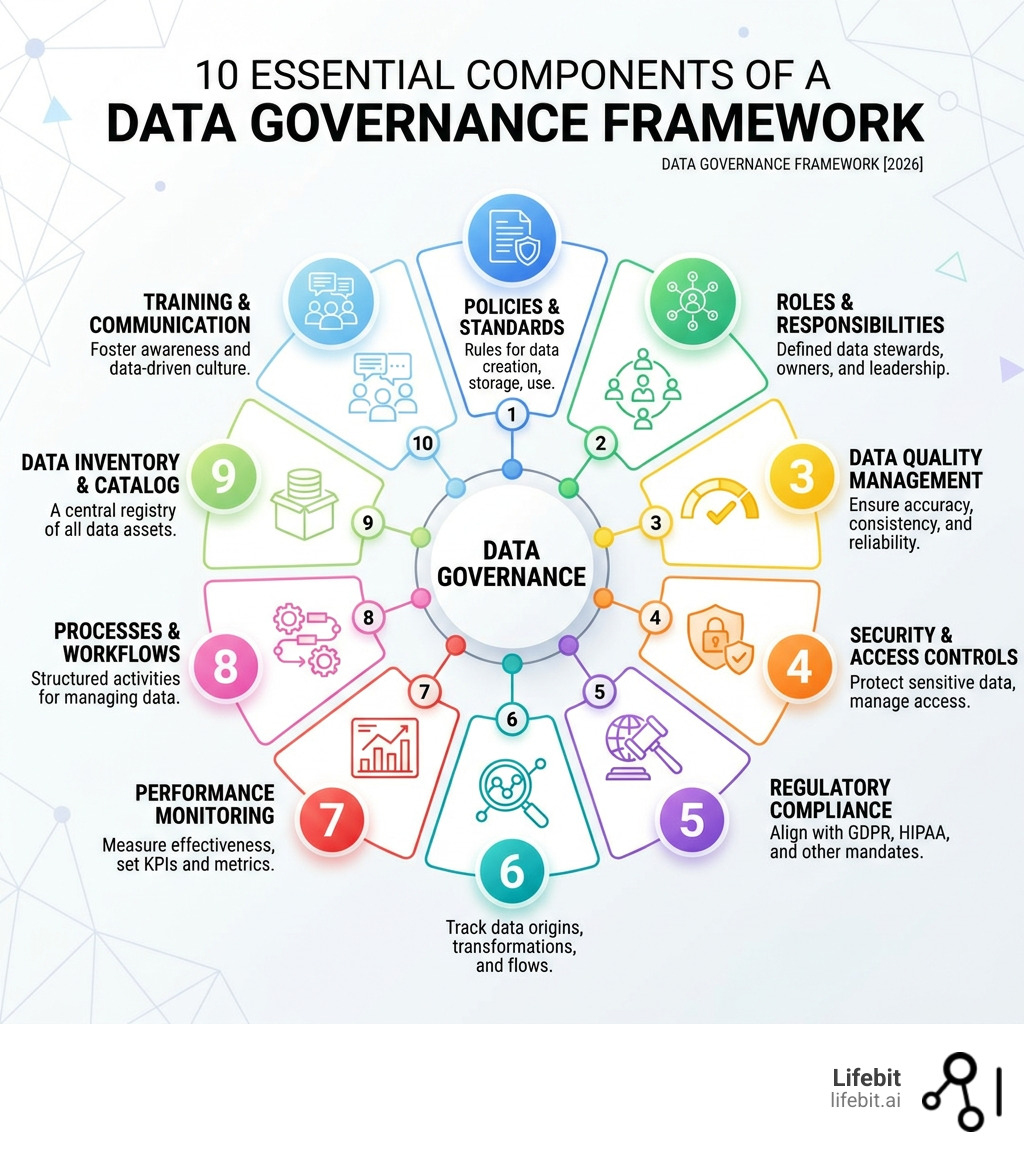
Here is what a data governance framework covers at a glance:
| Component | What It Does |
|---|---|
| Policies & Standards | Define rules for how data is created, stored, and used |
| Roles & Responsibilities | Assign ownership to data stewards, owners, and a CDO |
| Data Quality Management | Ensure data is accurate, consistent, and reliable |
| Security & Access Controls | Control who can see and use sensitive data |
| Regulatory Compliance | Align with GDPR, HIPAA, and other mandates |
| Metadata & Lineage | Track where data comes from and how it moves |
| Performance Monitoring | Measure outcomes with KPIs and quality metrics |
Without a framework, data becomes a liability instead of an asset. Teams work from conflicting records. Compliance audits fail. AI models train on bad data. Decisions slow down. To understand the gravity, we must look at the Data Lifecycle. A robust framework doesn’t just look at data in a database; it governs data from the moment of Creation (ingestion), through Storage (warehousing), Usage (analytics and AI), Archival (long-term retention), and finally Deletion (secure purging). At each stage, the framework provides the “rules of the road” to prevent data decay.
The scale of this problem is real. According to Gartner, poor data quality costs organizations an average of $12.9 million per year. And 80% of organizations pursuing digital expansion face obstacles directly tied to outdated data governance practices. This isn’t just about “dirty data”; it’s about the Data Value Chain. When data is siloed or untrusted, the entire chain breaks, leading to wasted engineering hours spent cleaning data rather than analyzing it.
For pharma companies, public health agencies, and regulatory bodies handling sensitive genomics, EHR, and claims data, the stakes are even higher. A missing audit trail or a misconfigured access control is not just an operational headache — it is a regulatory breach. In the biomedical field, data governance is the difference between a breakthrough discovery and a retracted study.
The good news: a well-built framework turns that chaos into a competitive advantage. As one widely cited principle in the field puts it, done correctly, data governance can transform the way an organization manages — and capitalizes on — its data.
I’m Dr. Maria Chatzou Dunford, CEO and Co-founder of Lifebit, where I have spent over 15 years building secure, federated platforms for biomedical data analysis — work that puts a robust data governance framework at the center of every compliant, AI-ready research environment. In this guide, I will walk you through exactly how to build one from scratch, step by step.
Essential data governance framework terms:
Cut Incident Response by 37% with a Data Governance Framework

In today’s high-speed digital economy, data is no longer just a byproduct of business; it is the fuel. But without a steering wheel and a set of brakes, that fuel can lead to a crash. We see organizations struggling to balance the need for speed with the necessity of safety. This is where a data governance framework transitions from a “nice-to-have” to an absolute survival requirement.
The primary drivers for implementing a framework today are risk reduction and operational efficiency. When everyone follows the same rules for creating and updating records, you eliminate the “missed handoffs” between teams—like marketing sending emails to a customer who just opted out via a support call. Beyond just avoiding annoyance, a structured approach significantly impacts the bottom line. For instance, DAMA-DMBOK’s modular structure cuts incident response by 37% according to IDC data. This means your team spends less time putting out fires and more time innovating.
The Shift to Proactive Governance
Historically, governance was reactive—something companies did only after a data breach or a failed audit. Today, the most successful organizations use proactive governance. This involves “Governance by Design,” where data quality checks and security protocols are embedded into the software development lifecycle (SDLC). Instead of fixing data after it enters the warehouse, you prevent bad data from ever being created.
Furthermore, a framework enables data democratization. It provides the guardrails that allow non-technical users to access and use data safely. Instead of locking data away in a dark room, you’re creating a self-service library where the rules of engagement are clear. To dive deeper into the legal side of this, check out more info about data privacy regulations.
Ensuring Regulatory Compliance and Privacy
We are living in an era of “privacy first.” Regulations like GDPR in Europe and HIPAA in the US have fundamentally changed the stakes of data management. Organizations must now know exactly how they collect, store, and use every byte of personal information. A data governance framework ensures that a business is adhering to these larger privacy and security regulations by design, not by accident.
Beyond GDPR and HIPAA, we are seeing the rise of Data Sovereignty laws. Countries like Saudi Arabia, India, and China are implementing strict rules that require data about their citizens to stay within national borders. A global data governance framework must account for these geographic nuances, often requiring a Federated Governance model where data is governed locally but can be analyzed globally.
One powerful example of ensuring compliance at scale is the media publisher Quartz case study on ensuring compliance at scale. By consolidating their customer data and prioritizing first-party data, they were able to get ahead of third-party cookie deprecation while maintaining strict adherence to global privacy standards. For us at Lifebit, this often involves managing data sovereignty—ensuring that sensitive biomedical data remains within its host jurisdiction while still being accessible for global research.
Supporting AI and Emerging Technologies
If data is the fuel, AI is the engine. But an engine is only as good as the fuel you put in it. Gartner identifies AI trust, risk, and security management (AI TRiSM) as the #1 top strategy trend for 2024. They predict that by 2026, organizations that operationalize AI transparency and security will achieve a 50% increase in adoption and user acceptance.
A robust data governance framework supports emerging technologies by:
- Providing high-quality, labeled datasets: AI models are notoriously sensitive to “garbage in, garbage out.” Governance ensures training data is representative and unbiased.
- Ensuring model transparency and interpretability: In regulated industries like healthcare, you must be able to explain why an AI made a specific recommendation. Governance tracks the lineage of the data used to train that model.
- Managing complex metadata: Big data and cloud environments generate massive amounts of metadata. Without governance, this metadata becomes a “data swamp” rather than a “data lake.”
- Establishing “AI Security”: This includes protecting against prompt injection, data poisoning, and unauthorized model access, ensuring that the AI itself doesn’t become a vector for data leakage.
5 Pillars of a Data Governance Framework: Build a Trusted Source
Building a framework isn’t just about buying a piece of software. It’s about balancing five core pillars: People, Processes, Technology, Data Quality, and Security. When these work in harmony, you create a “single source of truth” that the entire organization can trust.
According to the DGI’s 10 essential components for enterprise frameworks, a successful model must address “who decides how to decide.” This involves setting standards for everything from data naming conventions to how long a record should be retained before deletion.
Essential Roles and Responsibilities
Who actually “does” data governance? It’s a team effort. We typically see the following roles as essential:
- Chief Data Officer (CDO): The executive leader who aligns data strategy with business goals. The CDO is responsible for the “Data ROI” and ensuring the board understands data as a strategic asset.
- Data Stewards: The “subject matter experts” who understand the data in a specific domain (like finance or clinical trials). They are the ones who define what “valid” data looks like and resolve quality issues at the source.
- Data Owners: Senior managers accountable for the data within their business unit. They grant access permissions and are ultimately responsible for the data’s security and compliance.
- Data Governance Office (DGO): A central body (or individual in smaller firms) that maintains documentation, tracks metrics, and communicates policies across the organization.
- Data Custodians: Often IT professionals who handle the technical aspects of data storage, transport, and security implementation.
The Evolution of Governance Models
Organizations must choose a structural model that fits their culture:
- Centralized: A single team sets all rules. Best for highly regulated industries with low tolerance for variation.
- Decentralized: Each department sets its own rules. High speed, but leads to silos and conflicting data.
- Federated: A hybrid approach where a central body sets “global” standards (e.g., security, privacy) while local units manage “domain-specific” standards (e.g., marketing vs. R&D data). This is the gold standard for modern, agile enterprises.
You can find more info about decentralized data governance to see how this works in practice.
Comparing Popular Data Governance Framework Models
Choosing a starting point can be daunting. Most organizations don’t build from a totally blank slate; they adapt existing industry standards.
| Framework | Best For | Key Strength |
|---|---|---|
| DAMA-DMBOK | General Enterprise | Comprehensive; covers 11 functional areas of data management. |
| COBIT 2019 | Compliance/IT Audit | Excellent for SOX/GDPR; 80% adoption among Forbes Global 2000. |
| DGI Framework | Large Enterprises | Focuses heavily on roles, decision rights, and accountability. |
| DCAM | Financial Services | Specialized for maturity scoring; used by 65% of NA fintechs. |
| NIST Privacy Framework | Security-Focused | Aligns data governance with cybersecurity and risk management. |
For those focused on the intersection of IT and business risk, ISACA’s COBIT 2019 for enterprise governance provides a world-class blueprint for aligning technology goals with corporate priorities.
5 Steps to Launch a Data Governance Framework and Cut Risk
We believe in a “start small, scale fast” approach. Don’t try to govern every piece of data on day one. Instead, follow this proven 5-step roadmap.
Step 1: Assess Maturity
You can’t know where you’re going if you don’t know where you are. Use maturity models to benchmark your current state. Are you “Unaware” (data chaos), “Reactive” (fixing problems as they arise), or moving toward “Cohesion” (data-driven culture)? Most organizations find they are at Level 1 or 2, which is a perfectly fine place to start.
Step 2: Define Scope and the “6 Dimensions of Quality”
Pick one high-impact data domain—such as “Customer Records” or “Clinical Trial Outcomes”—and focus your initial efforts there. Within this scope, define what quality means using the six standard dimensions:
- Accuracy: Does the data reflect reality?
- Completeness: Are there missing values?
- Consistency: Is the data the same across all systems?
- Timeliness: Is the data up to date?
- Validity: Does it follow the required format (e.g., YYYY-MM-DD)?
- Uniqueness: Are there duplicate records?
Step 3: Secure Sponsorship and Build the Council
Without executive buy-in, your framework will likely fail. You need a champion who can provide the budget and authority to overcome cultural resistance. Form a Data Governance Council consisting of stakeholders from IT, Legal, and Business Units to meet monthly and resolve policy conflicts.
Step 4: Deploy Tools and Metadata Management
Scaffolding matters. This includes Data Catalogs for discovery (the “Google for your data”), automated quality monitoring, and metadata management platforms. Modern tools use AI to automatically tag sensitive data (PII) and map data lineage, showing exactly how data flows from a source system to a final report. For a look at how modern tech simplifies this, see our AI enabled data governance ultimate guide.
Step 5: Monitor ROI and Iterate
Track KPIs like data accuracy (aim for >95%), time saved in data discovery, and the reduction in compliance incidents. Governance is not a project with an end date; it is a continuous capability that must evolve as the business grows.
Assessing Maturity and Measuring ROI
Measuring success is critical for long-term investment. Organizations often use the EDM Council’s DCAM for maturity scoring to quantify their progress. In the fintech sector, this has led to a reported 22% reduction in operational risk. ROI isn’t just about saving money; it’s about the “value of the found”—how much more revenue can you generate when your data scientists spend 20% of their time on preparation instead of 80%? If a data scientist earning $150k spends 60% of their time cleaning data, that is $90k of wasted potential per year, per person.
Best Practices for Customizing Your Framework
No two organizations are identical. A biotech startup has different needs than a global bank. When customizing your data governance framework, keep these best practices in mind:
- Business Alignment: Ensure every rule has a “why” tied to a business outcome. If a rule doesn’t help reduce risk or increase revenue, discard it.
- Scalability: Choose tools that can handle the growth from gigabytes to petabytes. Cloud-native governance tools are essential for modern scale.
- Data Literacy: Treat training as an ongoing investment. Everyone in the company should be a “data person.” This involves teaching employees how to interpret data and why quality matters.
- Automation: Use AI to handle the tedious stuff, like PII (Personally Identifiable Information) scanning and metadata tagging. Manual governance is impossible at the scale of modern big data.
Frameworks like CMMI’s Data Management Maturity Model provide excellent guidance on how to evolve from fragmented practices to strategic, enterprise-wide excellence.
Stop Data Silos: Fix the 3 Biggest Data Governance Framework Failures
Let’s be honest: implementing a data governance framework is hard work. The biggest hurdles aren’t usually technical; they’re cultural. Understanding these pitfalls early can save your program from becoming “shelfware.”
- Data Silos and the “Hoarding” Mentality: Departments often guard their data like a dragon guards gold, fearing that sharing data will lead to loss of control or increased scrutiny. Breaking these silos requires a shift in mindset—viewing data as a shared corporate asset rather than departmental property. This shift must be driven from the CEO down.
- Cultural Resistance and “Governance Fatigue”: People hate new rules, especially if they perceive them as bureaucratic hurdles. To overcome this, focus on “enablement” rather than “restriction.” Instead of saying “You can’t use this data,” say “Here is the certified, high-quality version of this data that will make your analysis 10x faster.” Use Change Management strategies, such as identifying “Data Champions” in each department to lead by example.
- Technical Debt and Legacy Complexity: Legacy systems that don’t “talk” to each other can stall progress. Many organizations make the mistake of trying to move all data into a single warehouse before governing it. This is a recipe for failure. This is where a federated approach helps, allowing you to govern data where it lives (in situ) without forcing a massive, multi-year migration. By governing the access and the metadata, you can achieve consistency across a fragmented landscape.
The Cost of Inaction
When governance fails, the costs are often hidden but massive. In healthcare, it might mean a patient receives the wrong treatment because their EHR records were duplicated and inconsistent. In finance, it might mean a bank miscalculates its capital reserves, leading to massive regulatory fines. In the AI era, the cost of inaction is Model Drift and Algorithmic Bias, where an AI system begins making discriminatory or incorrect decisions because the underlying data was never governed for fairness or representative quality.
For a deeper dive into managing these complex environments, read our federated governance complete guide.
Data Governance Framework FAQ: Rules, Roles, and Automation
What is the difference between data governance and data management?
Think of it this way: Data Governance is the “constitution” (the rules, policies, and roles), while Data Management is the “administration” (the actual day-to-day execution of those rules, like database tuning or ETL pipelines). You need both to succeed.
How do I choose the right framework for my industry?
Look at your primary pain point. If it’s regulatory risk, start with COBIT. If it’s improving data science workflows, DAMA-DMBOK is a better fit. If you’re in a highly specialized field like genomics, you’ll need a framework that supports federated access and multi-omic harmonization.
Can a data governance framework be automated?
The execution can be automated, but the decisions cannot. You can use AI to automatically tag sensitive data, monitor for quality drops, and enforce access rules. However, humans must still define what “high quality” looks like and who should have access to what.
Cut Compliance Risk by 30% with Lifebit’s Federated Data Platform
Building a data governance framework from scratch is a journey, but you don’t have to walk it alone. At Lifebit, we specialize in the “how” of governance. Our next-generation federated AI platform allows organizations to govern sensitive biomedical data without moving it, reducing silos by 30% and ensuring 100% compliance with local data sovereignty laws.
By combining a Trusted Research Environment (TRE) with automated policy enforcement, we help you move from “data chaos” to “data confidence” in record time.
Secure your research with Lifebit’s federated biomedical data platform