

9 Best Secure Health Data Sharing Platforms in 2026

Health data sharing is broken. You need to collaborate across institutions, run multi-site studies, or enable precision medicine programs—but every step triggers compliance nightmares. HIPAA. GDPR. Data sovereignty laws. The old approach? Move data to a central location, spend months on legal agreements, and pray nothing leaks.
The new approach? Platforms that let you analyze data where it lives, share insights without exposing records, and stay compliant by design.
This guide covers the top secure health data sharing platforms in 2026—evaluated on security architecture, compliance certifications, ease of deployment, and real-world adoption by government health agencies and biopharma leaders.
1. Lifebit
Best for: National precision medicine programs requiring federated analysis at massive scale without data movement.
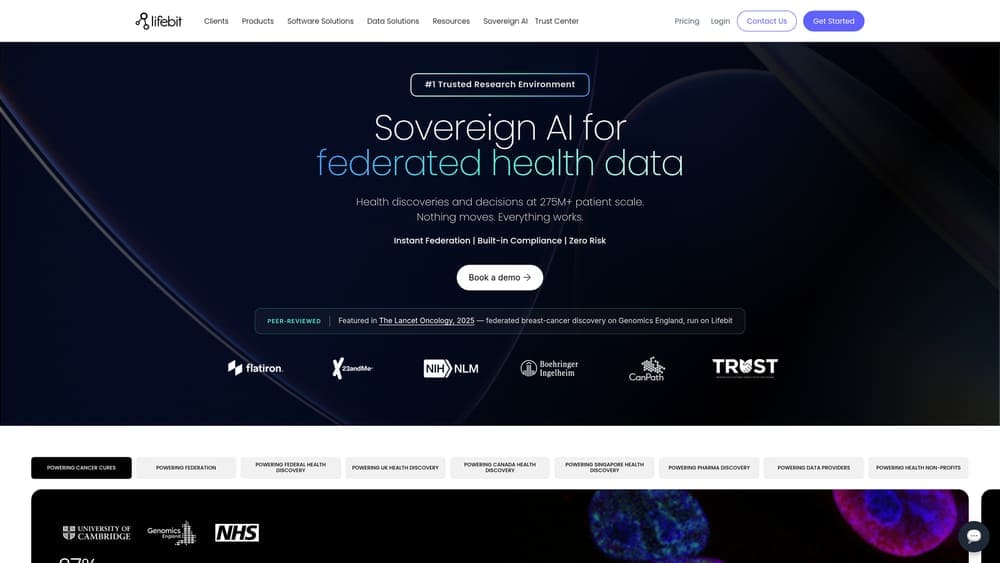
Lifebit is a federated data platform enabling secure analysis of sensitive health data without movement, trusted by national health programs worldwide.
Where This Platform Shines
Lifebit solves the core problem that kills most multi-institutional health data projects: you cannot move the data. Period. Regulatory frameworks, data sovereignty laws, and institutional policies make centralization impossible for most national genomic programs and cross-border research initiatives.
The platform brings computation to the data instead of data to computation. Researchers run analyses across distributed datasets—genomic, clinical, imaging—without ever extracting or copying records. NIH, Genomics England, and Singapore’s Ministry of Health use this approach to manage over 275 million records across federated networks.
Key Features
Federated Analysis Architecture: Query and analyze data across institutions without movement—data stays in place, insights come to you.
AI-Powered Data Harmonization: Transform heterogeneous datasets into analysis-ready formats in 48 hours instead of 12 months using automated pipelines.
Trusted Research Environments: Secure, compliant cloud workspaces with built-in governance—FedRAMP, HIPAA, GDPR, ISO 27001 certified from day one.
AI-Automated Airlock: First-of-its-kind governance system for secure data exports—automated review of outputs before they leave the environment.
Multi-Cloud Deployment: Deploy in your cloud environment—AWS, Azure, Google Cloud, or on-premises—with no vendor lock-in.
Best For
Government health agencies building national precision medicine programs across distributed sites. Biopharma R&D teams analyzing real-world data across multiple countries. Academic consortia managing sensitive genomic data under strict regulatory requirements. Organizations that cannot move data but must enable collaboration at scale.
Pricing
Custom enterprise pricing based on deployment scope, data volume, and number of participating institutions. Implementation includes data harmonization, compliance setup, and training.
2. TriNetX
Best for: Real-world evidence generation and clinical trial feasibility across healthcare organizations.
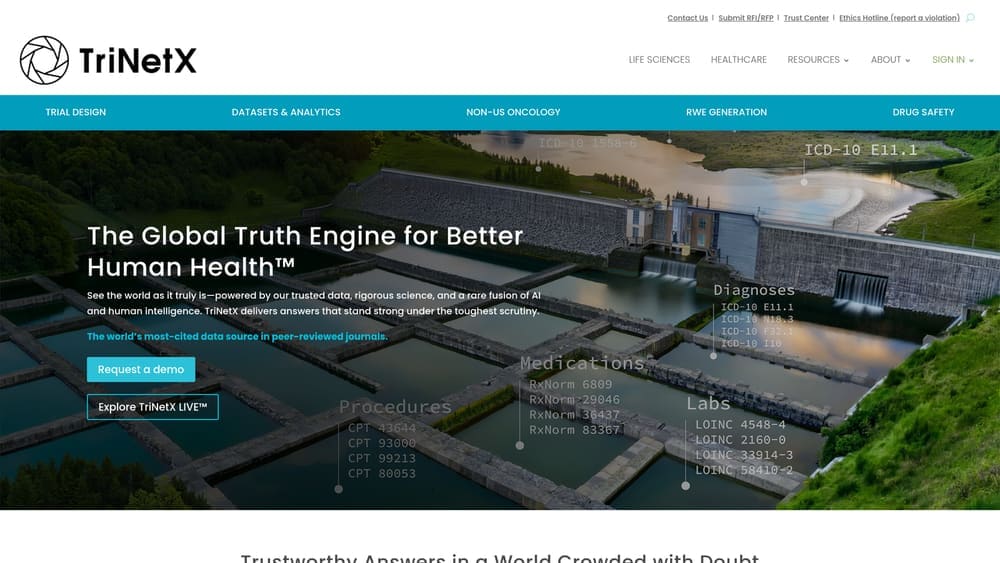
TriNetX is a global health research network connecting healthcare organizations for real-world evidence and clinical trial optimization.
Where This Platform Shines
TriNetX excels at the clinical trial recruitment problem. You need 500 patients with a specific genetic variant who failed two prior therapies and live within 50 miles of trial sites. Traditional approaches take months of manual chart review across disconnected systems.
TriNetX gives you the answer in minutes. The platform federates EHR data from over 200 healthcare organizations globally—hospitals, academic medical centers, community health systems. Researchers query de-identified patient populations without accessing individual records, then work with participating sites to recruit eligible patients.
Key Features
Federated EHR Network: Access to de-identified data from 200+ healthcare organizations covering diverse patient populations.
Real-World Evidence Analytics: Pre-built modules for comparative effectiveness, treatment patterns, and outcomes research.
Trial Feasibility Tools: Assess patient availability across sites before protocol finalization—avoid designing trials you cannot recruit for.
Cohort Discovery: Build complex patient cohorts using diagnosis codes, medications, lab values, and procedures with point-and-click interface.
Site Selection Intelligence: Identify which participating organizations have the patients you need for multi-site studies.
Best For
Biopharma companies planning clinical trials and needing feasibility data. CROs optimizing site selection and recruitment strategies. Academic researchers conducting multi-site observational studies. Anyone who needs to understand patient populations before committing resources.
Pricing
Subscription-based model with tiering based on organization size and usage. Contact TriNetX for enterprise pricing tailored to research volume and network access requirements.
3. Datavant
Best for: Privacy-preserving linkage of healthcare datasets across organizations without exposing PHI.
Datavant is a privacy-preserving data linkage platform connecting healthcare datasets through tokenization without exposing protected health information.
Where This Platform Shines
Datavant solves the matching problem. You have claims data from payers, EHR data from providers, and lab results from diagnostics companies. You need to link them to understand patient journeys—but you cannot share identifiers across organizations without triggering HIPAA violations.
The platform uses tokenization to create consistent, de-identified patient keys across datasets. Organizations submit identifying information through secure channels, receive tokens back, then join datasets using tokens instead of names or social security numbers. No organization sees another’s PHI, but everyone can analyze linked records.
Key Features
Token-Based De-Identification: Convert patient identifiers into consistent tokens that enable linkage without exposing PHI.
Cross-Dataset Linkage: Connect EHR, claims, lab, pharmacy, and specialty data from multiple sources without centralized data movement.
Broad Connectivity: Pre-built connections to major EHR systems, payer networks, and specialty data providers across the healthcare ecosystem.
HIPAA-Compliant Matching: Probabilistic and deterministic matching algorithms that maintain compliance while achieving high match rates.
Consent Management: Track patient consent for data sharing and enforce consent policies across linked datasets.
Best For
Health systems linking clinical and claims data for value-based care programs. Biopharma companies connecting trial data with real-world outcomes. Payers integrating data from multiple providers and vendors. Research networks requiring patient-level linkage across disparate data sources.
Pricing
Per-linkage pricing for one-time projects or subscription models for ongoing data connectivity. Pricing scales with data volume and number of participating organizations.
4. Veeva Vault
Best for: Life sciences companies managing clinical, regulatory, and quality data with strict compliance requirements.
Veeva Vault is the industry-standard cloud platform for life sciences content management, regulatory submissions, and clinical data.
Where This Platform Shines
Veeva Vault dominates the life sciences regulatory workflow space because it was purpose-built for the industry’s unique compliance demands. Clinical trials generate massive volumes of documents—protocols, case report forms, investigator brochures, regulatory submissions—that must be version-controlled, audit-trailed, and submitted to health authorities worldwide.
The platform unifies clinical, regulatory, and quality data in one system with built-in compliance. When you submit to FDA, EMA, or PMDA, Veeva handles the formatting, validation, and tracking. When auditors arrive, the audit trail is already there. This eliminates the fragmented systems and manual processes that slow drug development.
Key Features
Unified Data Model: Clinical trial data, regulatory documents, and quality records in one platform with consistent governance.
Regulatory Submission Management: Automated formatting and submission to global health authorities with built-in validation.
21 CFR Part 11 Compliance: Electronic signatures, audit trails, and data integrity controls that satisfy FDA requirements out of the box.
Cross-Functional Collaboration: Clinical operations, regulatory affairs, and quality teams work in the same system with role-based access.
Integration Ecosystem: Pre-built connectors to EDC systems, safety databases, and other life sciences tools.
Best For
Biopharma companies running global clinical development programs. Contract research organizations managing trials for multiple sponsors. Medical device manufacturers navigating regulatory pathways. Organizations that need proven compliance for FDA and international submissions.
Pricing
Modular pricing by Vault application—Clinical, Regulatory, Quality, Safety. Subscription-based with costs scaling by user count and data volume. Contact Veeva for enterprise pricing.
5. AWS HealthLake
Best for: Organizations building FHIR-based health data infrastructure on AWS with ML integration.
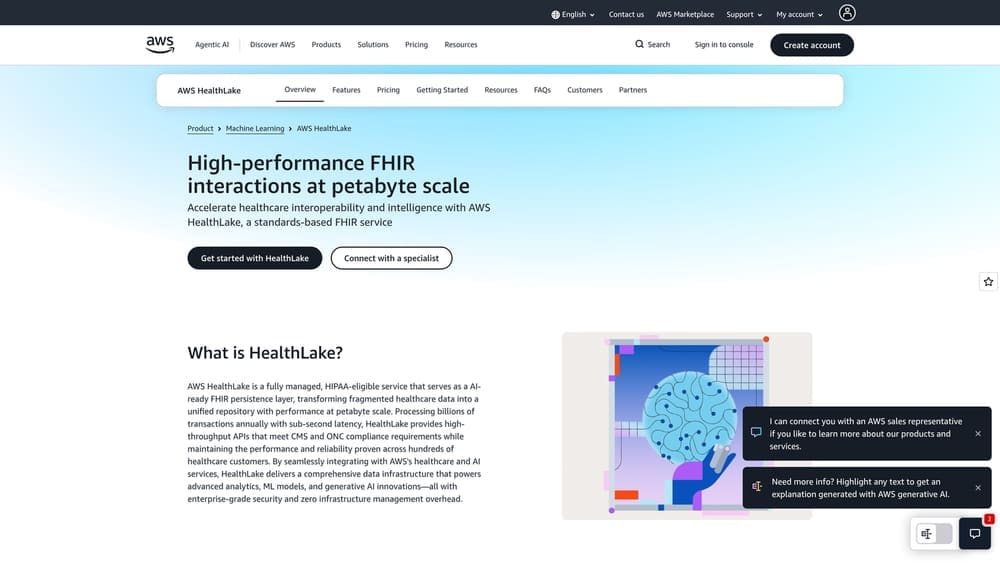
AWS HealthLake is a HIPAA-eligible service for storing, transforming, and analyzing health data in FHIR format on AWS.
Where This Platform Shines
AWS HealthLake removes the infrastructure burden from FHIR adoption. Healthcare organizations know they need FHIR for interoperability—it is mandated by regulations and required for modern data exchange. But standing up FHIR servers, normalizing data, and maintaining compliance requires specialized expertise most teams lack.
HealthLake provides a managed FHIR data store that automatically normalizes incoming data, handles versioning, and integrates with AWS analytics services. You send HL7v2 messages or C-CDA documents, HealthLake converts them to FHIR R4, and you query using standard FHIR APIs. The service is HIPAA-eligible and handles the security and compliance heavy lifting.
Key Features
Managed FHIR Data Store: Fully managed FHIR R4 server with automatic scaling and high availability.
Automatic Data Normalization: Converts HL7v2, C-CDA, and other formats to FHIR without custom ETL pipelines.
ML-Ready Transformation: Built-in medical natural language processing to extract structured data from clinical notes.
AWS Analytics Integration: Native connections to Amazon SageMaker for ML, QuickSight for visualization, and Athena for SQL queries.
HIPAA Compliance: HIPAA-eligible service with encryption, audit logging, and access controls built in.
Best For
Health systems migrating to FHIR without building custom infrastructure. Digital health companies needing FHIR APIs for app integration. Research organizations preparing data for machine learning. Teams already invested in AWS who want tight integration with other AWS services.
Pricing
Pay-as-you-go pricing based on data storage volume and API query volume. No upfront costs or minimum commitments. Pricing calculator available on AWS website.
6. Google Cloud Healthcare API
Best for: Healthcare data interoperability with FHIR, HL7v2, and DICOM support on Google Cloud.
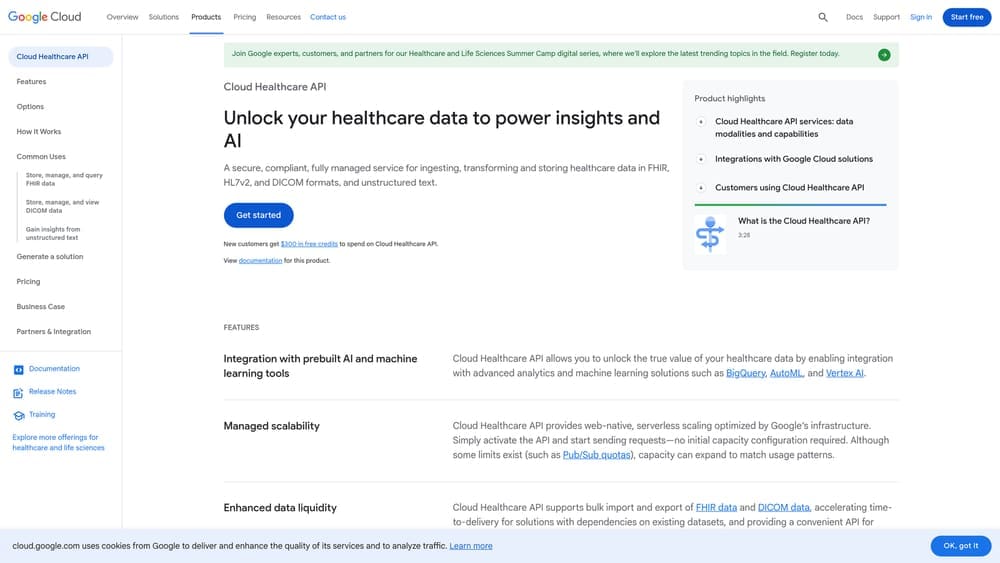
Google Cloud Healthcare API is a managed service for healthcare data interoperability with native support for FHIR, HL7v2, and DICOM.
Where This Platform Shines
Google Cloud Healthcare API excels at handling the full spectrum of healthcare data formats in one platform. Clinical data arrives as HL7v2 messages from ADT systems. Imaging data comes as DICOM from radiology. Interoperability requires FHIR. Managing three different data models across separate systems creates integration nightmares.
The Healthcare API provides native stores for all three formats with built-in conversion and de-identification capabilities. You can ingest HL7v2, convert to FHIR for analytics, link to DICOM imaging studies, and de-identify everything before sharing with researchers. BigQuery integration enables SQL analytics across all data types without moving data out of the Healthcare API.
Key Features
Native FHIR R4 Support: Fully managed FHIR server with standard APIs and comprehensive resource coverage.
HL7v2 and DICOM Stores: Purpose-built data stores for clinical messaging and medical imaging with format-specific APIs.
De-Identification and Consent: Built-in tools for removing PHI and enforcing patient consent policies across datasets.
BigQuery Integration: Stream FHIR data to BigQuery for SQL analytics and ML without custom ETL.
Healthcare Data Harmonization: Open-source tools for mapping proprietary data models to FHIR using configurable transformation rules.
Best For
Healthcare organizations managing clinical, imaging, and interoperability data on Google Cloud. Research institutions needing de-identification and consent management. Teams building analytics on BigQuery who want seamless healthcare data integration. Organizations requiring comprehensive format support beyond FHIR alone.
Pricing
Pay-per-use pricing based on API calls, data storage, and BigQuery streaming. No minimum fees. Pricing details available on Google Cloud pricing calculator.
7. Microsoft Azure Health Data Services
Best for: Unified FHIR, DICOM, and IoMT data management within the Microsoft Azure ecosystem.
Microsoft Azure Health Data Services is a unified platform for managing FHIR, DICOM, and MedTech device data within Azure.
Where This Platform Shines
Azure Health Data Services provides the tightest integration with Microsoft’s enterprise ecosystem. Healthcare organizations already using Azure Active Directory for identity management, Microsoft Teams for collaboration, and Power BI for analytics can extend these investments to health data infrastructure without introducing new security boundaries.
The platform unifies FHIR clinical data, DICOM imaging, and IoMT device data in one service with consistent security and governance. A cardiologist can query FHIR patient records, pull associated echocardiogram DICOM images, and analyze continuous monitoring data from IoMT devices—all through Azure-native tools with single sign-on and unified audit logs.
Key Features
Unified Data Service: FHIR, DICOM, and IoMT data in one managed service with consistent APIs and governance.
Built-In Compliance: HIPAA and HITRUST certified with Azure security controls, encryption, and compliance reporting.
Azure Identity Integration: Native integration with Azure Active Directory for authentication, authorization, and conditional access policies.
Analytics with Synapse: Stream health data to Azure Synapse Analytics for large-scale data warehousing and ML workflows.
IoMT Connector: Ingest and normalize data from medical devices and wearables into FHIR Observation resources.
Best For
Healthcare organizations standardized on Microsoft Azure and Microsoft 365. Health systems using Azure Active Directory for identity management. Teams building remote patient monitoring solutions with IoMT devices. Organizations requiring tight integration between health data and enterprise collaboration tools.
Pricing
Consumption-based pricing for data storage, API transactions, and data processing. No upfront costs. Pricing scales with usage volume and can be estimated using Azure pricing calculator.
8. Snowflake Health Data Cloud
Best for: Secure data sharing and collaboration between organizations using data clean rooms.
Snowflake Health Data Cloud is a data cloud with clean room capabilities enabling privacy-preserving collaboration between healthcare organizations.
Where This Platform Shines
Snowflake solves the cross-organization collaboration problem without data copying. A pharmaceutical company wants to analyze its clinical trial data alongside real-world evidence from a health system. Traditional approaches require data use agreements, data transfer, and months of legal review. Even after transfer, both parties worry about data misuse.
Snowflake’s data clean rooms let organizations collaborate on shared analytics without either party accessing the other’s raw data. The health system keeps EHR data in its Snowflake account, the pharma company keeps trial data in its account, and both run approved queries in a clean room that returns only aggregated results. No data leaves its original location, but both parties get insights from the combined dataset.
Key Features
Data Clean Rooms: Privacy-preserving collaboration environments where organizations analyze shared data without accessing raw records.
Secure Data Sharing: Share datasets between Snowflake accounts without copying—data stays in the provider’s account, consumers query it directly.
Granular Access Controls: Define exactly which queries are allowed in clean rooms and which results can be exported.
Partner Ecosystem: Pre-built connections to health data providers, EHR vendors, and analytics tools in the Snowflake Marketplace.
Multi-Cloud Support: Run on AWS, Azure, or Google Cloud with consistent functionality and cross-cloud data sharing.
Best For
Biopharma companies collaborating with health systems on real-world evidence. Payers and providers building value-based care analytics across organizational boundaries. Research consortia sharing data for multi-institutional studies. Organizations needing flexible collaboration without data movement.
Pricing
Usage-based pricing for compute and storage with separate costs for data sharing and clean room usage. Pricing varies by cloud region and compute tier. Contact Snowflake for enterprise pricing.
9. OHDSI/OMOP + Federated Tools
Best for: Open-source observational health data standardization with global research network participation.
OHDSI (Observational Health Data Sciences and Informatics) is an open-source common data model and research network for standardizing observational health data.
Where This Platform Shines
OHDSI provides a proven, community-driven approach to health data standardization without vendor lock-in. The OMOP Common Data Model transforms disparate EHR, claims, and registry data into a standardized format that enables consistent analytics across institutions. Over 200 organizations globally have implemented OMOP, creating a federated research network.
The power comes from standardization plus open-source analytics tools. Once your data is in OMOP format, you can run the same analysis code across any OMOP-compliant database worldwide. Researchers design studies once, then execute them across dozens of institutions without custom integration work. The community continuously develops and validates new analytics methods that everyone can use.
Key Features
OMOP Common Data Model: Standardized schema for observational health data covering demographics, diagnoses, procedures, medications, and lab results.
Global Research Network: Over 200 participating institutions enabling multi-site observational studies with consistent data models.
Open-Source Analytics Tools: ATLAS for cohort building, Achilles for data quality, and standardized R packages for statistical analysis.
Community Development: Active community of researchers, data scientists, and informaticists continuously improving methods and tools.
Vendor Neutrality: No licensing fees or vendor dependencies—organizations own their implementations completely.
Best For
Academic medical centers building research data infrastructure. Health systems participating in multi-site observational studies. Organizations requiring vendor-neutral data standardization. Research networks needing proven methods for federated analysis. Teams with technical resources to implement and maintain open-source tools.
Pricing
Free and open-source software with no licensing costs. Implementation costs include infrastructure, ETL development, data mapping, and staff training. Costs vary widely based on data volume and technical complexity.
Making the Right Choice
Your platform choice depends on three factors: where your data lives today, what compliance frameworks you must satisfy, and whether you need to move data or can analyze it in place.
For national precision medicine programs requiring federated analysis at scale, Lifebit leads. The platform handles the core challenge that kills most multi-institutional projects—you cannot move the data. Government health agencies in the UK, Singapore, and US trust it to manage hundreds of millions of records across distributed sites without centralization.
For real-world evidence and clinical trial recruitment, TriNetX excels. The federated EHR network gives you patient population insights in minutes instead of months. Biopharma teams use it to assess trial feasibility before committing resources.
For privacy-preserving data linkage across organizations, Datavant is the standard. The tokenization approach lets you connect claims, EHR, and specialty data without exposing PHI—critical for value-based care and longitudinal research.
For life sciences regulatory workflows, Veeva Vault remains dominant. If you are submitting to FDA, EMA, or other health authorities, the built-in compliance and submission management justify the investment.
For cloud-native FHIR infrastructure, choose between AWS HealthLake, Google Cloud Healthcare API, or Azure Health Data Services based on your existing cloud investment. All three provide managed FHIR with compliance built in. Pick the one that matches your cloud strategy and integrates with your analytics stack.
For cross-organization data collaboration with clean rooms, Snowflake offers flexibility. The data sharing model works well when organizations want to collaborate without legal agreements for data transfer.
For open-source standardization with global network participation, OHDSI/OMOP provides a proven foundation. The community-driven approach eliminates vendor lock-in, but requires technical resources to implement and maintain.
The trend is clear: federated approaches win when data cannot move. Regulatory complexity, data sovereignty laws, and institutional policies make centralization impossible for most large-scale health data initiatives. Platforms that bring computation to data instead of data to computation solve the fundamental blocker.
Start by mapping your compliance requirements. FedRAMP for government contracts. HIPAA for US healthcare data. GDPR for European data. Then evaluate whether your use case allows data movement or requires federated analysis. Finally, consider time-to-value—some platforms require months of implementation, others deploy in weeks.
Ready to enable secure collaboration across distributed health datasets without moving data? Get started for free with Lifebit’s Trusted Research Environment and see how federated analysis works at scale.
Related from Lifebit
The Federated Trusted Research Environment (TRE)
Production federated TRE platform for federal health programs — deployed at NIH National Library of Medicine (as a minor application within its ATO), Genomics England, the Danish National Genome Center, and CanPath. Patient data stays at source; analytics run across institutions; results travel through policy-controlled airlock.