

9 Best Target Identification AI Tools for Drug Discovery in 2026

AI is compressing target identification timelines that once stretched across years into something closer to weeks. For biopharma R&D leaders and translational research teams, that shift is real — but only if you’re working with the right platform.
The challenge is that not all target identification AI tools are built the same. Some excel at mining published literature. Others shine in generative biology or high-content phenomics. A smaller group are built specifically for regulated, federated environments where data cannot move across borders or institutional boundaries.
Choosing the wrong tool doesn’t just slow you down. It creates compliance exposure, data integration headaches, and validation gaps that surface late in the pipeline when they’re most expensive to fix.
The tools below were selected based on four criteria: data integration breadth across genomic, transcriptomic, clinical, and real-world data; validation capabilities backed by internal pipelines or published results; compliance posture for regulated enterprise and government environments; and real-world deployment track record. If you want broader context on how AI is reshaping the entire discovery process, Lifebit’s overview of AI-driven drug discovery is worth reading alongside this list.
1. Lifebit Trusted TargetID
Best for: Federated AI target identification across siloed genomic and clinical data in regulated environments
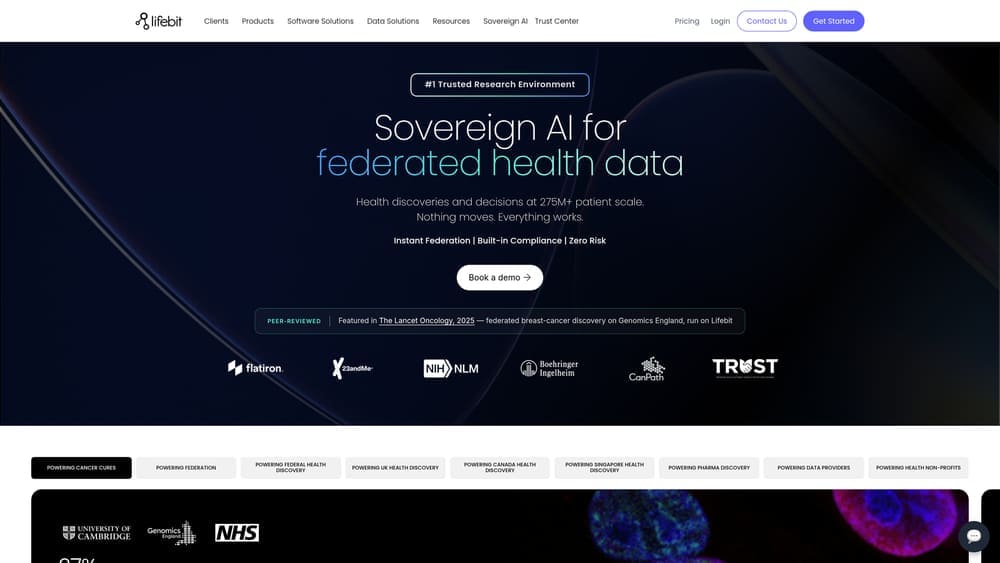
Lifebit Trusted TargetID is an AI-powered target identification and validation platform designed to operate across sensitive, fragmented genomic and clinical datasets without requiring data movement.
Where This Tool Shines
Most target identification platforms assume your data is already in one place. Trusted TargetID is built for the reality most large programs actually face: genomic data sitting in national biobanks, clinical records locked in hospital systems, and regulatory constraints that make centralization impossible or illegal.
By combining federated AI with the Trusted Data Factory’s 48-hour harmonization capability, it lets research teams run multi-omics target scoring across datasets that have never been in the same room. For national health programs and regulated biopharma environments, that’s not a nice-to-have. It’s the only architecture that actually works.
Key Features
Federated AI Analysis: Analyze genomic and clinical data where it lives, across institutions and borders, with no data movement and no compliance risk.
AI-Powered Harmonization via Trusted Data Factory: Unify disparate datasets in 48 hours using automated AI pipelines, replacing what traditionally required months of manual data engineering.
Multi-Omics Target Scoring: Score and prioritize targets across genomic, transcriptomic, and real-world clinical data in a single integrated workflow.
AI-Automated Airlock: A first-of-its-kind governance system that enables secure, auditable export of results without exposing underlying sensitive data.
Built-In Compliance: FedRAMP, HIPAA, GDPR, and ISO 27001 compliance baked in from day one, with deployment in your own cloud environment so you retain full control.
Best For
Government health agencies running national precision medicine programs, biopharma R&D teams working with multi-institutional or cross-border datasets, and CIOs or Chief Data Officers who need AI capabilities without surrendering data sovereignty. Trusted by organizations including NIH and Genomics England, with over 275 million records under management across 30+ countries.
Pricing
Custom enterprise pricing based on deployment scope and data scale. Contact Lifebit directly for a quote tailored to your program requirements.
2. BenevolentAI
Best for: Knowledge graph-driven target identification connecting literature, omics, and clinical evidence
BenevolentAI is an AI drug discovery company built around a proprietary biomedical knowledge graph that links billions of data points to surface novel target hypotheses.

Where This Tool Shines
BenevolentAI’s core strength is the depth and connectivity of its knowledge graph. Rather than searching literature or databases in isolation, its platform reasons across the relationships between genes, proteins, diseases, pathways, and clinical observations simultaneously. That multimodal reasoning can surface non-obvious target connections that siloed analysis would miss.
The company also runs an active internal pipeline, which means their platform isn’t just a vendor tool. It’s being tested and validated against real drug discovery challenges in-house, which adds a layer of credibility to their target identification outputs.
Key Features
Proprietary Knowledge Graph: Connects billions of biomedical data points spanning literature, omics, clinical data, and pathway databases into a unified reasoning layer.
Multimodal Reasoning: Integrates signals across literature, transcriptomics, proteomics, and clinical evidence to generate target hypotheses.
End-to-End Platform: Covers the workflow from initial target identification through candidate selection, reducing handoff friction across discovery stages.
Internal Pipeline Validation: Active in-house drug programs validate platform predictions against real biological outcomes.
Best For
Biopharma R&D teams looking for a knowledge graph-first approach to target identification, particularly in therapeutic areas where mechanistic complexity makes manual literature review insufficient. Best suited for partnership and licensing engagements rather than self-service deployment.
Pricing
Partnership and licensing model. Pricing is not publicly listed; contact BenevolentAI directly to discuss collaboration structures.
3. Insilico Medicine Pharma.AI
Best for: Generative AI-driven target discovery integrated with molecule design in a single platform
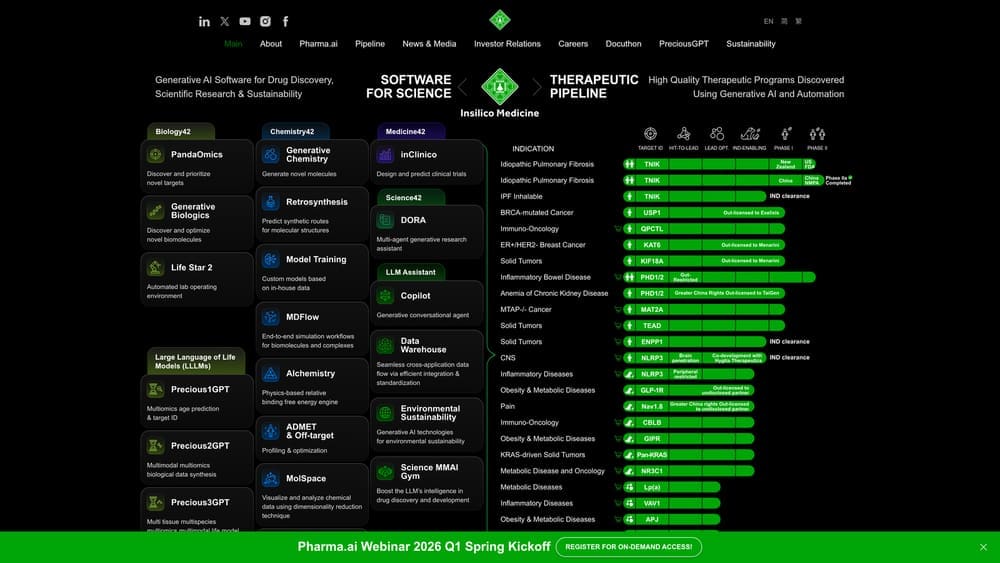
Insilico Medicine’s Pharma.AI is a generative AI platform that spans target discovery, molecule generation, and clinical trial prediction under one unified system.
Where This Tool Shines
Insilico’s differentiation is its generative biology approach. PandaOmics, the target identification engine, doesn’t just score existing targets. It proposes novel ones by combining multi-omics analysis with text mining across biomedical literature. That generative capability extends naturally into Chemistry42, which handles molecule generation, creating a seamless target-to-candidate workflow.
The platform’s internal pipeline has produced multiple clinical-stage assets, including what the company has described as one of the first generative AI-designed drugs to enter human trials. That track record matters when evaluating whether a platform’s outputs are biologically credible.
Key Features
PandaOmics: AI engine for target identification using multi-omics data integration and automated biomedical text mining.
Integrated Chemistry42 Workflow: Direct connection between target identification and generative molecule design, reducing the gap between target selection and lead generation.
Generative Biology: Proposes novel targets rather than just ranking known ones, expanding the discoverable target space.
InClinico: Clinical trial outcome prediction module that adds downstream validation context to target prioritization decisions.
Best For
Biopharma teams that want an integrated discovery platform covering target identification through molecule generation, particularly those working in novel biology where existing target databases have limited coverage.
Pricing
SaaS access is available for individual modules. Full platform enterprise licensing is available; contact Insilico Medicine for pricing details.
4. Recursion
Best for: Phenomics-first target discovery using large-scale cellular imaging and biological foundation models
Recursion is a drug discovery platform built on one of the world’s largest proprietary biological and chemical datasets, combining high-content cellular imaging with advanced machine learning.
Where This Tool Shines
Recursion’s approach is fundamentally different from knowledge graph or literature-mining tools. Their platform generates biological insight from cellular phenotypes, using high-throughput imaging to observe how cells respond to genetic and chemical perturbations at industrial scale. That phenotypic data becomes the substrate for target identification rather than curated databases.
The LOWE (Large-scale Omics World Embeddings) foundation models represent a significant step toward generalizable biological reasoning, allowing the platform to make predictions across biological contexts it hasn’t explicitly been trained on.
Key Features
Massive Proprietary Dataset: One of the largest collections of cellular images, transcriptomics data, and chemical perturbation profiles available for biological AI training.
Recursion OS: A unified operating system for biological data exploration, integrating imaging, omics, and chemical data into a single analytical environment.
LOWE Foundation Models: Large-scale biological foundation models enabling generalizable reasoning across diverse biological contexts.
High-Throughput Phenotypic Screening: Industrial-scale experimental infrastructure generating continuous biological data to feed and validate AI predictions.
Best For
Organizations interested in phenomics-driven target discovery, particularly those with a high tolerance for novel, data-intensive approaches and the scientific infrastructure to interpret phenotypic outputs. Best accessed through collaboration agreements.
Pricing
Partnership model. Platform access is structured through collaboration agreements rather than direct SaaS licensing.
5. Exscientia
Best for: Precision target selection grounded in patient-derived tissue biology for oncology and immunology
Exscientia is an AI-driven drug discovery company that integrates patient-derived tissue data with computational design to ground target selection in actual patient biology.
Where This Tool Shines
Where most target identification platforms work from population-level genomic or literature data, Exscientia anchors its approach in patient tissue. That biological grounding means targets are selected based on what’s actually happening in patient samples, not just what’s statistically associated with disease in large cohorts. For oncology and immunology programs where patient heterogeneity is high, that distinction has real implications for validation success rates.
Their automated design-make-test-learn cycles also compress the time between target identification and early validation, keeping the feedback loop tight.
Key Features
Patient Tissue-Derived Data Integration: Target selection informed by ex vivo patient tissue data, providing direct biological grounding beyond genomic associations.
AI-Driven Precision Medicine: Targets selected based on individual patient biology, supporting precision medicine approaches in heterogeneous diseases.
Automated Design-Make-Test-Learn Cycles: Rapid experimental validation loops that accelerate the path from target hypothesis to early confirmation.
Oncology and Immunology Focus: Deep domain expertise and validated workflows in high-complexity therapeutic areas.
Best For
Biopharma teams focused on oncology or immunology who need target identification grounded in patient biology rather than population-level associations. Best suited for partnership and co-development arrangements.
Pricing
Partnership and co-development model. Enterprise inquiries handled directly by Exscientia.
6. Open Targets
Best for: Open-source target prioritization using genetic and genomic evidence with no licensing cost
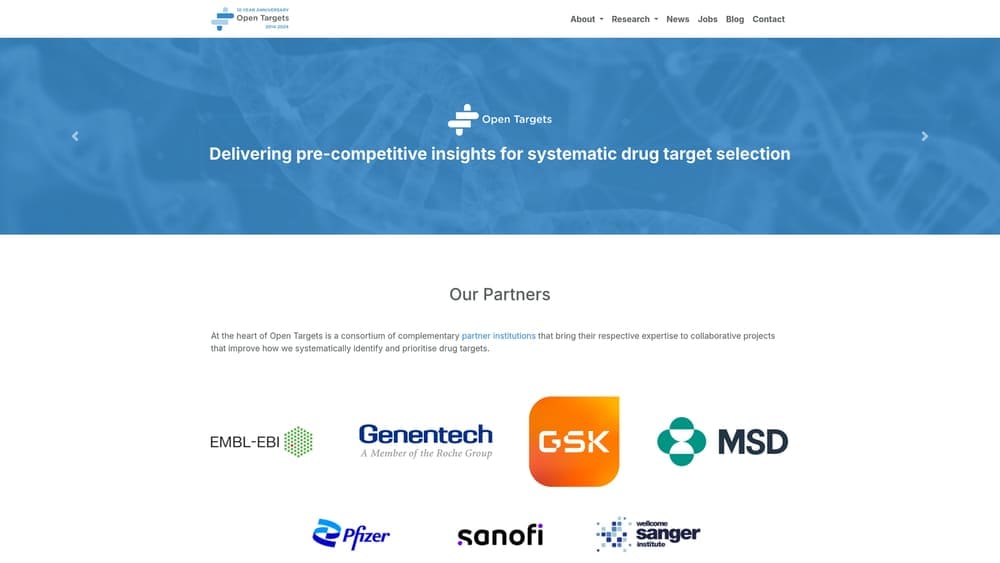
Open Targets is a free, open-source platform for the systematic identification and prioritization of drug targets, backed by a consortium of leading academic and industry organizations.
Where This Tool Shines
Open Targets occupies a unique position in this list: it’s free, publicly accessible, and backed by institutions including EMBL-EBI, the Wellcome Sanger Institute, GSK, and Bristol Myers Squibb. For academic teams and early-stage programs that need a rigorous, evidence-based starting point for target prioritization, it’s hard to beat as a baseline resource.
Its association scoring framework aggregates genetic, expression, pathway, and animal model evidence into a transparent, reproducible scoring system. That transparency is valuable for scientific communication and regulatory documentation.
Key Features
Multi-Source Evidence Aggregation: Integrates GWAS data, gene expression, literature, pathway databases, and animal model evidence into a unified target-disease association framework.
Association Scoring Framework: Transparent, reproducible scoring system for ranking target-disease pairs by genetic and functional evidence strength.
Consortium Backing: Developed and maintained by EMBL-EBI, Wellcome Sanger Institute, GSK, Bristol Myers Squibb, and other partners.
API Access: Programmatic API enables integration into custom computational pipelines and downstream analysis workflows.
Best For
Academic research groups, early-stage biotech teams, and biopharma teams looking for a rigorous, evidence-aggregated baseline for target prioritization before investing in proprietary platforms. Also useful as a validation reference layer alongside commercial tools.
Pricing
Completely free and open-source. No licensing fees or access restrictions.
7. Causaly
Best for: Causal AI reasoning over biomedical literature to generate mechanistically grounded target hypotheses
Causaly is an AI platform that applies causal reasoning to biomedical literature, going beyond keyword search to understand and map mechanistic cause-effect relationships relevant to target discovery.
Where This Tool Shines
The distinction between correlation-based literature mining and causal reasoning matters significantly in target identification. Most text-mining tools surface co-occurrence, meaning they tell you that Gene X and Disease Y appear together frequently. Causaly’s engine understands directionality and mechanism, telling you that Gene X upregulates Pathway Z, which drives Disease Y through a specific mechanism.
That mechanistic depth translates directly into higher-quality target hypotheses and better evidence packages for internal prioritization decisions.
Key Features
Causal AI Reasoning Engine: Understands cause-effect relationships across biomedical literature rather than surfacing simple co-occurrence patterns.
Real-Time Literature Coverage: Reads and reasons across millions of biomedical publications, with continuous updates as new research is published.
Hypothesis Generation and Evidence Mapping: Automatically generates target hypotheses and maps the supporting mechanistic evidence chain for each.
Mechanistic Pathway Exploration: Interactive tools for exploring and interrogating causal pathways connecting targets to disease biology.
Best For
Translational research teams and target biology groups who need mechanistically grounded target hypotheses supported by structured literature evidence. Particularly useful for therapeutic areas with rich published literature but complex, multi-step disease mechanisms.
Pricing
Enterprise SaaS model. Contact Causaly directly for pricing details.
8. Standigm ASK
Best for: Network pharmacology-based target identification and drug repositioning across integrated knowledge graphs
Standigm ASK is an AI target discovery platform specializing in network pharmacology, novel target identification, and drug repositioning using integrated proprietary and public biomedical knowledge graphs.
Where This Tool Shines
Standigm’s network pharmacology approach treats biological systems as interconnected networks rather than isolated gene-disease pairs. That systems-level perspective is particularly valuable when targets don’t have strong single-gene associations but emerge from network perturbations across multiple nodes.
The platform’s dual capability in de novo target discovery and drug repositioning also gives it practical versatility. For programs exploring both new biology and potential new indications for existing assets, having both workflows in a single system reduces analytical overhead.
Key Features
Network Pharmacology AI: Maps drug-target-disease relationships at the network level, identifying targets that emerge from systemic biological interactions.
Drug Repositioning Capabilities: Identifies new therapeutic applications for existing compounds alongside novel target discovery workflows.
Integrated Knowledge Graph: Combines proprietary biological data with curated public databases into a unified reasoning substrate.
Validated Pharma Partnerships: Active industry partnerships that validate platform predictions against real drug development programs.
Best For
Biopharma teams working in complex, polygenic disease areas where network-level target identification outperforms single-gene approaches, and programs exploring drug repositioning opportunities alongside primary discovery work.
Pricing
Enterprise licensing and partnership model. Contact Standigm directly for commercial terms.
9. Relation Therapeutics
Best for: Single-cell and spatial biology AI for high-resolution target identification at cellular and tissue level
Relation Therapeutics is an AI drug discovery company applying graph neural networks to single-cell multi-omics and spatial biology data to identify disease-relevant targets at cellular and tissue resolution.
Where This Tool Shines
Single-cell and spatial biology represent a significant leap in resolution for target identification. Rather than identifying targets from bulk tissue or population-level genomics, Relation’s platform can pinpoint which specific cell populations are driving disease biology and where in the tissue architecture those populations reside. That granularity is especially powerful in diseases defined by cellular heterogeneity, such as cancer and fibrosis.
Graph neural networks are well-suited to this data type because single-cell data is inherently relational. Cells influence each other, and capturing those relationships mathematically is something GNNs handle more naturally than traditional statistical approaches.
Key Features
Graph Neural Networks on Single-Cell Data: Applies GNN architectures to single-cell multi-omics datasets to capture cellular relationships and identify disease-driving programs.
Spatial Biology Integration: Incorporates spatial transcriptomics data to map target-relevant cell populations to specific tissue locations and microenvironments.
Cellular Program Mapping: Identifies and characterizes disease-relevant cellular programs with high specificity, going beyond bulk gene expression signatures.
Therapeutic Area Focus: Deep expertise in immunology, fibrosis, and oncology, where cellular heterogeneity makes single-cell approaches particularly valuable.
Best For
Research teams working in immunology, oncology, or fibrosis who need target identification at single-cell or spatial resolution, and organizations with access to or interest in generating single-cell and spatial biology datasets as part of their discovery strategy.
Pricing
Partnership and collaboration model. Pricing is not publicly listed; contact Relation Therapeutics to discuss engagement structures.
Which Tool Is Right for Your Program
The right target identification AI platform depends on three things: where your data lives, what your compliance requirements are, and how far along your discovery program is.
For government health agencies and national precision medicine programs working with sensitive, siloed population data, Lifebit Trusted TargetID is the only platform on this list built specifically for that architecture. Federated AI, 48-hour harmonization, and built-in FedRAMP, HIPAA, and GDPR compliance aren’t bolt-on features. They’re the foundation. If your data cannot move, your platform needs to go to the data. Lifebit does that.
For biopharma R&D teams running internal discovery programs, the choice depends on scientific philosophy. Insilico Medicine and BenevolentAI offer strong end-to-end platforms for teams that want integrated target-to-candidate workflows. Recursion and Exscientia are compelling for programs that want phenomics or patient tissue biology at the center of target selection. Causaly and Standigm ASK are excellent for teams that need mechanistic depth or network-level reasoning to complement omics-based approaches.
For academic consortia, hospitals, and early-stage teams working with limited budgets, Open Targets provides a rigorous, evidence-aggregated baseline at no cost. It’s also a valuable validation layer alongside any commercial platform.
The tools in this list represent the current frontier of AI-driven target identification. The gap between using the right one and the wrong one is measured in years of pipeline time and millions in wasted development spend.
If you’re building or scaling a regulated, data-intensive discovery program, get started with Lifebit to see how federated AI and the Trusted TargetID platform can accelerate your target identification without compromising data governance or compliance.