

10 Unique Biotech Companies in London: Federated Analytics

10 Biotech Companies in London Using Federated Analytics to Cut Data Access From Weeks to Hours
The most innovative biotech companies in London specializing in federated data analytics are fundamentally changing how the life sciences industry handles sensitive patient data. These pioneering firms enable the secure analysis of distributed datasets without moving information from its original source – solving critical privacy, security, and compliance challenges that have long blocked breakthrough research. In the traditional model, data silos acted as fortresses; today, federated analytics acts as a bridge, allowing insights to flow while the data remains stationary.
What you will get in this guide
- A deep dive into federated analytics and its role in modern drug discovery
- Why London’s “Golden Triangle” is a standout hub for privacy-preserving TechBio
- Detailed profiles of the technologies making “analyze in place” possible at scale
- How Lifebit helps teams access global biomedical data securely and fast
- An exploration of the regulatory landscape, including the NHS Secure Data Environment (SDE) network
London’s position as Europe’s biotech leader isn’t accidental. The city’s ecosystem generates £6.4 billion annually across 11.6 million square feet of laboratory space, while UK biotech secured £563 million in venture capital in Q3 2024 alone – a 49% jump from the previous quarter. This ecosystem combines world-class universities like UCL and Imperial College, direct NHS data access, and deep financial capital to power innovations in federated analytics. The convergence of “Big Data” and “Big Biology” in London has created a unique environment where computational power meets clinical expertise.
The challenge is clear: generating biomedical data is easy, but accessing information locked across thousands of disconnected locations remains painfully difficult. Federated data analytics solves this by enabling AI models to learn from distributed datasets without centralizing sensitive information. This preserves privacy while opening up insights that could save lives, particularly in oncology and rare disease research where data is often sparse and highly protected.
I’m Dr. Maria Chatzou Dunford, CEO and Co-founder of Lifebit, where we’ve spent over 15 years building federated platforms that connect researchers with secure, compliant access to global patient data. My work spans computational biology, AI in healthcare, and the Nextflow framework used worldwide for genomic analysis – giving me a front-row seat to how London’s ecosystem is tackling biotech’s toughest data challenges. In this guide, we will explore how London is leading the charge in this “privacy-first” revolution.
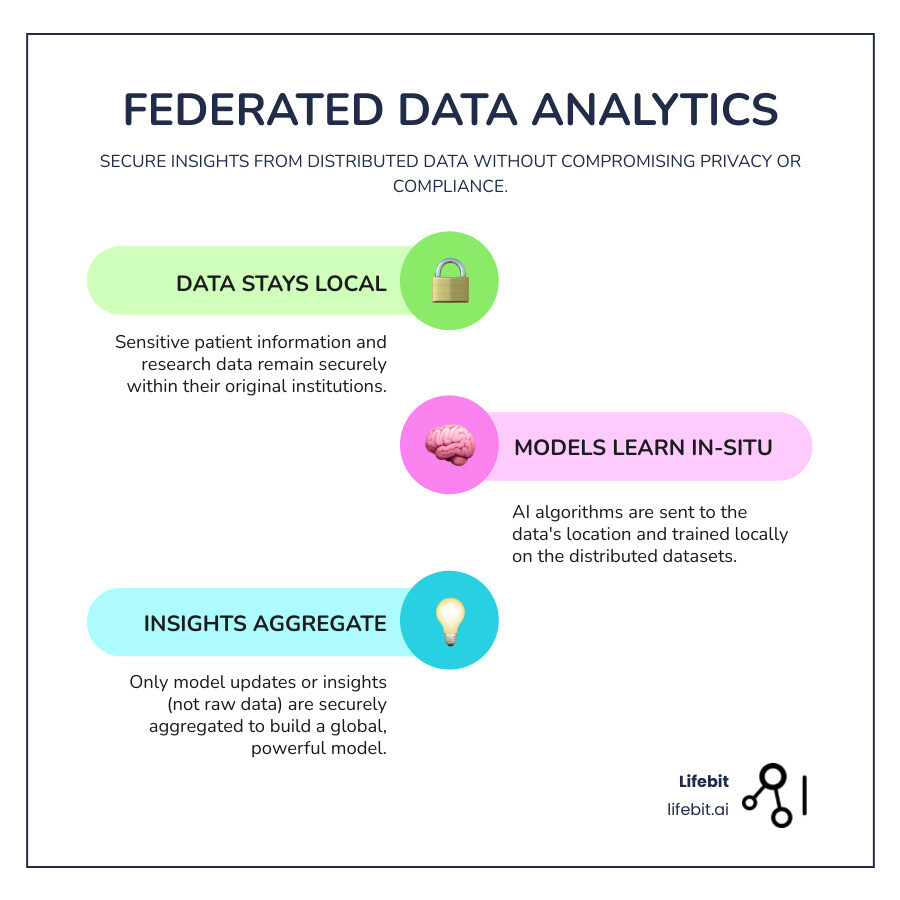
“List the most innovative biotech companies in London specializing in federated data analytics” terms made easy:
Why London’s £8.4B Golden Triangle is the Global Capital for Secure Data
London isn’t just a financial hub; it’s the beating heart of the UK’s “Golden Triangle,” a geographic concentration of research excellence spanning London, Cambridge, and Oxford. This dense network of research centers, healthcare providers, and world-leading universities spans 11.6 million square feet of laboratory space. When we talk about why London is the perfect breeding ground for federated analytics, we have to look at the numbers: this ecosystem generates £8.4 billion per annum and hosts about half of all UK-based research centers.
The sheer density of talent and data is staggering. With institutions like The Francis Crick Institute, the Wellcome Trust, and the Knowledge Quarter in King’s Cross, London provides a unique “collision space” where computer scientists and molecular biologists grab coffee and decide to rewrite the rules of drug discovery. This proximity facilitates the rapid exchange of ideas, allowing federated learning techniques developed in AI labs to be immediately applied to genomic datasets in clinical settings.
Furthermore, the UK government’s commitment to making the country a “science superpower” has led to massive investment in digital infrastructure. In Q3 2023 alone, the UK was securing £563 million in venture capital and public financing. This influx of capital specifically targets “TechBio”—companies that treat biology as a data problem. Federated analytics is the key that opens up this data without triggering the alarm bells of privacy regulators. By adopting a federated approach, London-based firms can comply with the UK’s stringent Data Protection Act while still participating in global research collaborations.
London also benefits from the presence of the NHS, which provides a longitudinal dataset of 65 million people. The transition toward Secure Data Environments (SDEs) within the NHS has made London the primary testing ground for federated queries. Researchers can now query data across different NHS Trusts without the data ever leaving the hospital firewall, a feat that was virtually impossible a decade ago. This infrastructure is what attracts global pharmaceutical giants to set up their AI research headquarters in the city.

10 London TechBio Teams Using Federated Data Analytics (Without Moving Patient Data)
The London TechBio sector is shifting from experimentation to execution. We are seeing a move toward foundational models that can simulate human biology, but these models require vast amounts of high-quality data. Below is a practical, privacy-first view of how leading London teams apply federated analytics in real research settings to overcome the data scarcity and privacy hurdles.
1. Lifebit
We provide a next-generation federated AI platform that solves the “data silo” problem at its core. Instead of moving sensitive genomic data – which is risky, expensive, and often illegal across international borders – our technology allows researchers to bring their analysis to the data. Our Trusted Research Environment (TRE) and Trusted Data Lakehouse (TDL) enable secure, real-time access to global multi-omic data. By using a federated query engine, we allow pharmaceutical companies to run complex GWAS (Genome-Wide Association Studies) across multiple biobanks simultaneously without any raw data being transferred. It is about creating a world where data access is never an obstacle to curing disease.
2. Large-scale AI drug discovery programs (London)
London hosts multiple well-funded AI drug discovery programs that combine biological knowledge graphs, multi-omics, and privacy-preserving analytics to accelerate hypothesis generation. These programs use federated learning to train Large Language Models (LLMs) on proprietary clinical trial data from multiple partners. In practice, federated approaches help these programs learn from distributed clinical and genomic sources without centralizing sensitive patient records, ensuring that competitive intellectual property is protected while the collective model improves its predictive accuracy for drug-target interactions.
3. Protein structure and computational chemistry labs (London)
AI-enabled protein structure prediction has reshaped early discovery, following the success of London-based DeepMind’s AlphaFold. London-based groups working in structure, docking, and molecular simulation increasingly depend on secure access to proprietary and regulated datasets. Federated execution patterns support collaboration across institutions while maintaining data sovereignty. For instance, a lab can refine a folding model using private experimental data from a partner hospital without the hospital needing to share the underlying atomic coordinates, which may be subject to strict usage agreements.
4. Lab-in-the-loop biology platforms (London)
Some of the most effective TechBio platforms close the loop between machine learning and wet-lab validation. These London-based teams use federated workflows to train models on distributed assay and clinical datasets while keeping raw data inside the originating lab, hospital, or partner environment. This is particularly useful for high-throughput screening where the data generated is too massive to move efficiently. By processing the data locally and only sharing the model weights, these platforms can iterate on biological designs in near real-time.
5. Automated protein engineering and synthetic biology teams (London)
Automation and ML can compress the design-build-test-learn cycle, but the most valuable training data often sits across many different commercial partners. Federated analytics enables secure model training across those datasets to improve hit rates without forcing partners to export raw data. In London’s synthetic biology hubs, this allows for the optimization of metabolic pathways by learning from the failures and successes of experiments conducted in different geographic locations, all while maintaining trade secrets.
6. RNA and organ-targeted therapeutic discovery groups (London)
London has strong depth in RNA biology and organ-targeted delivery research, particularly within the academic clusters of White City. Federated analysis can support biomarker discovery and patient stratification by running harmonized pipelines across multiple clinical sites. For RNA therapeutics, understanding how different delivery vehicles perform in diverse patient populations is key. Federated analytics allows researchers to aggregate these performance metrics without accessing individual patient identifiers, accelerating the path to personalized medicine.
7. Computational biophysics and “undruggable” target programs (London)
Programs tackling intrinsically disordered proteins and difficult targets are data hungry. Federated execution lets teams run consistent, auditable analyses across distributed biophysical and clinical evidence. This is vital when data cannot be moved due to contractual or regulatory restrictions. By using federated analytics, London biophysicists can query structural data from international synchrotrons and combine it with local clinical observations to identify novel binding pockets on proteins previously thought to be unreachable by small molecules.
8. Data-led immuno-oncology discovery (London)
Immuno-oncology depends on connecting tumor genomics, immune profiling, and longitudinal outcomes. Federated learning helps aggregate signal across hospitals and trials while reducing re-identification risk and supporting compliant collaboration. London’s leading cancer centers use these federated networks to identify rare responders to immunotherapy. By analyzing the T-cell repertoires of patients across multiple London trusts, researchers can find patterns that predict treatment success without ever centralizing the highly sensitive genetic data of the patients.
9. Cell therapy engineering and precision patient selection (London)
Engineering cell therapies requires careful patient stratification and safety monitoring across multiple clinical sites. Federated analytics supports multi-institutional learning (for example across trials and registries) while keeping sensitive source data inside secure environments. This is critical for CAR-T therapies, where monitoring for long-term adverse effects requires data from many different hospitals. Federated systems allow for the real-time monitoring of safety signals across the entire London healthcare network without compromising patient confidentiality.
10. Gene therapy programs using longitudinal patient evidence (London)
Rare disease data is often fragmented across countries and centers. Federated networks allow researchers to pool insight virtually, improving statistical power without centralizing records – especially important for small cohorts and high-sensitivity datasets. London’s gene therapy pioneers use federated analytics to track the long-term efficacy of treatments. Because the patient populations are so small, every data point is precious; federated analytics ensures that this data can be used for global research while adhering to the highest standards of data protection.
Why Researchers Need Secure Federated Analytics
The old way of doing things – copying files to a central server – breaks down at scale. In the era of big data, moving a petabyte of genomic information is physically slow, prohibitively expensive, and legally complex. Federated analytics allows for:
- Target identification: Finding the exact “lock” a new drug needs to fit into by analyzing thousands of genomes in situ.
- Causal biology: Moving beyond correlation to understand what actually causes a disease by linking disparate datasets through federated queries.
- Rare diseases: Small patient populations are often scattered globally. Federated networks allow us to pool insight virtually to find patterns that would be invisible in a single hospital.
Scaling Insights with Secure Federated Analytics
To scale, we need more than good code; we need trust. This is where Trusted Research Environments (TREs) come in. By providing a secure “walled garden” where researchers can run their algorithms, we address the Unlocking NHS data for research roadmap. This helps ensure that every byte of data used to advance research is handled with strong security and compliance, fostering a culture of transparency between patients, clinicians, and researchers.
Stop Moving Data: 5 Technologies Powering London’s TechBio Revolution
The “secret sauce” behind these companies involves a mix of cutting-edge tech. We aren’t just talking about basic machine learning; we’re talking about systems that can reason, secure, and scale. These technologies form the backbone of the federated infrastructure in London.
| Technology | What it Does | Why it Matters |
|---|---|---|
| Agentic AI | AI that can plan and execute complex lab tasks and data queries autonomously. | Automates the discovery of causal relationships and manages complex federated workflows without human intervention. |
| In-situ Analysis | Analyzing data exactly where it lives (e.g., inside a hospital’s firewall). | Eliminates the risk of data breaches during transit and complies with strict data residency laws. |
| Blockchain Governance | Using decentralized ledgers to track every access and modification of data. | Ensures absolute transparency and provides an immutable audit trail for regulators and data providers. |
| GPU Aggregation | Pooling computing power from distributed sources around the world. | Allows small London startups to train massive models that would otherwise require the resources of big tech giants. |
| Synthetic Data | Creating mathematical “twins” of data that mimic real patient patterns. | Allows for model testing and pipeline development without ever touching sensitive personal information. |
The Rise of the Lab-in-the-Loop
This “Lab-in-the-Loop” model—where AI makes a prediction, a robot tests it in a wet lab, and the results are fed back into the AI—is becoming the standard for London’s elite biotech firms. Federated analytics is the glue in this loop. It allows the AI to learn from “wet lab” results generated in different facilities simultaneously. For example, a company might have a synthesis robot in London and a testing suite in Stevenage. Federated analytics allows the central model to update based on both sets of data without the raw experimental logs ever leaving their respective sites. This not only speeds up the discovery process but also creates a more robust and reproducible scientific workflow.
Open up NHS Data: How London is Solving the TechBio Privacy Gap
Despite the excitement, we face real problems. The biggest is the “Data Silo.” Even within the same city, two hospitals might format their data so differently that an AI can’t read both. This lack of interoperability is a major bottleneck. This is why the Data, AI and Genomics Advisory Committee (DAGAC), launched by the BioIndustry Association in September 2024, is so critical – we need standardized rules for how data is shared and formatted across the ecosystem.
Another challenge is the talent gap. We need “bilingual” experts – people who understand both CRISPR and Python, both clinical oncology and federated learning. London is uniquely positioned to solve this, thanks to its concentration of multidisciplinary degree programs. Initiatives like the #BIGIMPACT campaign are working to inspire new careers in this space, ensuring London remains the top destination for global talent in the intersection of biology and data science.
Finally, we must address the roadmap for Unlocking NHS data for research. The NHS is the world’s most valuable longitudinal dataset, containing decades of records for a diverse population. If we can open it up through federated Secure Data Environments (SDEs), we won’t just be leading Europe; we’ll be leading the world. The goal is to move away from “data sharing” (which implies moving data) to “data access” (which implies federated queries). This shift is essential for maintaining public trust. When patients know their data never leaves the NHS, they are far more likely to consent to its use in research that could lead to the next generation of life-saving treatments.
London is also pioneering the use of the OMOP Common Data Model (CDM). By standardizing NHS data into this format, federated analytics platforms like Lifebit can run the same query across multiple hospitals and get consistent results. This technical standardization, combined with the legal framework of TREs, is creating a “plug-and-play” environment for biotech innovation that is unmatched globally.
FAQ: How Federated Analytics Protects Patient Data
What is federated data analytics in biotech?
It is a method of training AI models or performing statistical analysis across multiple decentralized devices or servers (like different hospitals) holding local data samples, without exchanging them. The “model” or the “query” travels to the data, rather than the data traveling to a central server. This ensures that the raw, sensitive information remains behind its original firewall.
How do London companies ensure data privacy?
Companies use “in-situ” analysis, which means the raw data never leaves its original secure environment. They also employ advanced encryption techniques like Homomorphic Encryption (which allows computation on encrypted data) and Differential Privacy (adding mathematical “noise” to data to prevent the re-identification of individuals). Furthermore, strict federated governance protocols ensure that only approved researchers can run specific, audited queries that meet GDPR and EHDS standards.
Why is London the best hub for federated learning?
It’s the combination of the “Golden Triangle” academic excellence, the centralized nature of the NHS, and the high concentration of venture capital. London has the highest density of TechBio startups in Europe, creating a “network effect” where innovation moves faster. The city also has a supportive regulatory environment that encourages the use of Secure Data Environments (SDEs) for medical research.
Does federated analytics slow down research?
On the contrary, it often speeds it up. While there is a slight computational overhead for federated queries, it eliminates the months (or years) typically spent on data transfer agreements, security audits for moving data, and the physical time required to move petabytes of information. By “analyzing in place,” researchers can start their work almost immediately once access is granted.
Is federated analytics compliant with GDPR?
Yes. In fact, federated analytics is often cited as a “privacy-by-design” approach that aligns perfectly with GDPR principles. Because raw personal data is not transferred or centralized, the risk of a large-scale data breach is significantly reduced, and data sovereignty is maintained by the original controller (e.g., the hospital).
Conclusion: Access Every Byte of Global Data with Lifebit
The future of biotech isn’t about who has the biggest hard drive; it’s about who has the best access. At Lifebit, we believe that all biomedical data that can be used to save lives should be used. By championing federated AI and Trusted Data Lakehouses, we are removing the obstacles that have traditionally slowed down drug discovery. We are moving from a world of data scarcity to a world of data abundance, where the only limit is our collective scientific imagination.
London’s most innovative biotech companies are proving that you don’t need to sacrifice privacy to achieve progress. We are moving toward a world of “Real-time Evidence,” where a doctor’s observation in a London clinic can securely inform a researcher’s model in New York within seconds, all while the patient’s identity remains fully protected. This is the promise of federated analytics: a global, secure, and lightning-fast research network.
The TechBio revolution is here, and it is federated. By leveraging the unique strengths of the London ecosystem—from the NHS to the Golden Triangle—we are building a new paradigm for medical research. Secure your research data with Lifebit and join us in building a future where cures are discovered at the speed of thought, and where every patient’s data contributes to a healthier world for everyone.