
Advanced ML omics research is the future of precision medicine

Why Advanced ML Omics Research Is Reshaping Precision Medicine
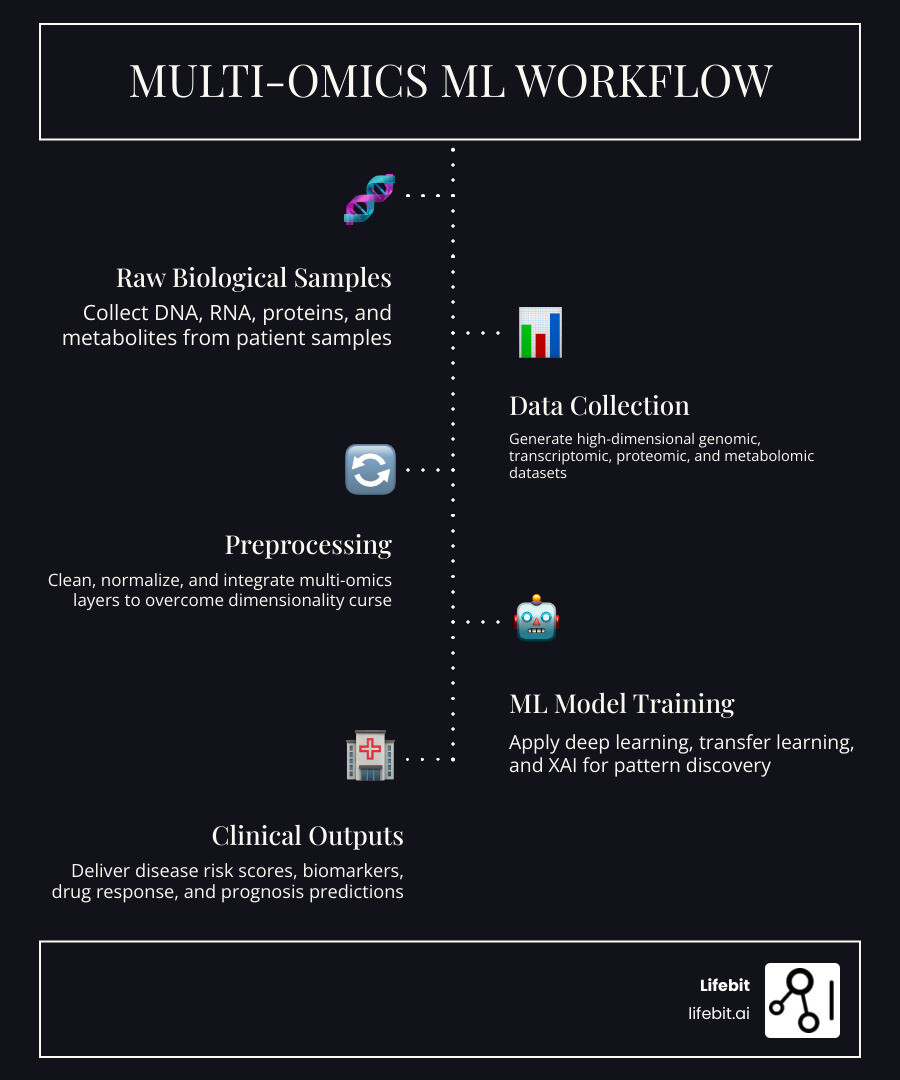
Advanced ML omics research is the application of machine learning — including deep learning, transfer learning, and explainable AI — to biological datasets like genomics, proteomics, transcriptomics, and metabolomics, with the goal of improving disease prediction, diagnosis, and treatment.
Here is what you need to know at a glance:
| What It Is | What It Does | Why It Matters |
|---|---|---|
| ML applied to multi-omics data | Finds hidden patterns across biological layers | Enables earlier, more accurate disease detection |
| Deep learning on genomic/proteomic data | Predicts disease risk and drug response | Outperforms traditional clinical risk scores |
| Transfer learning on small datasets | Overcomes data scarcity in rare diseases | Makes AI viable even with limited samples |
| Explainable AI (XAI) on omics models | Makes “black box” predictions interpretable | Builds clinical trust and supports biomarker discovery |
| Multi-omics data integration | Combines genomics, proteomics, metabolomics, and more | Gives a fuller molecular picture of disease |
Cardiovascular diseases remain the leading cause of death worldwide. Cancer still kills millions each year. And yet, the biological data needed to fight both has never been more abundant — or more difficult to analyze.
Proteomics platforms now identify up to 5,000 analytes per sample. Genomic biobanks hold data on hundreds of thousands of individuals. Public repositories contain tens of millions of single-cell transcriptomics records. The data exists. The challenge is making sense of it — fast enough, accurately enough, and at scale.
That is exactly where advanced ML omics research comes in.
I’m Maria Chatzou Dunford, CEO and Co-founder of Lifebit, with over 15 years of experience in computational biology, AI, and federated data infrastructure — much of it spent building the tools that make advanced ML omics research scalable and secure across institutions. Throughout this guide, I’ll draw on that experience to walk you through where the field stands today and where it’s heading.
Overcoming the Curse of Dimensionality in Advanced ML Omics Research
In Bioinformatics Data Analysis, we often talk about the “curse of dimensionality.” It sounds like a sci-fi movie plot, but for researchers, it’s a very real headache. This phenomenon occurs when the number of features (genes, proteins, metabolites) vastly exceeds the number of samples (patients). In mathematical terms, this is the $p \gg n$ problem, where $p$ represents parameters and $n$ represents the sample size.
As technologies like Next Generation Sequencing evolve, we aren’t just looking at a few genes; we are looking at tens of thousands of transcripts and thousands of proteins. Proteomics platforms today can identify up to 5,000 analytes in a single run. When you have thousands of features but only a few hundred patients, traditional statistical models tend to overfit, seeing patterns that aren’t actually there. This leads to models that perform perfectly on training data but fail miserably in real-world clinical settings.
To solve this, advanced ml omics research utilizes novel data preprocessing and Multi-omics integration strategies. One of the most exciting breakthroughs is DeepInsight, a technique that converts tabular omics data into image-like representations.
Why convert a spreadsheet to an image? Because it allows us to use Convolutional Neural Networks (CNNs) — the same powerful tech that powers facial recognition — to “see” spatial relationships between biological features. By arranging elements with similar characteristics into proximal neighbors using techniques like t-SNE or UMAP for dimensionality reduction, DeepInsight creates a spatial context that helps models generalize better and reduces the number of parameters needed. This transformation allows the model to capture non-linear correlations between distant biological markers that standard linear regression would overlook.
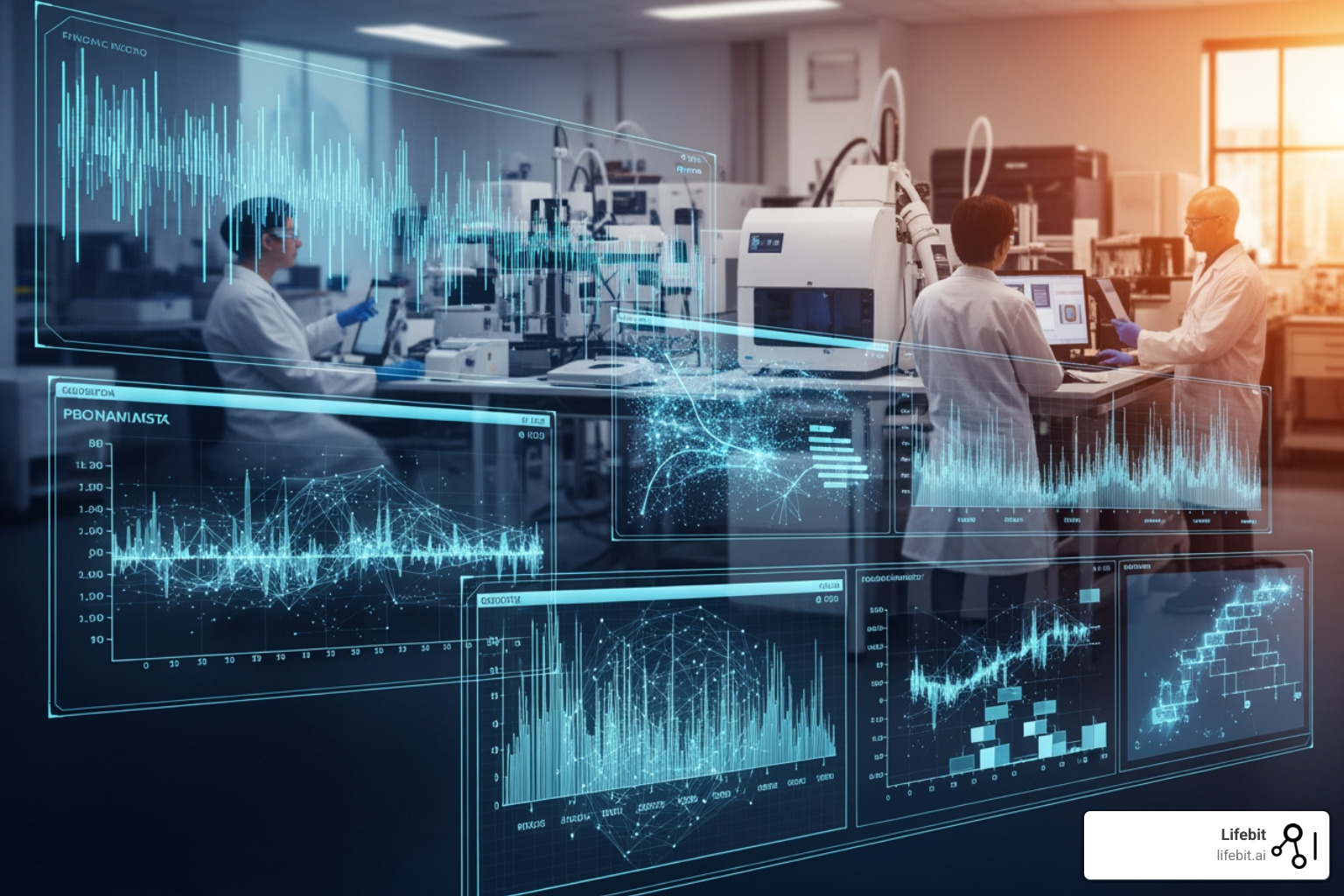
Effective integration isn’t just about stacking data; it’s about understanding how these layers interact. For instance, Scientific research on multi-omics integration strategies shows that combining different Omics layers can reveal causal variants that a single-layer analysis would miss. At Lifebit, we facilitate this through our Trusted Data Lakehouse (TDL), which harmonizes these massive, disparate datasets so they are “AI-ready” from day one. This involves rigorous data cleaning, normalization across different sequencing batches, and the application of feature selection methods like LASSO (Least Absolute Shrinkage and Selection Operator) to prune irrelevant noise before the data ever reaches the deep learning stage.
Beyond Traditional Methods: Deep Learning and Reinforcement Learning
For years, researchers relied on “traditional” ML like Random Forests or Support Vector Machines (SVM). While useful, these methods are often insensitive to the intricate, non-linear relationships hidden deep within biological systems. They often require extensive manual feature engineering, where a human expert must decide which biological markers are important before the model even starts training.
Advanced ML omics research pushes boundaries by adopting Deep Learning (DL), Graph Neural Networks (GNNs), and Reinforcement Learning (RL).
The Rise of Deep Learning and Transformers
Deep Learning automatically learns hierarchical representations. It doesn’t just look at a SNP (Single Nucleotide Polymorphism); it understands how that SNP interacts with gene expression and protein levels. Scientific research on neural network-based CVD risk prediction has demonstrated that DL models can outperform traditional risk scores like Framingham by integrating polygenic and clinical information.
One of the most significant shifts in the last 24 months has been the application of Transformers to genomics. Just as Large Language Models (LLMs) like GPT-4 treat words as tokens in a sentence, genomic transformers treat genes or DNA sequences as tokens. Models like Geneformer have been pre-trained on over 30 million single-cell transcriptomes, allowing them to understand the “grammar” of gene regulation. This allows researchers to predict how a cell might respond to a specific drug or a genetic mutation even if they have never seen that specific scenario before.
Graph Neural Networks (GNNs) for Biological Networks
Biology is inherently networked. Proteins interact with other proteins; genes regulate other genes. Traditional ML treats these as independent variables, but Graph Neural Networks treat them as nodes in a complex web. By modeling the human interactome as a graph, GNNs can predict drug-target interactions with much higher accuracy, identifying which molecules are likely to bind to a disease-causing protein while minimizing off-target effects.
Reinforcement Learning and Transfer Learning
- Reinforcement Learning (RL): This is being used for “top-down” design of protein architectures. Imagine an AI that designs a drug by constantly correcting its own errors until it finds the perfect molecular fit. RL agents can navigate the astronomical search space of possible protein folds to find stable, therapeutic structures.
- Transfer Learning: This is the “secret sauce” for rare disease research. Since rare diseases have small sample sizes, we can’t train a massive model from scratch. Instead, we take a model pre-trained on a massive dataset (like the UK Biobank) and “fine-tune” it on the smaller rare disease dataset. This mitigates the small sample size issue and brings precision medicine to patients who have historically been left behind.
Traditional ML vs. Advanced DL in Omics
| Feature | Traditional ML (RF, SVM, LR) | Advanced Deep Learning (CNN, GNN, Transformer) |
|---|---|---|
| Data Volume | Best for smaller, structured data | Thrives on massive, high-dimensional data |
| Feature Engineering | Requires manual selection | Automatically learns features |
| Relationship Modeling | Linear or simple non-linear | Complex, multi-layered non-linear |
| Integration | Limited multi-modal capability | Designed for multi-modal fusion |
| Interpretability | Generally high | Lower (requires XAI techniques) |
Clinical Applications of Advanced ML Omics Research
The ultimate goal of advanced ml omics research is clinical impact. We aren’t just building models for the sake of it; we are building them to save lives. The transition from bench to bedside requires models that are not only accurate but also robust across diverse global populations.
Cardiovascular Research and Polygenic Risk Scores
In Cardiovascular Research, ML is being used to predict everything from 10-year risk of major adverse cardiac events to the likelihood of sudden cardiac death in the young. Models like GPS-mult have been trained on genomic data from over 116,000 individuals to provide risk assessments that are far more personalized than standard clinical checks. By integrating proteomic data (blood-based protein markers) with genomic data, researchers can now identify “high-risk” individuals who would have been missed by traditional cholesterol and blood pressure screenings.
Precision Oncology and Immunotherapy
In Cancer Genomics, the focus is often on Tumor Mutation Burden (TMB) and predicting immunotherapy resistance. By analyzing the tumor microenvironment through Genomics and transcriptomics, we can identify which patients will respond to specific treatments, avoiding the “trial and error” approach that wastes precious time for cancer patients. Advanced ML models can now predict the likelihood of a patient developing “cytokine release syndrome” (a dangerous side effect) during CAR-T cell therapy, allowing doctors to intervene earlier.
Pharmacogenomics and Drug Discovery
Advanced ML is revolutionizing how we discover drugs. Traditional drug discovery takes 10-15 years and billions of dollars. ML-driven omics research allows for In Silico Drug Screening, where millions of potential compounds are tested against a digital twin of a disease pathway. Furthermore, pharmacogenomics models can predict how a patient’s unique genetic makeup will affect their metabolism of a drug, reducing the incidence of Adverse Drug Reactions (ADRs), which are a leading cause of hospitalization worldwide.
Scaling Research with Federated AI
To do this research at scale, you need more than just a laptop. You need a robust infrastructure. Modern microbiome research, for example, often utilizes extensive data warehouses containing over 60,000 samples with associated metadata.
This is where Lifebit’s Trusted Research Environment (TRE) comes in. Because health data is highly sensitive, it often cannot be moved or shared due to strict data sovereignty laws like GDPR in Europe or HIPAA in the US. Our federated AI platform allows researchers to bring their advanced ml omics research models to the data, rather than moving the data to the models. This “data-centric” approach ensures compliance while enabling real-time access to global datasets across five continents. Researchers can run complex deep learning pipelines on data residing in the UK, Brazil, and Japan simultaneously without the raw data ever leaving its secure home.
Predictive Modeling for Disease Prevention
Predictive modeling is shifting from reactive to proactive. By integrating longitudinal data — data collected from the same patients over many years — we can track the “molecular trajectory” of a disease.
The MildInt framework is a prime example of this. It uses deep learning to integrate multimodal longitudinal data, allowing researchers to see how a patient’s Genomic profile might interact with changes in their proteome over time. This leads to better disease diagnosis and treatment prognosis, particularly in chronic conditions like hypertension and heart failure, where early intervention can prevent permanent organ damage.
Interpretable AI: Solving the ‘Black Box’ Problem for Clinical Trust
One of the biggest hurdles in adopting AI for Genomics in a hospital setting is the “black box” problem. If a model predicts a high risk of heart failure, a clinician needs to know why. They can’t just take the AI’s word for it; they need to understand which biological pathways are implicated to decide on a course of treatment.
Explainable AI (XAI) methods are now an essential part of advanced ml omics research. Techniques like SHAP (SHapley Additive exPlanations) and Integrated Gradients allow us to peer inside the model and see which specific genes or proteins are driving the prediction. For example, in a model predicting Alzheimer’s progression, XAI might reveal that the model is heavily weighting a specific inflammatory protein, prompting the clinician to consider anti-inflammatory therapies.
Global vs. Local Interpretability
- Global Interpretability: This helps researchers understand which features are most important across the entire population. This is vital for Biomarker Discovery, as it highlights genes that are consistently associated with a disease.
- Local Interpretability: This explains why a specific individual received a certain prediction. This is the cornerstone of Precision Medicine, allowing for a truly personalized diagnostic report.
This transparency is crucial for:
- Biological Discovery: Identifying new biomarkers that can be validated in a lab. If an AI identifies a previously unknown gene as a top predictor for lung cancer, it opens a new avenue for drug development.
- Clinical Trust: Giving doctors the confidence to use AI-derived insights in their decision-making. A “score” is not enough; a “reason” is required for clinical adoption.
- Experimental Validation: Ensuring that the associations the AI finds are biologically plausible and reproducible. It helps distinguish between a true biological signal and a technical artifact (noise).
Regulatory Hurdles and Standardization
The challenge of reproducibility remains significant. Adding more omics layers doesn’t always make a model better; sometimes it just makes it more complex and harder to replicate in different patient populations. Regulatory bodies like the FDA and EMA are now developing frameworks for “Software as a Medical Device” (SaMD) that specifically address AI models. These frameworks require that advanced ml omics research be conducted using standardized pipelines and rigorous cross-validation to ensure that a model trained on one ethnic group still performs accurately on another. This is why we emphasize Integrating Multi-Modal Genomic and Multi-Omics Data for Precision Medicine using reproducible workflows like Nextflow and Snakemake.
Frequently Asked Questions about Advanced ML Omics Research
How does transfer learning help with small datasets in rare disease research?
Transfer learning allows us to take a “pre-trained” model that has already learned the “language of biology” from a large dataset (like 30 million single cells in the Geneformer model). We then fine-tune this model on a much smaller dataset related to a rare disease. This “transfers” the broad knowledge of gene interactions to a specific task, significantly improving accuracy even when data is scarce. It essentially gives the model a “head start,” so it doesn’t have to learn everything from scratch with only 50 or 100 samples.
What are the primary challenges in analyzing high-dimensional multi-omics data?
The main challenges include the “curse of dimensionality” (too many features, too few samples), data noise, and the difficulty of harmonizing data from different sources. For example, matching a patient’s DNA sequence (which is static) with their blood protein levels (which change throughout the day) requires sophisticated temporal modeling. There are also ethical and security challenges regarding patient privacy, which is why federated learning is becoming the industry standard.
How does multi-omics integration improve predictive modeling for cancer?
Cancer is a multi-layered disease involving genetic mutations, epigenetic changes, and metabolic shifts. By Integrating Multi-Modal Genomic and Multi-Omics Data for Precision Medicine, we can see the full picture. A genetic mutation might suggest a risk, but transcriptomic data can confirm if that gene is actually being expressed, and proteomics can confirm if the resulting protein is present. This multi-step verification allows for more accurate subtyping of cancers, which is essential for choosing the right immunotherapy and predicting potential resistance before treatment begins.
Can ML models help in identifying new drug targets?
Yes, absolutely. By using Graph Neural Networks to analyze protein-protein interaction networks, ML can identify “hub” proteins that are central to disease pathways but haven’t been targeted by existing drugs. This “target identification” phase is the first and most critical step in the drug discovery pipeline, and advanced ML is making it faster and more accurate than ever before.
Conclusion: The Path to Clinical Translation
Advanced ML omics research is no longer just a theoretical exercise; it is the foundation of AI in Genomics 2.0. The focus will shift from simply building models to translating them into routine clinical practice and pharmacovigilance.
The future of medicine lies in our ability to decode the “language of life” across all its layers. This requires not just smart algorithms, but a secure, scalable infrastructure that respects patient privacy while fostering global collaboration.
At Lifebit, we are proud to provide the next-generation federated AI platform that powers this research. From our Trusted Research Environment to our Real-time Evidence & Analytics Layer (R.E.A.L.), we help biopharma and governments turn high-dimensional data into life-saving insights.
Are you ready to scale your research? Connect with us for custom platform support and maintenance and let’s build the future of precision medicine together.