

When Bots Unite: Navigating AI Federations in Your Favorite Space Opera

Why Your Data Can’t Afford to Leave Home
AI for Federation is a decentralized approach where organizations collaboratively train machine learning models without sharing raw data. Instead of centralizing sensitive information, each participant trains a model locally and shares only encrypted model updates (gradients) with a server. The server aggregates these updates into a global model, which is sent back to participants for more training. This cycle repeats until the model achieves optimal performance.
Key Benefits of AI for Federation:
- Privacy-First: Raw data never leaves your secure environment
- Compliance-Ready: Meets GDPR, HIPAA, and other regulatory requirements
- Better Models: Learns from diverse, siloed datasets without centralization
- Cost-Efficient: Reduces data transfer and storage costs by 70%+
- Real-Time Insights: Enables pharmacovigilance and safety surveillance across institutions
Common Use Cases:
- Multi-hospital clinical research without patient data sharing
- Cross-border pharmacovigilance for drug safety monitoring
- Financial fraud detection across banking networks
- AI model training on genomic data while preserving patient privacy
Think of it like a galactic alliance where each planet keeps its secrets but shares battle strategies. No empire needs to hand over its blueprints, yet everyone benefits from collective intelligence. That’s exactly how federated AI solves the data privacy nightmare facing healthcare, pharma, and regulatory agencies today.
The numbers back this up. Federated learning models achieve up to 99% of the quality of centralized approaches while processing data 13 times faster than single-model baselines. They enable real-time collaboration across institutions that would never agree to pool their raw data due to privacy laws, competitive concerns, or sovereignty requirements.
I’m Maria Chatzou Dunford, CEO and Co-founder of Lifebit. We’ve spent over a decade building federated platforms that power secure drug findy and real-world evidence generation across global healthcare networks. By leveraging AI for Federation, we open up insights from biomedical and genomic data without compromising privacy. This is how federated AI works—and why it’s the only viable path for organizations handling sensitive, regulated data at scale.
AI for Federation terminology:
- AI for data harmonization
- FDA Sentinel 3.0
- AI for Genomics
What is Federated AI? The Tech That Keeps Your Data Safe
Imagine two hospitals, each with decades of patient data. Together, they could train an AI to spot disease patterns neither could see alone. The problem? Sharing patient files is illegal, unethical, and a privacy disaster.
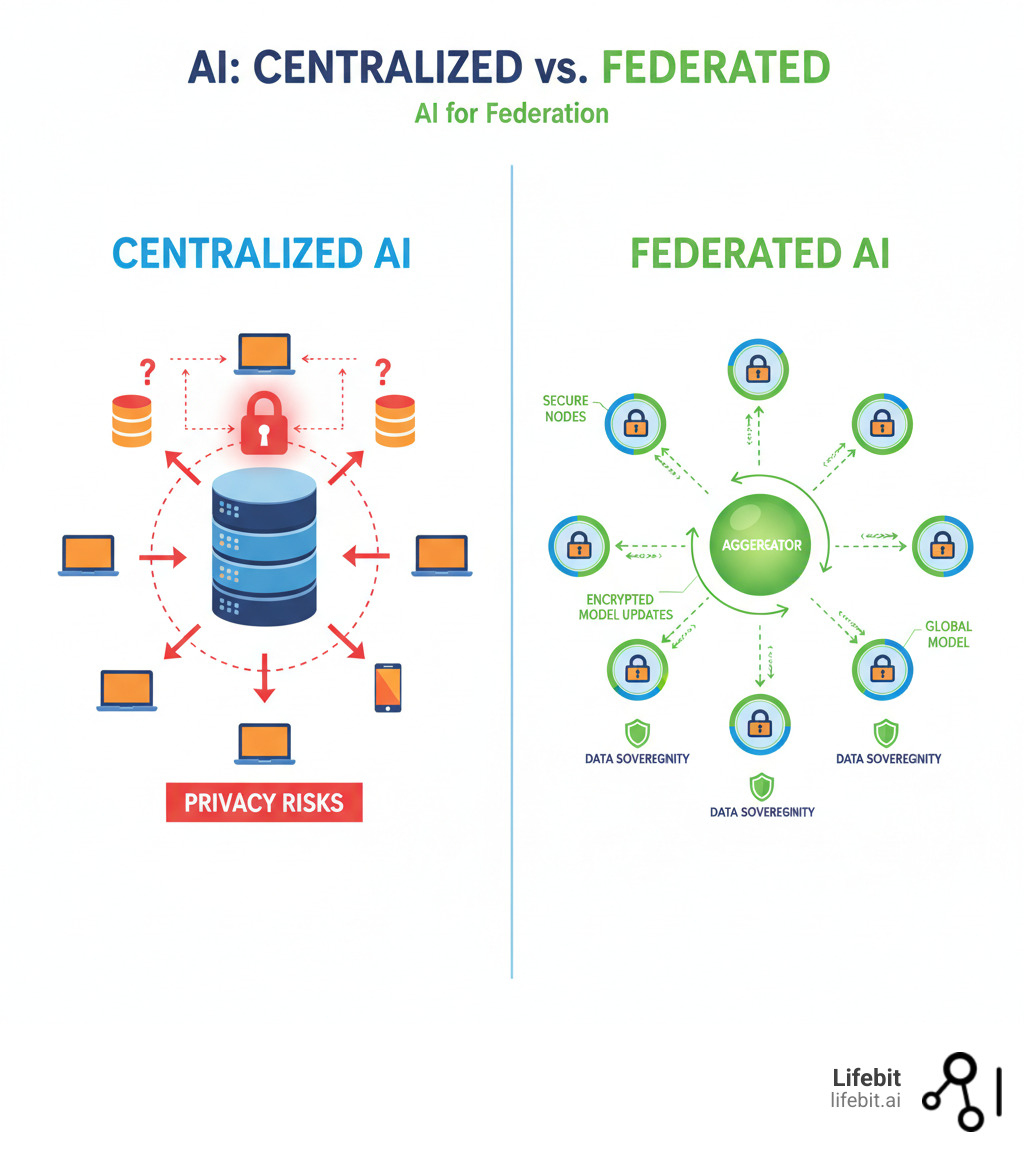
Traditional AI demands centralizing all data. It’s like asking every hospital to mail its patient database to a central warehouse for training. While powerful, this creates a single point of failure, a honeypot for hackers, and a compliance nightmare that violates GDPR, HIPAA, and other data protection laws.
AI for Federation flips this approach on its head. Instead of moving data to the algorithm, we move the algorithm to the data.
Here’s how it actually works. Each hospital (or bank, or research lab) keeps its sensitive data locked safely behind its own firewall. The data never budges. Instead, each organization trains a local AI model on its own private dataset. Think of it like each planet in our galactic alliance running war game simulations using only its own battle records.
The clever part is that instead of raw data, each site sends back only model updates—the mathematical adjustments learned during training. These gradients are encrypted instructions for adjusting the model. No patient names, genetic sequences, or actual records ever leave the site.
These model updates flow to a central aggregation server (what we call a federation server). This hub combines the learning from all participating sites into a single, smarter global model. It’s like collecting battle strategies from across the galaxy without anyone revealing their planet’s location or defenses. The improved global model then goes back to each site, where it trains again on local data, generating new updates. This cycle repeats until the model reaches peak performance across the entire federation.
The result? You get an AI model trained on vastly more diverse data than any single organization could access alone, but the raw data never leaves its original secure location. As detailed in this overview, federated learning enables decentralized model training across multiple organizations by sharing only model updates, not raw data—preserving privacy while meeting strict regulatory requirements.
This is why federated learning has become the only viable path for healthcare, finance, and any industry dealing with sensitive information. It’s not just a nice-to-have feature. It’s a fundamental redesign of how we build AI in a world where data privacy isn’t optional anymore.
Why Federated AI Crushes Centralized Models: The Strategic Edge
Centralized AI, with its insatiable hunger for data, is a glaring vulnerability. One breach or regulatory misstep could expose vast amounts of sensitive information. AI for Federation offers a strategic edge that centralized models cannot match, especially for regulated sectors like healthcare, finance, and government across the UK, USA, Europe, Canada, Singapore, and Israel.

The difference is stark: centralized AI is like handing over your kingdom’s keys, while federated AI is like sharing battle strategies. Traditional AI forces you to move sensitive data to a central location, creating a massive target for hackers and a single point of regulatory failure.
Data privacy and security are core strengths of federated AI. By keeping data localized, sensitive information remains in its original secure environment. Only model gradients are sent to a central server, not the raw data. This fundamental shift drastically reduces the risk of data breaches and inference attacks. Data owners retain complete control, which is a game-changer for privacy-conscious entities.
For organizations facing strict regulations like GDPR in Europe or HIPAA in the USA, data sovereignty is non-negotiable. You can’t simply move patient data across borders for training. AI for Federation inherently supports this by keeping data within its legal boundaries. As data protection laws expand globally, federated learning has become a standard for compliance, allowing us to operate confidently across the five continents where we work.
Collaboration without compromise is where the “federation” truly shines. Multiple parties can improve a model without sharing sensitive data. Imagine banks training a fraud detection model or hospitals collaborating on disease prediction without ever seeing each other’s patient records. This approach open ups insights from siloed datasets, fostering innovation impossible with traditional methods.
Traditional AI models, trained on limited datasets, often suffer from serious bias, failing to represent diverse populations. AI for Federation addresses this by leveraging a wide variety of real-world, localized datasets. By aggregating insights from diverse sources—different hospitals, regions, and demographics—the global model becomes more robust, accurate, and less biased. This leads to fairer outcomes and has been proven in deployments across security analytics, manufacturing, and telecom to boost accuracy and maintain compliance.
There’s also a strong business case. The decentralized nature of federated training makes it more resilient to network failures. Less data transfer improves privacy and reduces operational costs for data movement and storage. This translates into tangible financial benefits, with cost reductions of 70%+ in many scenarios, making advanced AI more accessible and sustainable.
How AI for Federation Powers Secure, Compliant Collaboration
AI for Federation‘s ability to enable secure, compliant collaboration is transformative. In critical sectors like healthcare and pharmacovigilance, multi-institutional collaboration often requires centralizing sensitive patient data—a process fraught with legal and ethical risks.
Our experience across biopharma, governments, and public health agencies confirms federated learning is the future of collaborative research. A 2020 nature.com Scientific Report highlights how it facilitates multi-institutional medical collaborations without sharing patient data. This gives researchers unprecedented freedom in analysis, avoiding cumbersome data transfer agreements and the risks of centralization.
In practice, an AI model can learn from diverse patient cohorts in hospitals across London, New York, or Singapore to improve disease prediction. This happens while patient data remains secure within each hospital. This method can achieve up to 99% of the model quality of centralized approaches, but with vastly superior privacy and security.
Our Trusted Research Environment (TRE) and Trusted Data Lakehouse (TDL) are built on these federated principles, empowering secure research and pharmacovigilance across hybrid data ecosystems. These are production systems processing real-world data across continents today.
This capability is crucial for data governance and compliance. It allows us to control how AI models are trained, ensuring adherence to strict regulatory standards. Localized data provides clear accountability and auditability, which is essential for demonstrating compliance. This builds trust and fosters secure, ethical AI-driven collaboration. When regulators ask where patient data went, the answer is simple: it never left home.
Build Your Own AI Federation: Step-by-Step Guide
Starting your own AI for Federation journey might seem like launching a new interstellar fleet, but with a clear roadmap, it’s entirely achievable. The beauty of federated learning lies in its cyclical pattern—a continuous loop of learning and improvement that keeps data privacy at its core while steadily building a more intelligent model.
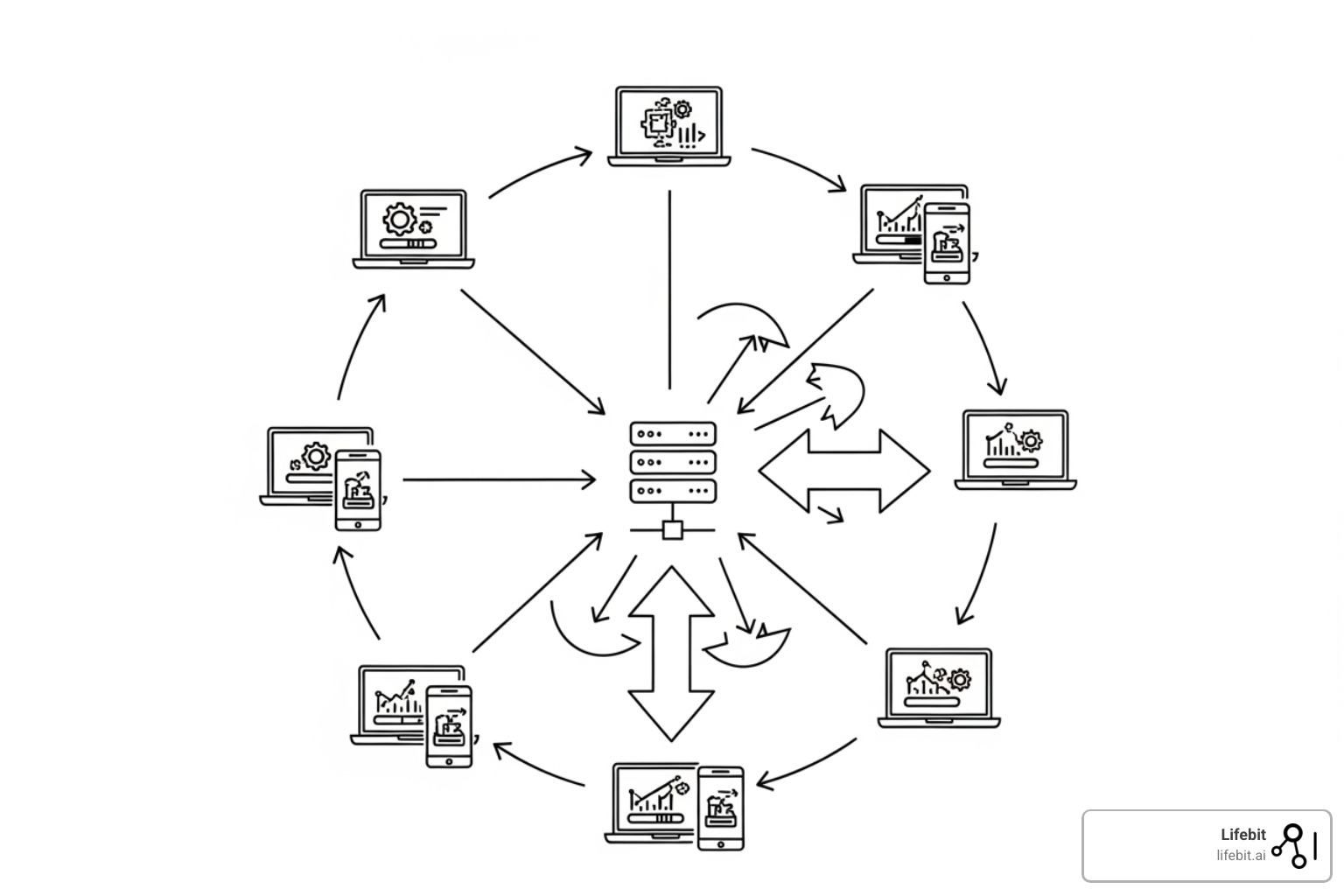
Think of it like this: you’re not moving data around the galaxy. Instead, you’re sending teachers to each planet, letting them learn locally, and then sharing only the lessons learned—never the private stories behind them.
The implementation begins with initialization and distribution. We define the initial AI model architecture and its starting parameters—essentially creating a “seed” model that holds the potential for greatness but hasn’t yet learned anything specific. This seed is then securely distributed to all participating organizations or devices within your federation. Each member receives an identical starting point.
Next comes local training, where the real magic happens. Each participant downloads the global model and trains it using their own private dataset. This training occurs entirely within their secure environment—behind their own firewalls, within their own data centers, under their own governance. The raw data never budges. What does emerge from this local training are the model updates, or gradients, which represent the adjustments the model needs to make based on what it learned from that specific dataset.
The aggregation and model updates phase is where individual wisdom becomes collective intelligence. Each participant sends only these encrypted model updates back to a central server—not a single byte of raw data. The server aggregates these updates, typically by averaging them, to create a new, improved global model. It’s like each planet sharing battle strategies without revealing their secret weapons.
Finally, iteration and convergence ensures continuous improvement. The updated global model is redistributed to all participants, and the entire cycle repeats. With each iteration, the model learns from more perspectives, becoming more robust and accurate. This continues until the model reaches a predefined level of performance or convergence, meaning it has effectively learned from the collective knowledge of the entire federation.
But let’s be honest—building a robust AI federation isn’t all smooth sailing. Just like coordinating a diverse galactic alliance, we encounter real obstacles that demand strategic solutions. Understanding these challenges upfront is what separates a successful federation from one that struggles to get off the ground.
Overcoming the Top Challenges in AI for Federation
The path to a fully operational AI for Federation requires navigating several key challenges. These aren’t impossible, but they do require thoughtful approaches and the right technical strategies.
Data heterogeneity and interoperability is often the first hurdle. Data across different organizations can be incredibly diverse—varying in format, quality, and statistical distribution. One hospital might use ICD-10 codes while another uses SNOMED CT. One lab might measure values in milliliters while another uses liters. This “statistical heterogeneity” can make it difficult for models to generalize effectively across the federation. Our strategy involves robust data harmonization capabilities built directly into our platforms, ensuring that disparate datasets can contribute meaningfully to a unified model. Ensuring that datasets and parameters of local nodes are interoperable is crucial for seamless collaboration.
Communication overhead and bandwidth constraints present another practical challenge. In a federated setup, model updates are constantly flowing between participants and the central server. For large models or a vast number of participants, this can strain network bandwidth and slow down training. We address this through model pruning and compression—streamlining the locally trained model before transmission, reducing the amount of data transferred without significant loss in model quality.
Security risks and preventing data leakage remain concerns even in federated systems. While federated learning is inherently privacy-preserving, sophisticated adversaries could still attempt to infer sensitive information from shared model updates or inject malicious updates. We mitigate these risks by implementing advanced encryption frameworks and cryptographic techniques like secure multi-party computation and differential privacy. These add protective layers that further obscure individual data points. Strategies for preventing data leakage are continuously evolving, with researchers developing innovative approaches that improve both transparency and accountability.
The privacy-accuracy trade-off is perhaps the most delicate balancing act. More aggressive privacy-preserving techniques can sometimes slightly reduce model accuracy, and vice versa. Our approach is to work closely with legal and technology teams to carefully calibrate this balance based on the specific application and regulatory requirements. In pharmacovigilance, where patient safety is paramount, we prioritize privacy while ensuring the model maintains sufficient accuracy for critical safety surveillance.
Transparency and accountability can be challenging when raw data remains private. How do you verify model outputs for accuracy, fairness, and bias if you can’t see the underlying data? We address this by incorporating consensus algorithms and auditable logging mechanisms. These systems ensure that important information about model updates and performance is recorded, fostering transparency throughout the federation. Researchers are also exploring methods for “federated unlearning,” which would allow us to efficiently erase a participant’s data influence from the global model if needed, further enhancing data governance.
Finally, incentives for participation matter more than many realize. Ensuring all members of the federation participate truthfully and contribute effectively is vital for success. We design our federated platforms to provide clear benefits and demonstrable value to all participants, fostering a collaborative environment where shared success becomes the ultimate reward. When everyone wins, everyone stays engaged.
Real-World Wins: How Federated AI Is Already Saving Money, Time, and Lives
The promise of AI for Federation isn’t some distant future vision – it’s already changing industries today, delivering measurable results that directly impact bottom lines and save lives. Think of it as our galactic alliance moving from theory to action, with each successful deployment proving that collaborative intelligence without data sharing isn’t just possible, it’s superior.

In healthcare and pharmacovigilance, federated AI is genuinely revolutionary. Picture multiple hospitals across London, Berlin, and Boston working together on a rare disease diagnosis model. Each hospital keeps its patient records locked down tight within its own secure walls, yet they’re collectively training an AI that learns from thousands of diverse cases. This is exactly what our platform enables. The results are striking: a collaborative federated model achieves 99% of the quality you’d get from pooling all the data centrally, but it’s 13 times faster and doesn’t require a single patient record to leave its home institution. This approach accelerates drug findy, powers therapeutic innovation, and enables real-time adverse drug reaction surveillance across global healthcare networks. When every day matters in identifying drug safety signals, this speed advantage literally saves lives.
Financial services institutions are seeing similar breakthroughs. Banks in New York, London, and Singapore can now collectively train fraud detection models without ever sharing their customers’ financial records. They’re generating more accurate credit scores by learning from diverse populations while maintaining strict compliance with financial privacy regulations. The collective intelligence approach catches fraud patterns that individual institutions would miss, reducing losses while respecting data sovereignty requirements across different jurisdictions.
Your smartphone’s smart assistant probably already uses federated learning, even if you didn’t know it. That predictive text that seems to know exactly what you’re typing, your voice recognition that understands your accent better every day, or those eerily accurate photo suggestions – they’re all improving through federated training. Your device learns from your personal usage patterns locally and sends only encrypted model updates to the cloud. Your actual messages, photos, and voice recordings never leave your phone. Major collaboration platforms have taken this approach, offering meeting summarization and multilingual support. In large-scale deployments across 32 languages, teams have achieved 97% of the AI quality compared to centralized models while slashing costs by more than 94%. That’s the efficiency of AI for Federation in action.
In manufacturing and industrial IoT, factories across different continents are aggregating sound and image data from assembly lines to detect machine breakdowns and defective products before they become expensive problems. Each factory keeps its sensitive operational data local – protecting competitive intelligence and trade secrets – while contributing to a global model that makes every participating facility smarter and more efficient. The same federated approach powers security analytics, where distributed networks detect cyber threats collectively without sharing sensitive network traffic data that could itself become a vulnerability.
Even environmental monitoring is benefiting. Imagine satellite imagery from multiple countries feeding into climate and sea-level rise prediction models. Each nation maintains sovereignty over its data – crucial for geopolitical reasons – yet scientists gain access to the comprehensive datasets needed for accurate regional predictions. This is collaborative intelligence that respects borders while solving borderless problems.
The Next Frontier: LLMs and the Rise of Federated Intelligence
Large Language Models represent the newest frontier for federated AI, and the implications are enormous. These AI powerhouses traditionally required centralizing massive datasets in expensive data centers, effectively locking out smaller organizations and most of the world’s data from contributing to their development.
But AI for Federation is changing that equation completely. The research paper “The Future of Large Language Model Pre-training is Federated” makes a compelling case that federated learning can open up the majority of the planet’s data and computational resources for LLM pre-training – resources that data-center-centric methods currently can’t touch. Organizations with private data sources and computational resources can now collaborate on pre-training LLMs with billions of parameters without centralizing anything.
Our internal work demonstrates that federated training scales beautifully with model size, enabling billion-scale federated LLM training using surprisingly limited resources. The approach proves remarkably resilient to the classic challenges of statistical and hardware heterogeneity across different sites. Even with partial participation – when not all nodes are available for every training round – convergence remains robust. This opens the door to truly compute-efficient collaborative training that was simply impossible before.
Beyond individual LLMs, we’re witnessing the emergence of Federated Intelligence – a fascinating evolution that combines federated learning with collective intelligence. Think of it as changing a fleet of individual starships into a coordinated armada. The Federation of Agents (FoA) research framework exemplifies this shift, enabling specialized AI agents to collaborate dynamically based on their capabilities rather than following rigid scripts.
The results are remarkable. FoA shows a 13-times improvement over single-model baselines and a 6.5-times improvement over uncoordinated ensemble approaches on complex benchmarks like HealthBench Hard. It consistently outperforms across all evaluated themes, proving that when specialized AI agents truly unite, their collective intelligence far exceeds what any individual model can achieve. This points toward a future of decentralized intelligence where individual agents learn and contribute without centralizing power or data – a vision of collaborative AI that’s both more powerful and more democratic than anything we’ve seen before.
Conclusion: Don’t Get Left Behind—Join the AI Federation Revolution
The old way of doing AI is dying. And honestly? It’s about time.
For too long, we’ve been stuck in a world where using powerful AI meant choosing between innovation and privacy. Where collaboration required data centralization. Where regulations like GDPR felt like roadblocks instead of guardrails. That world doesn’t work anymore – not for healthcare, not for pharma, not for anyone dealing with sensitive, regulated data.
AI for Federation changes everything. It’s not just a technical upgrade; it’s a fundamental rethinking of how we build intelligent systems. This is collaborative AI that respects boundaries. Data-centric AI that keeps data where it belongs. Privacy-preserving technology that doesn’t compromise on performance.
The numbers tell the story. Federated models achieve 99% of centralized model quality while being 13 times faster. Organizations reduce data transfer costs by over 70%. Real-time pharmacovigilance becomes possible across institutions that would never share raw patient data. These aren’t theoretical benefits – they’re happening right now, across hospitals in London, research centers in New York, regulatory agencies in Singapore, and pharmaceutical companies spanning five continents.
We’re not just watching this revolution unfold. At Lifebit, we’ve spent over a decade building the infrastructure that makes it real. Our next-generation federated AI platform powers secure drug findy and real-world evidence generation across global healthcare networks. The Trusted Research Environment (TRE), Trusted Data Lakehouse (TDL), and R.E.A.L. (Real-time Evidence & Analytics Layer) aren’t buzzwords – they’re working systems delivering real-time insights, AI-driven safety surveillance, and secure collaboration across hybrid data ecosystems right now.
Your data holds answers. Answers that could save lives, accelerate drug development, or catch adverse reactions before they become crises. But those answers are trapped in silos, locked away by legitimate privacy concerns and regulatory requirements. AI for Federation is the key that opens up those insights without ever exposing the raw data itself.
The future of AI development isn’t about hoarding data in massive central repositories. It’s about intelligent collaboration where everyone contributes, everyone benefits, and nobody has to sacrifice privacy or control. It’s about building collective intelligence that respects individual sovereignty – exactly like our galactic alliance, where shared strategies never require surrendering secrets.
Don’t let your organization get left behind because your data can’t travel. The federation is here. The technology works. The results speak for themselves.
Learn how federated technology can be used for real-time adverse drug reaction surveillance and see what becomes possible when privacy and innovation finally work together instead of against each other.