

AI for Patient Safety: From Clinical Trials to the Bedside

The Primary Benefits of Integrating AI for Patient Safety
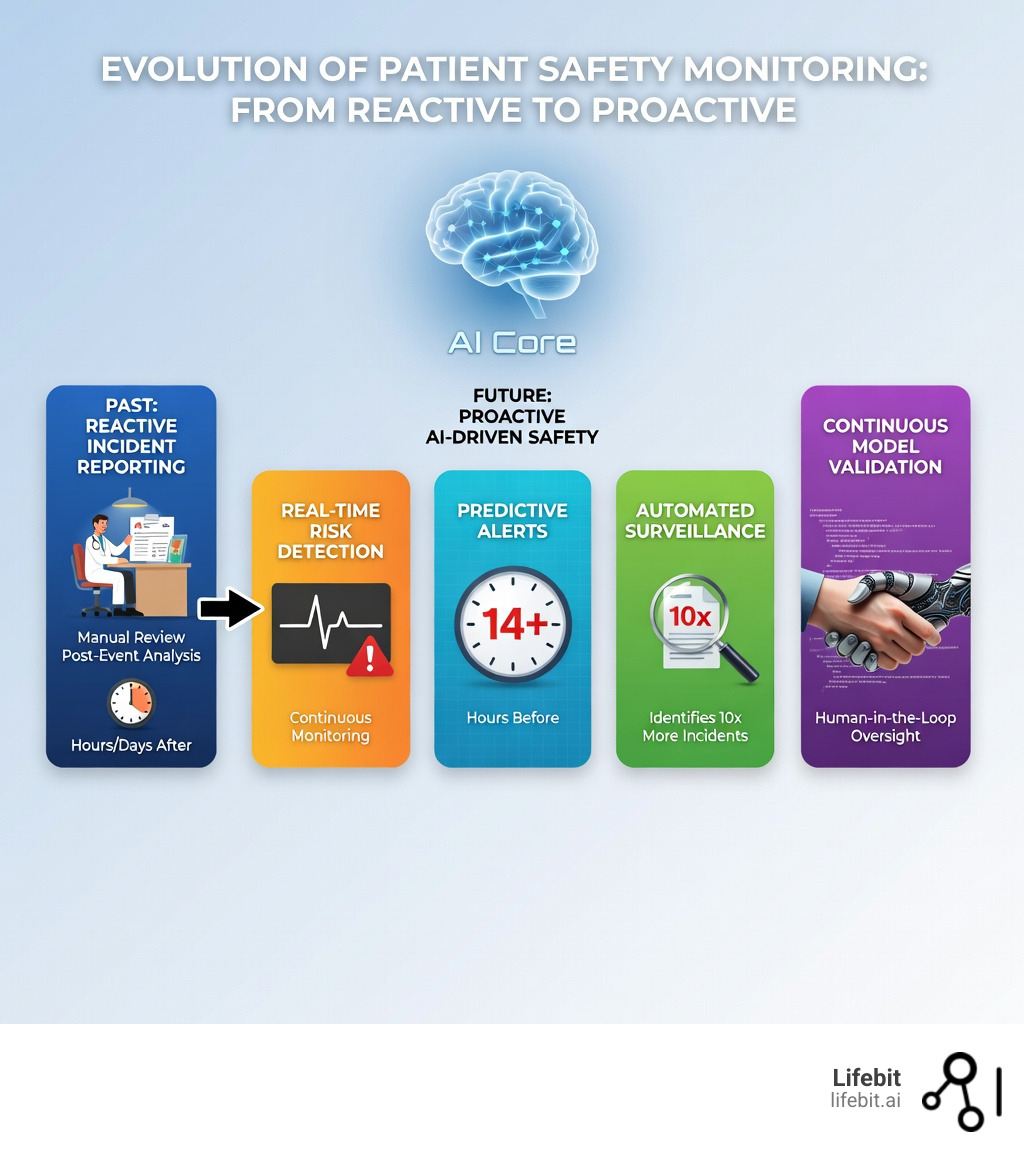
AI for patient safety is changing healthcare by enabling early detection of clinical deterioration, reducing diagnostic errors, and automating safety surveillance—preventing harm before it occurs. From predicting sepsis 14 hours before cardiac arrest to identifying medication errors with 95% precision, AI systems are moving patient safety from reactive reporting to proactive risk management.
In the traditional healthcare model, safety is often viewed through the lens of the “Swiss Cheese Model,” where multiple layers of defense (human checks, protocols, physical barriers) have holes. When these holes align, an adverse event occurs. AI acts as a dynamic, intelligent layer that can identify when these holes are beginning to align in real-time, providing a safety net that is far more robust than manual oversight alone.
Key benefits of AI for patient safety include:
- Early detection: AI identifies sepsis, falls, and deterioration hours before events occur, allowing for preemptive clinical intervention.
- Diagnostic support: Models like Med-PaLM-2 match physician-level accuracy on medical exams and provide a “second set of eyes” for complex differential diagnoses.
- Error reduction: Automated analysis catches 10x more safety incidents than manual review by scanning unstructured data in electronic health records (EHRs).
- Workflow efficiency: AI reduces documentation burden by hours per clinician per day, directly addressing the burnout that often leads to human error.
- Predictive monitoring: Machine learning detects vital sign artifacts with >87% accuracy, significantly reducing the “noise” of non-actionable alarms.
However, implementation requires careful governance. A widely used sepsis AI picked up only 7% of cases in one study, delaying treatment for 1,709 patients. Success depends on continuous validation, diverse training data, and human-AI collaboration that augments rather than replaces clinical judgment.
As CEO and Co-founder of Lifebit, I’ve spent over 15 years building federated platforms that enable secure, compliant biomedical data analysis at scale—work that’s central to advancing AI for patient safety across clinical trials and real-world care. My experience spans computational biology, precision medicine, and the ethical deployment of AI in healthcare settings where data quality and patient trust are non-negotiable.
Related content about AI for patient safety:
- AI for Pharmacovigilance Ultimate Guide
- Beyond Vigilance: AI’s Role in Proactive Drug Safety
- AI-Powered Pharmacovigilance Guide 2025
When we talk about AI for patient safety, we aren’t just talking about fancy gadgets; we’re talking about a fundamental shift in how we protect lives. The primary benefit is the ability to process massive, unstructured datasets that humans simply can’t keep up with. In pilot testing at major institutions like Stanford Children’s, patient safety officers validated AI’s choice of issues 93% of the time. This isn’t just a “nice to have”—it’s a force multiplier for safety teams.
Enhancing Medication Safety with AI
Medication errors are among the most common types of medical mistakes, affecting millions of patients annually. AI for patient safety addresses this by automating the “Five Rights” of medication administration: the right patient, the right drug, the right dose, the right route, and the right time. AI solutions that address deterioration from sepsis have been associated with significant reductions in mortality across multiple health systems. For example, a hybrid algorithm used for medication entity identification reached a precision of 95.0% and a recall of 91.6%.
By automating the “boring” stuff—like creating a taxonomy of problems (where AI achieved 91% accuracy for parent categories)—we allow clinical teams to focus on the high-stakes interventions that save lives. Furthermore, AI can cross-reference a patient’s entire genetic profile and history of drug-drug interactions in milliseconds, a task that would take a human pharmacist significantly longer and be prone to oversight.
Research published in JAMA Health Forum highlights that while the promise is immense, the real value lies in clinical decision support (CDS) that actually works at the bedside, providing actionable insights rather than just more data points.
Reducing Diagnostic Errors with AI for Patient Safety
Diagnostic errors are a silent epidemic, contributing to nearly 1 in 10 patient deaths in some settings. This is where AI for patient safety truly shines. Models like Med-PaLM-2 have reached physician-level performance on medical licensing examination-style questions. In blinded studies, physicians actually preferred Med-PaLM-2’s answers on eight out of nine dimensions when compared to answers written by human peers.
But it’s not about replacing the doctor; it’s about the “second set of eyes.” Physicians with AI support are more accurate than unaided physicians in reaching correct diagnoses and developing comprehensive differential diagnoses. By reducing diagnostic delays, we prevent the “domino effect” of medical errors that often starts with a single missed clue. For instance, in radiology, AI can flag potential anomalies in X-rays or MRIs that might be missed by a fatigued radiologist at the end of a 12-hour shift, ensuring that critical findings are prioritized for human review.
Streamlining Clinical Workflows to Prevent Burnout
We can’t talk about patient safety without talking about the people providing the care. Clinician burnout is a safety risk. A tired doctor is more likely to make a mistake. Administrative burdens, such as quality measure reporting, cost a single institution an estimated $5.6 million annually. This “cognitive tax” reduces the mental bandwidth available for direct patient care.
AI-assisted documentation and ambient listening tools can reduce this administrative load significantly. When AI handles the “pajama time” (the hours clinicians spend charting at home), it indirectly improves AI for patient safety by ensuring that when a clinician is with a patient, they are rested, focused, and present. Ambient AI can capture the nuances of a patient-doctor conversation, ensuring that no critical detail is lost in the transition from the exam room to the electronic record.
Moving from Reactive to Proactive Safety Monitoring
The old way of doing things was reactive: a patient got hurt, we filed a report, and we held a meeting to make sure it didn’t happen again. This “autopsy-based” approach to safety is inherently limited because it requires harm to occur before a lesson is learned. AI for patient safety flips this script. We are moving toward identifying “near misses” and risk indicators before harm occurs, creating a “pre-emptive” safety culture.
Take the Deterioration Early Warning System (DEWS). In research on proactive risk assessment, DEWS identified more than 50% of patients with in-hospital cardiac arrest up to 14 hours before the event. That is a massive window for intervention that traditional systems like the Modified Early Warning Score (MEWS) simply don’t provide. While MEWS relies on static thresholds, AI-driven DEWS looks at the trajectory of a patient’s data, spotting subtle trends that precede a crisis.
Leveraging Real-Time Data for Proactive AI for Patient Safety
Real-time surveillance is the holy grail of clinical care. Machine learning models can now distinguish clinically relevant pulse arterial O2 saturation and blood pressure readings from “artifacts” (technical glitches caused by a patient moving or a sensor slipping) with an AUC of over 0.87. This is critical because it directly addresses “alarm fatigue.”
Alarm fatigue occurs when clinicians become desensitized to the constant ringing of monitors, 85% to 99% of which are often non-actionable. By using AI to filter out the noise, we ensure that when an alarm goes off, it actually means something, allowing for faster response times to genuine emergencies.
Specific use cases include:
- Sepsis Alerts: Predicting deterioration hours before clinical onset by analyzing heart rate variability and lactate trends.
- ABC4D: A safe insulin bolus dosing system that reduces postprandial hypoglycemia by predicting glucose fluctuations.
- Fall Prevention: Using EHR data and computer vision sensors to predict which patients are at high risk of a tumble, allowing nurses to intervene before the patient attempts to get out of bed unassisted.
- Pressure Injury Prediction: Using random forest models to achieve up to 98% prediction accuracy for hospital-acquired pressure ulcers, enabling early repositioning and specialized bedding protocols.
Digital Twins and Predictive Modeling
One of the most exciting frontiers in AI for patient safety is the concept of the “Digital Twin.” This involves creating a virtual model of a patient’s physiology based on their real-time data, genetics, and medical history. Clinicians can use this twin to simulate the effects of a specific medication or surgical procedure before performing it on the actual patient. This allows for a level of personalized safety planning that was previously impossible, identifying potential adverse reactions in a virtual environment rather than at the bedside.
Lessons from High-Reliability Industries
We often look to aviation or nuclear power for safety inspiration. Why? Because they are “high-reliability” industries. They don’t just hope for the best; they engineer for it. In healthcare, we can use AI to reduce variance—the “luck of the draw” depending on which doctor you see or what time of day you’re admitted. By using AI to standardize care protocols and provide real-time checklists, we ensure that every patient gets the same high-quality, consistent care, regardless of geographic or shift-based differences. AI doesn’t get tired, it doesn’t have “off days,” and it doesn’t forget to check a box.
Navigating Risks, Ethics, and Governance in Healthcare AI
Let’s be honest: AI isn’t perfect. A widely publicized sepsis detection system picked up only 7% of 2,552 sepsis patients in one study. That means it missed 1,709 patients that the hospital’s own manual methods caught. This is a sobering reminder that AI for patient safety is a tool, not a cure-all. If clinicians rely too heavily on a flawed algorithm, it can actually create new safety risks—a phenomenon known as “automation bias.”
Public concern is real. A poll by the Artificial Intelligence Policy Institute shows overwhelming concern about AI risks. We must address “black box” issues where we don’t know how the AI reached a conclusion. Trust is built through transparency and continuous monitoring. This is why “Explainable AI” (XAI) is so important; a doctor shouldn’t just be told a patient is at risk; they should be shown why (e.g., “Risk score high due to rising respiratory rate and falling pH”).
Regulatory Frameworks and Stakeholder Considerations
Governance isn’t just a hurdle; it’s a safety feature. Frameworks like the EU Medical Device Regulation (MDR) and the 2023 Biden Executive Order on AI Safety are setting the stage for how we manage these tools. The upcoming EU AI Act, for instance, classifies many healthcare AI applications as “high-risk,” requiring rigorous documentation, logging, and human oversight.
We need clear lines of accountability: if an AI makes a wrong call, who is responsible? Regulators, developers, and clinicians must work together to ensure that “Software as a Medical Device” (SaMD) is held to the highest safety standards. This includes “post-market surveillance,” where the performance of an AI model is tracked in the real world to ensure it doesn’t degrade over time—a process known as “model drift.”
Ensuring Equity and Trust in AI Models
If an AI is trained only on data from one demographic, it may not work for another. This is the “bias” problem. For example, a pulse oximetry algorithm that is less accurate on darker skin tones can lead to delayed oxygen therapy. We need diverse datasets to ensure that AI for patient safety works for everyone, regardless of race, gender, or socioeconomic status.
At Lifebit, we address this through federated learning, which allows AI models to be trained on diverse, global datasets without the data ever leaving its original, secure location. This preserves patient privacy while ensuring the AI is exposed to the widest possible range of human biology. Improving health literacy through AI-driven communication tools can also help bridge the gap, ensuring patients understand their care and can advocate for their own safety. When patients trust the technology, they are more likely to engage with it, creating a virtuous cycle of data quality and safety.
Specific Use Cases: From Chatbots to Documentation
How does this look in practice? The impact of AI for patient safety is best understood through the measurable improvements it brings to clinical environments. By moving from manual, retrospective audits to real-time, AI-assisted reviews, hospitals are identifying risks that were previously invisible.
| Feature | Manual Review | AI-Assisted Review |
|---|---|---|
| Detection Rate | Baseline | 10x More Incidents Identified |
| Time Spent | 100+ Hours/Month | ~15 Hours/Month (Validation Only) |
| Accuracy (Taxonomy) | Variable | 91% (Parent Categories) |
| Proactive Lead Time | 0 Hours (Post-Event) | 14+ Hours (Pre-Event) |
| Data Scope | Sampled (e.g., 10% of charts) | Comprehensive (100% of charts) |
Natural Language Processing (NLP) and Unstructured Data
Approximately 80% of medical data is unstructured—hidden in clinician notes, discharge summaries, and social worker reports. Standard safety tools often miss this data. NLP-assisted review has identified an additional 728 patients with evidence of opioid use problems that were missed in standard clinical notes. By “reading” between the lines, AI can identify social determinants of health or behavioral cues that suggest a patient is at high risk for readmission or self-harm.
AI in the Operating Room and Specialized Care
In the surgical suite, AI is being used to improve “surgical counts” (ensuring no sponges or instruments are left inside a patient) using computer vision. It can also monitor the phases of a surgery, alerting the team if a critical safety step, like a “time-out,” has been bypassed.
Other specific use cases include:
- Patient-Facing Chatbots: AMIE (Articulate Medical Intelligence Explorer) showed greater performance on 28 of 32 dimensions assessed by specialist physicians, providing patients with accurate, empathetic triage before they even reach the ER.
- Medication Dispensing: AI interfaces designed with pharmacist input to catch errors before the pill reaches the patient, using barcode validation and dose-checking algorithms.
- Mental Health: NLP of clinical notes adds predictive value to suicide risk models, catching linguistic cues (such as changes in sentiment or social withdrawal) that human reviewers might miss during a brief consultation.
- Radiology “Second Reader”: AI algorithms that pre-scan thousands of images to flag urgent cases (like a brain bleed or pneumothorax), ensuring the most critical patients are moved to the top of the radiologist’s queue.
Frequently Asked Questions about AI in Healthcare
How does AI reduce clinician burnout?
AI acts as a “digital scribe,” automating documentation, coding, and prior authorizations. By handling these repetitive, low-value tasks, it reduces the cognitive load on clinicians, allowing them to focus on the patient. This “indirect” safety benefit is huge—a clinician who isn’t drowning in paperwork is a safer clinician. When doctors have more time to think and interact, they are less likely to miss subtle clinical cues.
What are the biggest risks of AI in patient care?
The biggest risks include algorithmic bias (where the AI is “unfair” to certain groups), hallucinations (where generative AI makes things up), and over-reliance (where clinicians stop questioning the machine). We also have the risk of “model drift,” where an AI’s performance degrades over time as patient populations or clinical practices change. For example, an AI trained before COVID-19 might struggle to accurately predict respiratory failure in a post-pandemic world without retraining.
Can AI replace human clinical judgment?
Absolutely not. We view AI as augmented intelligence. It provides the data, the patterns, and the alerts, but the final decision—the “human touch”—must remain with the clinician. AI is great at math and pattern recognition across millions of data points; humans are great at context, compassion, and handling the “unforeseen” gaps in the system. The goal is a “human-in-the-loop” system where AI handles the data processing and humans handle the complex decision-making.
How does AI impact the cost of patient safety?
While the initial investment in AI infrastructure can be significant, the long-term savings are substantial. By preventing adverse events like sepsis or falls, hospitals save millions in non-reimbursable care costs and legal liabilities. Furthermore, AI-driven efficiency reduces the administrative cost of safety reporting, which currently costs large health systems millions of dollars annually in manual labor.
Is patient data safe when using AI?
Data privacy is a paramount concern. Modern AI implementations use techniques like data encryption, de-identification, and federated learning to ensure that patient identities are protected. At Lifebit, our federated approach ensures that sensitive biomedical data stays behind the hospital’s firewall, while still allowing the AI to learn from the patterns within that data. This “privacy-by-design” approach is essential for maintaining patient trust.
Conclusion: The Future of High-Reliability Care
The future of healthcare is high-reliability care, powered by AI for patient safety. We are standing at the threshold of a new era where medical errors are no longer seen as an inevitable byproduct of a complex system, but as preventable events that can be intercepted by intelligent technology. But we can’t get there without a foundation of secure, harmonized, and diverse data.
At Lifebit, we are building the infrastructure that makes this possible. Our next-generation federated AI platform allows organizations to access global biomedical and multi-omic data without moving it—ensuring compliance with the strictest global privacy laws. Through our Trusted Research Environment (TRE) and Trusted Data Lakehouse (TDL), we enable the real-time insights needed for advanced pharmacovigilance and safety surveillance.
By leveraging our Real-time Evidence & Analytics Layer (R.E.A.L.), health systems and biopharma can move from reactive reporting to a future where patient harm is predicted and prevented. The journey from clinical trials to the bedside is complex, but with the right AI governance and federated technology, we can make “zero harm” a reality. The technology is here; the challenge now is to implement it with the transparency, equity, and clinical rigor that patients deserve.
Ready to see how federated AI can transform your safety outcomes?
Contact us today to learn more about Lifebit’s federated AI solutions.