

The 4 Big Challenges with Airlock & how Lifebit’s AI-Automated Airlock solves them for Trusted Research Environments

1. What is Airlock?
It is the mechanism by which authorised personnel review, approve, or reject data leaving secure research environments.
In biomedical research, these environments, known as Trusted Research Environments (TREs), hold sensitive health data such as genomic, clinical, or demographic information. Airlock acts as a secure gateway, ensuring that only approved, non-sensitive and non-individual-level results data can be exported out of the Trusted Research Environment.
It’s not just a “compliance step”. A good airlock system enforces governance, provides accountability, and ensures every data export is traceable and transparent. In simple terms, it keeps sensitive information inside a Trusted Research Environment where it belongs and lets only safe, approved data outputs out.
2. Why Is Airlock Needed in TREs?
Trusted Research Environments are specifically designed to host and protect highly sensitive health data and must therefore enforce strict controls over what leaves the environment. These environments should comply with global data protection and governance standards, such as the 5 Safes Framework, GDPR, HIPAA, FedRAMP, and institutional ethics standards, all of which set firm requirements for how data exports are handled.
Without robust Airlock governance, sensitive or identifiable information could unintentionally exit a secure environment, undermining compliance, exposing patients to privacy risks, and eroding institutional trust in the TRE model. A fit-for-purpose Airlock is what ensures that TREs remain truly “trusted,” by guaranteeing that every export is reviewed, justified, and compliant with the policies that safeguard the data.
3. The 4 Big Challenges of Airlock
As organisations scale their research, the need for controlled and compliant data export becomes more complex. Different Airlock approaches have emerged over time, but each carries its own operational challenges. These challenges fall into 4 major categories:
Challenge 1: Scalability Limits of the Traditional (Manual) Airlock Model
The Manual Airlock model, where every export is reviewed by a human, provides strong oversight but quickly becomes a bottleneck as research environments grow.
Common issues include:
- Reviewer workload grows exponentially as users and workflows scale
- Inconsistencies appear across reviewers or institutions
- Approvals take longer and delay project timelines
- Complex exports increase the risk of human error
Manual models simply do not scale for modern TREs that support national-level cohorts, multi-modal workflows, and large user populations.
Challenge 2: Governance Complexity in Federated Models
When research spans multiple TREs or data sites, each site retains full governance control. This ensures local oversight but complicates cross-site data export.
Typical issues in federated environments include:
- Every site has its own rules, policies, and approval workflows
- Each TRE/data site must approve its own results before federation
- Multi-site exports create fragmented or duplicated audit trails
- Manual coordination struggles when analyses span many institutions
Federation introduces governance complexity that traditional or siloed Airlock tools cannot manage.
Challenge 3: Rule-Based Automation Alone Is Not Enough
Basic automated models rely on rules or patterns to decide whether an export is safe. While faster than manual review, they lack the nuance required in biomedical research.
Limitations include:
- Static rules may incorrectly block safe files or miss sensitive ones
- Sensitive content detection can be incomplete or unreliable
- Governance teams must continually update and maintain rulesets
- Rules lack contextual understanding of scientific outputs
Rule-based automation increases throughput, but without intelligence it cannot replace the nuanced judgement needed for complex analyses or high-risk data.
Challenge 4: Fragmented Oversight Across Multiple Airlock Models
Most organisations operate more than one model depending on the sensitivity of the data, type of user access, maturity of the programme, or structure of research collaborations.
Typical fragmentation includes:
- Manual checks for highly sensitive exports
- Automated checks for trusted workflows
- Federated approvals for multi-site analyses
- Semi-automated approaches for mixed-risk scenarios
Managing these models independently often leads to duplication, inconsistent enforcement, and difficulty maintaining a coherent governance approach.
4. How does Lifebit’s AI-Automated Airlock solves these challenges?
Lifebit’s AI-Automated Airlock was designed specifically to address these 4 core Airlock challenges. By combining AI-powered checks, configurable governance, full auditability and federated capability, it ensures safe, scalable and intelligent results data export across any TRE architecture.
“Traditional results data export controls haven’t evolved for the number of user scale and sensitivity of modern biomedical research. With the Lifebit AI-Automated Airlock, we’re introducing a completely new model — one where AI takes care of compliance automatically, so researchers can focus on discovery and authorities on increasing and enriching datasets. This is the first system in the industry that brings intelligence, trust, and transparency to every results data export.”
— Maria Dunford, CEO of Lifebit, commented in the corresponding press release.
Key Capabilities
✅ Solving Challenge 1: Scalability
Lifebit introduces AI-powered pre-checks and automated policy-based approvals, dramatically reducing manual workload.
This ensures:
- Exports from trusted workflows can be auto-approved
- AI assists reviewers by flagging potentially sensitive content
- Manual review is reserved only for genuinely high-risk cases
- Approvals speed remains consistent even as users or datasets grow
This transforms manual bottlenecks into scalable, predictable review flows.
✅ Solving Challenge 2: Governance Complexity in Federated Setups
Lifebit provides the only production-grade federated Airlock, purpose-built for multi-site research.
It ensures:
- Each site retains full data governance and oversight
- Approvals are captured with standardised metadata across all TREs
- All exports (from every site) are fully logged and traceable
- Federated workflows trigger coordinated approvals automatically
This enables fast, compliant cross-institution collaboration without compromising local control.
✅ Solving Challenge 3: Limitations of Rule-Based Automation
Lifebit’s solution goes beyond rules by adding multi-check controls, AI-driven sensitivity detection, content analysis, and contextual understanding.
This allows the system to:
- Detect sensitive content more accurately than static rules or 1 rule-at-a-time
- Adapt to evolving data types, workflows, and governance policies
- Reduce false flags and minimise administrative overhead
- Provide reviewers with AI enriched, contextual information that mimics human intelligence and detection sensitivity
The result: safer, human-like intelligent automation that still maintains strict compliance.
✅ Solving Challenge 4: Fragmented Oversight Across Models
Lifebit unifies manual, semi-automated, automated, and federated models into one governance framework.
Benefits include:
- One consistent governance engine across every type of export
- One audit trail, regardless of model type or workflow use
- One interface for reviewers and administrators
- Flexible configuration to support diverse programme needs, in-on-place
This provides a single, cohesive Airlock experience across all use cases and institutions.
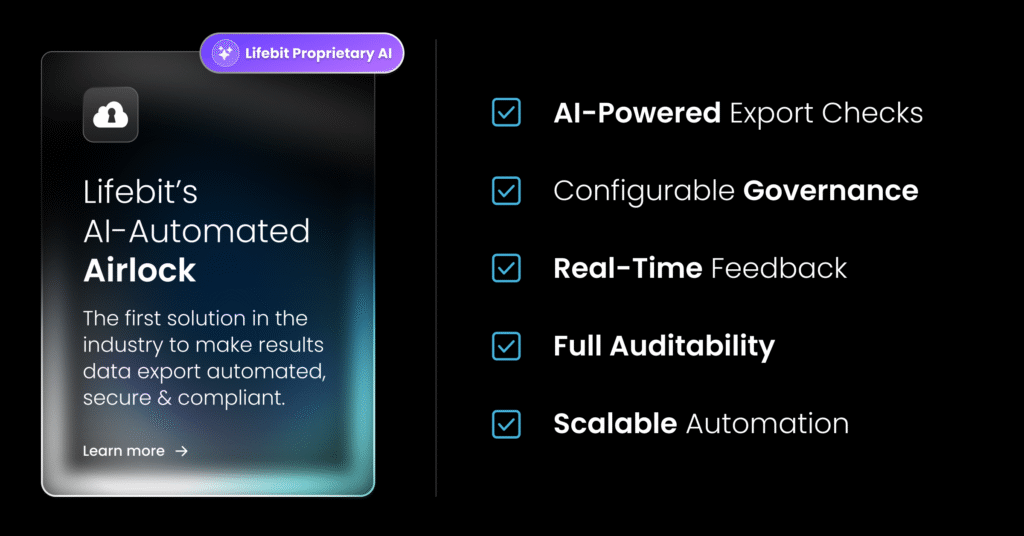
Why It’s Unique
🧑💻 Manual Review Excellence: For Trusted Research Environments requiring human oversight, Lifebit provides an advanced, intuitive interface with in-line file previews, advanced search, and metadata tracking.
⚙️ Semi and Fully Automated Checks: Built-in automation can trust verified workflows, apply policy-based conditions, and use AI to detect sensitive content, optimising security and speed of reviewing data exports.
🌐 Federated Capability: The only production-grade federated airlock in the market. It enables secure, multi-site research where each organisation retains data control but can still collaborate seamlessly on joint analyses.
Outcome
Lifebit’s Airlock doesn’t just enforce compliance — it empowers collaboration.
It transforms complex, manual oversight into a transparent, AI-governed process, ensuring that only safe and approved data leaves secure environments.
It is what truly makes a Trusted Research Environment “trusted.” Without it, a research environment cannot genuinely be called trusted.
In a world where biomedical data fuels breakthroughs, Airlock is what keeps biomedical data innovation ethical, compliant, and secure – and Lifebit’s AI-Automated Airlock is leading that transformation.