
Automated Clinical Data Curation: How AI Transforms Raw Health Data Into Research-Ready Assets
Your research team has been waiting four months for a dataset that should have taken four weeks. The culprit? Clinical data from three hospital systems that don’t speak the same language. One uses SNOMED codes. Another uses local terminology that hasn’t been updated since 2015. The third has critical information buried in physician notes written in medical shorthand. Your data scientists can’t start analyzing until someone cleans this mess—and that someone is burning through budget at an alarming rate.
This isn’t a rare scenario. It’s the default state of clinical data in 2026.
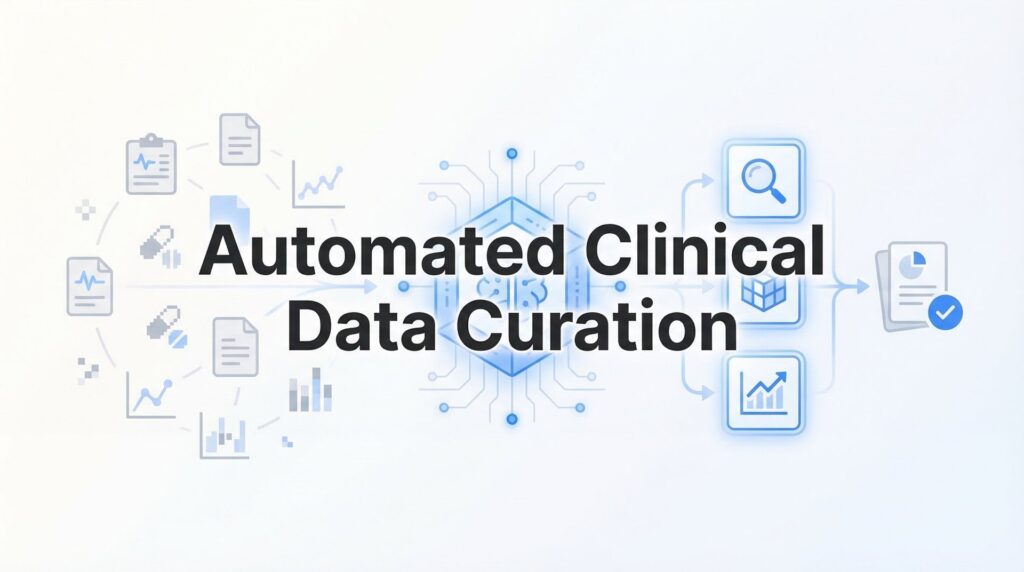
Automated clinical data curation is changing this reality. Instead of teams spending months manually standardizing, validating, and harmonizing health data, AI-powered systems handle the heavy lifting—converting incompatible formats, mapping local codes to standard terminologies, extracting structured information from unstructured notes, and flagging quality issues before they corrupt your analysis. The result is research-ready data in days instead of months, with consistency that manual processes simply can’t match.
The Real Cost of Manual Data Wrangling
Let’s be clear about what clinical data curation actually involves. It’s not just “cleaning” data in the Excel sense. It’s a multi-layered transformation process that includes standardization (converting data to consistent formats and units), validation (checking accuracy, completeness, and logical consistency), deduplication (identifying and resolving duplicate records), terminology mapping (translating local codes to standard vocabularies like SNOMED CT, LOINC, or ICD-10), and quality scoring (assessing data fitness for specific research purposes).
When done manually, this process creates predictable bottlenecks. Different analysts make different judgment calls about how to handle edge cases. One person maps “Type II Diabetes” to one SNOMED code. Another chooses a slightly different concept. These inconsistencies compound across thousands of records, creating significant challenges in health data standardisation that undermine research validity.
The scale problem becomes obvious when you’re working with multi-site data. A national precision medicine initiative might pull from 50 hospitals, each with its own EHR configuration, local terminology preferences, and data quality standards. Manual curation teams can’t maintain consistent decision-making across that complexity. They become the rate-limiting step.
Here’s what this looks like in business terms: A pharmaceutical company planning a real-world evidence study budgets six months for data preparation before analysis can begin. A government health agency delays a population health initiative because they can’t harmonize data from regional systems fast enough. An academic medical center misses a regulatory submission deadline because the data lineage documentation took longer than the actual analysis.
The hidden cost isn’t just time. It’s the research that never happens because the data preparation burden is too high. It’s the questions that don’t get asked because analysts know the data isn’t ready. It’s the competitive disadvantage when your peers are already analyzing while you’re still cleaning.
Manual approaches worked when clinical research meant a single-site study with a few hundred patients. They break down completely in the era of real-world evidence, federated data networks, and precision medicine programs that need to analyze millions of patient records across heterogeneous systems.
The Technical Pipeline: How Automation Handles the Complexity
Automated clinical data curation isn’t magic. It’s a systematic pipeline that applies AI where it excels—pattern recognition, consistency, and scale—while keeping humans in the loop for validation and edge cases.
The process starts with ingestion. Raw clinical data arrives in whatever format the source system provides—HL7 messages, FHIR resources, CSV exports from EHRs, claims files, registry data. The automation platform normalizes these varied inputs into a working format without losing critical metadata like timestamps, provenance, or data lineage information.
Next comes extraction. This is where natural language processing earns its keep. Clinical notes contain information that structured fields miss—why a medication was discontinued, the severity of a symptom, social determinants of health mentioned in provider documentation. NLP models trained on clinical text extract entities (medications, diagnoses, procedures), relationships (this drug caused that side effect), and temporal information (when did symptoms start relative to treatment).
Terminology mapping is where automation shows its real power. Converting local codes to standard vocabularies like SNOMED CT (for clinical findings and procedures), LOINC (for lab tests and observations), or RxNorm (for medications) requires understanding semantic relationships. Machine learning models trained on millions of mapping examples can suggest the correct standard code with high accuracy, flagging ambiguous cases for human review. Organizations increasingly turn to AI for data harmonization to handle this complexity at scale.
The system then transforms data to common data models. OMOP CDM has become the de facto standard for observational research. FHIR is gaining traction for interoperability use cases. Automated platforms handle the structural transformation—mapping source tables to standardized schemas, ensuring referential integrity, creating the observation periods and visit contexts that analytical tools expect. Understanding different clinical data models is essential for choosing the right approach for your research needs.
Entity resolution happens in parallel. The same patient might appear in multiple source systems with slight variations in name, date of birth, or identifiers. Machine learning models trained on matching patterns can identify these duplicates with accuracy that exceeds manual review, using probabilistic matching algorithms that account for data entry errors, nicknames, and demographic changes over time.
Quality scoring runs continuously. Algorithms flag records with missing critical fields, values outside expected ranges, temporal inconsistencies (death date before birth date), or patterns that suggest data entry errors. These quality flags become metadata that researchers can use to filter or stratify their analyses.
Here’s the crucial point: ‘automated’ doesn’t mean ‘unsupervised.’ The AI handles the repetitive, pattern-based work that would take humans months. But data stewards still validate the terminology mappings for their specific use case. Subject matter experts still review edge cases flagged by the system. The difference is that these experts spend their time on genuinely ambiguous decisions, not on mechanical tasks that machines do better.
Where Automation Delivers Measurable Impact
Real-world evidence generation is the most obvious win. Regulatory agencies increasingly accept RWE for post-market surveillance, label expansions, and even new indications. But generating credible RWE requires transforming messy EHR data into analyzable cohorts with documented data quality and provenance. Automated curation makes this feasible at scale, and understanding the benefits of real-world data in clinical research helps organizations prioritize these investments.
Think about what’s involved in defining a study cohort from EHR data. You need to identify patients with a specific condition—but that condition might be coded dozens of different ways across your source systems. You need lab values in standardized units. You need to construct treatment episodes from fragmented medication records. You need to exclude patients with data quality issues that would bias your results. Doing this manually for a multi-site study with 50,000 patients is a months-long project. Automated systems can execute the same logic in hours.
Clinical trial feasibility and site selection represent another high-value application. Before investing millions in a trial, sponsors need to know if they can recruit enough eligible patients. This requires querying across multiple potential sites, each with different EHR systems and coding practices. Platforms specializing in clinical trial data integration enable federated queries where standardized logic runs against locally curated data, returning feasibility counts without moving sensitive information. What used to take weeks of manual chart review can happen in days.
Regulatory submissions demand audit-ready data with complete lineage documentation. Reviewers need to trace every derived variable back to its source, understand every transformation applied, and verify that quality controls were consistently applied. Automated platforms generate this documentation as a byproduct of the curation process. Every terminology mapping, every deduplication decision, every quality flag is logged and traceable. This turns data lineage from a manual documentation burden into an automated compliance output.
The ROI calculation is straightforward. If your team currently spends six months preparing data for a study, and automation compresses that to six weeks, you’ve gained four months of productivity. But the real value often comes from the studies that become possible. Data that was too messy to use becomes analyzable. Questions that would have taken too long to answer become feasible. The competitive advantage comes from being able to move faster than organizations still stuck in manual workflows.
Evaluating Platforms: What Actually Matters
Not all automated curation platforms are built the same. Here’s what separates production-ready solutions from promising prototypes.
Standard Terminology Support: The platform must handle the vocabularies your data uses and the standards your analyses require. SNOMED CT, LOINC, ICD-10, RxNorm, and CPT are table stakes. But also check: Can it handle local code systems and map them to standards? Does it support the specific OMOP vocabulary version you need? Can you add custom mappings for organization-specific codes? Organizations evaluating vendors should explore data harmonization services that bridge the gap between disparate datasets.
Unstructured Data Capabilities: Clinical notes contain critical information that structured fields miss. The platform’s NLP should extract entities, relationships, and temporal information with documented accuracy. Ask for performance metrics on your specific types of notes—pathology reports require different models than progress notes. Can the system handle the medical shorthand and abbreviations common in your data?
Compliance and Security: Where does the platform run? If it’s a cloud service, which compliance certifications does it hold—HIPAA, GDPR, ISO 27001? Can it deploy in your own cloud environment for data sovereignty? Does it support the audit logging and access controls your compliance team requires? These aren’t nice-to-haves. They’re showstoppers if the platform can’t meet your regulatory obligations. For organizations handling sensitive health information, HIPAA compliant data analytics capabilities are non-negotiable.
Deployment Flexibility: Vendor lock-in is a real risk. Can you deploy the platform in your own infrastructure? Can you export curated data in standard formats? What happens if you need to switch vendors—do you lose your transformation logic and quality rules? The best platforms let you own your data pipeline, not just rent access to it.
Transparency and Explainability: Black-box transformations are unacceptable for research-grade data. You need to understand why the system made each decision. How does it handle terminology mapping conflicts? What rules does it apply for entity resolution? Can you inspect and override automated decisions? Platforms that can’t explain their logic create compliance and scientific validity risks.
Red flags to watch for: Vendors who won’t share accuracy metrics for their NLP models. Platforms that require all data to leave your environment for processing. Solutions that can’t handle your specific data types or use cases. Promises of “100% automated” curation—legitimate platforms acknowledge that human validation remains essential for edge cases and domain-specific decisions.
Questions to ask during evaluation: How do you handle ambiguous terminology mappings? What’s your accuracy on entity resolution with our types of identifiers? Can we customize transformation rules for our specific research needs? How do you maintain data lineage through the entire pipeline? Can we deploy in our sovereign cloud environment? What does the audit trail look like for regulatory submissions?
Implementation: Setting Realistic Expectations
Here’s what a typical implementation timeline looks like. A pilot project with a single data source and well-defined use case might take 4-6 weeks. This includes data profiling, configuration of transformation rules, validation of output quality, and documenting the pipeline. Production deployment across multiple data sources with ongoing curation typically takes 3-4 months, depending on data complexity and organizational readiness.
What accelerates implementation? Clear use case definition upfront. Access to subject matter experts who can validate terminology mappings. Data sources that already have basic quality controls. Organizations that treat data curation as infrastructure rather than a one-off project. Executive sponsorship that removes bureaucratic obstacles. Establishing robust clinical data governance frameworks early in the process prevents costly rework later.
What causes delays? Underestimating the data profiling phase—you need to understand what’s actually in your source systems before you can automate curation. Lack of access to data stewards who know the local coding practices. Compliance reviews that weren’t planned for. Unrealistic expectations that automation means zero human involvement.
The human element remains critical. Data stewards validate that automated mappings make sense for your specific clinical context. Subject matter experts review edge cases flagged by quality algorithms. Compliance teams verify that the pipeline meets regulatory requirements. The automation doesn’t replace these roles—it amplifies them by handling the mechanical work and escalating genuinely ambiguous decisions.
Measuring success requires the right metrics. Time-to-analysis is obvious—how long from raw data to research-ready dataset? Data quality scores matter—what percentage of records pass validation rules? Analyst productivity is telling—how many studies can your team launch in a quarter compared to before automation? Coverage is important—what percentage of your available data can you actually use for research?
The goal isn’t just faster curation. It’s unlocking data that was previously unusable because manual preparation wasn’t feasible. It’s enabling research questions that couldn’t be answered because the data wrangling burden was too high. It’s creating consistent, repeatable pipelines that generate audit-ready outputs instead of one-off manual processes that can’t be reproduced.
From Reactive Cleaning to Proactive Readiness
The fundamental shift automated clinical data curation enables is moving from reactive data cleaning to proactive data readiness. Instead of scrambling to prepare data when a research question arises, organizations build pipelines that continuously curate data as it’s generated. Instead of each study requiring months of custom preparation, standardized data assets are ready for analysis on demand.
This isn’t just about efficiency. It’s about making different kinds of research possible. Federated analyses across multiple institutions become feasible when each site can curate to common standards. Rapid response to emerging health threats becomes realistic when data pipelines can be reconfigured in days instead of months. Precision medicine programs can actually deliver on their promise when genomic and clinical data can be harmonized at scale, enabling integrated multi-omics data approaches that transform disease understanding.
The organizations moving fastest are the ones treating data curation as infrastructure, not a project. They’re investing in platforms that can grow with their needs. They’re building teams that combine domain expertise with data engineering skills. They’re establishing governance frameworks that balance automation with appropriate human oversight.
Your next step is straightforward: assess where manual data wrangling is currently your biggest bottleneck. Is it multi-site studies that take too long to launch? Real-world evidence programs that can’t scale? Regulatory submissions delayed by data preparation? Identify where automation would have the highest impact, and evaluate platforms against your specific requirements.
The New Standard for Research-Grade Data
Automated clinical data curation isn’t a luxury for organizations with unlimited budgets. It’s becoming table stakes for anyone serious about real-world evidence, precision medicine, or regulatory-grade research at scale. The gap between organizations with modern data infrastructure and those still relying on manual processes is widening rapidly.
FDA’s Real-World Evidence framework and similar initiatives from regulatory bodies worldwide are raising the bar for data quality and documentation. The volume of available clinical data continues to grow—EHRs, claims, registries, wearables, genomic databases. The research questions are getting more complex, requiring integration across data types that were previously siloed. Manual approaches simply can’t keep pace. Modern clinical data management systems are designed to handle this complexity while maintaining regulatory compliance.
The organizations that will lead in clinical research over the next decade are the ones building data infrastructure now. They’re the ones who can launch studies in weeks instead of months. They’re the ones who can answer questions that competitors can’t because the data preparation burden is too high. They’re the ones generating regulatory-grade evidence while others are still cleaning data.
The technology exists. The standards are established. The regulatory pathway is clear. What separates organizations that capture this advantage from those that fall behind is the willingness to treat data curation as strategic infrastructure rather than a tactical project. Start by evaluating your current data pipeline. Identify the bottlenecks that automation can eliminate. Find a platform that meets your compliance requirements and can deploy in your environment. Build the team that can operate and govern these systems effectively.
The data you need for breakthrough research already exists. Automated curation is what makes it usable. Get-Started for Free and discover where automation can transform your data pipeline from bottleneck to competitive advantage.