

Beginner’s Guide to Federated Data Access
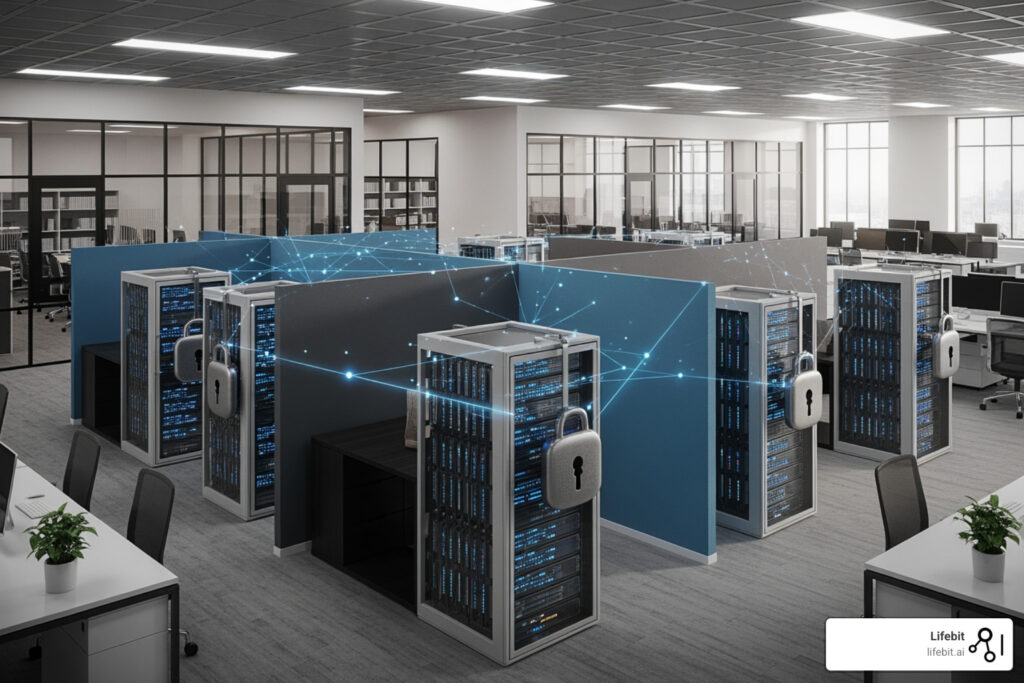
Why Nearly 97% of Enterprise Data Remains Locked Away
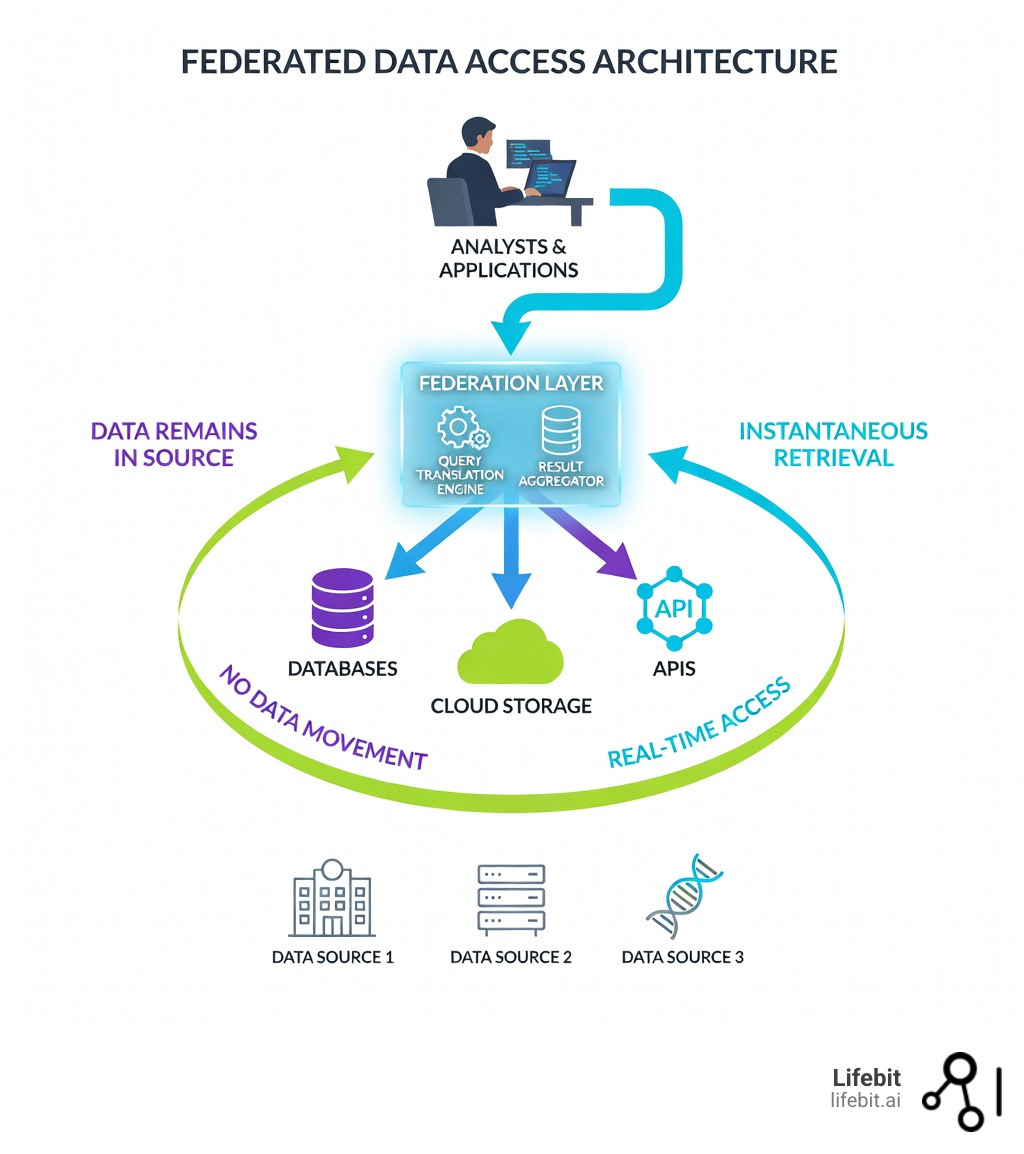
Federated data access enables organizations to query and analyze data across multiple systems—databases, cloud platforms, on-premises servers—without physically moving or copying it. Instead of extracting, changing, and loading (ETL) data into a central warehouse, federated access creates a virtual layer that connects distributed sources in real time.
Quick Answer: What You Need to Know
- Definition: A data integration approach that provides unified access to distributed data sources without physical consolidation
- How It Works: Queries are translated, routed to each source, and results are aggregated on-demand
- Key Benefit: Access fresh data in real time while avoiding costly duplication and storage overhead
- Best For: Organizations with siloed data across departments, geographies, or regulatory boundaries
- Difference from Data Warehouses: No data movement; queries run against live sources instead of historical copies
Most organizations struggle with data scattered across multiple systems. Healthcare institutions store patient records in separate EHR platforms. Pharmaceutical companies manage clinical trial data, genomics datasets, and real-world evidence in different silos. Regulatory agencies need to analyze data without moving it across jurisdictional boundaries.
Traditional ETL processes are slow, expensive, and create stale copies of data. By the time you’ve ingested and transformed everything, the insights are already outdated. Federated data access solves this by treating distributed data like a “live video stream” rather than making physical copies—you see what’s happening now, not what happened days or weeks ago.
I’m Maria Chatzou Dunford, CEO and Co-founder of Lifebit, where we’ve built a federated biomedical data platform that powers secure, compliant analysis across genomic and clinical datasets without moving sensitive patient information. Over 15 years working in computational biology and health-tech, I’ve seen how federated data access transforms research by breaking down silos while preserving privacy and control.
What is Federated Data Access and How Does it Work?
At its heart, federated data access is about virtualization. Imagine you’re trying to plan a dinner party with friends living in London, New York, and Singapore. Instead of flying everyone to one kitchen (the data warehouse approach), you all jump on a video call. Everyone stays in their own kitchen with their own ingredients, but you coordinate the cooking in real time.
In technical terms, a Federated database system acts as a meta-database management system. It transparently maps multiple autonomous databases into a single “virtual” database. When a user asks a question, the system knows exactly which “kitchen” has the right ingredients to provide the answer.
This approach is because it respects the autonomy of the original data sources. Each database keeps its own security protocols, its own format, and its own physical location. We aren’t forcing a “one size fits all” schema on them; we are building a bridge that translates between them. For a deeper dive into the collaborative side of this, check out our Federated data sharing complete guide.
The Core Architecture of Federated Data Access
To make this magic happen, we rely on a sophisticated architecture. It’s not just a simple “plug and play” connection; it’s a multi-layered system designed for speed and security.
- Federation Layer (Middleware): This is the “brain” of the operation. It sits between the users and the data sources. It receives the incoming query and decides how to break it down.
- Metadata Management: This layer keeps a catalog of what data exists where. It doesn’t store the data itself, but it knows that “PatientID” in Database A is the same as “SubjectRef” in Database B.
- Schema Mapping: This handles the translation. It resolves “semantic heterogeneities”—a fancy way of saying it fixes the problem where different systems use different names or formats for the same thing.
- Security Enforcement: Since the data stays put, this layer ensures that only authorized users can “see” the data they are allowed to access, respecting local governance rules.
| Feature | Data Federation | Data Warehousing | Data Virtualization |
|---|---|---|---|
| Data Movement | None (Virtual) | High (ETL/Copy) | None (Virtual) |
| Data Freshness | Real-time | Stale (Batch updates) | Real-time |
| Storage Cost | Low | High | Low |
| Best Use Case | Distributed, live sources | Historical analytics | Broad data abstraction |
How Query Processing Works in a Federated System
When you hit “Enter” on a query in a federated data access environment, a complex chain of events kicks off. It’s a bit like a high-speed translator at a UN summit.
First, the system performs query translation. It takes your standard SQL query and translates it into the specific “language” of each connected source—whether that’s another SQL database, a NoSQL store, or a cloud bucket.
Next comes sub-query routing. The system breaks your big request into smaller pieces and sends them to the respective sources. But it doesn’t just send them blindly; it uses something called predicate pushdown. This is a Technical detail on federated query optimization where the filtering happens at the source. Instead of bringing 1 million records back to the federation layer to find 10 specific ones, the system tells the source: “Only send me those 10.”
Finally, the aggregation phase merges the results from all sources into a single, cohesive response. To the user, it looks like the data came from one place. To the IT department, it’s a relief because the network wasn’t clogged with unnecessary data transfers.
Key Benefits: Why Organizations are Abandoning Traditional ETL
For decades, ETL (Extract, Transform, Load) was the only way to do business. But in a world where the global data integration market is projected to grow to $47.60 billion by 2034, the “old way” is becoming a bottleneck.
The most immediate benefit is real-time access. In fields like pharmacovigilance or fraud detection, waiting 24 hours for an ETL job to run is 24 hours too long. Federated access provides “up-to-the-second” data freshness.
Then there’s the cost efficiency. Organizations using logical data management achieve up to a 345% ROI. Why? Because you aren’t paying to store the same data twice (once in the source and once in the warehouse), and you aren’t paying for the massive compute power required to move petabytes of data across the globe.

Furthermore, this model offers improved organizational flexibility. If you acquire a new company or open a new lab in Canada, you don’t need to spend six months integrating their data into your warehouse. You simply plug their source into the federation layer, and they are part of the ecosystem immediately. For those looking to run complex math on this distributed data, our Guide to federated analytics explains how to get it done.
Strengthening Security and Compliance Through Federated Data Access
One of the biggest headaches for global organizations is data sovereignty. Laws like GDPR in Europe or specific health data regulations in Singapore and the US often forbid moving sensitive data out of a specific region or jurisdiction.
Federated data access is the ultimate compliance hack. Because the data never leaves its original location, you satisfy residency requirements by design. You aren’t “exporting” data; you are “visiting” it.
We implement this through:
- Role-Based Access Control (RBAC): Ensuring users only see what their credentials allow.
- PII Masking: Automatically hiding personally identifiable information before it reaches the analyst.
- Audit Logging: Creating a transparent record of who accessed what, which is vital for regulatory reporting.
For a full breakdown of how to manage this at scale, see our Federated governance complete guide.
Scaling Insights with Federated Data Access in Hybrid Environments
Modern enterprises don’t live in just one cloud. They have some data on-premises in London, some in AWS in New York, and some in a private cloud in Israel. This “hybrid” reality is where traditional integration goes to die.
Federation thrives here. It provides a “single pane of glass” across hybrid environments. It doesn’t matter if the data is in a legacy SQL server or a modern data lake; the federation layer provides interoperability. This is the foundation of what we call the Key features of a federated data lakehouse, combining the structure of a warehouse with the flexibility of a lake.
Real-World Use Cases Across Healthcare, Finance, and E-commerce
The impact of federated data access isn’t theoretical—it’s saving lives and billions of dollars every day.
- Healthcare & Life Sciences: This is our bread and butter at Lifebit. Researchers can perform population genomics by querying genomic data in the UK and clinical data in Europe simultaneously. This allows for faster target discovery and more personalized medicine without ever compromising patient privacy.
- Finance: Banks use federated models for real-time fraud detection. By analyzing transaction patterns across different regional branches (without moving the sensitive financial records to a central hub), they can spot a fraudulent “spending spree” across three continents in milliseconds.
- E-commerce: Global retailers use federation to get a “360-degree” view of their customers. They can join web clickstream data from the cloud with in-store purchase data from on-premises servers to create hyper-personalized marketing—all while keeping the data fresh.
The Scientific research on federated learning in healthcare shows that these models are often as accurate as centralized ones, but with a fraction of the privacy risk.
Federated Learning vs. Data Federation
A common question we get is: “Is this the same as federated learning?” The answer is: they are cousins, but not twins.
Data Federation is about access. It’s about being able to query and see data from multiple places at once. Think of it as a “read-only” window into multiple rooms.
Federated Learning, on the other hand, is about training. Instead of bringing data to the AI model, you send the AI model to the data. The model “learns” locally at each site, and only the “lessons learned” (model weights) are sent back to a central server to create a global master model.
Both are essential for a modern data strategy. Data federation provides the infrastructure, and federated learning provides the advanced intelligence. You can read more about these Federated learning applications to see how they work together.
Overcoming Challenges and Implementing a Federated Strategy
While the benefits are massive, we have to be honest: federated data access isn’t a “magic button.” There are real challenges to solve.
Latency is the big one. If one of your data sources is on a slow connection in a remote location, your entire query might wait for it. We solve this through AI-powered query optimization and strategic caching.
Data Quality is another hurdle. If “Database A” lists gender as “M/F” and “Database B” lists it as “1/0,” your federation layer needs to be smart enough to harmonize that on the fly.
How to Implement Successfully:
- Assess the Landscape: Identify where your data lives and who needs it.
- Define Governance: Set your RBAC and privacy rules early.
- Select the Right Tools: Choose a platform that supports your specific data types (like Lifebit for biomedical data).
- Start Small: Run a pilot project with two or three sources before scaling globally.
For a step-by-step roadmap, check out our Steps to implement a federated data platform.
Frequently Asked Questions about Federated Data Access
Is federated data access the same as data virtualization?
Not exactly. Data virtualization is the broader “umbrella” term for any technology that lets you work with data without moving it. Federated data access is a specific type of virtualization focused on making multiple autonomous databases look like one.
Can it handle unstructured and semi-structured data?
Yes! While it started with structured SQL databases, modern federated systems (like those using Apache Calcite or specialized engines) can handle JSON, Parquet files, and even “schema-on-read” formats. This is crucial for multi-omic research where data formats vary wildly.
How does it support data privacy and residency?
This is its superpower. By keeping data within its original jurisdictional boundaries, you comply with local laws (like the UK Data Protection Act or GDPR) while still allowing global teams to gain insights. The data stays home; the insights travel.
Conclusion: The Future of Global Research
The era of the “data monolith” is over. As enterprise data continues to grow—and as 97% of it remains untapped—the only way forward is a decentralized, federated approach. The future will be defined by AI-powered optimization that makes federated queries as fast as local ones, and hybrid models that seamlessly bridge the gap between a lab in London and a clinic in New York.
At Lifebit, we are proud to be at the forefront of this shift. Our platform provides the secure, real-time access needed to turn fragmented data into life-saving breakthroughs. Whether you are in biopharma, government, or public health, it’s time to stop moving your data and start using it.
Unlock Global Research with the Lifebit Federated Biomedical Data Platform