

Beyond the Hype: A Guide to Data-Driven Clinical Trials and AI Platforms

Why Data-Driven Clinical Trials Are Now Essential to Research Success
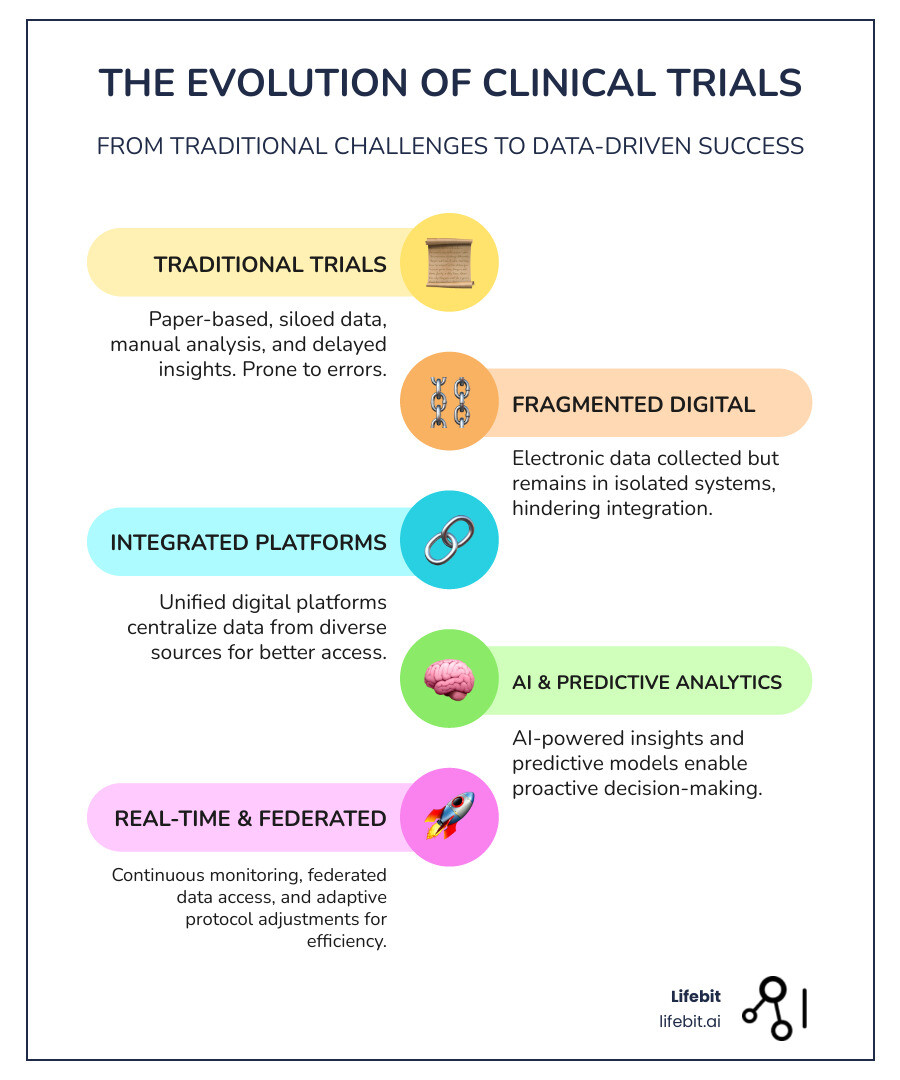
Data driven clinical trials use real-time analytics, AI-powered insights, and integrated digital platforms to improve trial design, patient recruitment, safety monitoring, and regulatory compliance—replacing traditional paper-based, siloed approaches with unified, evidence-based decision-making.
Key components of data-driven clinical trials:
- Real-time data collection from electronic health records, wearables, and patient-reported outcomes
- Predictive analytics to anticipate recruitment challenges, safety signals, and protocol deviations
- AI integration that reduces trial duration by 50% and improves success rates by 10%
- Federated data access enabling secure, compliant analysis across institutions without moving sensitive data
- Continuous monitoring through dashboards that track enrollment, diversity, and adverse events in real time
The clinical trial industry stands at a crossroads. A typical Phase III trial now generates 3.6 million data points—three times more than 15 years ago. Yet 80% of trials face delays or termination due to recruitment challenges, and delays cost between $600,000 and $8 million per day. The problem isn’t a lack of data—it’s the inability to turn that data into timely, actionable insights.
Traditional clinical trial methodologies rely on delayed data access, manual analysis, and fragmented systems. By the time researchers identify a safety signal or enrollment gap, weeks or months have passed. Data-driven approaches flip this model. They enable dynamic monitoring, proactive risk mitigation, and precise protocol adjustments—changing clinical research from reactive to predictive.
I’m Maria Chatzou Dunford, CEO and Co-founder of Lifebit, a genomics and biomedical data platform that powers data driven clinical trials through federated AI and secure, compliant environments. Over the past 15 years, I’ve built tools to accelerate precision medicine and enable real-time evidence generation across global healthcare institutions.
Key data driven clinical trials vocabulary:
Stop Wasting $8M a Day: Why Data-Driven Clinical Trials are Mandatory
In the high-stakes world of pharmaceutical development, time isn’t just money—it’s lives. Yet, we are still seeing the same old story: 80% of clinical trials are delayed, and 37% of sites struggle to meet their enrollment targets. When a single day of delay can cost a sponsor up to $8 million, the “old way” of doing things isn’t just inefficient; it’s financially and ethically unsustainable. This $8 million figure isn’t just a headline; it represents the combined cost of lost patent life, ongoing operational overhead for site maintenance, and the opportunity cost of delayed market entry for life-saving therapies.
Traditional methodologies are buckling under the weight of modern research. Today’s Phase III trials generate 3.6 million data points, a 300% increase over the last 15 years. Managing this volume with manual entry and siloed spreadsheets leads to a “data-rich but information-poor” (DRIP) environment. We often see research centers relying on anecdotal evidence rather than hard metrics, resulting in missed safety signals and recruitment bottlenecks that could have been avoided. Furthermore, manual Source Data Verification (SDV)—the process of cross-checking trial data against original medical records—can consume up to 25-30% of a total trial budget. In a data-driven model, this is replaced by Risk-Based Monitoring (RBM), which uses statistical algorithms to identify sites that actually require intervention, rather than visiting every site regardless of performance.
To combat this, the industry must adopt Best Practices for Conducting and Reporting Pharmacoepidemiologic Safety Studies Using Electronic Healthcare Data Sets. These guidelines emphasize the need for structured, high-quality data that can be audited and traced back to its origin.
Traditional Trial Bottlenecks:
- Delayed Data Access: Waiting weeks for site monitors to verify paper records, leading to a reactive rather than proactive safety posture.
- Recruitment Inefficiency: Relying on a limited pool of known patients instead of broad real-world data (RWD) to identify eligible participants in underserved areas.
- Fragmented Systems: Data trapped in disparate EHRs, labs, and imaging centers that do not communicate, requiring manual reconciliation.
- Manual Errors: Human entry mistakes that compromise data integrity, leading to costly queries and potential regulatory submission rejections.
Maximizing Efficiency in Data-Driven Clinical Trials
The shift to data driven clinical trials isn’t just a marginal improvement; it’s a total overhaul. By incorporating artificial intelligence into clinical data management, the duration of trials has been reduced by 50%, and success rates have improved by 10%.
We use predictive modeling to anticipate challenges before they occur. For example, by analyzing historical enrollment patterns and real-time site performance, we can proactively mitigate risks by shifting resources to high-performing sites or adjusting inclusion criteria. Real-time monitoring allows for “dynamic triggers”—if a safety event occurs, the system flags it instantly, allowing for immediate intervention rather than waiting for a monthly review. This proactive stance safeguards participant safety and trial integrity simultaneously. By leveraging automated data pipelines, sponsors can move from “data lock” to analysis in days rather than months, significantly accelerating the path to regulatory submission.
The PRINCIPLED Framework: Designing Inferential Studies with Routine Healthcare Data
One of the most exciting advancements in our field is the ability to use routine healthcare data—like insurance claims and electronic health records (EHRs)—to evaluate the causal effects of drugs. However, doing this correctly requires a rigorous framework to avoid the “data dredging” that often plagues observational research. Without a structured approach, researchers may inadvertently find correlations that do not imply causation, leading to flawed clinical conclusions.
The FDA Sentinel Innovation Center has provided a roadmap for this through the PRINCIPLED process guide. This framework is designed to help us generate “decision-grade” evidence from the real world. The Sentinel system itself is a powerhouse, containing structured data representing 844 million person-years of observation. The PRINCIPLED framework consists of nine critical steps, including defining the causal question, assessing data fitness, and implementing a “Target Trial Emulation” strategy.
| Feature | Randomized Controlled Trials (RCTs) | Non-Interventional (PRINCIPLED) |
|---|---|---|
| Data Source | Primary (Collected for trial) | Secondary (Routine healthcare data) |
| Patient Population | Highly Controlled/Strict | Broad/Real-World |
| Bias Mitigation | Randomization | Target Trial Emulation & Propensity Scoring |
| Cost | High ($$$) | Moderate ($) |
| Timeframe | Years | Months |
Causal Questions and Data Fitness
The first rule of a data driven clinical trial using routine data is that you must have a well-defined causal question. We achieve this by specifying a “target trial protocol”—essentially, we design the observational study as if it were a randomized trial we were about to run. This involves defining the eligibility criteria, the treatment strategies, the assignment procedure, the follow-up period, the outcomes, and the statistical analysis plan before looking at the data results.
We then assess if our data source is “fit-for-purpose” by looking at relevance and reliability. Does the data accurately capture the eligibility criteria? Can we reliably identify the treatment and the outcome? For example, if we are studying a drug’s effect on heart failure, we might use a phenotyping algorithm. In a recent case study, a claims-based algorithm achieved 83% accuracy in differentiating heart failure subtypes when linked to EHR data. This level of precision is essential for Assessing Electronic Health Records and Medical Claims Data To Support Regulatory Decision-Making. Furthermore, we utilize propensity scoring to balance the characteristics of treated and untreated groups, effectively mimicking the balance achieved through randomization in a traditional trial. This allows us to account for “confounding by indication,” where patients are prescribed certain drugs because of their underlying health status, which could otherwise bias the results.
Solving the Diversity Gap: Using Data to Build Inclusive Research
For too long, clinical trials have failed to represent the populations they aim to treat. We believe that health equity isn’t just a goal—it’s a requirement for scientific validity. If a drug is only tested on a narrow demographic, we cannot be certain of its efficacy or safety in the broader population. Data-driven strategies are the key to breaking down these barriers.
A massive review of 246 studies involving over 95,000 patients showed that while we are making progress, there is still work to do to align trial participants with the US Census. This is why the FDA now requires Diversity Action Plans (DAPs) for Phase III studies under the Food and Drug Administration Omnibus Reform Act (FDORA). These plans must outline the sponsor’s goals for enrollment, the rationale for those goals, and the specific strategies they will use to achieve them. We use real-time recruitment dashboards to track the demographics of enrolled patients as the trial progresses. If we see a gap in representation, we don’t wait until the end of the trial to notice—we act immediately.
Barriers to Trial Participation:
- Geographic Constraints: Patients living far from major research hospitals often cannot participate due to travel costs and time.
- Socioeconomic Factors: Lack of transportation, childcare, or the inability to take time off work creates a barrier for low-income participants.
- Trust Deficit: Historical mistreatment of minority groups in medical research has led to a lingering and understandable skepticism.
- Narrow Inclusion Criteria: Overly restrictive protocols, such as excluding patients with common comorbidities, unintentionally exclude diverse groups who may have higher rates of those conditions.
Improving Inclusion through Data-Driven Clinical Trials
We tackle these barriers by partnering with community health organizations and industry groups like Transcelerate to improve Diversity of Clinical Trial Participants. By using data-driven site selection, we can identify locations in diverse neighborhoods that have the infrastructure to support a trial but are often overlooked by traditional CROs. This involves analyzing geospatial data to find “medical deserts” and placing mobile units or satellite sites in those areas.
Our analysis of oncology and immunology trial demographics provides a foundation for improvement. By using social media campaigns custom to specific patient groups and providing trial information in multiple languages, we can build trust and awareness. Furthermore, Decentralized Clinical Trial (DCT) technologies—such as remote monitoring and home nursing visits—allow patients to participate without the burden of frequent travel. Data allows us to move from “ambition” to “actionable strategy,” ensuring that the medicines of tomorrow work for everyone, regardless of their background or zip code.
Global Adoption and the Role of CROs in Data Strategy
The landscape of clinical research is shifting geographically. The Asia-Pacific (APAC) region is emerging as a dominant force, now accounting for over 50% of global clinical trials. This growth is driven by favorable regulatory environments, cost efficiencies, and a large, treatment-naïve patient population. Singapore, in particular, has become a fast, efficient hub for APAC research, offering a sophisticated digital infrastructure that supports high-velocity data collection.
In this evolving environment, the role of the Contract Research Organization (CRO) has changed. They are no longer just service providers; they are data strategists. Leading CROs are now integrating Adaptive platform trials which allow for multiple treatments to be tested simultaneously, with the protocol evolving based on incoming data. This “perpetual trial” model can significantly reduce the time it takes to identify effective therapies by dropping ineffective arms early and focusing resources on promising candidates.
In the EU, the focus is on data harmonization and the “health data revolution.” The implementation of the Clinical Trials Regulation (CTR) and the Clinical Trials Information System (CTIS) aims to create a single entry point for clinical trial submissions in the EU, streamlining the process across member states. Furthermore, the European Health Data Space (EHDS) is set to provide a framework for the secure sharing of health data for research and innovation. However, this requires navigating complex GDPR requirements. We see CROs as the bridge between these regional nuances, implementing global data strategies that maintain compliance with local regulations like GDPR and HIPAA while maximizing trial efficiency. They must manage the “sovereignty” of data, ensuring that while insights are shared globally, the raw data remains protected within its jurisdiction of origin.
Future-Proofing Research Sites with Federated AI and Unified Platforms
The biggest challenge in data driven clinical trials has always been data gravity—the fact that large datasets are hard to move. When dealing with petabytes of genomic or imaging data, the traditional model of downloading data to a local server is no longer feasible or secure. This is where Lifebit’s federated AI platform changes the game. Instead of moving sensitive patient data to the researcher, we move the analysis to the data.
Our platform uses a Trusted Research Environment (TRE) and a Trusted Data Lakehouse (TDL) to provide secure, real-time access to global biomedical and multi-omic data. This approach adheres to the FAIR principles of scientific data management—making data Findable, Accessible, Interoperable, and Reusable. The TRE operates under the “Five Safes” framework: Safe People (authorized researchers), Safe Projects (approved research), Safe Settings (secure environment), Safe Data (de-identified data), and Safe Outputs (vetted results). This ensures that patient privacy is never compromised while still allowing for high-impact research.
By using our R.E.A.L. (Real-time Evidence & Analytics Layer), sponsors can gain insights from diverse datasets—including imaging, genomics, and wearables—without compromising patient privacy. This is the foundation of Lifebit’s federated platform, which powers large-scale research and pharmacovigilance for governments and biopharma alike. Federated learning allows AI models to be trained across multiple decentralized servers holding local data samples, without exchanging them. This means a model can learn from a hospital in London and a clinic in New York simultaneously, gaining a more robust understanding of disease patterns than any single dataset could provide.
The Future Importance of Data-Driven Clinical Trials
The future of drug development is centered around data. We are moving toward a hybrid data ecosystem where traditional trial data is augmented by real-world evidence and AI-driven safety surveillance. This allows for:
- Precision Medicine: Tailoring treatments to specific patient subpopulations based on genetic markers identified through large-scale multi-omic analysis.
- AI-Driven Safety: Identifying rare adverse events in seconds rather than weeks of manual review by using Natural Language Processing (NLP) to scan physician notes and patient reports.
- Secure Collaboration: Enabling scientists across the globe to work together in unified workspaces while maintaining strict data governance and audit trails.
Technology is no longer the bottleneck; the focus must now shift to refining our processes and embracing a culture where data drives every decision, from the first patient enrolled to the final regulatory approval.
Frequently Asked Questions about Data-Driven Clinical Trials
How does real-time data collection improve participant safety?
Real-time collection allows for “active monitoring.” Instead of waiting for a scheduled site visit to report an adverse event, data from wearables or digital diaries is uploaded instantly. AI algorithms can then scan this data for patterns or “triggers,” alerting the medical monitor immediately if a safety threshold is crossed. This allows for faster intervention, such as dose adjustments or patient withdrawal, significantly reducing risk. For example, a wearable device could detect a heart arrhythmia in a participant hours before they even feel symptoms, allowing for immediate medical attention.
What is the role of Real-World Evidence (RWE) in drug approval?
RWE is increasingly used by regulatory bodies like the FDA and EMA to support new drug applications or expand the indications of existing drugs. While randomized trials remain the gold standard, RWE provides insights into how a drug performs in a broader, more diverse population over a longer period. It is particularly valuable for post-marketing surveillance and for understanding rare side effects that might not appear in a smaller trial. It also helps in understanding the “long-term” effectiveness of a drug in a real-world setting where patients may have multiple comorbidities and take other medications.
How do data-driven approaches reduce the cost of clinical trials?
Data-driven approaches reduce costs primarily through efficiency and risk mitigation. By using predictive analytics for site selection, sponsors avoid “rescue” costs associated with underperforming sites. AI-enabled data cleaning can reduce the time spent on manual queries by 50%. Furthermore, identifying a failing drug candidate early through real-time analysis can save hundreds of millions of dollars in unnecessary Phase III expenditures. By automating routine tasks, research staff can focus on high-value activities like patient engagement and complex clinical assessments.
Is data privacy maintained in federated clinical trials?
Yes, privacy is a cornerstone of the federated model. In a federated system, the raw patient data never leaves the secure environment of the hospital or data provider. Only the “insights” or the mathematical updates to an AI model are shared. This ensures compliance with strict regulations like GDPR and HIPAA, as the data remains under the control of the original data owner. Advanced encryption and anonymization techniques further ensure that individual patients cannot be re-identified from the shared insights.
Conclusion
The transition to data driven clinical trials is no longer a “nice-to-have” strategic advantage—it is an operational necessity. As trial complexity grows and the demand for personalized medicine increases, the old manual ways of working simply cannot keep up. By embracing real-time insights, the PRINCIPLED framework for causal inference, and inclusive, data-backed recruitment, we can bring life-saving therapies to market faster and more safely than ever before.
At Lifebit, we are committed to this journey. Our federated AI platform is designed to break down silos and enable the next generation of precision research. The tools are here, the data is available, and the path forward is clear.