

The World of Bioinformatics Data Analysis at Your Fingertips
Why Bioinformatics Data Analysis is Changing Modern Healthcare
Bioinformatics data analysis is the computational processing and interpretation of biological data—particularly genomic, transcriptomic, proteomic, and metabolomic information—to uncover patterns, identify disease mechanisms, and accelerate drug findy. At its core, it bridges biology, computer science, and statistics to transform massive datasets from DNA sequencers and other high-throughput technologies into actionable insights for research and clinical care.
Key components of bioinformatics data analysis:
- Data Types: Genomic sequences (DNA), transcriptomes (RNA), protein structures, and metabolite profiles
- Core Processes: Sequence alignment, variant calling, gene expression quantification, and pathway analysis
- Essential Tools: Programming languages (R, Python), workflow systems, and cloud platforms
- Applications: Disease diagnosis, personalized medicine, drug findy, and population health research
- Critical Requirements: Data security (HIPAA, GDPR, GxP compliance), reproducibility, and scalable infrastructure
The field’s growth is staggering. While nucleic acid sequence archives held the equivalent of one human genome in 1999, they now hold petabyte-scale data from millions of genomes, demanding sophisticated computational analysis. This growth has been accelerated by the achievement of the $1,000 genome milestone, making DNA sequencing a practical diagnostic tool for hospitals and clinics. Yet this data explosion creates a critical challenge: how do we turn raw sequences into meaningful biological insights quickly, securely, and at scale?
As Maria Chatzou Dunford, I’ve spent over 15 years working at the intersection of computational biology, AI, and high-performance computing, including contributing to Nextflow—a breakthrough workflow framework used worldwide for bioinformatics data analysis. Through my work at Lifebit, I’ve seen how federated, cloud-based platforms can overcome the silos and bottlenecks that slow down findy, enabling researchers to analyze diverse datasets in secure, compliant environments without moving sensitive information.
Simple Bioinformatics data analysis glossary:
The ‘Omics’ Revolution: Making Sense of Massive Biological Data
The life sciences are experiencing a data tsunami. The sheer volume of information from high-throughput instruments has sparked the “omics” revolution, fundamentally changing how we study living systems.
Bioinformatics data analysis provides the tools to explore these massive datasets. While classic data types like DNA, amino acid sequences, and 3D protein structures remain central, the field has expanded dramatically. We now analyze genomics (complete DNA blueprints), transcriptomics (active gene patterns via RNA), and proteomics (protein studies). The field also includes metabolomics (cellular fuel), epigenomics (gene control tags on DNA), and metagenomics (microbial communities in environments like the human gut). Each “omics” layer offers a unique view, and together they create a comprehensive picture of molecular life.
To manage this data, biological databases like the International Nucleotide Sequence Database Collaboration (INSDC) and the Worldwide Protein Data Bank (wwPDB) are essential. These curated repositories allow researchers worldwide to store, access, and search for biological information. Data sharing through global research consortia is also critical for accelerating science. Securely comparing datasets from around the world is especially powerful for studying rare or complex diseases that require large, diverse patient populations.
Understanding Genomics and Transcriptomics
Genomics forms the foundation of modern bioinformatics data analysis. With whole genome sequencing now practical, analysis workflows can process complete human genomes to identify genes, regulatory elements, and variations. This starts with aligning the short DNA sequences (reads) from a sequencer to a reference genome. For organisms without a reference, de novo genome assembly pieces these reads together like a complex puzzle. This foundational analysis reveals complex biological processes and disease mechanisms on a genome-wide scale.
Genomic data analysis focuses heavily on variant discovery—finding differences between an individual’s genome and the reference. These variants include:
- Single Nucleotide Polymorphisms (SNPs): The most common type, where a single DNA base is changed. While many are harmless, some, like specific SNPs in the APOE gene, are strongly associated with an increased risk for Alzheimer’s disease.
- Insertions and Deletions (INDELs): Small stretches of DNA that are either added or removed. A famous example is the ΔF508 mutation in the CFTR gene, a three-base-pair deletion that causes most cases of cystic fibrosis.
- Structural Variants (SVs): Larger-scale changes, including inversions, translocations, or duplications of entire gene segments. These are often implicated in developmental disorders and cancer.
- Copy Number Variations (CNVs): A type of SV where a person has an abnormal number of copies of a section of DNA. For example, an increased copy number of the HER2 gene is a key biomarker and therapeutic target in some breast cancers.
For clinical use, exome sequencing analysis offers a cost-effective way to diagnose genetic conditions by focusing on protein-coding regions (the exome), which contain over 85% of known disease-causing mutations.
Transcriptomics explores which genes are active and at what level. The workhorse technique, RNA sequencing (RNA-Seq), involves extracting all RNA from a sample, converting it to more stable cDNA, sequencing it, and then mapping the resulting reads back to the genome to quantify gene expression. Differential gene expression analysis is a key first step in biomarker discovery, identifying genes that are significantly up- or down-regulated between conditions (e.g., diseased vs. healthy tissue). For instance, comparing a tumor sample to adjacent normal tissue can reveal cancer-driving genes that are overexpressed, pointing to potential drug targets. RNA-Seq also reveals how a single gene can produce multiple protein versions through alternative splicing, a process often dysregulated in disease, and can identify entirely novel transcripts that were previously unannotated.
Exploring Proteomics and Other ‘Omics’
Proteins are the workers of the cell, and proteomics bioinformatic analysis studies their sequences, structures, and functions using techniques like mass spectrometry. A key area is analyzing post-translational modifications (PTMs)—chemical changes to proteins after they are made—which act as molecular switches that control protein activity, localization, and degradation. Protein structure prediction, revolutionized by AI tools, is critical, as a protein’s shape determines its function. Protein interaction mapping (interactomics) reveals how proteins work together in networks, which is essential for understanding cellular coordination and disease.
Metabolomics provides a snapshot of an organism’s physiological state by studying small molecules like sugars and lipids. Epigenomics adds another layer by mapping chemical modifications to DNA that control gene expression without changing the sequence itself. Metagenomics analysis studies the genetic material of entire microbial communities from environmental samples, revolutionizing our understanding of the microbiome.
The true power of the “omics” revolution emerges from integrating multi-omics data. Combining information from genomics, transcriptomics, proteomics, and metabolomics builds a complete picture of biological systems. For example, a genomic study might identify a mutation in a cancer patient, but transcriptomic data can confirm if the mutated gene is actually being expressed, and proteomic data can show if the protein itself is present and functional. This integrated approach allows us to trace how changes cascade from DNA to proteins and metabolites, and ultimately to health or disease—a crucial capability for personalized medicine and drug discovery.
The Analyst’s Arsenal: Tools and Platforms for Bioinformatics Data Analysis
Turning raw biological data into meaningful insights requires the right computational toolkit. Bioinformatics data analysis brings together programming languages, sophisticated software platforms, and cloud infrastructure to make sense of the petabyte-scale datasets generated by modern sequencing.
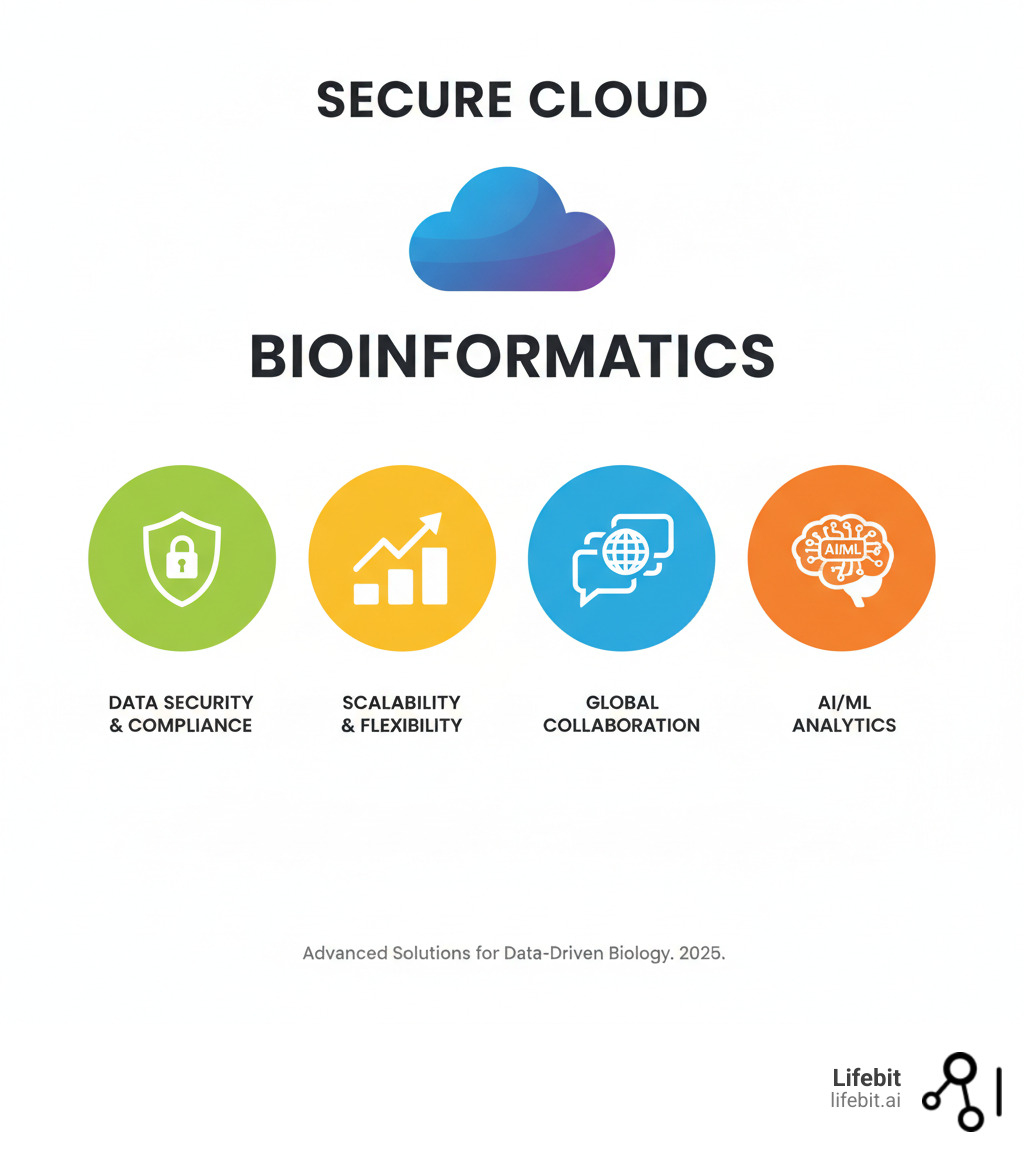
The journey from a sequencer’s output to biological discovery is complex, often involving dozens of interconnected steps. Building and managing these pipelines across different computing environments is a major challenge, compounded by data silos, security requirements, and compliance standards (HIPAA, GDPR, GxP). Modern bioinformatics platforms exist to solve these challenges, offering scalable infrastructure, reproducible workflows, and built-in security.
Key Programming Languages and Tools in Bioinformatics Data Analysis
Programming languages provide the flexibility to develop custom algorithms, automate tasks, and build coherent workflows.
R is a statistical workhorse in bioinformatics, prized for its sophisticated statistical methods and publication-quality graphics. Its Bioconductor project provides thousands of specialized packages for genomic data analysis, from differential gene expression (e.g., DESeq2, edgeR) to pathway enrichment.
Python is ideal for scripting, automation, and data manipulation. Its clean syntax and vast library ecosystem, including Biopython for parsing biological formats, pandas for data handling, and scikit-learn for machine learning, make it perfect for integrating tools and applying complex algorithms.
Unix and Bash scripting remain fundamental for orchestrating command-line tools. Most high-performance computing (HPC) environments run on Linux, and many core bioinformatics tools—such as BWA for sequence alignment, Samtools for handling alignment files, and GATK for variant calling—are command-line based, making shell scripting an essential skill for pipeline development.
User-Friendly Software and Platforms for Bioinformatics Data Analysis
You don’t need a computer science degree to perform sophisticated bioinformatics data analysis. A growing ecosystem of user-friendly platforms puts powerful analytical capabilities into the hands of biologists, clinicians, and researchers.

GUI-based software offers approachable multiomic analysis through intuitive interfaces. These platforms abstract away underlying complexity while providing robust statistical algorithms and rich visualizations, allowing researchers of all skill levels to perform complex analyses without writing code.
Web-based collaborative platforms support accessible and reproducible research, often through intuitive interfaces that make it easier for biologists to analyze complex data without advanced bioinformatics training. These platforms often integrate with training networks, providing comprehensive learning resources alongside the analytical tools.
Workflow management systems are the backbone of reproducible science, addressing the “reproducibility crisis” by ensuring complex, multi-step analyses run consistently. Systems like Nextflow, Snakemake, and those using the Common Workflow Language (CWL) allow researchers to define pipelines that are portable across different computing environments—from a local laptop to a large-scale cloud cluster. They often integrate with containerization technologies like Docker and Singularity, which package a tool and all its dependencies into a single, self-contained unit. This guarantees that an analysis performed today will yield the exact same result years from now, regardless of system updates.
Cloud-based solutions are essential for handling modern genomic data volumes. They offer secure, scalable environments with specific advantages like object storage (e.g., Amazon S3, Google Cloud Storage) for durable and cost-effective data archiving, and the ability to leverage spot instances for massive, parallel computations at a fraction of the on-demand cost. This provides greater speed and security while breaking down data silos. Cloud-based secondary analysis for whole human genomes typically costs a fraction of what it would to maintain equivalent on-premises infrastructure.
Laboratory Information Management Systems (LIMS) designed for genomics help labs manage the volume and complexity of sequencing data, tracking samples from arrival to final analysis and improving data integrity through standardization and automation.
What matters most is whether your analytical infrastructure can scale with your data, maintain security and compliance, and enable collaboration. That’s where platforms like Lifebit’s Trusted Research Environment come in—providing the secure, federated infrastructure that modern biomedical research demands.
The Hidden Price of Slow Bioinformatics: Open up Medical Breakthroughs in Days, Not Months
The real value of bioinformatics data analysis is measured in lives saved, diseases diagnosed earlier, and treatments personalized to individual patients. Every day that research is delayed by infrastructure bottlenecks, data silos, or compliance issues represents a real human cost.
Why Your Research Is Stuck—and How Secure Cloud Bioinformatics Delivers Results Fast
Traditional on-premise computing creates invisible barriers that slow down findy. When sequencing data arrives faster than servers can process it, when collaborators can’t access datasets, or when IT teams spend weeks configuring security protocols, research gets stuck. This is why secure, cloud-based bioinformatics platforms are essential.
Our federated platform eliminates these bottlenecks by providing secure, real-time access to global biomedical and multi-omic data. With built-in harmonization and federated governance, data remains secure while being accessible for analysis, turning what once took months into days.
Bioinformatics data analysis transforms patient care in several critical ways. In disease diagnosis and prognosis, identifying correlations between gene sequences and diseases enables early, accurate detection. Algorithms can classify cancers based on molecular data, providing crucial prognostic information that guides therapeutic decisions.
Personalized medicine and pharmacogenomics represent another frontier where speed matters. Tailoring treatments to a patient’s unique DNA sequence helps get the right treatment to the right patient faster. Bioinformatics data analysis enables pharmacogenomics platforms to predict how an individual will respond to drugs, leading to more effective therapies and avoiding adverse reactions.
In drug findy and development, the acceleration is even more dramatic. Target identification and computer-aided drug design use bioinformatics to model how potential drug molecules interact with biological targets, significantly accelerating the findy process. We can now leverage AI-based modeling to simulate molecular interactions and predict efficacy before expensive lab work begins.

Clinical trials also benefit enormously from rapid bioinformatics data analysis. From identifying patient cohorts to assessing treatment efficacy, computational analysis accelerates the journey from lab to clinic. Our platform provides the infrastructure for large-scale, compliant research and pharmacovigilance, enabling high-volume automated multi-omics workflows that are impossible with traditional infrastructure.
Microbial genomics and metagenomics are crucial for understanding infectious diseases and antibiotic resistance in real-time. The COVID-19 pandemic demonstrated how rapid genomic analysis can track variants and inform public health responses within days.
The difference between days and months isn’t just about efficiency—it’s about impact. With built-in capabilities for harmonization, advanced AI/ML analytics, and federated governance through our Trusted Research Environment, our platform delivers real-time insights that accelerate findy while maintaining the highest standards of data security and regulatory compliance.
The Future is Now: AI, Challenges, and Best Practices
We’re in an extraordinary moment for bioinformatics data analysis, powered by AI breakthroughs and an urgent need for faster, more accurate biological insights. Yet with this progress comes a set of persistent challenges that demand smart solutions and disciplined best practices.
Machine Learning and AI in Bioinformatics
AI and machine learning are game-changers in life sciences, moving from theoretical potential to practical application.
- In drug discovery, AI-based modeling can predict optimal candidates and screen vast compound libraries in a fraction of the time. DeepMind’s AlphaFold, for example, has revolutionized protein structure prediction, solving a 50-year-old grand challenge and dramatically accelerating our understanding of protein function and drug targetability.
- In personalized medicine, algorithms analyze a patient’s multi-omic and clinical data to predict disease risk and tailor treatment plans. Machine learning models can integrate genomic variants, gene expression levels, and electronic health records to recommend the most effective therapy for a specific cancer patient.
- For diagnostic tools, AI is matching and sometimes surpassing human experts. Convolutional Neural Networks (CNNs) can analyze histopathology images to detect cancer cells with remarkable accuracy, while other models can identify subtle patterns in MRI scans that indicate the early onset of neurodegenerative diseases.
- For biomarker discovery, ML algorithms like Random Forests or Gradient Boosting excel at sifting through high-dimensional ‘omics’ datasets to identify the few key genes or proteins that are most predictive of a disease state or treatment response.
At the population level, AI helps analyze large-scale datasets to uncover genetic predispositions and inform public health strategies. Our federated AI platform is specifically designed to leverage these advanced analytics, enabling researchers to extract deeper insights from biomedical data while maintaining stringent security and compliance.
Challenges and Best Practices in Bioinformatics Data Analysis
Despite the immense potential, bioinformatics data analysis faces real, practical challenges. The good news? Each challenge has sparked innovative solutions and highlighted best practices.
- Data Volume and Complexity: The sheer volume of sequencing data can overwhelm traditional computing. The solution is scalable cloud-based platforms that provide the elasticity to handle massive datasets efficiently. Advanced lossless compression technologies can also slash data transfer and storage costs.
- Data Silos: Fragmented information across teams and institutions grinds collaboration to a halt. This is why we built our Trusted Research Environment (TRE) and Trusted Data Lakehouse (TDL)—to enable secure, real-time access to global biomedical data without the risk of moving sensitive information.
- Data Integrity and Reproducibility: A study that can’t be reproduced is scientifically invalid. Laboratory Information Management Systems (LIMS) and robust workflow management systems ensure data integrity and that analysis pipelines execute consistently. Documenting every step and using containerized tools are critical for verification.
- Security and Compliance: HIPAA, GDPR, and GxP regulations are non-negotiable legal requirements. Prioritize platforms with built-in security features, granular access controls, and comprehensive audit trails. Our federated approach ensures information stays within secure, compliant environments.
- Data Visualization: If you can’t communicate your findings clearly, their impact is limited. Powerful visualization tools are essential for translating complex data into understandable insights. For example, heatmaps are invaluable for showing gene expression patterns across dozens of samples, while network diagrams are crucial for mapping out protein-protein interactions and understanding cellular pathways.
- Cost Management: Evaluate the total cost of ownership for any solution. While open-source tools appear free, the expertise, infrastructure, and maintenance they require can create significant hidden costs. Commercial platforms often include support and optimization that can lower overall costs.
- The Skills Gap: There is a critical shortage of bioinformaticians who possess deep expertise in both biology and computational science. This bottleneck can be addressed by investing in training and adopting user-friendly platforms that empower biologists and clinicians to perform their own analyses without extensive coding knowledge.
Emerging Trends and Future Directions in Bioinformatics Data Analysis
The future of bioinformatics data analysis is unfolding now, with several exciting trends reshaping what’s possible.
Single-Cell Omics: This revolutionary approach allows researchers to analyze the genomic, transcriptomic, and epigenomic profiles of individual cells. Techniques like single-cell RNA sequencing (scRNA-seq) are revealing unprecedented cellular heterogeneity within tissues, such as identifying rare cancer stem cells within a tumor or mapping the diverse cell types in the developing brain. This creates new bioinformatics challenges in handling sparse, high-dimensional data.
Federated Learning: This is a breakthrough for collaborative research on sensitive data. Instead of pooling data in one place, a shared AI model is sent to each decentralized dataset. The model trains locally, and only the anonymous, aggregated model updates are sent back to a central server. This allows models to learn from multiple private datasets without the data ever leaving its secure environment—a core capability of our platform.
Real-time Analysis: The turnaround time for sequencing analysis is shrinking, moving from weeks to days or even hours. This is becoming a necessity for clinical diagnostics, such as rapid pathogen identification during an outbreak, and for monitoring dynamic biological processes.
Quantum Computing in Bioinformatics: While still in its infancy, quantum computing holds staggering potential to solve problems that are intractable for classical computers, such as simulating complex molecular interactions for drug design or solving massive optimization problems in genome assembly.
Environmental Impact: There is a growing awareness of the carbon footprint of large-scale computational analysis. Green bioinformatics aims to optimize algorithms and infrastructure for energy efficiency, and some platforms have begun displaying estimated CO2 emissions to encourage more sustainable research practices.
These trends point toward a future where bioinformatics data analysis is more powerful, accessible, secure, and responsible, empowering researchers to make breakthroughs faster and more collaboratively than ever before.
Conclusion
The journey through bioinformatics data analysis reveals we are in an era where the mysteries of life are being decoded, one sequence at a time. What once seemed impossible—reading entire genomes in hours, predicting disease before symptoms appear, and designing personalized drugs—is now our reality.
We’ve explored how this field transforms massive datasets into life-saving insights, from the explosion of “omics” data to the powerful tools of AI and cloud computing. We’ve seen how bioinformatics data analysis is already accelerating diagnoses, enabling personalized treatments, and fast-tracking drug findy.
Yet, significant challenges remain: exponential data growth, strict security and compliance needs, and data silos that hinder collaboration. The future of bioinformatics data analysis depends on platforms that meet these challenges head-on.
The next generation of medical breakthroughs will come from secure, federated environments where scientists can access and analyze diverse datasets without compromising privacy. They will emerge where AI can open up hidden insights and collaboration happens seamlessly across borders.
At Lifebit, we’ve built our platform around this vision. Our Trusted Research Environment (TRE) and other federated solutions break down data silos while maintaining the highest standards of security and compliance. We’re enabling researchers across biopharma, governments, and public health agencies worldwide to collaborate on the analyses that matter most—from identifying rare disease variants to finding the next generation of therapeutic targets.
The promise of data-driven biology is about turning the tsunami of biological data into a wave of hope: faster diagnoses, more effective treatments, and medical breakthroughs that were once just dreams.
Ready to see how federated analytics can transform your research? Learn how a Trusted Research Environment can accelerate your research and find what’s possible when data, security, and innovation come together.