

9 Best Biotech Data Management Solutions for Secure Research in 2026
Biotech organizations are drowning in data—genomic sequences, clinical trial results, real-world evidence, multi-omics datasets. The problem isn’t volume. It’s fragmentation. Data sits in silos across departments, partners, and geographies. Compliance requirements like HIPAA, GDPR, and FedRAMP make moving it risky. Legacy systems can’t handle the scale or complexity modern research demands.
The right data management solution doesn’t just store your data. It harmonizes it, secures it, and makes it actionable without forcing you to move it. This guide covers top platforms built for biotech’s unique challenges: regulatory compliance, federated access, AI-powered analysis, and enterprise-scale genomics.
1. Lifebit
Best for: Federated genomic analysis and national-scale precision medicine programs requiring zero data movement
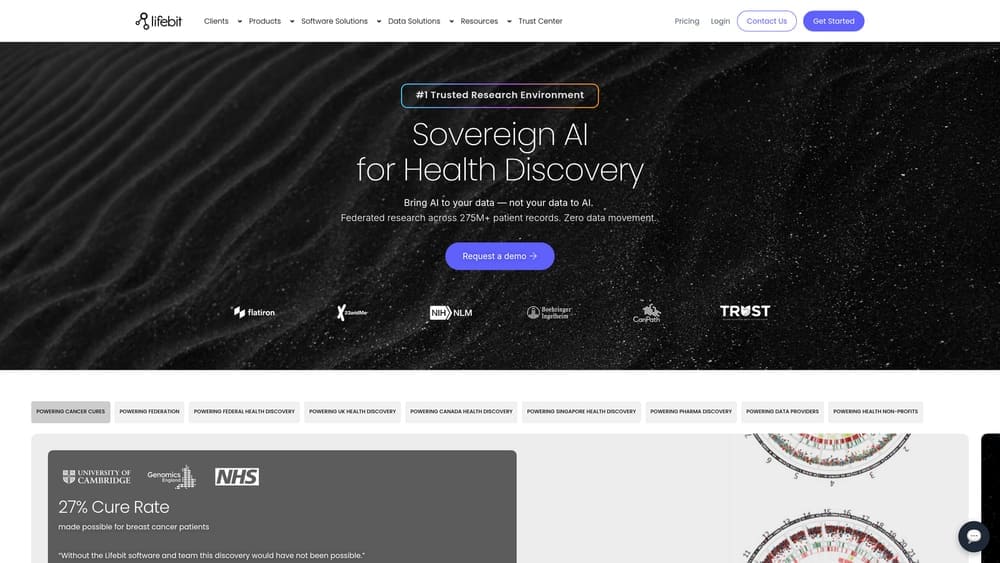
Lifebit is a federated data platform enabling secure analysis of genomic and clinical data without moving it from your infrastructure.
Where This Tool Shines
Lifebit solves the core problem facing multi-institutional biotech research: how to analyze data that can’t legally or practically be centralized. Your data stays in your cloud environment—AWS, Azure, or GCP—while the platform brings compute to the data instead of the other way around.
This approach eliminates the compliance headaches and security risks of data transfer. NIH, Genomics England, and Singapore’s Ministry of Health trust Lifebit to manage over 275 million records across national health programs. The platform handles data at scale while maintaining full sovereignty and control.
Key Features
Federated Analysis Architecture: Data never leaves your cloud environment—analysis happens where data lives, eliminating transfer risks and compliance barriers.
AI-Powered Data Harmonization: The Trusted Data Factory harmonizes disparate datasets in 48 hours using AI, collapsing timelines that traditionally took 12+ months.
Trusted Research Environment: Secure, compliant cloud workspaces with full audit trails, role-based access controls, and activity monitoring built for regulated research.
AI-Automated Airlock: Industry-first governance system for secure data exports that automates disclosure control while maintaining compliance with data protection regulations.
Multi-Jurisdiction Compliance: FedRAMP, HIPAA, GDPR, and ISO27001 compliance built into the platform from day one—no additional configuration required.
Best For
Government health agencies building national precision medicine programs. Biopharma organizations running multi-site clinical trials with sensitive patient data. Academic consortia needing to analyze pooled datasets without centralizing them. Any organization managing genomic data across jurisdictions with strict data sovereignty requirements.
Pricing
Custom enterprise pricing based on deployment scale, data volume, and compliance requirements. Deploy in your own cloud infrastructure—you maintain ownership and control.
2. Benchling
Best for: R&D teams needing integrated molecular biology workflows and electronic lab notebooks
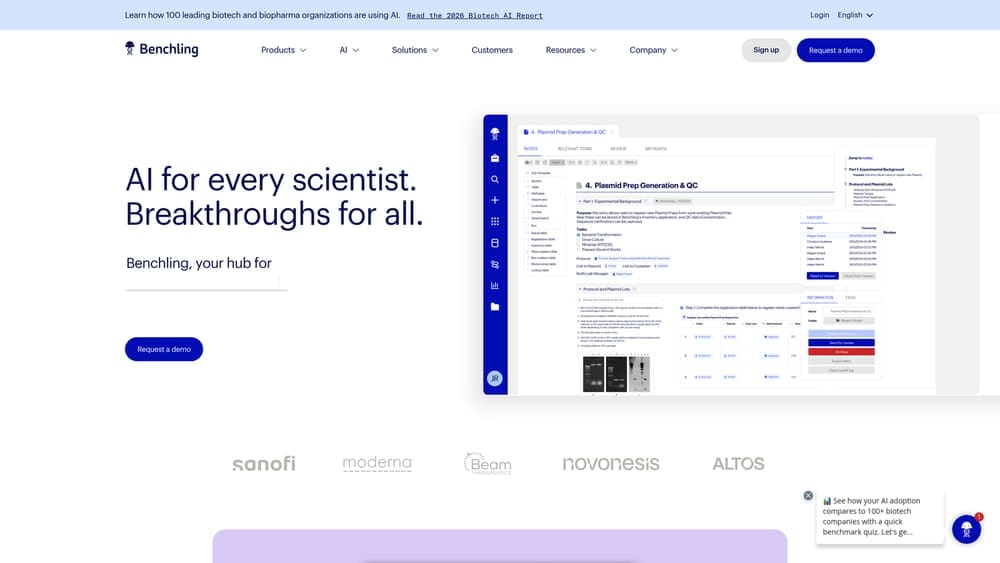
Benchling is a cloud-based R&D platform unifying molecular biology workflows, inventory management, and experimental data.
Where This Tool Shines
Benchling excels at replacing the fragmented toolset most biotech labs cobble together—spreadsheets, paper notebooks, standalone LIMS systems. It gives molecular biologists purpose-built tools for sequence design, plasmid mapping, and protocol management in one unified interface.
The platform’s strength is its deep understanding of molecular biology workflows. You’re not forcing your research into generic project management software. Benchling speaks your language, whether you’re designing CRISPR experiments or tracking antibody development pipelines.
Key Features
Molecular Biology ELN: Electronic lab notebook with native tools for DNA/protein sequence editing, primer design, and cloning workflows.
Integrated LIMS: Sample tracking, inventory management, and workflow automation connected directly to experimental records.
Workflow Automation: Extensive API and integration capabilities let you connect instruments, automate data capture, and build custom workflows.
Team Collaboration: Real-time collaboration features designed for distributed research teams working on shared experiments and protocols.
Best For
Early-stage biotech companies building R&D infrastructure from scratch. Academic labs transitioning from paper notebooks to digital systems. Molecular biology teams needing specialized tools beyond generic data management platforms.
Pricing
Free tier available for academic researchers. Enterprise pricing varies based on team size and feature requirements—contact for custom quotes.
3. DNAnexus
Best for: Large-scale genomic data processing and secure multi-organization collaboration
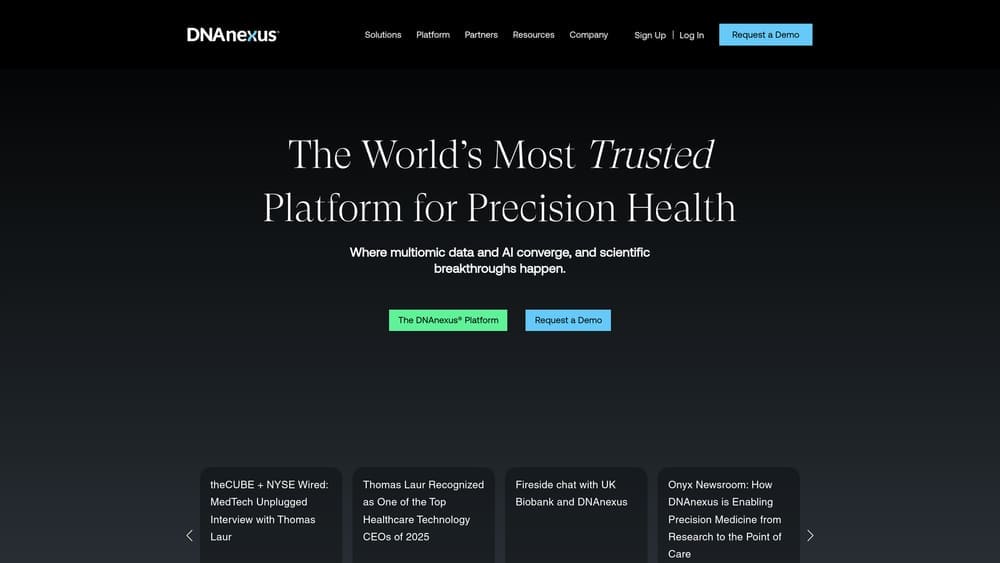
DNAnexus is a cloud-native platform for petabyte-scale genomic data management, analysis, and collaboration.
Where This Tool Shines
DNAnexus built its reputation handling massive genomic datasets for population-scale sequencing projects. The platform processes petabytes of raw sequencing data with pre-built bioinformatics pipelines optimized for scale and reproducibility.
What sets DNAnexus apart is its collaboration model. You can securely share specific datasets or analysis results with external partners without duplicating data or compromising security. This matters when you’re running multi-institutional studies or collaborating with CROs on clinical trials.
Key Features
Petabyte-Scale Processing: Infrastructure designed to handle whole genome sequencing data at population scale without performance degradation.
Pre-Built Pipelines: Curated library of bioinformatics tools and workflows for variant calling, RNA-seq analysis, and other common genomic analyses.
Secure Collaboration: Granular permissions system lets you share specific datasets or results with external collaborators while maintaining data control.
Compliance Certifications: FedRAMP and HIPAA compliance with audit trails and access controls required for clinical genomics applications.
Best For
Biotech companies running large-scale sequencing studies. Clinical labs processing patient genomic data under HIPAA requirements. Research consortia needing to share genomic datasets across organizations.
Pricing
Usage-based model charges for compute and storage consumption. Enterprise agreements available for predictable pricing on large-scale projects.
4. Veeva Vault
Best for: Regulatory compliance, clinical operations, and life sciences content management
Veeva Vault is the industry-leading cloud platform for life sciences document management, clinical trials, and regulatory submissions.
Where This Tool Shines
Veeva owns the regulatory compliance space in life sciences. The platform was purpose-built for 21 CFR Part 11 compliance from the ground up—not retrofitted with compliance features as an afterthought.
If your work involves regulatory submissions, clinical trial master files, or quality management documentation, Veeva provides the validated infrastructure auditors expect to see. The platform’s audit trails, electronic signatures, and document version control meet FDA requirements without custom configuration.
Key Features
21 CFR Part 11 Compliance: Built-in controls for electronic records and signatures meeting FDA requirements without additional validation work.
Modular Application Suite: Separate modules for clinical operations, regulatory submissions, quality management, and medical affairs—use what you need.
Unified Content Management: Single source of truth for all regulated documents with automated version control and approval workflows.
Validation Documentation: Pre-validated system with extensive documentation packages reducing your validation burden for new deployments.
Best For
Pharmaceutical companies managing regulatory submissions and clinical trial documentation. Biotech organizations preparing for FDA audits. Quality assurance teams needing validated document management systems.
Pricing
Modular pricing based on which Vault applications you deploy. Typical implementations start at mid-six figures annually for enterprise deployments.
5. Flywheel
Best for: Medical imaging data management and AI model development for imaging applications
Flywheel is a research data platform specializing in medical imaging curation, management, and AI development workflows.
Where This Tool Shines
Flywheel speaks DICOM natively. If your research involves MRI, CT, PET, or other medical imaging modalities, Flywheel handles the unique challenges of imaging data better than general-purpose platforms.
The platform automates the tedious work of imaging data curation—de-identification, metadata extraction, quality control checks. This matters when you’re building imaging AI models that require thousands of curated scans with consistent metadata and proper anonymization.
Key Features
DICOM-Native Architecture: Built specifically for medical imaging formats with native understanding of imaging metadata and file structures.
Automated De-Identification: Removes patient identifiers from DICOM headers and burned-in annotations while preserving research-relevant metadata.
AI Development Tools: Integrated environment for training and validating imaging AI models with version control and experiment tracking.
HIPAA-Compliant Infrastructure: Cloud-based platform with security controls and audit trails required for protected health information.
Best For
Radiology research groups building imaging biomarkers. Biotech companies developing imaging-based diagnostics. Academic medical centers managing multi-site imaging studies.
Pricing
Custom pricing based on storage requirements, number of users, and compute needs for analysis workflows. Contact for deployment-specific quotes.
6. Seven Bridges
Best for: Multi-omics data integration and collaborative biomedical research at scale
Seven Bridges is a biomedical data analysis platform enabling integration of genomic, transcriptomic, and clinical data.
Where This Tool Shines
Seven Bridges excels at breaking down data silos between different omics layers. The platform lets you integrate whole genome sequencing with RNA-seq, proteomics, and clinical phenotype data in unified analysis workflows.
The platform’s commitment to FAIR data principles—Findable, Accessible, Interoperable, Reusable—means your analyses are reproducible and your data remains useful long after initial studies complete. This matters for multi-year research programs where data needs to support multiple downstream analyses.
Key Features
FAIR Data Principles: Platform architecture designed around making data findable, accessible, interoperable, and reusable across research teams.
Multi-Omics Integration: Native support for integrating genomic, transcriptomic, proteomic, and clinical data in unified analysis workflows.
Common Workflow Language: Uses CWL standard for portable, reproducible bioinformatics pipelines that work across different compute environments.
Industry Partnerships: Established relationships with major pharmaceutical companies provide validated workflows for drug discovery applications.
Best For
Translational research teams integrating multiple data types. Pharmaceutical companies running target discovery programs. Research consortia needing standardized, reproducible analysis workflows.
Pricing
Project-based licensing for individual studies or enterprise agreements for organization-wide deployments. Pricing scales with compute and storage usage.
7. Medidata
Best for: Clinical trial management with industry-leading EDC and AI-powered optimization
Medidata is a comprehensive clinical trial technology platform owned by Dassault Systèmes, offering electronic data capture and trial management tools.
Where This Tool Shines
Medidata dominates the clinical trial EDC market for good reason. The platform handles the complex data collection requirements of multi-site, international clinical trials with proven reliability at scale.
What differentiates Medidata now is its AI capabilities. The platform uses historical trial data to optimize site selection, predict enrollment challenges, and identify patients likely to respond to treatment. This intelligence helps sponsors avoid costly trial delays and protocol amendments.
Key Features
Market-Leading EDC: Electronic data capture system trusted by the majority of top pharmaceutical companies for Phase II-IV clinical trials.
AI-Powered Optimization: Machine learning models predict patient enrollment rates, site performance, and protocol feasibility based on historical trial data.
Integrated Trial Suite: Unified platform covering EDC, CTMS, ePRO, randomization, drug supply management, and safety reporting.
Synthetic Control Arms: Capability to create synthetic control groups from historical data, potentially reducing placebo arm requirements in certain trial designs.
Best For
Pharmaceutical companies running multi-site Phase II-IV trials. CROs managing clinical operations for multiple sponsors. Biotech organizations preparing for pivotal registration trials.
Pricing
Per-study pricing based on trial complexity, patient numbers, and modules required. Enterprise licenses available for organizations running multiple concurrent trials.
8. Sapio Sciences
Best for: Flexible scientific data management combining LIMS, ELN, and workflow automation
Sapio Sciences is a configurable scientific data management platform unifying laboratory information management and electronic notebooks.
Where This Tool Shines
Sapio’s strength is configurability without custom code. The platform provides no-code tools for building custom workflows that match your lab’s specific processes—not forcing you to change how you work to fit the software.
This flexibility matters when your workflows don’t fit standard LIMS templates. Whether you’re running high-throughput screening, managing biorepositories, or tracking complex sample genealogies, Sapio adapts to your requirements without expensive professional services engagements.
Key Features
No-Code Configuration: Build custom workflows, data models, and user interfaces without programming—reducing deployment time and IT dependencies.
Unified LIMS and ELN: Integrated laboratory information management and electronic notebook functionality in a single platform.
Sample Chain of Custody: Comprehensive sample tracking with full audit trails for regulated environments requiring complete sample genealogy.
Instrument Integration: Pre-built connectors for common laboratory instruments with automated data capture and parsing capabilities.
Best For
Labs with unique workflows that don’t fit standard LIMS templates. Organizations wanting to reduce dependence on IT for workflow changes. Biotech companies needing both LIMS and ELN functionality in one platform.
Pricing
Subscription-based model with pricing varying by modules deployed, number of users, and configuration complexity. Contact for deployment-specific quotes.
9. Palantir Foundry
Best for: Enterprise-wide data integration with government-grade security for life sciences applications
Palantir Foundry is an enterprise data integration and analytics platform adapted for life sciences with advanced security certifications.
Where This Tool Shines
Palantir brings enterprise-scale data integration capabilities originally built for defense and intelligence agencies to life sciences. The platform excels at connecting disparate data sources across your organization into a unified analytical environment.
Foundry’s ontology layer is its secret weapon. It creates a semantic model of your data that lets non-technical users explore complex relationships between clinical, genomic, and operational data without writing SQL queries. This democratizes data access while maintaining rigorous security controls.
Key Features
Ontology Layer: Semantic data model representing complex relationships between entities—patients, samples, experiments, results—in an intuitive, explorable format.
Enterprise Data Integration: Connectors for hundreds of data sources with automated pipelines for continuous data synchronization and transformation.
Government-Grade Security: FedRAMP High and Impact Level 5 authorization—the highest security certifications available for cloud platforms.
ML Model Deployment: Integrated environment for developing, validating, and deploying machine learning models on your integrated data.
Best For
Large pharmaceutical companies with complex, siloed data across multiple systems. Government health agencies requiring FedRAMP High authorization. Organizations needing to integrate clinical, research, and operational data at enterprise scale.
Pricing
Enterprise pricing based on deployment scope, data volume, and number of users. Implementations typically require significant investment—expect seven-figure annual contracts for large deployments.
Making the Right Choice
Your ideal platform depends on your specific use case and constraints. If you’re managing federated genomic data across multiple jurisdictions where data can’t be moved, Lifebit provides the only architecture that analyzes data in place while maintaining compliance. Organizations building national precision medicine programs or multi-site clinical trials with strict data sovereignty requirements will find Lifebit’s federated approach eliminates traditional barriers to collaboration.
For R&D workflow management, Benchling offers the most comprehensive molecular biology toolset. Teams running wet lab experiments need its specialized sequence editing and protocol management capabilities. DNAnexus remains the gold standard for raw genomic data processing at population scale—if you’re generating terabytes of sequencing data, its infrastructure handles the computational demands.
Regulatory compliance drives different choices. Veeva Vault is the established standard for FDA-regulated environments where validated systems and audit trails are non-negotiable. Medidata dominates clinical trial EDC for similar reasons—proven reliability and industry acceptance matter when regulatory approval depends on data integrity.
Imaging-focused research requires specialized tools. Flywheel handles DICOM data and de-identification workflows better than general platforms. Multi-omics integration calls for Seven Bridges’ FAIR data approach. And if you need ultimate flexibility to match unique laboratory workflows, Sapio’s no-code configuration reduces dependence on IT resources.
The common thread across successful implementations is matching platform architecture to your data governance requirements. Can your data be centralized, or must it remain distributed? Do you need to share data across organizational boundaries while maintaining control? How much compliance validation is required? Answer these questions first, then select the platform that aligns with your constraints.
Managing sensitive, siloed biotech data across departments, partners, or geographies? Get started for free with Lifebit’s federated platform and see how analyzing data in place eliminates the compliance and security risks of traditional centralized approaches.