

BI vs. Data Analytics: What’s the Difference, Really?

Beyond Basic Dashboards: Why Understanding Data Intelligence Similar Platforms Matters
Data intelligence similar platforms are changing how organizations move beyond traditional BI reporting. As you evaluate options, it’s crucial to understand the landscape, which includes:
- Business Intelligence (BI) Platforms: Focus on historical reporting and dashboards.
- Analytics and BI Platforms: Combine BI with some predictive capabilities.
- Data Intelligence Platforms: Use AI to understand, reason, and act on data.
- Cloud Data Platforms: Provide scalable data warehousing with integrated analytics.
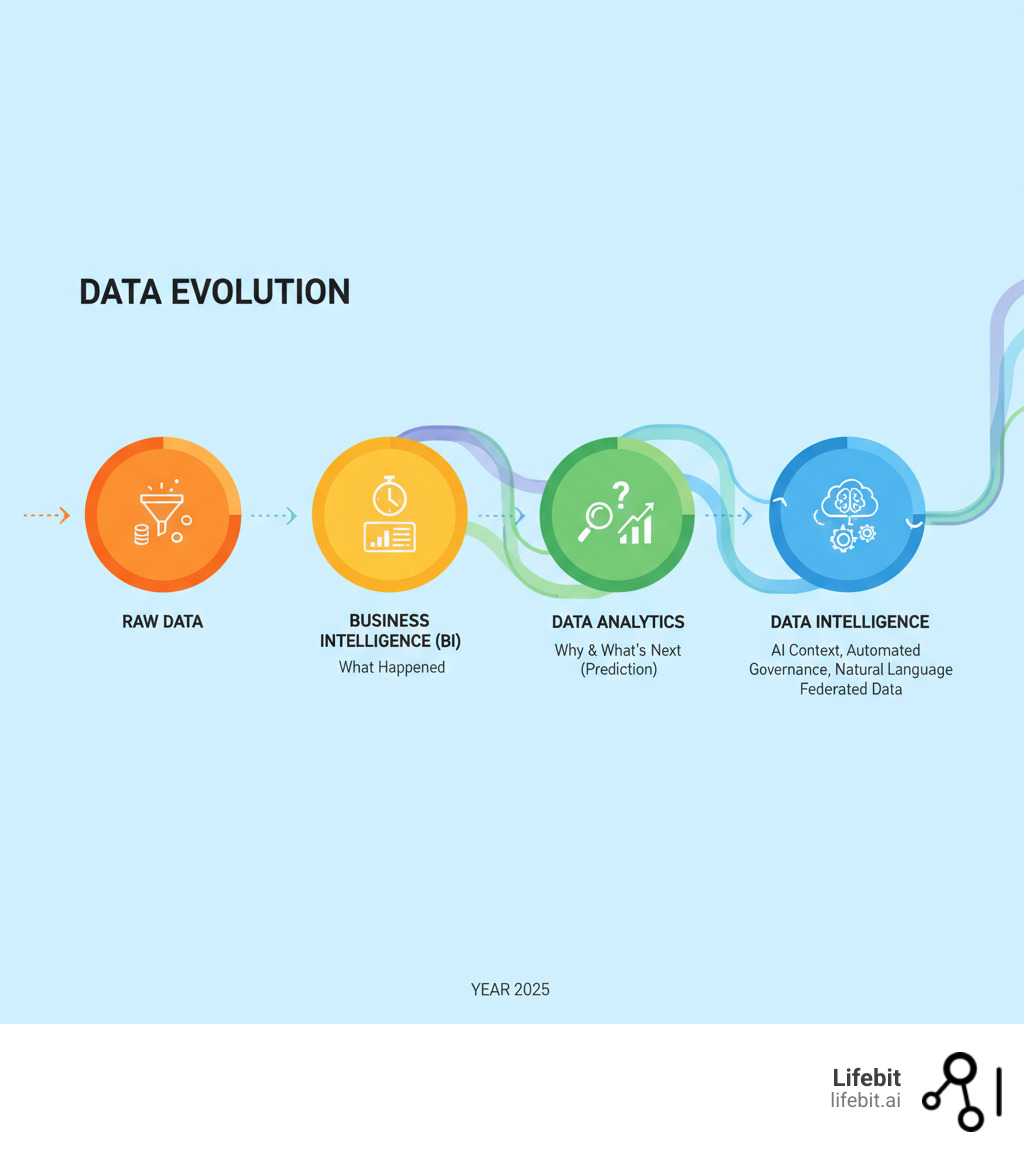
The Core Difference: Traditional BI tells you what happened. Data analytics explains why it happened. Data intelligence uses AI to understand data context, automate management, and enable natural language queries—no SQL expertise required.
The confusion is understandable. A 2024 Gartner report notes that organizations utilizing analytics and AI are better positioned to manage complexity, build trust in data, and empower their teams. Yet many struggle to distinguish between platforms that simply report on data versus those that truly reason with it.
The stakes are high. For global pharma, public sector agencies, and regulatory bodies managing siloed data, the wrong platform means slow data onboarding, poor data quality, and inaccessible AI. The right choice enables real-time pharmacovigilance, cohort analysis, and AI-powered evidence generation—all while data stays secure.
I’m Maria Chatzou Dunford, CEO and Co-founder of Lifebit. I’ve spent over 15 years building platforms that deliver data intelligence similar capabilities for federated biomedical analysis. My work in computational biology, AI, and genomics helps organizations move from basic reporting to AI-driven insights that save lives.
Business Intelligence (BI): Reporting on What Happened
Think of Business Intelligence (BI) as your car’s rearview mirror. It shows you where you’ve been and what has already happened. BI tools collect, process, and analyze historical data, presenting it in formats like dashboards and reports to help monitor key metrics. The BI industry is booming, with businesses in the UK, USA, Canada, and Europe adopting these solutions as big data becomes more prevalent.
BI platforms excel at descriptive analytics, answering questions like, “What were our sales last quarter?” They provide comprehensive reporting and interactive data visualizations, often with self-service options for business users to explore data without deep technical expertise.
The Role of Traditional BI
Traditional BI provides foundational insights into business operations. Its primary functions include:
- Performance Monitoring: This is the bread and butter of BI. It involves tracking Key Performance Indicators (KPIs) against predefined targets. For a retail company, this could be monitoring daily sales, website traffic, and conversion rates. In a manufacturing setting, it might be tracking production output, defect rates, and equipment uptime. For healthcare providers in the UK or USA, crucial KPIs could include patient admission rates, average length of stay, and hospital-acquired infection rates. BI dashboards provide an at-a-glance view of these metrics, allowing managers to see if they are on track to meet their goals.
- Trend Identification: BI tools are adept at spotting patterns in historical data. By analyzing sales data over several years, a business can identify seasonal spikes (e.g., increased sales during holidays) and plan inventory accordingly. This is typically done through time-series analysis and visualization. However, these trends are based purely on past performance and don’t account for new market variables.
- Business Reporting: BI automates the generation of regular reports for different stakeholders. These can range from static, paginated reports for executive leadership (e.g., a monthly financial summary) to interactive, ad-hoc reports that allow business analysts to drill down into specific data points. The goal is to provide a consistent, standardized view of business operations and market performance.
- Centralized Data Source: To achieve a unified view, traditional BI relies heavily on a centralized data warehouse or data mart. Data from various operational systems (CRM, ERP, SCM) is extracted, transformed, and loaded (ETL) into this central repository. This creates a “single source of truth,” ensuring that everyone in the organization is working from the same set of data and definitions, which is crucial for consistent reporting.
These capabilities are essential for reacting to immediate issues and understanding the general trajectory of operations.
Limitations of a BI-Only Approach
While useful for understanding the past, a BI-only approach has significant limitations. It’s like having a map of where you’ve been but no GPS to guide you forward.
- Rear-View Mirror Focus: BI is inherently retrospective. It excels at showing what happened but offers little insight into why it happened or what might happen next. Imagine a retail manager seeing a dashboard that shows a 15% drop in sales last month. The BI tool reports the fact, but it can’t explain the cause. Was it a new competitor’s promotion, a poorly received marketing campaign, an economic downturn in a key region, or simply unseasonably bad weather? The dashboard doesn’t know.
- Lack of Predictive and Prescriptive Power: Because BI is backward-looking, it cannot forecast future trends or prescribe actions. A manufacturing company can see its production numbers from last week, but a BI tool can’t predict that a critical piece of machinery is 80% likely to fail in the next 48 hours. This means opportunities are missed (e.g., proactively upselling to a customer likely to buy) and risks go unmitigated (e.g., unplanned factory downtime).
- The “Why” Gap and Manual Investigation: When a BI dashboard flags an anomaly—like the sales drop—it triggers a manual, time-consuming investigation. A human analyst must form a hypothesis, pull data from multiple disparate systems (CRM, web analytics, social media feeds, inventory logs), attempt to join it all together, and manually search for correlations. This process is slow, often taking days or weeks, and is prone to human bias and error. By the time an answer is found, the opportunity to act may have already passed.
- Data Silos and Inflexibility: Traditional BI systems are often rigid. They are built on a pre-defined data model within a data warehouse. If a business user has a new question that requires data not already in the warehouse, it can trigger a lengthy IT change request process. This inflexibility stifles curiosity and slows down the pace of discovery, a significant handicap in today’s fast-moving markets.
For organizations with massive, diverse datasets, relying solely on BI leads to reactive decision-making. This is especially true in fields like federated biomedical research, where understanding the “why” and “what’s next” can have life-saving implications.
Data Analytics (DA): Explaining Why It Happened and What’s Next
If BI is the rearview mirror, Data Analytics (DA) is the diagnostic system and GPS combined. It doesn’t just show what happened; it digs deeper to explain why it happened and predict what will happen next.
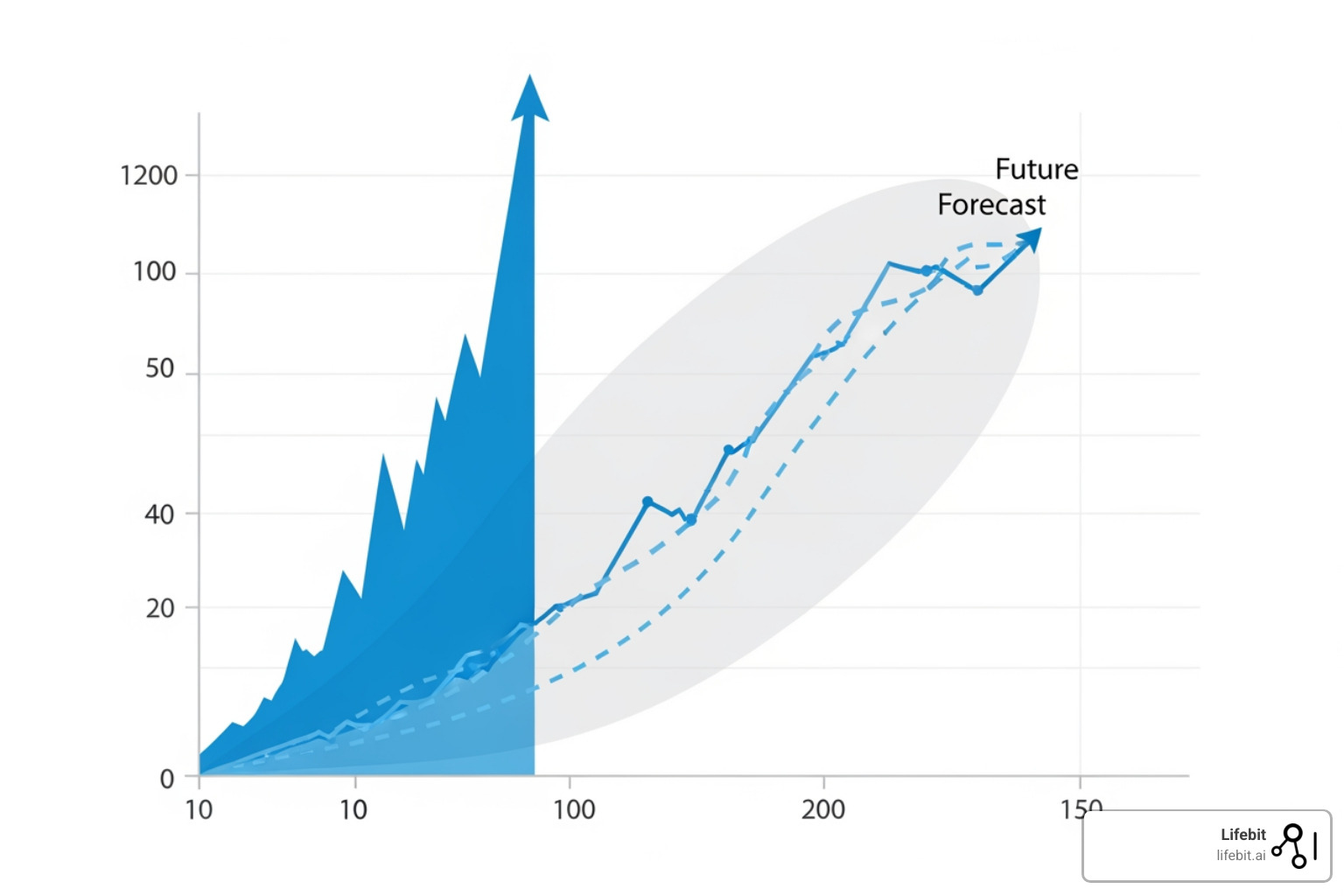
Data Analytics moves beyond simple reporting to encompass a range of techniques that unlock deeper insights. For organizations evaluating data intelligence similar platforms, understanding these different layers of analytics is key. These capabilities, including Data discovery and advanced modeling, are no longer limited to specialized data scientists.
The Four Types of Data Analytics
Data Analytics can be broken down into four distinct types, each answering a progressively more complex question:
- Descriptive Analytics (What happened?): This is the most basic form and is largely synonymous with traditional Business Intelligence. It summarizes historical data to provide a snapshot of the business. Examples include sales reports, website traffic dashboards, and social media engagement metrics. It’s the foundation upon which all other analytics are built.
- Diagnostic Analytics (Why did it happen?): This is the next logical step. When descriptive analytics shows an unexpected trend (e.g., a spike in customer churn), diagnostic analytics is used to dig deeper and find the root cause. An analyst might use techniques like drill-down, data discovery, and correlation analysis. For example, if a software company sees a drop in user engagement, diagnostic analytics could reveal that the drop is isolated to users on a specific mobile operating system who recently received an app update, pointing to a potential bug. This is a move from observation to investigation.
- Predictive Analytics (What will happen next?): This is where DA begins to offer a forward-looking view. It uses statistical models and machine learning techniques to analyze historical and current data to forecast future outcomes. Common applications include:
- Retail: Predicting which customers are most likely to churn or which products are often purchased together (market basket analysis).
- Finance: Building models to predict credit risk and identify fraudulent transactions in real-time.
- Healthcare: Forecasting disease outbreaks or identifying patients at high risk of developing chronic conditions based on their electronic health records and genomic data.
- Prescriptive Analytics (What should we do about it?): This is the most advanced form of analytics and begins to blur the lines with data intelligence. It goes beyond predicting an outcome to recommending specific actions to take to achieve a desired result. For example, a prescriptive model wouldn’t just predict that a customer is likely to churn; it would also recommend the best retention offer (e.g., a 10% discount, a free upgrade) to present to that specific customer to maximize the probability of keeping them. It uses complex algorithms and AI to simulate the outcomes of various choices and suggest the optimal path.
[TABLE] comparing Business Intelligence vs. Data Analytics
Here’s how Business Intelligence and Data Analytics stack up against each other:
| Feature | Business Intelligence (BI) | Data Analytics (DA) |
|---|---|---|
| Focus | Past (what happened) | Past & Future (why it happened, what will happen) |
| Goal | Monitor, report, summarize, track KPIs | Explain, predict, find insights, optimize |
| Methods | Reporting, dashboards, scorecards, descriptive analytics | Statistical analysis, data mining, forecasting, machine learning |
| User | Business users, management | Data analysts, data scientists, business users |
The distinction matters because understanding where your organization sits on this spectrum helps you evaluate whether you need a simple BI solution or something more sophisticated. And as you’ll see in the next section, there’s an even more advanced level that combines analytics with artificial intelligence to create truly intelligent systems.
Data Intelligence (DI): The Leap to AI-Driven Understanding
Imagine if your data platform could learn, understand context, reason on its own, and tell you what to do next. That’s the promise of Data Intelligence (DI), where Artificial Intelligence (AI) and Machine Learning (ML) transform raw data into actionable wisdom.
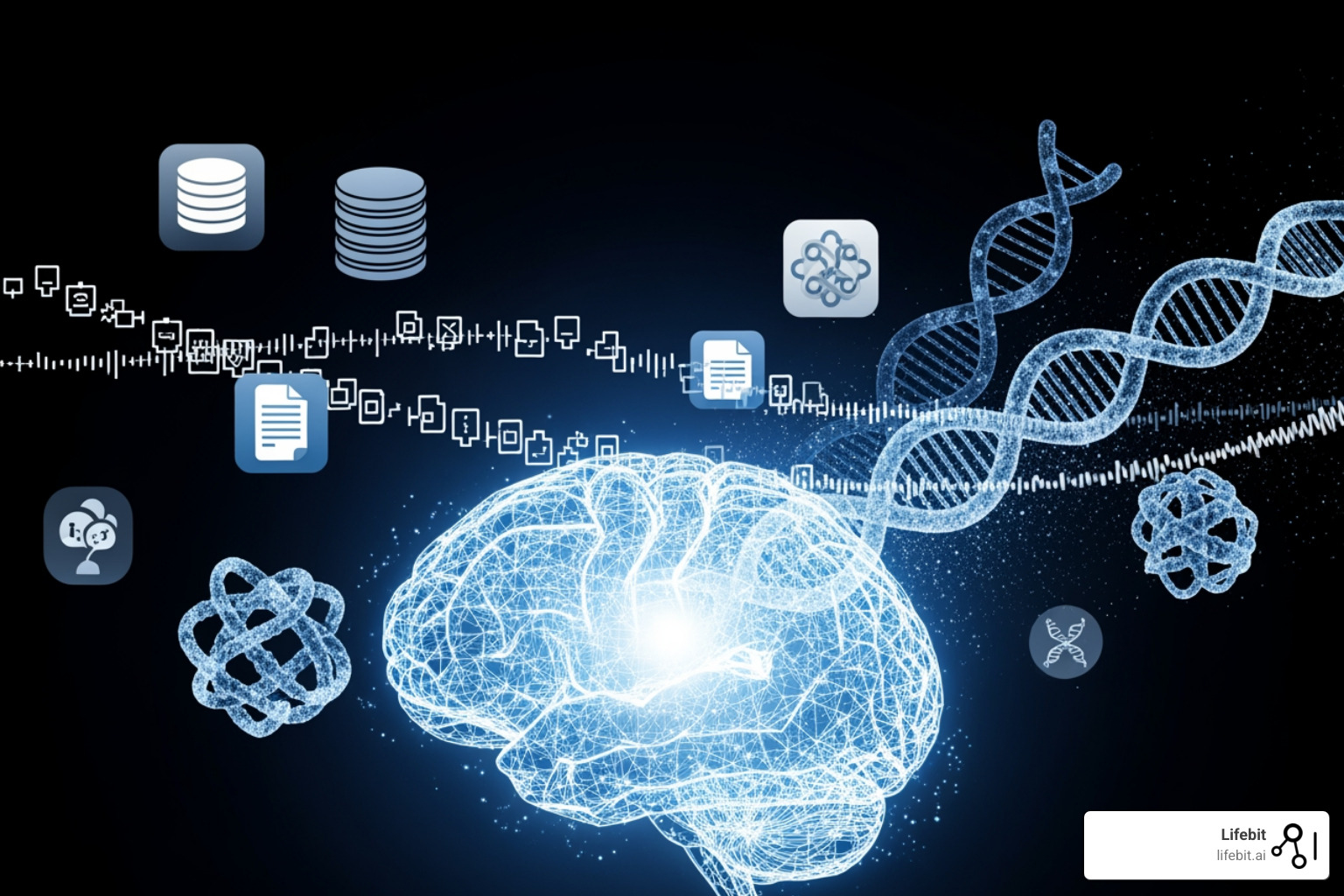
Data intelligence similar platforms go beyond crunching numbers to derive meaning. As HPE explains, DI uses AI to understand the information an organization collects. It’s not just insights from data, but intelligence about the data itself—its origin, quality, security, and lineage. This holistic, 360-degree view is critical for building trust, especially in regulated fields like federated biomedical research.
In short: BI tells you what happened. Analytics explains why. Data intelligence adds semantic understanding and prescriptive recommendations to tell you, “Here’s what you should do about it, and here’s why.”
How DI Surpasses BI and Analytics
Data intelligence platforms represent a fundamental leap forward by being active, not passive:
- They understand context and semantics (Active Metadata): DI platforms use AI to build an “active metadata” graph. This isn’t a static list of table definitions; it’s a dynamic model of your entire data estate. The AI learns business concepts—for example, it understands that “patient,” “subject,” and “participant” can refer to the same entity in different biomedical datasets. It automatically discovers relationships, such as linking a patient’s genomic data to their clinical trial records and pharmacy claims, creating a rich, contextualized view that is impossible to build manually.
- They learn from user interaction and queries: A DI platform is not a static tool; it’s a learning system. It observes how data is used, which queries are run, and what insights users find valuable. If researchers frequently query for data on a specific gene in relation to a particular cancer, the platform can proactively cache this data, suggest related datasets, or even pre-compute analyses to accelerate future discovery. This continuous learning loop makes the platform smarter and more valuable over time.
- They automate data management and optimization: The intelligence isn’t just for analysis; it’s also for operations. Based on observed usage patterns, DI models can automatically optimize the underlying data infrastructure. This includes tasks like optimizing data layout, creating or dropping indexes, partitioning tables, and tiering storage to balance cost and performance. This automates tasks that would typically require a team of database administrators, saving enormous time and resources.
- They enable true natural language interaction: This goes far beyond simple keyword search. Through advanced Natural Language Processing (NLP) and Natural Language Understanding (NLU), DI platforms allow any user to have a conversation with their data. A clinical researcher could ask, “Show me female patients over 50 with the BRCA1 mutation who responded positively to Drug X but experienced neurological adverse events, and compare their gene expression profiles to non-responders.” The platform understands the complex entities and relationships in this query, translates it into code, executes it across multiple federated sources, and returns a synthesized answer, often with visualizations.
- They connect and harmonize disparate data at scale: DI platforms are built to thrive on complexity. They are designed to connect and harmonize incredibly diverse data sources—structured databases, unstructured clinical notes, medical images (DICOM), genomic files (VCF, BAM), and streaming IoT sensor data—into a unified, queryable view. This is often achieved through a data fabric architecture, which provides a virtualized layer over the physical data, making it accessible without costly and risky data movement.
- They provide a governed platform for building custom AI: DI platforms are not just for consuming insights; they are for creating them. They provide first-class support for AI and ML development, allowing data science teams to connect their models directly to high-quality, governed business data. This enables the creation of custom AI applications—like a new diagnostic algorithm or a personalized treatment recommendation engine—with enterprise-grade security, lineage, and governance built-in from the start.
The Impact on Decision Making
The power of data intelligence is clear in its impact on decision-making:
- Radical data democratization: When everyone can “talk” to data in their own language, insights are no longer bottlenecked by a small team of data specialists. A marketing manager in Canada can ask about campaign performance, a lab scientist in the UK can query genomic data, and a clinician in the USA can investigate treatment outcomes, all without writing a single line of SQL. As Gartner notes, this empowerment is key for organizations to manage complexity and build trust.
- From reactive to predictive operations: The impact on operations is profound. In healthcare, DI enables real-time pharmacovigilance. Instead of discovering a drug’s side effect months later from submitted reports, a DI platform can continuously monitor real-world data (RWD) from hospitals and flag a statistically significant increase in an adverse event signal as it emerges. In supply chain management, it means moving from reacting to disruptions to predicting them based on weather patterns, shipping lane congestion, and geopolitical risk signals.
- Hyper-personalization at scale: DI moves beyond broad generalizations to deliver highly personalized insights and recommendations. In medicine, this means identifying precise patient subpopulations that respond differently to treatments based on a combination of their genetics, lifestyle, and comorbidities. In e-commerce, it means creating a unique experience for every visitor, with personalized product recommendations, content, and offers.
- Intelligent and automated data governance: In a world of increasing data regulation (GDPR, HIPAA, CCPA), robust governance is not optional. DI platforms integrate governance directly into the data lifecycle. They use AI to automatically discover and classify sensitive data (like PII or PHI), apply the correct access policies, and generate detailed audit trails of who accessed what data, when, and for what purpose. At Lifebit, our federated approach takes this a step further, enabling cross-organizational analysis while ensuring sensitive data never leaves its secure, local environment, thus upholding data sovereignty and patient privacy.
The shift from reporting data to reasoning with it is a fundamental change in how organizations innovate and compete.
Core Capabilities of Platforms with Data Intelligence and Similar Functions
When evaluating data intelligence similar platforms, you’re choosing your organization’s data strategy foundation. A 2024 Gartner report confirms that organizations utilizing analytics and AI are better positioned to manage complexity, build trust in data, and empower their teams. Here are the core capabilities that separate true data intelligence platforms from the rest.
Must-Have Features for Data Intelligence and Similar Platforms
Look for these features to ensure a platform delivers genuine AI-powered insights:
- Unified Data Access via a Data Fabric: A true DI platform must break down data silos. It should provide a single, coherent access layer—often called a data fabric—that can connect to all of your data, wherever it lives. This includes structured data in traditional databases and data warehouses (like Snowflake, Redshift, or BigQuery), semi-structured data in data lakes (e.g., Parquet, Avro files), and unstructured data like text documents, images, and complex biomedical files (e.g., VCF, FASTQ). The key is that it provides this unified view without requiring you to move all your data into a single repository, which is often impractical and expensive.
- AI-Powered Active Data Catalog: This is the brain of the data fabric. Unlike a traditional, passive data catalog that relies on manual curation, an active catalog uses machine learning to automatically scan data sources, profile the data, and infer its meaning (semantic tagging). It automatically discovers and maps relationships between datasets, tracks data lineage from source to consumption, and even suggests data quality improvements. This living catalog becomes the foundation for all intelligence, providing the context needed for NLP and automated insights.
- Natural Language Query and Interaction (NLQ/NLU): The platform must democratize data access by allowing users to ask questions in plain English (or other languages). This requires more than just keyword search; it demands sophisticated Natural Language Understanding (NLU) to interpret the user’s intent, entities, and relationships within a question. For example, the system must understand that “top-performing drugs” means ranking by sales revenue or clinical efficacy, depending on the user’s role and context. It should also support conversational interaction, allowing users to ask follow-up questions to refine their analysis.
- Native Support for Unstructured and Complex Data: A significant portion of an organization’s most valuable information is locked in unstructured formats. A DI platform must be able to extract and analyze this information. This means using computer vision models to analyze medical images, NLP to extract entities and sentiment from clinical notes or research papers, and specialized bioinformatics tools to process genomic and proteomic data. Simply being able to store these files is not enough; the platform must be able to integrate insights from them with structured data.
- Automated and Proactive Insights: The platform should not wait for users to ask questions. It should use its AI engine to continuously monitor data streams and proactively surface important findings. This includes anomaly detection (e.g., “There is an unusual spike in network login failures from a new geography”), trend identification (“Sales of Product X are accelerating in the Midwest region”), and correlation analysis (“We’ve found a strong correlation between customers who use Feature Y and a lower churn rate”). These insights are pushed to relevant users, shifting the organization from a reactive to a proactive stance.
Integration and Governance in a Modern Data Stack
The most powerful platform in the world is useless if it can’t work with your existing infrastructure or if it creates compliance headaches. This is where integration and governance become non-negotiable.
- Seamless Connectivity and Interoperability: A modern DI platform should augment, not replace, your existing data stack. It must offer robust, pre-built connectors to a wide array of data sources, data warehouses (Snowflake, BigQuery, etc.), data lakes, and BI tools (like Tableau or Power BI). The goal is to improve the value of your current investments by adding a layer of intelligence on top, rather than forcing a costly and disruptive “rip and replace” migration.
- AI-Driven Automated Security: Security in a DI environment must be intelligent and dynamic. The platform should use AI to automate critical security functions. This includes automatically classifying data based on sensitivity, enforcing dynamic access controls based on user role and context (not just static permissions), and using anomaly detection to monitor for insider threats or potential data breaches in real-time.
- End-to-End Compliance and Auditing: To meet stringent regulatory requirements like GDPR in Europe and HIPAA in the USA, the platform must provide a complete, unalterable audit trail. This means logging every query and data access event. Data lineage capabilities are crucial, allowing you to trace any data point or insight back to its original source, including all transformations it underwent. This “glass box” approach is essential for building trust and proving compliance to regulators.
- Cloud-Native Scalability and Elasticity: Data volumes are not static. A DI platform must be built on a cloud-native architecture that can dynamically and automatically scale compute and storage resources up or down based on demand. This ensures you have the power you need for large-scale analysis without paying for idle resources during quiet periods. This elasticity is key to managing costs while handling petabyte-scale datasets.
- Federated Governance for Multi-Party Collaboration: For many industries, especially healthcare and finance, the most valuable insights come from combining data from multiple organizations. However, privacy and competitive concerns prevent data centralization. A leading DI platform must support federated governance. This allows analysis and AI models to be run across a network of institutions by sending the computation to the data, rather than moving the data. The data remains in its original, secure location, under the control of the local data owner. This is the fundamental principle behind the Lifebit platform, enabling secure, collaborative research at a global scale.
Frequently Asked Questions about Data Intelligence
Here are answers to common questions about data intelligence and how it differs from other tools.
What is the main difference between data intelligence and business intelligence?
The simplest distinction is: Business Intelligence tells you what happened, while data intelligence explains why it happened and what to do next.
BI looks backward, using historical data for dashboards that monitor KPIs. Data intelligence similar platforms look forward. They use AI to reason with data, providing context, predicting future outcomes, and recommending actions. They also enable natural language queries, automate data management, and learn from user interactions.
For organizations with complex, federated biomedical data, this is critical. BI shows adverse event rates; data intelligence explains why they differ, predicts future issues, and flags safety signals in real-time across distributed sources—all while keeping data secure.
Can a small business use data intelligence?
Yes, absolutely. Data intelligence similar capabilities are no longer just for large enterprises. Cloud-based platforms have democratized access to sophisticated AI and ML tools for small and medium-sized businesses across the UK, USA, Canada, and beyond.
The key is to start small. Identify a specific business problem, like customer churn or inventory waste, and use a platform with intuitive, self-service interfaces. You can gain actionable insights without a dedicated data science team. Choose scalable tools that can grow with your business, prove the value on a small scale, and expand from there.
How does data intelligence relate to a data fabric?
Think of a data fabric as the intelligent foundation connecting your data sources, and data intelligence as the brain that makes sense of it all.
A data fabric is an architecture that unifies disparate data sources (on-premise, cloud, structured, unstructured) into a single logical view. It automates integration and makes all data accessible as if it were in one place, even when physically distributed.
Data intelligence operates on top of this foundation. It uses AI to understand the connected data, learn its meaning, and extract insights. The data fabric handles the “plumbing,” while data intelligence provides the “reasoning.”
At Lifebit, our federated AI platform embodies this synergy. The fabric connects biomedical data across institutions without centralization. Our data intelligence similar capabilities then allow researchers to query this network, run AI models, and generate insights while data remains secure under local governance.
Conclusion: From Reporting Data to Reasoning with It
We’ve journeyed from Business Intelligence (what happened) and Data Analytics (why it happened) to the frontier of Data Intelligence, where AI understands, learns, and advises on what to do next.
This is a fundamental shift from passively reporting on data to actively reasoning with it. Organizations in London, New York, and beyond are gaining a competitive edge by asking questions in plain English and receiving AI-driven answers that suggest concrete actions.
For sectors like biopharma and public health, this leap to data intelligence similar capabilities is transformative. The old model of waiting weeks for reports is obsolete. Real-time pharmacovigilance, analysis across federated datasets, and AI-powered evidence generation are now essential.
At Lifebit, our federated AI platform was built for this reality. We enable secure, real-time access to siloed global biomedical data without centralizing it. Through harmonization, advanced AI, and federated governance, we help organizations turn complex data into life-saving insights.
The future isn’t about collecting more data; it’s about making data intelligent. It’s about empowering every decision-maker to act with confidence. That is the promise of data intelligence, and it’s the future we are building.
Ready to see what reasoning with your data looks like?