

9 Best Enterprise Genomic Data Platforms in 2026
Managing genomic data at enterprise scale is a compliance nightmare wrapped in a technical puzzle. You’re dealing with petabytes of sensitive sequencing data, multi-site collaborations across borders, and regulators breathing down your neck. The wrong platform means data silos, security gaps, and research bottlenecks that cost months, or years.
The right one? It becomes invisible infrastructure that lets your scientists focus on science.
We evaluated platforms based on what actually matters: security architecture, data harmonization speed, federated analysis capabilities, regulatory compliance, and total cost of ownership. No fluff. No vendor marketing speak. Just what works for government health agencies, biopharma R&D teams, and academic consortia handling real genomic workloads.
Here are the top enterprise genomic data platforms in 2026.
1. Lifebit
Best for: Government agencies and multi-national consortia requiring data sovereignty without movement
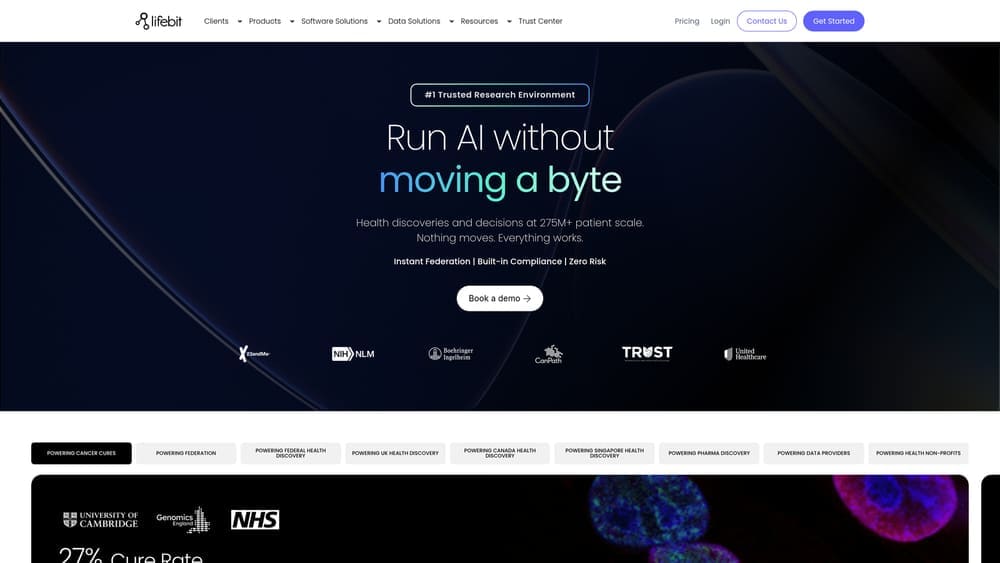
Lifebit is a federated genomic data platform that enables secure analysis without moving data across borders or systems.
Where This Platform Shines
Lifebit solves the fundamental problem that kills most large-scale genomic initiatives: you can’t move the data. When you’re running a national precision medicine program or coordinating research across hospital systems in different countries, traditional centralized platforms force you to copy petabytes of sensitive genomic data into a single location. That’s a compliance disaster waiting to happen.
The platform’s federated architecture lets you query and analyze data where it already lives. Your data stays in your cloud, under your control, meeting your local regulations. This approach has made it the infrastructure behind programs like Genomics England and deployments across NIH initiatives. When data sovereignty isn’t optional, federation isn’t a nice-to-have feature.
Key Features
Federated Analysis Engine: Query distributed datasets without data movement, maintaining compliance across jurisdictions while enabling collaborative research.
AI-Powered Data Harmonization: Converts heterogeneous genomic data to analysis-ready formats in 48 hours instead of the typical 6-12 month timeline.
Trusted Research Environment: Fully isolated cloud workspaces with complete tenant control over access, compute, and data governance policies.
AI-Automated Airlock: First-of-its-kind governance system that automatically reviews and approves data exports based on configurable policies, eliminating manual bottlenecks.
Built-In Compliance: FedRAMP, HIPAA, GDPR, and ISO27001 certified from day one, with architecture designed for regulated environments.
Best For
Government health agencies building national genomic programs, biopharma companies managing multi-site clinical trials with strict data residency requirements, and academic consortia coordinating research across institutions where data cannot legally leave its source location. Organizations managing over 275 million records have deployed this platform when compliance and data sovereignty are non-negotiable.
Pricing
Custom enterprise pricing based on deployment scale and data volume. The platform deploys in your cloud infrastructure, so you maintain ownership and control without vendor lock-in.
2. DNAnexus
Best for: Clinical genomics and pharmaceutical companies requiring FDA-compliant workflows
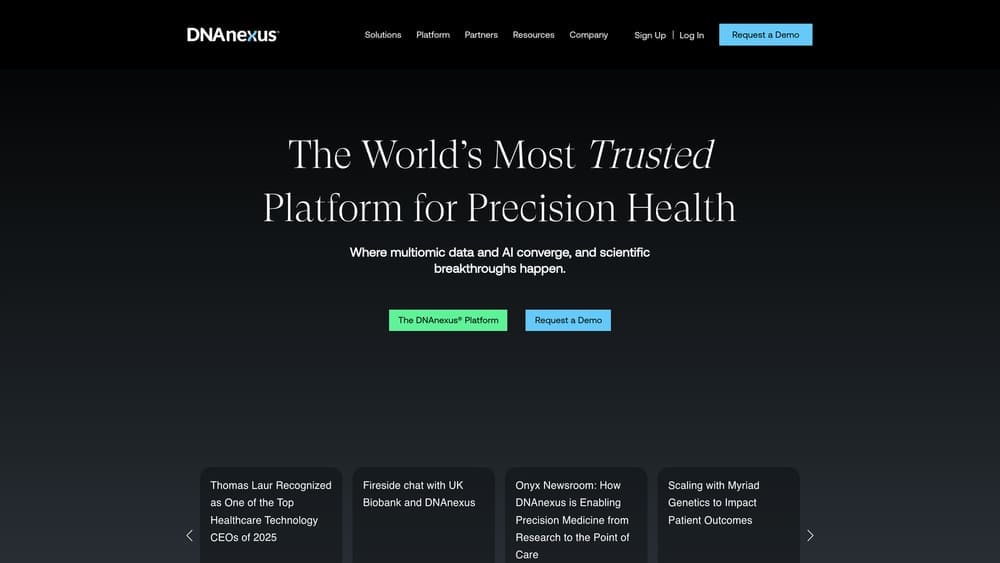
DNAnexus is a cloud-based genomics platform with regulatory compliance features designed for clinical and pharmaceutical applications.
Where This Platform Shines
DNAnexus built its reputation in spaces where regulatory compliance isn’t just important, it’s everything. If you’re submitting genomic data to the FDA as part of a drug approval, running clinical diagnostic pipelines, or managing patient data in a CLIA-certified lab, this platform understands the documentation and validation requirements that keep regulators happy.
The Apollo platform provides a unified environment for multi-modal analysis, and their pharma partnership ecosystem means common workflows are already validated and ready to deploy. When your genomic analysis needs to withstand regulatory scrutiny, having pre-built, validated pipelines saves months of qualification work.
Key Features
FDA 21 CFR Part 11 Compliance: Workflows designed to meet electronic records and signatures requirements for regulated submissions.
Clinical NGS Pipelines: Pre-validated analysis workflows for clinical applications, reducing time-to-deployment for diagnostic labs.
Apollo Multi-Modal Platform: Integrated environment for analyzing genomic, clinical, and imaging data in a single workspace.
Pharma Ecosystem: Strong network of pharmaceutical partnerships with shared validated workflows and reference datasets.
Security Certifications: SOC 2 Type II and HIPAA certified infrastructure with comprehensive audit trails for regulated environments.
Best For
Pharmaceutical R&D teams running clinical trials with genomic endpoints, clinical diagnostic laboratories requiring CLIA-compliant workflows, and biotech companies preparing regulatory submissions. Organizations that prioritize regulatory compliance and need validated pipelines ready to deploy find this platform reduces compliance overhead.
Pricing
Subscription-based model with enterprise tiers typically starting around $50K annually. Pricing scales with the number of users, data volume, and compute requirements.
3. Seven Bridges
Best for: Population genomics initiatives and large-scale collaborative research programs
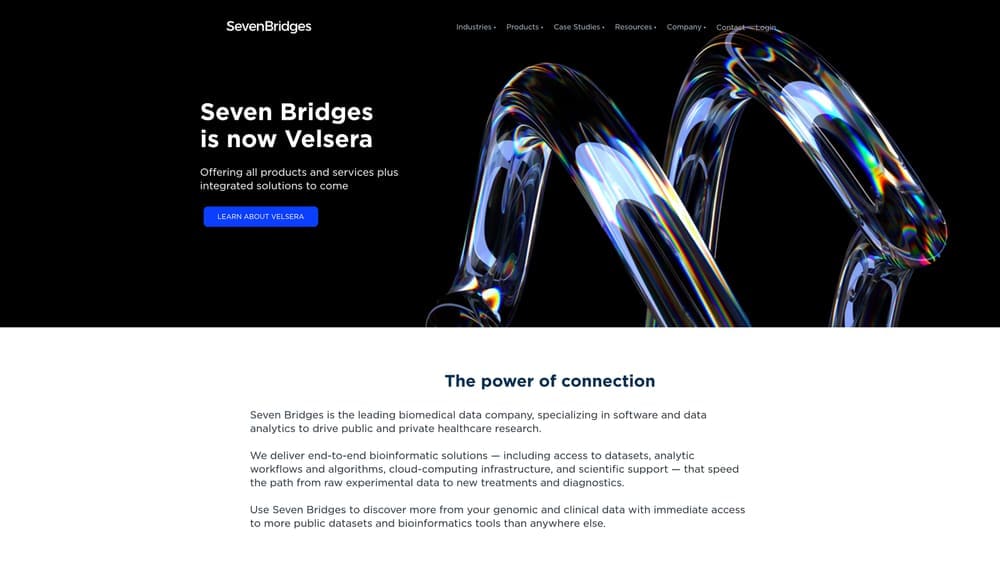
Seven Bridges is a biomedical data analysis platform powering major population genomics initiatives including the Cancer Genomics Cloud and Kids First program.
Where This Platform Shines
Seven Bridges has become the infrastructure behind some of the most ambitious population genomics projects in the world. The Cancer Genomics Cloud, built in partnership with the National Cancer Institute, and the CAVATICA platform for pediatric research demonstrate their ability to handle massive, complex datasets across distributed research teams.
Their support for Common Workflow Language (CWL) and multi-cloud deployment gives research teams flexibility in how they build and share analysis pipelines. When you’re coordinating hundreds of researchers across institutions, all analyzing subsets of the same population-scale dataset, having a platform designed for that collaborative complexity matters.
Key Features
CAVATICA Platform: Specialized environment for pediatric research data analysis, supporting the NIH Kids First Data Resource Center.
Cancer Genomics Cloud: NCI-partnered platform providing access to TCGA, TARGET, and other major cancer genomics datasets.
Common Workflow Language Support: CWL compatibility enables portable, reproducible analysis pipelines that work across environments.
GRAF Germline Pipeline: Optimized analysis workflow for population-scale germline variant calling and quality control.
Multi-Cloud Deployment: Platform operates across AWS, Google Cloud, and Azure, letting organizations choose their preferred infrastructure.
Best For
Population genomics consortia analyzing cohorts of thousands to millions of samples, cancer research programs requiring access to TCGA and related datasets, and pediatric research initiatives. Organizations coordinating distributed research teams around shared large-scale datasets benefit from the collaborative infrastructure and pre-loaded reference data.
Pricing
Usage-based compute pricing plus platform subscription fees. Enterprise agreements available for large deployments with predictable workloads and volume discounts.
4. Illumina Connected Analytics
Best for: Organizations heavily invested in Illumina sequencing infrastructure
Illumina Connected Analytics is a cloud platform tightly integrated with Illumina sequencing instruments and DRAGEN analysis pipelines.
Where This Platform Shines
If your sequencing core runs on Illumina instruments, this platform offers the tightest integration you’ll find. Data flows directly from sequencer to cloud without manual intervention, and the DRAGEN pipeline integration means you’re using the same analysis algorithms Illumina optimizes and validates for their instruments.
The BaseSpace Sequence Hub connectivity creates a seamless workflow from sample loading to analyzed variants. For organizations that have standardized on Illumina hardware and want to minimize the complexity of connecting sequencing to analysis, this vertical integration eliminates integration headaches.
Key Features
Native DRAGEN Integration: Direct access to Illumina’s hardware-accelerated analysis pipelines without separate licensing or setup.
Instrument-to-Cloud Transfer: Automated data movement from Illumina sequencers to cloud storage, eliminating manual upload steps.
BaseSpace Connectivity: Integrated with BaseSpace Sequence Hub for unified sequencing run management and data access.
Clinical Interpretation Tools: Variant interpretation and reporting features designed for clinical genomics workflows.
Illumina Ecosystem: Seamless interoperability with other Illumina software and services, reducing integration complexity.
Best For
Sequencing cores and clinical labs running primarily Illumina instruments, organizations wanting turnkey integration between sequencing and analysis, and teams that prioritize vendor-supported workflows over maximum flexibility. The platform works best when your entire sequencing operation lives within the Illumina ecosystem.
Pricing
Tiered subscription model with pricing varying by sequencing throughput, number of users, and feature access. Volume discounts available for high-throughput operations.
5. Google Cloud Life Sciences
Best for: Cloud-native teams building custom genomics infrastructure with AI integration
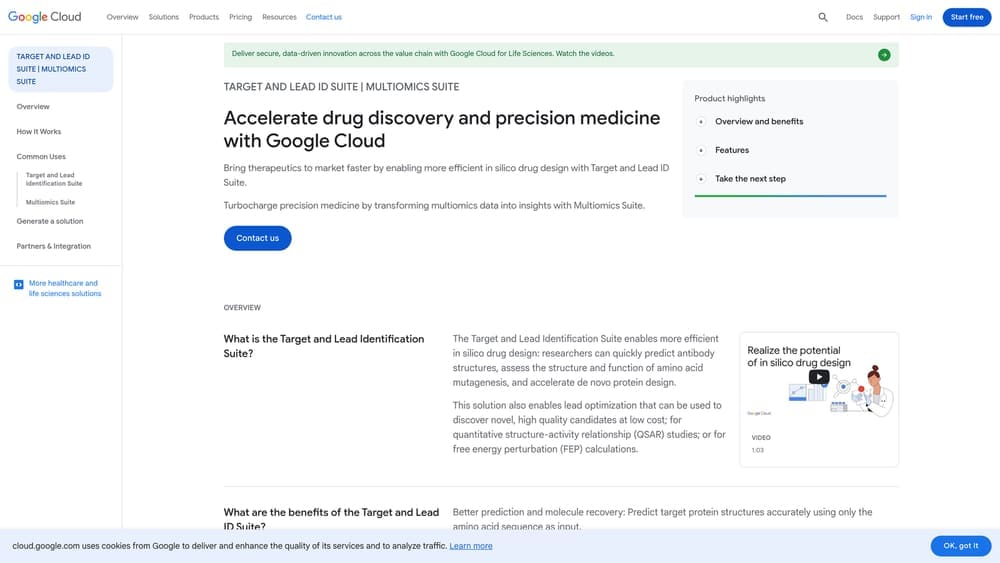
Google Cloud Life Sciences is hyperscale cloud infrastructure for genomics with deep integration into Google’s AI and analytics services.
Where This Platform Shines
Google Cloud Life Sciences isn’t a genomics platform in the traditional sense. It’s infrastructure and tools that let you build exactly the platform you need. If you have engineering capacity and want to leverage Google’s strengths in AI and large-scale data analytics, this approach gives you maximum flexibility.
BigQuery integration means you can run SQL queries across population-scale variant datasets in seconds. Vertex AI lets you build custom machine learning models on your genomic data. The Healthcare Data Engine provides FHIR compliance for integrating clinical and genomic data. When you need to combine genomics with Google’s AI capabilities, this infrastructure makes it possible.
Key Features
BigQuery Genomics: Query population-scale variant datasets using SQL, enabling rapid exploration of millions of samples.
Vertex AI Integration: Build and deploy custom machine learning models on genomic data using Google’s AI infrastructure.
Healthcare Data Engine: FHIR-compliant data management for integrating clinical records with genomic data.
Global Infrastructure: Data residency options across regions worldwide, supporting compliance with local data sovereignty requirements.
Open-Source Compatibility: Support for Nextflow, Cromwell, and other popular workflow engines without vendor lock-in.
Best For
Organizations with strong engineering teams that want to build custom genomics infrastructure, teams requiring tight integration with AI and machine learning capabilities, and cloud-native operations comfortable managing their own platform layer. This approach works best when you need flexibility and have the technical capacity to architect your own solutions.
Pricing
Pay-as-you-go model for compute, storage, and services. Significant volume discounts available through committed use contracts for predictable large-scale workloads.
6. Terra
Best for: Academic researchers and NIH-funded initiatives requiring open-source infrastructure
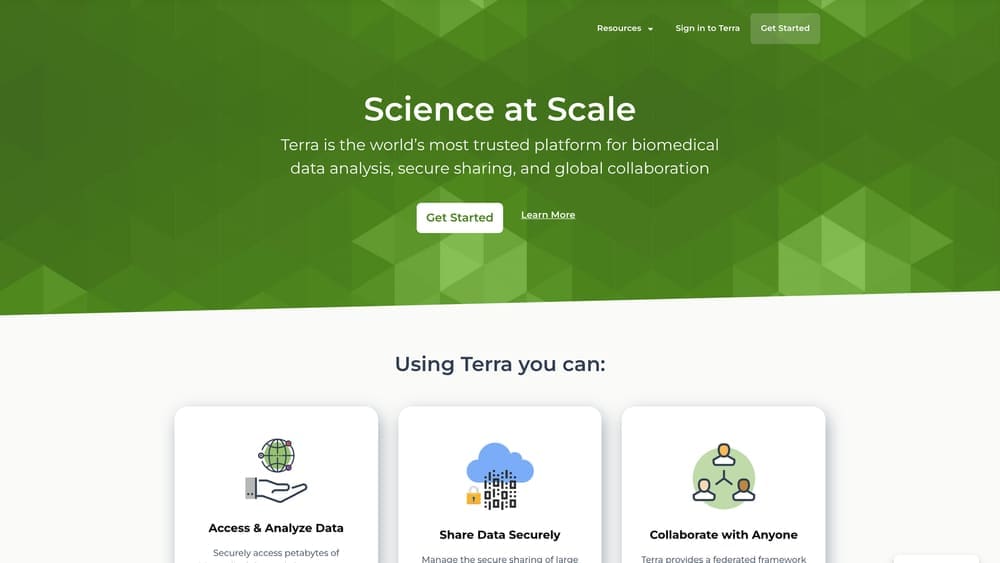
Terra is an open-source genomics platform developed by Broad Institute and Verily, powering major NIH-funded research programs.
Where This Platform Shines
Terra emerged from the Broad Institute’s need to support large-scale collaborative genomics research, and it shows. The platform powers AnVIL (NHGRI’s Genomic Data Science Analysis, Visualization, and Informatics Lab-Space) and BioData Catalyst, making it the infrastructure behind major NIH data sharing initiatives.
The Workflow Description Language (WDL) has a strong community and extensive library of validated pipelines. Jupyter notebook integration lets computational biologists build custom analyses alongside standardized workflows. The open-source model means you’re not locked into proprietary tools, and the cost transparency features help research teams manage cloud spending effectively.
Key Features
WDL Workflow Language: Strong community support and extensive pipeline library for reproducible genomic analysis.
AnVIL Integration: Direct access to NHGRI-funded datasets and analysis workspaces through the AnVIL ecosystem.
BioData Catalyst Support: Integration with NIH’s NHLBI BioData Catalyst for heart, lung, blood, and sleep research data.
Jupyter Notebooks: Interactive analysis environment for custom computational biology workflows alongside standardized pipelines.
Cost Transparency: Built-in tools for tracking and optimizing cloud spending, critical for grant-funded research.
Best For
Academic researchers working with NIH-funded datasets, computational biology teams that prioritize open-source tools and reproducibility, and grant-funded projects where cost visibility and optimization matter. The platform works particularly well for teams already embedded in the Broad Institute or NIH data ecosystems.
Pricing
Free platform access with users paying only for underlying Google Cloud compute and storage costs. No platform licensing fees, making it attractive for grant-funded research with limited budgets.
7. Benchling
Best for: Biotech R&D teams integrating genomics with laboratory workflows and sample management
Benchling is an R&D cloud platform connecting genomic data with laboratory workflows, sample management, and experimental design.
Where This Platform Shines
Benchling approaches genomics from the laboratory side rather than the pure bioinformatics angle. The platform integrates electronic lab notebooks, LIMS functionality, and sequence design tools into a unified environment. For biotech companies where genomic analysis is one piece of a larger R&D workflow involving sample tracking, experimental design, and CRISPR engineering, this integration eliminates data silos.
The Registry feature creates a single source of truth for biological entities—plasmids, cell lines, antibodies—with their associated genomic data. When your genomic analysis needs to connect directly to what’s happening at the bench, this laboratory-centric approach makes more sense than bolt-on integrations between separate systems.
Key Features
Integrated ELN and LIMS: Unified electronic lab notebook and laboratory information management system eliminating data silos.
Sequence Design Tools: CRISPR guide design, primer design, and other molecular biology tools integrated with genomic data.
Biological Registry: Centralized database for plasmids, cell lines, and other biological entities with version control.
API-First Architecture: Extensive APIs for integrating with sequencing instruments, analysis pipelines, and other R&D systems.
SOC 2 Type II Certified: Security controls appropriate for intellectual property protection in competitive biotech environments.
Best For
Biotech R&D teams where genomic analysis is tightly coupled with laboratory work, organizations using CRISPR and other genome engineering tools, and companies needing unified sample tracking from bench to sequence analysis. The platform works best when laboratory integration matters as much as computational analysis.
Pricing
Per-seat licensing model with enterprise tiers for large deployments. Pricing scales with the number of users and modules deployed.
8. Flywheel
Best for: Translational research combining imaging and genomic data
Flywheel is a research data platform with particular strength in managing and analyzing both imaging and genomic data for translational studies.
Where This Platform Shines
Flywheel emerged from the neuroimaging community but has expanded to handle multi-modal data including genomics. For translational research programs that combine MRI, CT, PET imaging with genomic sequencing—think cancer research correlating tumor imaging with molecular profiles, or neurology studies linking brain imaging to genetic variants—this platform handles both data types natively.
The automated de-identification pipelines are particularly strong, handling both DICOM imaging data and genomic files with appropriate privacy controls. The Gears framework provides reproducible analysis workflows that can span imaging and genomic analysis steps in a single pipeline.
Key Features
Multi-Modal Data Management: Native support for imaging (DICOM, BIDS) and omics data in a unified platform.
Automated De-Identification: Configurable pipelines for removing PHI from both imaging and genomic data according to institutional policies.
Gears Framework: Reproducible analysis workflows that can combine imaging and genomic processing steps.
DICOM and BIDS Support: Strong standards compliance for medical imaging alongside genomic data formats.
Flexible Deployment: Available for both academic and commercial deployments with appropriate compliance features.
Best For
Translational research programs combining imaging and genomics, cancer centers correlating radiology with molecular profiling, and neuroscience studies integrating brain imaging with genetic data. Organizations already managing large imaging datasets who need to add genomics capabilities find this multi-modal approach more efficient than separate systems.
Pricing
Subscription-based model with pricing scaling based on data volume and number of users. Enterprise agreements available for large academic medical centers and research institutions.
9. Paradigm4 (SciDB)
Best for: Organizations building custom computational biology infrastructure requiring complex matrix operations
Paradigm4 provides an array database platform optimized for the complex genomic matrices and custom computational biology workflows that traditional databases handle poorly.
Where This Platform Shines
Paradigm4’s SciDB takes a fundamentally different approach to genomic data storage. Instead of treating variants as records in a relational database, it stores them as multi-dimensional arrays optimized for the matrix operations common in population genomics and expression analysis. For computational biologists running complex queries across millions of samples and billions of variants, this architecture can be orders of magnitude faster than traditional approaches.
The platform integrates directly with R and Python, letting computational biologists work in familiar environments while leveraging the optimized database backend. When you’re building custom analytics that don’t fit into standard genomics pipelines, having a database designed for scientific computing rather than enterprise transactions matters.
Key Features
Array Database Architecture: Multi-dimensional array storage optimized for genomic matrices rather than traditional relational structures.
R and Python Integration: Direct integration with scientific computing languages, eliminating data export steps for custom analysis.
Matrix Optimization: Specifically designed for variant matrices and expression data common in population genomics and transcriptomics.
Streaming Ingestion: Handle continuous data streams from sequencing operations without batch loading delays.
Flexible Deployment: Available for both on-premise and cloud deployment depending on organizational requirements.
Best For
Organizations with strong computational biology teams building custom analytics infrastructure, research groups running complex population genetics analyses that strain traditional databases, and teams requiring tight integration with R and Python for scientific computing. This approach works best when you’re doing computational biology research rather than running standardized clinical pipelines.
Pricing
Enterprise licensing based on deployment size, number of nodes, and support tier. Pricing structured for organizations building long-term infrastructure rather than project-based work.
Making the Right Choice
The platform decision comes down to three questions: Where does your data live and can it move? What compliance frameworks do you need? And how much engineering capacity do you have in-house?
For government agencies and multi-national consortia where data sovereignty is non-negotiable, federated platforms that analyze data in place eliminate your biggest compliance headache. Lifebit’s architecture solves the fundamental problem that kills most large-scale initiatives: you can’t move the data across borders without triggering regulatory nightmares.
Organizations running FDA-regulated clinical work need DNAnexus’s validated pipelines and 21 CFR Part 11 compliance. Population genomics programs coordinating hundreds of researchers benefit from Seven Bridges’ collaborative infrastructure and pre-loaded reference datasets. Illumina-heavy operations get the tightest integration with Connected Analytics.
Cloud-native teams with strong engineering capacity can leverage Google Cloud Life Sciences or Terra to build exactly what they need. Biotech R&D groups integrating genomics with laboratory workflows should look at Benchling’s unified environment. Translational research combining imaging and genomics fits Flywheel’s multi-modal approach. And computational biology teams building custom analytics infrastructure may need Paradigm4’s array database architecture.
Start with your hardest constraint and work backward. If data can’t leave its source location due to regulations, that eliminates centralized platforms immediately. If you lack engineering resources to build custom infrastructure, managed platforms make more sense than bare cloud services. If you’re submitting to regulators, pre-validated pipelines save months of qualification work.
The right platform becomes invisible. Your scientists stop thinking about infrastructure and focus on science. Your compliance team stops panicking about data movement. Your engineers stop fighting integration problems. That’s when you know you chose correctly.
Ready to see how federated genomic infrastructure eliminates data movement compliance issues? Get started for free and analyze your distributed datasets without copying data across borders.