

Ethical AI Platform: How to Pick a Bot with a Conscience

Ethical AI Platform: Stop Regulatory Risk and Build Trust in 2026
An ethical AI platform is a specialized system that embeds fairness, transparency, accountability, and privacy directly into AI development and deployment—going beyond generic AI tools to provide governance guardrails, audit trails, and regulatory alignment. Unlike standard development frameworks, these platforms actively monitor for bias, track data lineage, and enforce human oversight at every stage of the AI lifecycle.
Top ethical AI platform resources and frameworks include:
- Fairwork AI Certification – Labor ethics framework protecting over 1 million workers across 826 company ratings in 41 countries
- Partnership on AI – Multi-stakeholder consortium with 126 partners advancing responsible practices through research and guidelines
- EthicsEngine – Independent benchmarking platform evaluating 15 frontier models weekly across 300 ethical scenarios
The economic potential of Generative AI could add between $17 trillion and $26 trillion to the global economy, yet this opportunity comes with enormous responsibility. As AI investment approaches $200 billion globally by 2025, organizations face mounting pressure from regulations like the EU AI Act, UNESCO’s Recommendation on the Ethics of AI (applicable to 194 member states), and shifting public expectations. Gartner predicts that by 2026, AI models from organizations that operationalize transparency, trust, and security will achieve a 50% increase in adoption and user acceptance—making ethical AI not just a compliance checkbox but a strategic differentiator.
The stakes extend beyond algorithms to people. AI systems don’t build themselves—they rely on massive human effort for data annotation, labeling, and monitoring, often in low-oversight environments. This hidden workforce, documented by Fairwork across consultations with over 8,300 workers, faces exploitation risks that threaten both supply chain resilience and corporate reputation. New regulations like the EU’s Corporate Sustainability Due Diligence Directive now extend compliance requirements to these digital labor supply chains.
I’m Maria Chatzou Dunford, CEO and Co-founder of Lifebit, where we’ve spent over a decade building secure, federated platforms for biomedical data analysis that prioritize privacy and ethical governance. Throughout my career in computational biology and health-tech entrepreneurship, I’ve witnessed how the right ethical AI platform can transform data-driven innovation while protecting patient rights and research integrity.
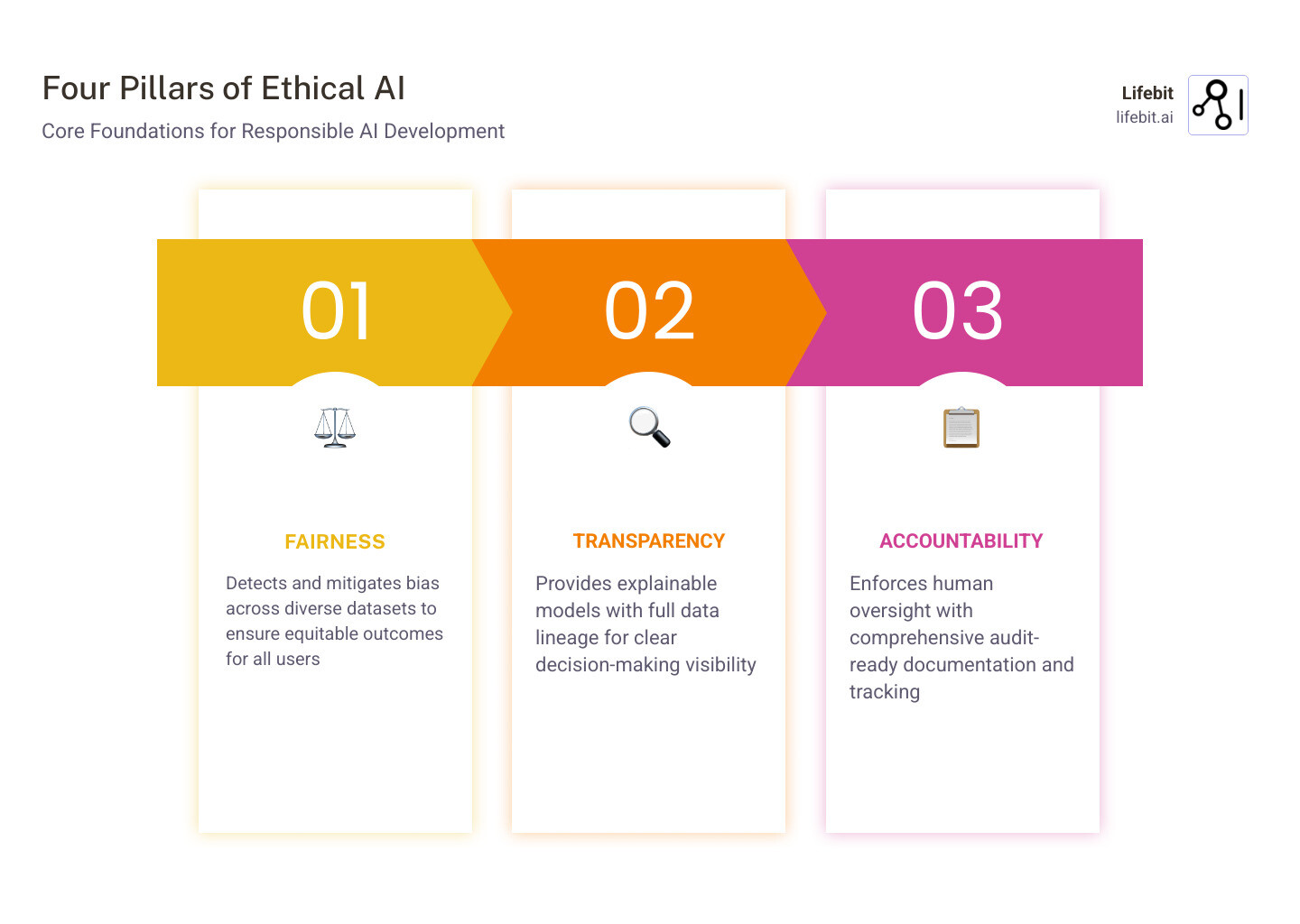
Simple ethical ai platform word guide:
Ethical AI Platform: Why Your Organization Needs Governance Now
In the early days of AI, “innovation” often meant moving fast and breaking things. But when the “things” being broken are patient privacy, social equity, or legal compliance, the costs are too high. We have entered an era where trust is the new innovation frontier. Organizations can no longer treat AI ethics as a philosophical debate; it is now a core business requirement.
The rise of generative AI has intensified these risks. From “hallucinations” that present fiction as fact to the accidental leakage of intellectual property, the pitfalls are numerous. This is why a dedicated ethical AI platform is distinct from a general development tool. While standard tools focus on model performance and speed, ethical platforms act as an “operating system for trust.”

The regulatory landscape is shifting beneath our feet. The UNESCO Recommendation on the Ethics of AI provides a global standard applicable to 194 member states, emphasizing human rights and dignity. Meanwhile, the EU AI Act is setting a high bar for algorithmic accountability. Without a centralized platform to manage these requirements, organizations face a fragmented, manual effort that is prone to error.
| Feature | General AI Development Tools | Ethical AI Platforms |
|---|---|---|
| Primary Goal | Model accuracy and speed | Trust, safety, and compliance |
| Governance | Manual or siloed | Centralized and automated |
| Bias Testing | Optional/Ad-hoc | Continuous and systemic |
| Audit Readiness | Low (fragmented logs) | High (cryptographic audit trails) |
| Human Oversight | Limited | Built-in “Human-in-the-loop” |
Investing in an ethical AI platform isn’t just about avoiding fines. Organizations that operationalize these frameworks see a significant reduction in manual effort via automation and faster adoption of governance workflows. By operationalizing ethics, we move from reactive damage control to proactive, responsible innovation.
Essential Capabilities of a Modern Ethical AI Platform
What should you actually look for in a “bot with a conscience”? It starts with moving beyond simple checklists to integrated technical capabilities.
- Bias Mitigation and Fairness: The platform must proactively identify and reduce algorithmic bias. This is critical in fields like healthcare, where biased data can lead to unequal treatment recommendations. AI-enabled data governance ensures that the data feeding these models is representative and high-quality.
- Explainability (XAI): If an AI makes a decision, we need to know why. This is especially true for “safety-critical” AI in medicine or finance. A platform should offer tools that translate complex neural networks into human-readable rationales.
- Privacy-Preserving Architecture: Modern platforms use techniques like federated learning to analyze data without ever moving it. This privacy-preserving AI approach is foundational to our work at Lifebit, allowing researchers to gain insights from sensitive biomedical data while keeping that data securely behind local firewalls.
- Real-Time Monitoring and Data Lineage: Models drift over time. A robust platform provides continuous monitoring to detect when a model starts behaving unexpectedly. It also maintains a clear record of data lineage—knowing exactly where data came from and how it was transformed.
Navigating Global Regulations and Standards
Compliance is a moving target. An ethical AI platform acts as a compass, helping you align with diverse frameworks such as:
- UNESCO RAM (Readiness Assessment Methodology): Tools to help states and organizations evaluate their preparedness for ethical AI.
- NIST AI Risk Management Framework: A gold standard for identifying and mitigating risks throughout the AI lifecycle.
- EU Corporate Sustainability Due Diligence Directive (CS3D): This CS3D regulation requires companies to ensure ethical practices across their entire supply chain—including the digital labor used to train AI.
- ISO 42001: The international standard for AI management systems.
By using a platform that automates alignment with these standards, organizations can achieve 100% audit readiness, turning a bureaucratic nightmare into a streamlined, repeatable process.
Ethical AI Platform: Stop Exploitation in Your Digital Supply Chain
One of the most overlooked aspects of AI ethics is the “hidden workforce.” Millions of humans are involved in data annotation, content moderation, and labeling. This supply chain often stretches into regions with weak regulatory protections, leading to potential exploitation.
Responsible organizations must look beyond the algorithm to the people powering it. The Fairwork AI Supply Chain Certification is a vital tool here. Their methodology has been applied in over 41 countries and has improved working conditions for over 1 million people. It evaluates companies on five principles: Fair Pay, Fair Conditions, Fair Contracts, Fair Management, and Fair Representation.
This isn’t just a moral obligation; it’s a risk management strategy. Exploitative labor practices create fragile supply chains and significant reputational risks. Scientific research on AI ethics at work highlights that “politics by automatic means” can reinforce inequality if not managed through structured, ethical processes. By choosing an ethical AI platform that prioritizes supply chain transparency, we ensure that our technological progress doesn’t come at the cost of human dignity.
Ethical AI Platform: Scale Enterprise Innovation Without Governance Debt
Scaling AI from a single pilot project to an enterprise-wide strategy is where most organizations stumble. The complexity of managing dozens of models across different departments can lead to “governance debt.”
To scale safely, an ethical AI platform must integrate seamlessly with existing MLOps (Machine Learning Operations) workflows. This allows for:
- Automated Workflows: Reducing the manual burden on legal and risk teams.
- Continuous Auditing: Ensuring that as models are updated or fine-tuned, they remain within ethical boundaries.
- Model Drift Detection: Automatically alerting teams when a model’s performance or fairness begins to degrade in production.
For sensitive industries, this integration often requires specialized infrastructure. Our essential guide to AI platforms for biomedical data explains how to balance high-performance analytics with the strict requirements of AI for regulatory compliance.
Scaling Your Ethical AI Platform Across the Enterprise
Effective scaling requires a structured approach to “Lifecycle Stewardship”:
- Centralized Inventory: You cannot govern what you cannot see. Maintain a complete registry of every AI model, its purpose, its data sources, and its risk profile.
- Cross-Functional Collaboration: Ethical AI is not just an “IT problem.” Effective platforms drive higher engagement across legal, risk, and data teams by providing unified dashboards that everyone can understand.
- Trusted Research Environments (TREs): Use a TRE guide to set up secure zones where data can be analyzed without risk of unauthorized export or exposure.
- Risk-Based Tiering: Not every AI needs the same level of scrutiny. A chatbot for the company cafeteria requires less oversight than an AI assisting in clinical diagnoses. Platforms should allow for flexible, risk-based governance.
Ethical AI Platform: 2026 Guide to Picking the Right System
By 2026, the market for ethical AI will be more mature, but also more crowded. To pick the right platform, you must look for “Accountability Without Gatekeepers.” This means choosing systems that provide transparent, auditable results rather than “black box” promises.
One emerging trend is the use of Independent Ethical Benchmarking Standards. Tools like EthicsEngine use 300 scenarios to evaluate model reasoning, providing cryptographic audit trails that prove a model’s “moral” consistency.
Another critical factor is the architecture of the platform itself. For global organizations, a decentralized AI platform is often the only way to comply with strict data residency laws while still enabling global collaboration.
| Industry | Primary Ethical Concern | Recommended Platform Feature |
|---|---|---|
| Healthcare | Patient Privacy & Bias | Federated Governance & TREs |
| Finance | Explainability & Fairness | XAI Tools & Audit Trails |
| Government | Accountability & Sovereignty | Open-Source Foundations & Local Data Control |
Ethical AI Platform: Answers to Your Top 3 Governance Questions
How does an ethical AI platform differ from standard AI tools?
Standard tools focus on performance and speed, while an ethical AI platform prioritizes fairness, transparency, and compliance through built-in governance guardrails. While a standard tool might help you build a model faster, an ethical platform ensures that the model is safe to deploy and won’t create long-term legal or reputational liabilities.
Can these platforms help with EU AI Act compliance?
Yes, they provide the necessary documentation, bias testing, and risk assessments required to meet high-risk AI system obligations under the EU AI Act. They automate the collection of “evidence” needed for audits, which can reduce governance cycle times by up to 50%.
Why is labor ethics included in AI platform discussions?
AI depends on massive human effort for data labeling; ethical platforms ensure this “hidden workforce” is treated fairly, reducing supply chain and ESG risks. As regulations like the CS3D come into force, companies will be legally required to prove that their digital supply chains are free from exploitation.
Ethical AI Platform: Future-Proof Your Innovation with a Trusted Partner
The promise of AI is transformative, but its success depends entirely on trust. Whether we are accelerating medical research or optimizing global supply chains, we must ensure our innovations are grounded in human values. An ethical AI platform is the essential bridge between technical capability and societal responsibility.
At Lifebit, we believe that the most powerful AI is the one that respects the boundaries of privacy and ethics. Our Lifebit Platform is built on the principles of federated governance and secure, real-time access to biomedical data. By empowering researchers to collaborate without compromising data security, we are helping to build a future where innovation and ethics go hand in hand.
Ready to secure your AI future? Start by choosing a partner that puts a conscience at the heart of the code.