

How to Implement Federated Data Analysis: A Step-by-Step Guide for Healthcare Organizations
Your genomic data sits in a research hospital in Boston. Clinical outcomes data lives in a government health database in London. Real-world evidence from patient registries is locked in servers across Singapore. You need all of it to answer a single research question: Does this drug candidate work across diverse populations?
Moving that data to a central location isn’t just difficult. It’s often illegal.
HIPAA regulations in the United States, GDPR across Europe, and national data sovereignty laws in dozens of countries create a compliance minefield. Centralizing sensitive health data triggers regulatory reviews that can take years. Patient consent requirements multiply. Legal teams at each institution demand different contractual protections. The project stalls before it starts.
Yet the research questions remain urgent. Precision medicine programs need population-scale data. Drug development requires real-world evidence across demographics. Public health initiatives depend on insights from distributed healthcare systems.
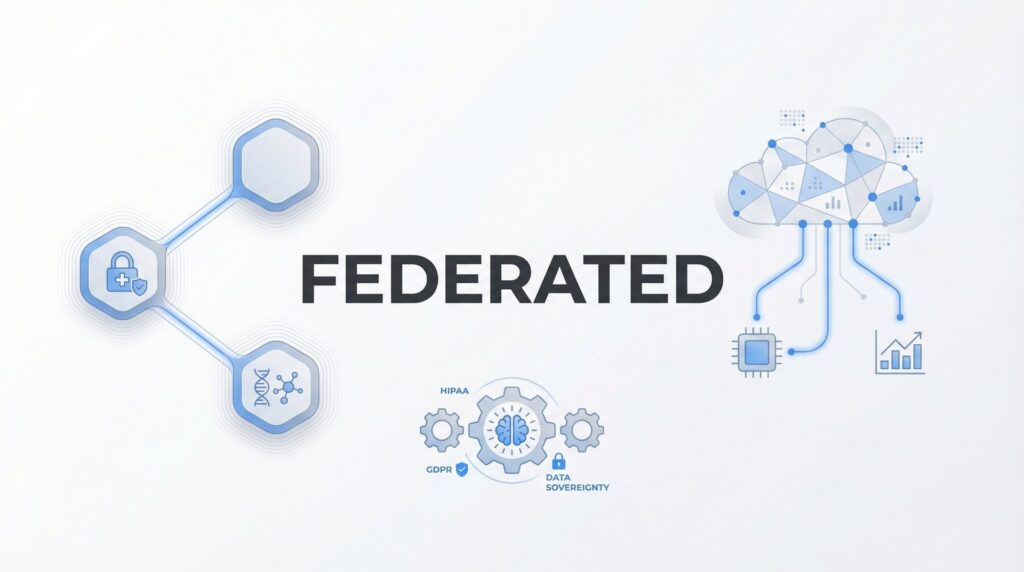
Federated data analysis solves this fundamental problem. Instead of moving sensitive data to your algorithms, you move your algorithms to the data. The data never leaves its secure environment. Each institution maintains complete control. You get the insights without the risk.
This isn’t theoretical. Government health agencies like NIH and Genomics England use federated approaches to power national precision medicine programs. Biopharma companies access real-world evidence across hospital networks without ever seeing individual patient records. Academic consortia analyze genomic data across continents while maintaining strict privacy controls.
This guide walks you through implementing federated analysis in your organization. From assessing your current infrastructure to running your first cross-institutional query. Whether you’re building a national health data network or trying to access clinical data across multiple research sites, these steps move you from concept to working system.
Step 1: Audit Your Data Landscape and Define Analysis Goals
You can’t federate what you don’t understand. Start by mapping exactly where your sensitive data currently lives.
Create a comprehensive inventory. Which hospitals hold clinical records? Which research institutions have genomic data? Which government agencies control population health databases? Document the physical and cloud locations. Note whether data sits on-premise, in AWS, Azure, Google Cloud, or hybrid environments.
For each data source, record the format and standards in use. Does the hospital use OMOP Common Data Model? FHIR resources? A proprietary electronic health record schema? Are genomic files in VCF format? CRAM? Proprietary array data? This matters because federated queries only work when you can translate between different schemas.
Assess data quality at each location. How complete are the records? What’s the rate of missing values? Are diagnoses coded consistently? This step reveals problems before they break your federated queries. A site with 40% missing diagnosis codes will return misleading results no matter how sophisticated your federation technology.
Document the regulatory environment for each data location. A hospital in Germany operates under GDPR. A research site in California adds CCPA requirements. A government database in Singapore has national data sovereignty rules. Federal agencies may require FedRAMP compliance. Each jurisdiction creates constraints on what you can query and how results can be shared. Understanding HIPAA compliant data analytics requirements is essential for any US-based data sources.
Now define your specific analysis goals. Vague objectives like “improve research” don’t guide implementation decisions. Concrete questions do.
Do you need to identify patient cohorts matching specific genomic and clinical criteria across institutions? Calculate drug effectiveness across diverse populations? Run GWAS studies on distributed genomic data? Validate AI models on real-world data without centralizing it?
Each use case has different technical requirements. Cohort identification needs fast count queries. GWAS requires secure computation on individual-level data. Model validation demands result aggregation with statistical disclosure controls.
Success indicator: You have a document showing every data location, the format and standards at each site, regulatory requirements, data quality metrics, and three to five specific research questions you need federated analysis to answer. Share this with stakeholders. If they can’t understand your current state and target outcomes from this document, keep refining it.
Step 2: Establish Governance Framework and Data Use Agreements
Technical implementation fails without governance foundations. You need clear rules about who can query what data, under which conditions, and for which approved purposes.
Start with data use agreements that work across all participating institutions. Each organization has its own legal requirements, but the agreements must be standardized enough to avoid negotiating from scratch for every new project.
Define access tiers. Public health surveillance might allow broader access than drug development research. Academic studies have different approval processes than commercial applications. Create clear categories with pre-defined permissions for each.
Establish approval workflows for new queries and research projects. Who reviews requests? How long does approval take? What documentation is required? A government health agency might need institutional review board approval plus data governance committee sign-off. A hospital network might require privacy officer review and legal clearance.
Build these workflows before deploying technology. Otherwise your federated system sits idle while queries wait months for approval.
Set up output review processes. This is critical. Even aggregated results can potentially reveal sensitive information if the cohort is small enough or the query is designed to isolate specific individuals.
Define minimum cohort sizes for any result release. Many organizations use a threshold of 10 or 20 patients. Results from smaller groups get suppressed automatically. Implement privacy-preserving statistical data analysis mechanisms that add statistical noise to protect individual privacy while maintaining analytical validity.
Decide what level of granularity can leave each secure environment. Can researchers see individual-level results? Only aggregated statistics? Summary tables? The answer depends on your regulatory requirements and institutional risk tolerance.
Create a data governance committee with representatives from each participating institution. This group reviews edge cases, updates policies as regulations change, and resolves disputes about data access or result disclosure. A robust federated governance framework ensures consistency across all participating nodes.
Document everything. Auditors and regulators will ask how you protect patient privacy, ensure appropriate use, and maintain compliance across jurisdictions. Your governance framework documentation is the answer.
Success indicator: You have signed data use agreements with all participating institutions, documented approval workflows, defined output disclosure rules, and a functioning governance committee. Test the system by submitting a sample query request and tracking it through the full approval process. If it takes longer than two weeks, your workflows need streamlining.
Step 3: Harmonize Data Standards Across Nodes
Different institutions name the same thing differently. One hospital codes diabetes as ICD-10 E11. Another uses SNOMED CT 44054006. A research database has a proprietary code. Your federated query for “patients with type 2 diabetes” will miss two-thirds of the relevant patients unless you solve this.
Select a common data model that all participating sites will map their data to. For observational health data, OMOP CDM is the established standard. It’s used by OHDSI (Observational Health Data Sciences and Informatics), a global collaborative with hundreds of participating institutions.
OMOP provides standardized tables for clinical concepts, visit records, drug exposures, procedures, and measurements. It uses standardized vocabularies that map local codes to common identifiers. This means your query for diabetes works the same way at every site, regardless of their source coding system. Learn more about implementing OMOP for healthcare data to accelerate your standardization efforts.
For genomic data, consider standards like GA4GH (Global Alliance for Genomics and Health) schemas. For imaging data, DICOM remains the standard. The key is consistency across your federation.
Map local data schemas to the common model at each participating site. This is detailed work. A hospital’s electronic health record has dozens or hundreds of tables. Each field needs mapping to the appropriate OMOP concept.
Many organizations underestimate this effort. Schema mapping for a single large hospital can take three to six months if done manually. AI-powered tools can reduce this to 48 hours by automatically suggesting mappings based on field names, data patterns, and semantic similarity.
Implement automated validation to ensure data quality and consistency after mapping. Run test queries that check for expected patterns. Do diagnosis dates come before treatment dates? Are age ranges realistic? Do medication codes match known drug classes?
Set up continuous monitoring. Data quality drifts over time as source systems change. Automated validation catches problems before they corrupt your federated analysis results.
Address vocabulary standardization. Even with OMOP, sites might use different versions of standard vocabularies. Establish a common vocabulary version across all nodes. Understanding data harmonization principles helps ensure consistent results across your entire network. Update it systematically when new versions release.
Success indicator: Submit a test query for a common clinical concept like “patients with hypertension” to all nodes. Each site should return results using the same data structure and concept definitions. If results are comparable and the query syntax is identical across sites, your harmonization worked.
Step 4: Deploy Secure Compute Environments at Each Data Location
Data never leaves its secure location in a federated system. This means compute must happen where the data lives. Each participating site needs a trusted research environment that meets compliance requirements while enabling analysis.
Install secure compute infrastructure at each node. This isn’t a simple database connection. You need isolated environments where approved researchers can run analyses without direct access to raw data.
The environment must meet regulatory standards for your jurisdiction. HIPAA compliance in the United States requires specific technical safeguards: encryption at rest and in transit, access controls, audit logging, and breach notification capabilities. GDPR adds requirements for data minimization and purpose limitation. FedRAMP certification is mandatory for federal agencies.
Configure network security that allows query distribution without exposing raw data. Queries come in through secure API endpoints. Results go out through controlled channels. Direct data access is blocked at the network level.
Implement authentication and access controls that work across the federated network. A researcher approved at one institution shouldn’t automatically get access at others. But they also shouldn’t need separate credentials for every site.
Many organizations use federated identity management. A researcher authenticates once through their home institution. That credential is trusted across the network based on pre-established agreements. Role-based access control determines what each user can do at each site.
Set up comprehensive audit logging. Every query, every data access attempt, every result export gets recorded with timestamp, user identity, and purpose. This isn’t optional. It’s required for compliance and critical for identifying security incidents.
Logs must be tamper-proof and retained according to regulatory requirements. Many jurisdictions require seven years of audit history. Store logs in write-once storage or blockchain-based systems that prevent modification.
Deploy monitoring that tracks system health, query performance, and security events in real-time. You need to know immediately if a node goes offline, if query response times degrade, or if someone attempts unauthorized access.
Success indicator: Each node can receive an authorized query, execute it against local data, and return aggregated results. Test this with a simple count query. If every site responds correctly and audit logs capture the complete transaction, your secure compute environments are working.
Step 5: Configure the Central Orchestration Layer
Individual secure compute nodes are valuable. A coordinated federation is transformative. The orchestration layer distributes queries across all nodes, aggregates results, and provides the unified interface researchers actually use.
Deploy the coordination system that manages the federated network. This central component receives queries from researchers, determines which nodes have relevant data, distributes the query to those nodes, collects results, and aggregates them into a final answer.
The orchestration layer doesn’t see raw data. It sees only the aggregated results that each node returns. This maintains the fundamental privacy guarantee of federated analysis.
Set up result aggregation that combines insights without exposing individual-level data. If you’re counting patients who meet specific criteria, the orchestration layer sums the counts from each node. If you’re calculating means or running regression models, it combines the statistical summaries using privacy-preserving techniques.
Implement differential privacy or other statistical disclosure controls. Even aggregated results can reveal sensitive information if cohorts are small. Differential privacy adds calibrated statistical noise that protects individual privacy while maintaining the analytical validity of results.
Configure disclosure thresholds. Automatically suppress results from cohorts below your minimum size threshold. Flag results that might enable re-identification through linkage with external data. This happens before researchers see any output.
Build dashboards for monitoring query status, node health, and system performance. Researchers need visibility into whether their query is running, which nodes have responded, and when results will be available. Administrators need real-time monitoring of system health across the entire federation.
Set up alerting for failures and anomalies. If a node stops responding, if query times exceed thresholds, or if someone submits an unusual volume of queries, the system should notify administrators immediately.
Create a query library where approved analyses can be saved and reused. A validated query for identifying diabetes patients shouldn’t need re-approval every time someone runs it. Build a repository of pre-approved queries that researchers can execute with minimal friction.
Success indicator: Submit a single query through the orchestration layer. It should automatically distribute to all relevant nodes, collect results, apply disclosure controls, and return aggregated insights. If you can run a cross-institutional analysis with one query submission instead of coordinating with each site individually, your orchestration layer is working.
Step 6: Run Validation Queries and Iterate
Your federated system is deployed. Now prove it works. Start with simple validation queries that verify connectivity and data consistency before moving to complex analyses.
Begin with basic count queries. How many patients are in each node? How many have diagnosis codes recorded? How many have lab results? These queries test whether the orchestration layer can reach each node and whether data mappings are working.
Compare federated results against known benchmarks. If you have a test dataset with known characteristics, run the same query against both the federated system and the test data. Results should match within expected tolerance.
Discrepancies reveal problems. If one node returns counts that are 30% lower than expected, investigate the data mapping. A missing vocabulary entry might be causing the site to miss relevant patients. If aggregated results don’t match the benchmark, check your aggregation logic.
Gradually increase query complexity. After counts work, try simple statistics: means, medians, standard deviations. Then move to cohort identification queries that combine multiple criteria. Finally, test complex analytical queries like survival analysis or predictive modeling.
Each step reveals different potential issues. Simple counts might work while complex queries fail because of subtle schema differences. Statistical calculations might produce incorrect results if data types aren’t handled consistently across nodes.
Run the same query multiple times and verify consistency. Results should be identical for deterministic queries. If you get different answers each time, you have a data consistency problem or a bug in the aggregation logic.
Test edge cases. What happens when a query returns zero results from some nodes? How does the system handle nodes that are temporarily offline? Can it recover gracefully from network failures? These scenarios will happen in production. Validate the system’s behavior now.
Involve actual researchers in validation. Have them run real analyses using the federated system. Collect feedback on query performance, result clarity, and usability. Technical validation proves the system works. User validation proves it’s actually useful.
Success indicator: Federated query results match expected values within acceptable tolerance. Researchers can successfully run their actual analyses using the system. Query performance meets requirements. When problems occur, you have monitoring and logging that quickly identifies the root cause.
Moving From Concept to Production
You now have a roadmap from scattered, siloed data to a functioning federated analysis network. The key milestones: complete data inventory, signed governance agreements, harmonized data standards, secure compute at each node, central orchestration, and validated queries.
This isn’t a six-week project. Depending on the number of participating institutions and data complexity, expect three to twelve months for full implementation. A federation connecting three hospitals with standardized OMOP data might deploy in three months. A national health program spanning dozens of institutions with heterogeneous data sources can take a year.
But you can start generating value much sooner. Even two or three connected nodes can answer research questions that were previously impossible. Start small. Prove the concept with a limited federation. Add nodes incrementally as you refine processes and build confidence.
The organizations seeing the fastest results share one trait: they treat governance and data harmonization as prerequisites, not afterthoughts. Get those right, and the technical deployment becomes straightforward. Rush past them, and you’ll spend months debugging problems that stem from unclear policies or inconsistent data mappings.
Common pitfalls to avoid: underestimating schema mapping complexity, skipping validation queries, neglecting user training, and failing to plan for ongoing maintenance. Federated systems require continuous attention. Data quality monitoring, vocabulary updates, security patches, and policy refinements are ongoing work.
Plan for scale from the beginning. Your initial federation might connect three sites. But if the goal is a national program, design infrastructure that can handle hundreds of nodes. Build automation for onboarding new sites. Create standardized processes that don’t require custom work for each addition.
Ready to move faster? Lifebit’s Federated Data Platform handles the infrastructure complexity so your team can focus on the science. Data stays where it lives. Secure compute deploys in your cloud environments with full compliance built in. AI-powered harmonization reduces schema mapping from months to 48 hours. The orchestration layer distributes queries and aggregates results automatically. You get the insights without the implementation burden.
Organizations using Lifebit’s platform are already running federated analyses across national health programs, multi-site clinical trials, and international research consortia. Over 275 million records under management. Deployments in 30+ countries. FedRAMP, HIPAA, GDPR, and ISO27001 compliance from day one.
Get-Started for Free and see how federated analysis can unlock insights from your distributed data.