

7 Proven Strategies to Harmonize Clinical and Genomic Data Quickly
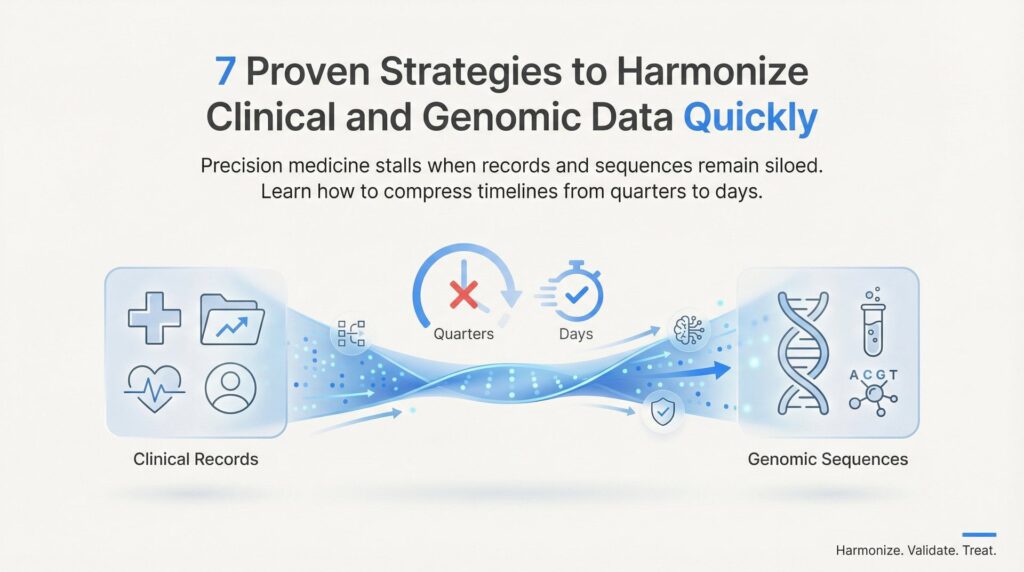
The gap between clinical records and genomic sequences is where precision medicine goes to die. You have patient outcomes in one silo, variant data in another, and months of manual mapping ahead before anyone can extract value. Meanwhile, drug targets go unvalidated, patient stratification stalls, and competitors move faster.
The organizations winning this race aren’t working harder—they’re working smarter. They’ve abandoned the 12-month harmonization timelines that used to be standard. They’re achieving in days what once took quarters.
This isn’t about cutting corners. It’s about applying the right strategies at the right scale. Whether you’re a government health agency building a national biobank, a biopharma team racing to validate targets, or a research consortium drowning in heterogeneous data, these seven strategies will compress your harmonization timeline from months to hours—without sacrificing quality or compliance.
1. Adopt a Common Data Model from Day One
The Challenge It Solves
Every custom data schema you create is a future liability. When your clinical data uses “diagnosis_date” and your genomic platform uses “sample_collection_timestamp,” you’re building translation debt. Multiply that across hundreds of fields and dozens of sources, and you have exponential rework every time you add a new dataset or collaborate with another institution.
Without a common framework, every integration becomes a one-off project. Your team spends months mapping the same concepts repeatedly instead of analyzing data.
The Strategy Explained
Implement a Common Data Model before you touch your first dataset. The OMOP Common Data Model, maintained by OHDSI, provides standardized vocabularies and table structures specifically designed for observational health research. It defines how clinical observations, procedures, drug exposures, and measurements should be represented.
Think of it like choosing a programming language before writing code. You’re selecting a shared vocabulary that everyone speaks. When your clinical data and genomic annotations both map to OMOP concepts, they’re automatically aligned. New data sources plug in without custom translation layers.
This isn’t theoretical. OMOP is used across national health programs and academic medical centers specifically because it eliminates the schema translation problem. You map once to the standard, then everything connects.
Implementation Steps
1. Select your CDM framework based on your use case—OMOP for observational research, FHIR for interoperability-focused projects, or domain-specific models for specialized research.
2. Map your existing data sources to the CDM schema using the model’s standard vocabulary—this is your one-time translation investment that pays dividends on every future integration.
3. Establish CDM compliance as a requirement for all new data ingestion, ensuring every source system outputs or transforms to your chosen standard before entering your research environment.
Pro Tips
Don’t try to map everything perfectly on day one. Start with high-value clinical concepts and the genomic annotations you actually use for analysis. Expand your mapping coverage iteratively as new research questions emerge. The goal is standardization, not perfection.
2. Deploy AI-Powered Semantic Mapping
The Challenge It Solves
Manual data mapping is where harmonization timelines go to die. A single experienced data curator can map maybe 50-100 fields per day if they’re working efficiently. When you’re dealing with thousands of clinical variables and complex genomic annotations, the math becomes impossible. You’re looking at months of full-time work before you can run your first query.
The real killer isn’t just the time—it’s the expertise bottleneck. You need people who understand both clinical terminology and genomic nomenclature. Those people are expensive and rare.
The Strategy Explained
Machine learning models can identify semantic relationships across data types at scale. These systems learn from existing mappings and apply pattern recognition to suggest relationships between clinical terms and genomic concepts. Instead of manually reviewing every field, your team validates AI suggestions and handles edge cases.
The shift is fundamental. You move from “map everything manually” to “review what the AI flagged as uncertain.” Routine mappings happen automatically. Your experts focus on ambiguous cases and quality assurance. This is how you compress months into days.
Modern semantic mapping tools use natural language processing to understand context, not just keyword matching. They recognize that “myocardial infarction,” “heart attack,” and “MI” all refer to the same clinical concept. They can map genomic variant nomenclature across different annotation systems.
Implementation Steps
1. Deploy a semantic mapping platform that includes pre-trained models for healthcare terminology—look for systems that understand SNOMED, LOINC, RxNorm, and genomic ontologies out of the box.
2. Feed your existing mapped datasets as training examples to improve accuracy on your specific data patterns and institutional terminology preferences.
3. Establish confidence thresholds where high-confidence mappings auto-approve while uncertain relationships queue for expert review, creating a hybrid workflow that maximizes both speed and accuracy.
Pro Tips
Track your AI’s accuracy over time and feed corrections back into the model. Every validated mapping makes the system smarter. Within weeks, you’ll see your manual review queue shrink as the model learns your institution’s specific patterns and preferences.
3. Implement Federated Architecture for Multi-Site Data
The Challenge It Solves
Data sovereignty isn’t a technical problem—it’s a showstopper. Government agencies can’t ship sensitive health records across borders. Hospital systems won’t send patient data to external clouds. Biopharma partners demand control over proprietary datasets. Traditional centralized approaches require months of legal negotiations, data transfer agreements, and compliance reviews before you can start harmonization.
Even when you get approval, moving terabytes of genomic data is slow and expensive. Then you’re maintaining duplicate copies with all the security and compliance overhead that entails.
The Strategy Explained
Federated architecture harmonizes the schema without moving the data. You standardize how data is structured and queried across sites while the actual records stay exactly where they are. Each institution maintains full control over their data. You send queries to the data instead of bringing data to the queries.
This approach is increasingly adopted specifically to address GDPR, HIPAA, and emerging data sovereignty frameworks. When Singapore’s Ministry of Health needs to collaborate with European research partners, federated architecture eliminates the compliance nightmare of international data transfers.
The technical implementation uses standardized APIs and common data models. Each site runs the same harmonization logic locally. Results are aggregated, but raw data never leaves its home environment. You get the analytical power of centralized data with the compliance profile of distributed systems.
Implementation Steps
1. Deploy identical data harmonization environments at each participating site using containerized infrastructure that ensures consistent processing logic regardless of local cloud provider or on-premise setup.
2. Establish a federated query layer that translates research questions into site-specific queries, executes them locally, and aggregates results while maintaining differential privacy guarantees.
3. Implement automated compliance checks at each node to ensure queries meet local governance requirements before execution, with audit trails that satisfy regulatory inspection needs.
Pro Tips
Start with a two-site federation to prove the model before scaling. The technical challenges are manageable. The governance and trust-building take longer. Use early wins to demonstrate value and build institutional confidence in the federated approach.
4. Automate Quality Control with Validation Pipelines
The Challenge It Solves
Manual quality assurance creates a sequential bottleneck. You harmonize a dataset, then wait days or weeks for QA review. Issues get flagged. You fix them. QA reviews again. This ping-pong continues until someone declares the data “good enough.” Meanwhile, your research timeline bleeds out.
The alternative—shipping without QA—is worse. Garbage in, garbage out. You build analyses on flawed data, draw wrong conclusions, and waste months pursuing artifacts instead of biology.
The Strategy Explained
Automated validation pipelines run quality checks in real-time as data flows through your harmonization process. Completeness checks ensure required fields are populated. Range validations flag biologically impossible values. Consistency rules verify that related fields align logically. Format validators ensure data types match expected patterns.
The key difference from manual QA is parallelization and continuous feedback. Checks run automatically on every record. Issues are flagged immediately, not after days of batch processing. Your pipeline handles routine validations. Human experts investigate only the anomalies that matter.
Built-in audit trails document every check performed, every issue detected, and every correction applied. When regulators ask how you ensured data quality, you have automated evidence instead of manual spreadsheets.
Implementation Steps
1. Define validation rules for each data element based on biological constraints, regulatory requirements, and analytical needs—document these as executable specifications, not informal guidelines.
2. Build validation checkpoints at each harmonization stage: ingestion, transformation, mapping, and output, creating a multi-layered defense against quality issues.
3. Configure automated alerts for critical failures that require immediate attention while logging minor issues for batch review, preventing alert fatigue while maintaining oversight.
Pro Tips
Version control your validation rules just like code. As you learn more about your data, you’ll refine what constitutes an error versus an edge case. Being able to track and rollback validation logic prevents false positive explosions when you adjust thresholds.
5. Use Pre-Built Connectors for Common Data Sources
The Challenge It Solves
Custom ETL development is where budgets and timelines explode. Every data source has its own API quirks, authentication methods, and data formats. Building a connector for Epic EHR from scratch can take months. Add Illumina sequencing platforms, Cerner clinical systems, and various biobank databases, and you’re looking at a multi-year integration roadmap.
Worse, these custom connectors become technical debt. When Epic releases an API update or Illumina changes their output format, your custom code breaks. You’re maintaining integration infrastructure instead of doing research.
The Strategy Explained
Pre-built connectors for common healthcare and genomics platforms eliminate the integration development cycle entirely. Instead of writing custom code to extract data from Epic, you configure a tested connector that already handles Epic’s authentication, pagination, rate limiting, and data formatting.
These aren’t generic database connectors—they’re purpose-built for specific platforms. An Illumina connector understands VCF formats, quality scores, and annotation structures. A Cerner connector knows how to navigate their specific FHIR implementation and terminology mappings.
The time savings compound. You’re not just avoiding initial development. You’re avoiding ongoing maintenance, version compatibility testing, and emergency fixes when source systems change. The connector vendor handles updates. You handle research.
Implementation Steps
1. Inventory your critical data sources and prioritize based on data volume and access frequency—focus connector deployment on the systems that will deliver immediate harmonization value.
2. Deploy certified connectors for your top-tier sources like major EHR systems, sequencing platforms, and institutional biobanks, validating data extraction in a test environment before production rollout.
3. Reserve custom development only for truly unique data sources that lack standard connectors, and even then, build using modular frameworks that simplify future maintenance.
Pro Tips
Don’t assume you need custom connectors just because your institution “does things differently.” Most perceived uniqueness is actually standard platform configuration. Test pre-built connectors first. You’ll be surprised how often they work out of the box.
6. Establish Governance Guardrails Before You Start
The Challenge It Solves
Governance negotiations kill momentum. You’ve harmonized the data. Your researchers are ready to analyze. Then you hit the approval wall. Data access committees meet monthly. Legal reviews take weeks. Every research question triggers a new round of approvals. Your 48-hour harmonization timeline turns into a 6-month access approval process.
The problem isn’t that governance is unnecessary—it’s that reactive governance creates unpredictable delays. When every data request is a special case requiring custom review, you’ve built a system optimized for “no.”
The Strategy Explained
Pre-approved governance templates and automated airlock systems move approval decisions upstream. Instead of reviewing every analysis request, you define categories of acceptable use in advance. Researchers work within pre-approved boundaries. Automated systems enforce the rules you’ve already agreed to.
An AI-automated airlock, for example, can scan analysis outputs for sensitive information before export. It applies your governance rules automatically—checking for small cell counts, personally identifiable information, or proprietary data. Compliant outputs pass through immediately. Edge cases flag for human review.
This approach transforms governance from a bottleneck into infrastructure. Your compliance requirements are encoded into the system. Researchers get fast access within defined guardrails. Administrators maintain control without becoming the limiting factor.
Implementation Steps
1. Define data access tiers and pre-approved use cases with your governance stakeholders before harmonizing data—document what analyses are automatically permitted versus requiring special approval.
2. Implement automated access control systems that grant permissions based on researcher credentials, project approvals, and data sensitivity levels, eliminating manual provisioning delays.
3. Deploy automated export controls that scan analysis outputs for compliance with your governance policies before allowing data to leave secure environments, creating a safety net that enables speed.
Pro Tips
Start with the most restrictive governance tier and expand permissions based on demonstrated need and compliance track record. It’s easier to loosen restrictions than to tighten them after researchers have grown accustomed to unrestricted access.
7. Prioritize Iterative Harmonization Over Perfection
The Challenge It Solves
Perfectionism is the enemy of progress in data harmonization. You want every field mapped, every edge case handled, every quality check passed before you release data for analysis. Meanwhile, your researchers are blocked, your drug development timeline slips, and competitors ship with “good enough” data that’s actually sufficient for their questions.
The pursuit of perfect data ignores a fundamental reality: different analyses need different levels of precision. A genome-wide association study has different quality requirements than a case report. Waiting until your data is perfect for every possible use case means it’s perfect for none.
The Strategy Explained
Iterative harmonization starts with high-value data subsets and refines continuously. Identify the clinical and genomic fields required for your most urgent research questions. Harmonize those first. Ship them. Get feedback. Then expand to the next tier of data elements.
This approach delivers value in days instead of months. Your researchers start analyzing while you’re still harmonizing lower-priority fields. You learn what quality issues actually matter versus which ones are theoretical concerns. Your harmonization roadmap evolves based on real usage instead of speculation.
The compound effect is powerful. Early wins build institutional confidence. Researchers provide feedback that improves your harmonization logic. You avoid wasting time on perfect mappings for fields no one actually queries. Your process improves through iteration, not through upfront planning.
Implementation Steps
1. Identify your highest-priority research questions and map backward to the minimum data elements required to answer them—this becomes your Phase 1 harmonization scope.
2. Set aggressive timelines for initial data release measured in days not months, accepting that some fields will be incomplete or require refinement based on actual usage patterns.
3. Establish feedback loops where researchers report data quality issues directly into your harmonization backlog, creating a continuous improvement cycle driven by real analytical needs.
Pro Tips
Version your harmonized datasets explicitly. When you improve a mapping or fix a quality issue, release it as a new version. Researchers can choose to re-run analyses with improved data or continue with their current version. This prevents the “moving target” problem while enabling continuous improvement.
Putting It All Together
Speed without accuracy is useless. Accuracy without speed is too expensive. The organizations harmonizing clinical and genomic data quickly have figured out how to get both.
Start with a common data model—OMOP gives you the vocabulary. Layer in AI-powered mapping to eliminate manual bottlenecks. Use federated architecture when data can’t move. Automate your quality control. Deploy pre-built connectors instead of custom code. Lock down governance before you touch the data. And ship iteratively instead of waiting for perfection.
The difference between 12 months and 48 hours isn’t magic. It’s strategy.
These seven approaches work because they attack different bottlenecks in your harmonization pipeline. Common data models eliminate schema translation overhead. AI handles routine mapping at scale. Federation solves the data sovereignty problem. Automation removes manual QA delays. Pre-built connectors skip months of development. Upfront governance prevents downstream approval loops. Iterative delivery creates momentum instead of perfection paralysis.
Pick one approach from this list and implement it this week. Then add another. Compound improvements beat heroic efforts every time.
If you’re managing clinical and genomic data across multiple sites, dealing with compliance requirements that make centralization impossible, or simply tired of harmonization projects that measure timelines in quarters instead of days, you need infrastructure built for speed and scale. Get started for free and see how federated architecture, AI-powered harmonization, and automated governance can compress your timeline from months to hours—without compromising on security or compliance.