

9 Best Healthcare AI Infrastructure Platforms in 2026
Healthcare organizations are drowning in data they can’t use. Genomic sequences, clinical records, imaging files, real-world evidence—it’s all there, but siloed across systems that don’t talk to each other. Meanwhile, compliance requirements make moving this data nearly impossible.
The result? Billion-dollar research programs stuck waiting months for data access while competitors move faster.
A healthcare AI infrastructure platform solves this by providing the secure, compliant foundation to run AI workloads on sensitive health data—without moving it, without compromising governance, without the 18-month integration projects. Here are the top platforms actually delivering on that promise in 2026, evaluated on security posture, compliance certifications, data harmonization capabilities, and real-world deployments at scale.
1. Lifebit
Best for: Government health programs and biopharma requiring federated analysis with compliance built-in
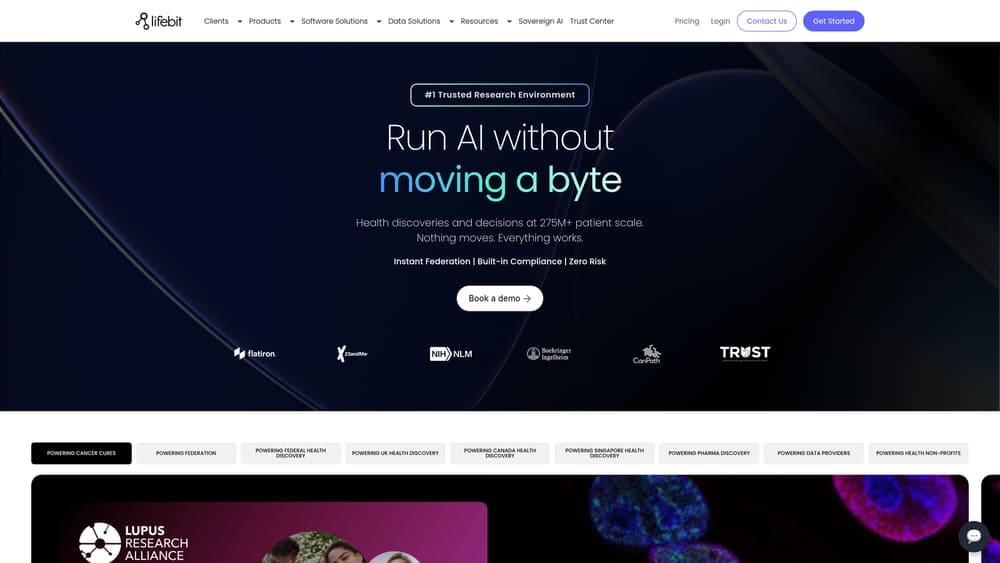
Lifebit is a federated data platform that enables secure AI analysis on sensitive health data without moving it, with AI-powered harmonization and built-in compliance for government and enterprise deployments.
Where This Platform Shines
Lifebit’s core differentiator is its federated architecture. You can run AI workloads on data where it lives—across institutions, borders, and cloud environments—without centralizing anything. This matters when you’re managing national health programs or multi-site clinical trials where data movement isn’t just difficult, it’s legally prohibited.
The platform is trusted by organizations like NIH, Genomics England, and Singapore’s Ministry of Health to manage over 275 million records. That’s not hype—it’s proof that the architecture works at scale under the most stringent regulatory requirements.
Key Features
Federated Analysis: Run AI where data lives with no movement required, enabling cross-border research and consortium projects while maintaining data sovereignty.
Trusted Data Factory: AI-powered data harmonization that takes 48 hours instead of 12 months, automatically mapping disparate sources to common standards like OMOP CDM.
AI-Automated Airlock: First-of-its-kind governance system for secure data exports, providing automated compliance checks before any data leaves the environment.
Comprehensive Compliance: FedRAMP, HIPAA, GDPR, and ISO27001 certified out of the box, with compliance built into the architecture rather than bolted on afterward.
Deploy in Your Cloud: Full control with deployment in your own cloud environment, eliminating vendor lock-in while maintaining all platform capabilities.
Best For
Government health agencies building national precision medicine programs, biopharma R&D teams under pressure to accelerate pipelines, and academic consortia managing regulated data across multiple institutions. If your primary challenge is analyzing sensitive data without moving it while maintaining strict compliance, this platform was built for exactly that.
Pricing
Enterprise pricing model with quotes based on deployment scale. Contact Lifebit directly for pricing tailored to your specific use case and data volume requirements.
2. Google Cloud Healthcare API
Best for: Organizations already invested in Google Cloud seeking native healthcare data management
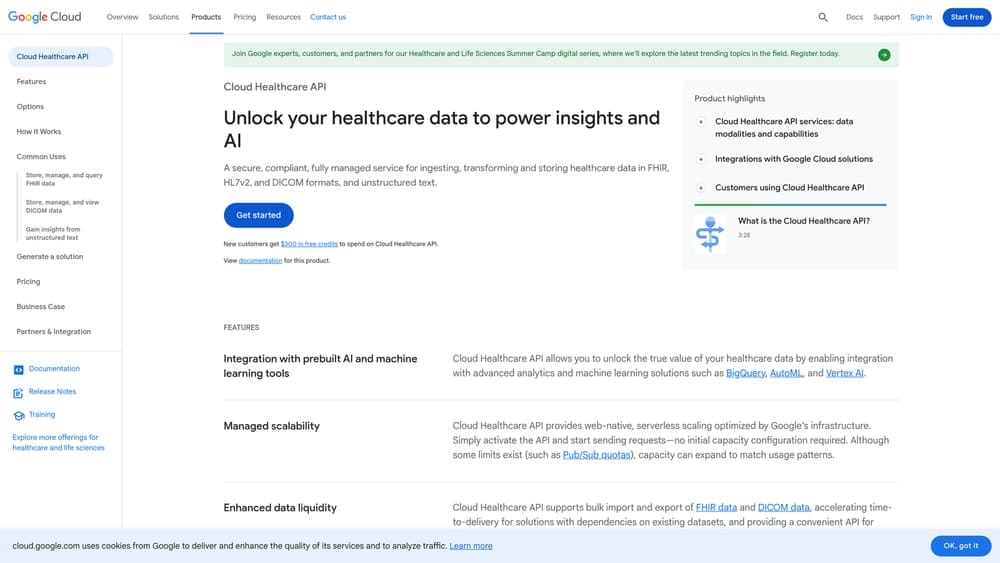
Google Cloud Healthcare API is Google’s healthcare data management platform with native FHIR and DICOM support, integrated with Vertex AI for machine learning workflows.
Where This Platform Shines
Google’s healthcare offering is tightly integrated with its broader cloud ecosystem. If you’re already running workloads on Google Cloud, the Healthcare API provides native FHIR R4 and DICOM stores that connect directly to BigQuery for analytics and Vertex AI for machine learning.
The de-identification API is particularly strong, using Google’s natural language processing capabilities to automatically detect and remove protected health information from unstructured clinical text. This automation significantly reduces the manual work typically required for data anonymization.
Key Features
Native FHIR R4 and DICOM Stores: Managed storage for healthcare data standards with built-in validation and querying capabilities.
Vertex AI Integration: Direct connection to Google’s machine learning platform for building and deploying healthcare AI models at scale.
De-identification API: Automated PHI detection and removal using advanced NLP, supporting both structured and unstructured data.
BigQuery Integration: Seamless connection to Google’s analytics engine for large-scale data analysis and reporting.
Cloud Healthcare Consent Management: Built-in tools for managing patient consent preferences across data access requests.
Best For
Health systems and research organizations already standardized on Google Cloud infrastructure, particularly those working with large volumes of FHIR data or requiring tight integration with BigQuery analytics workflows.
Pricing
Pay-as-you-go model with FHIR storage starting at $0.05 per GB per month. Additional charges apply for API calls, data ingestion, and de-identification operations based on usage volume.
3. Microsoft Azure Health Data Services
Best for: Enterprise healthcare organizations standardized on Microsoft’s cloud ecosystem
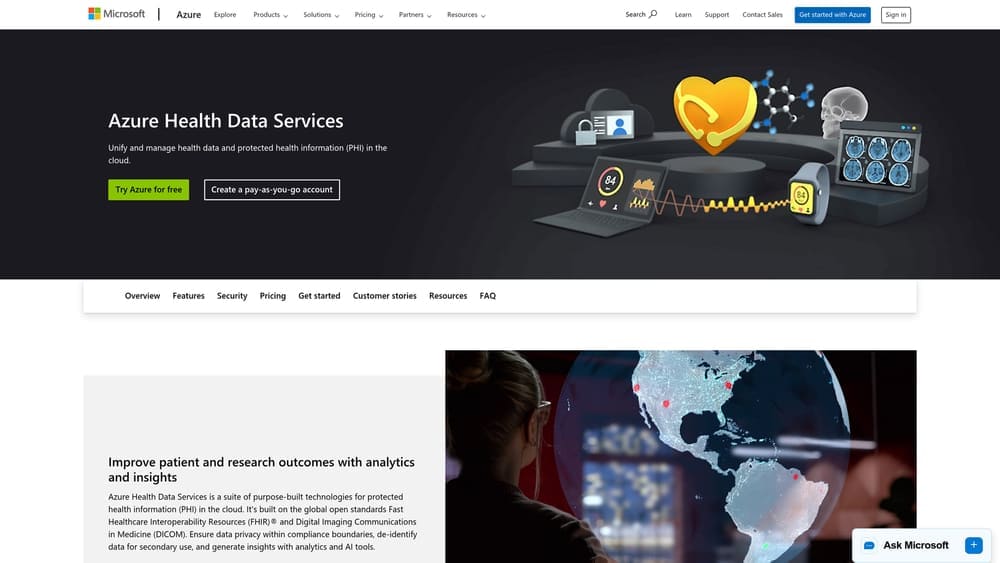
Microsoft Azure Health Data Services is Microsoft’s unified healthcare data platform combining FHIR server, DICOM service, and MedTech service with Azure AI integration.
Where This Platform Shines
Azure’s healthcare offering provides a comprehensive suite of managed services specifically designed for health data. The platform supports SMART on FHIR, making it particularly attractive for organizations building patient-facing applications or integrating with electronic health record systems.
The HITRUST CSF certification is significant for healthcare organizations that need to demonstrate compliance with a comprehensive security framework. Microsoft has also invested heavily in integrating Azure OpenAI Service, giving healthcare developers access to large language models with enterprise-grade security and compliance controls.
Key Features
Managed FHIR Server with SMART on FHIR: Fully managed FHIR server supporting the SMART on FHIR framework for secure application integration.
DICOM Service: Purpose-built service for medical imaging data with support for standard DICOM operations and DICOMweb protocols.
Azure OpenAI Service Integration: Access to GPT models with healthcare-specific privacy and compliance controls for building conversational AI and clinical documentation tools.
MedTech Service: IoT connector for ingesting and normalizing data from medical devices and wearables into FHIR format.
HITRUST CSF Certified: Comprehensive security certification specifically designed for healthcare organizations managing sensitive patient data.
Best For
Healthcare organizations already invested in Microsoft’s enterprise ecosystem, particularly those building patient engagement applications or requiring tight integration with Microsoft 365 and Teams for clinical workflows.
Pricing
Pay-as-you-go pricing with FHIR API calls starting at $0.012 per 10,000 transactions. Storage, data ingress/egress, and compute resources are billed separately based on usage.
4. AWS HealthLake
Best for: Organizations requiring automatic FHIR transformation with integrated genomics capabilities
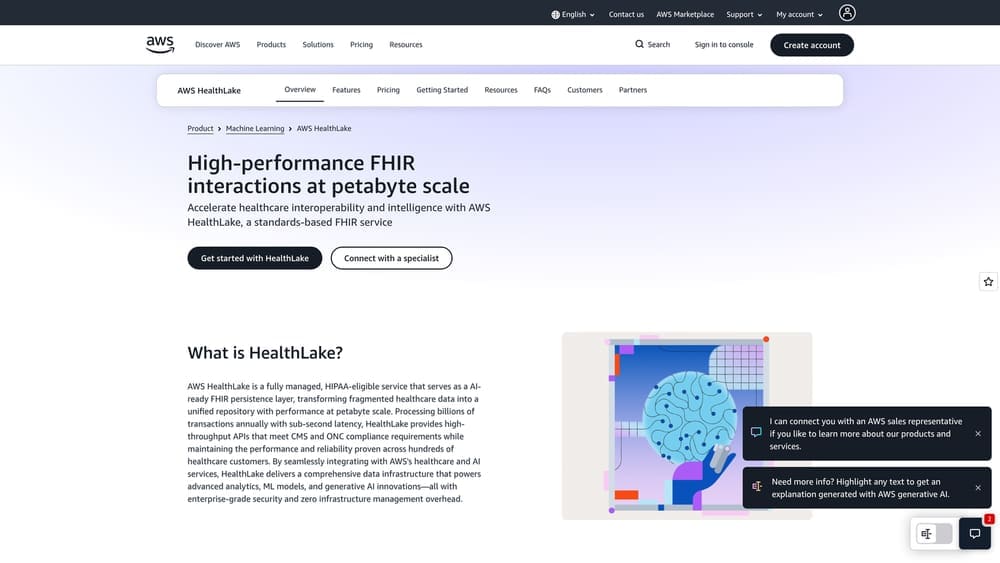
AWS HealthLake is a HIPAA-eligible service that transforms and structures health data into FHIR format with integrated analytics and machine learning capabilities.
Where This Platform Shines
HealthLake’s automatic data transformation is its standout feature. The service can ingest unstructured clinical notes, claims data, and other healthcare formats, then automatically transform them into FHIR resources using natural language processing. This eliminates months of manual data mapping work.
The integration with Amazon Omics is particularly valuable for organizations working with genomics data. You can connect clinical phenotype data in HealthLake with genomic sequences in Omics, enabling genotype-phenotype association studies without building custom integration pipelines.
Key Features
Automatic FHIR Data Transformation: Built-in NLP and machine learning to convert unstructured clinical data into structured FHIR resources without manual mapping.
Natural Language Processing for Clinical Notes: Automated extraction of medical concepts, medications, diagnoses, and procedures from free-text clinical documentation.
SageMaker Integration: Direct connection to AWS’s machine learning platform for building and deploying predictive models on healthcare data.
Amazon Omics Integration: Seamless connection to AWS’s genomics service for multi-omics analysis and precision medicine applications.
Integrated FHIR Analytics: Built-in querying and analytics capabilities optimized for healthcare use cases and clinical research.
Best For
Healthcare organizations already running on AWS infrastructure, particularly those dealing with large volumes of unstructured clinical data or combining clinical and genomics data for precision medicine initiatives.
Pricing
Pay-as-you-go model with data storage starting at $0.046 per GB per month. Additional charges apply for data ingestion, transformation, and query operations based on volume.
5. DNAnexus
Best for: Genomics-heavy research programs requiring multi-party collaboration
DNAnexus is a cloud-based platform purpose-built for genomics and multi-omics analysis, with strong pharma partnerships and collaborative research capabilities.
Where This Platform Shines
DNAnexus was built specifically for genomics, and that specialization shows. The platform is optimized for whole genome sequencing, whole exome sequencing, and multi-omics workflows in ways that general-purpose healthcare platforms simply aren’t.
The Apollo platform enables true multi-party collaboration where different organizations can contribute data and analysis to shared projects while maintaining control over their own data. This is critical for consortium research projects where data sharing agreements are complex and data sovereignty requirements vary by jurisdiction.
Key Features
Apollo Platform for Multi-Party Collaboration: Secure environment enabling multiple organizations to collaborate on shared projects while maintaining individual data control and governance.
Optimized for WGS, WES, and Multi-Omics: Purpose-built infrastructure and tools specifically designed for genomic data processing and analysis at scale.
UK Biobank Research Analysis Platform Partner: Official platform for UK Biobank, providing access to one of the world’s largest genomic datasets for approved researchers.
FDA 21 CFR Part 11 Compliant: Regulatory compliance for pharma and biotech organizations conducting clinical trials and drug development research.
Federated Genomics Network: Distributed analysis capabilities enabling genomic research across multiple sites without centralizing sensitive data.
Best For
Biopharma companies running genomics-driven drug discovery programs, academic research consortia conducting large-scale genomic studies, and organizations requiring secure access to major biobank resources like UK Biobank.
Pricing
Enterprise pricing with tiered models based on compute usage and storage requirements. Contact DNAnexus for quotes tailored to your specific genomics workload and collaboration needs.
6. Flywheel
Best for: Medical imaging AI development and radiology research
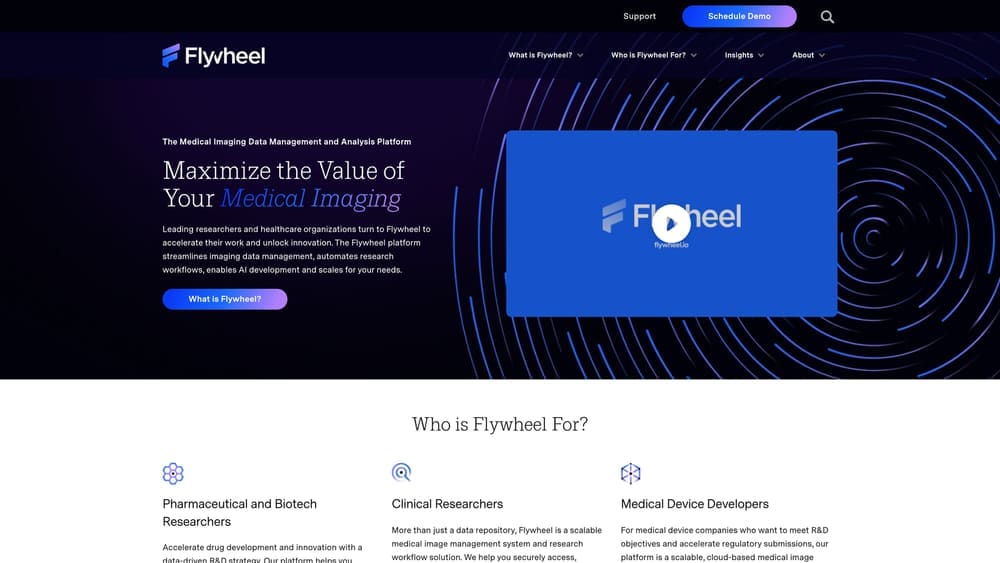
Flywheel is a research data platform specializing in medical imaging with built-in de-identification, annotation tools, and AI/ML development capabilities.
Where This Platform Shines
Flywheel is DICOM-native, meaning it understands medical imaging data at a fundamental level rather than treating it as generic file storage. The platform automatically extracts metadata from DICOM headers, organizes studies hierarchically, and handles the complex relationships between imaging series.
The integrated annotation and labeling tools are particularly valuable for teams building computer vision models for radiology AI. You can manage the entire workflow—from image ingestion to annotation to model training—within a single platform rather than cobbling together disparate tools.
Key Features
DICOM-Native with Automated De-Identification: Purpose-built DICOM handling with automatic PHI removal from image headers and pixel data.
Integrated Annotation and Labeling Tools: Built-in capabilities for radiologist annotation workflows, supporting both bounding boxes and segmentation masks.
Gear Exchange for Containerized Algorithms: Marketplace and execution environment for containerized imaging analysis algorithms, enabling reproducible research.
Strong Academic Research Adoption: Widely used across academic medical centers and radiology research departments with proven track record in imaging studies.
Multi-Modal Imaging Support: Handles CT, MRI, PET, X-ray, ultrasound, and other imaging modalities with format-specific optimization.
Best For
Academic medical centers conducting radiology research, AI companies developing computer vision models for medical imaging, and healthcare organizations building imaging biomarker programs or clinical decision support tools.
Pricing
Enterprise pricing model based on storage volume and user count. Contact Flywheel for quotes specific to your imaging data volume and research team size.
7. Palantir Foundry for Healthcare
Best for: Complex enterprise data integration across disparate health systems
Palantir Foundry is an enterprise data integration platform with powerful ontology-based modeling, used by NHS and major health systems for complex data unification.
Where This Platform Shines
Palantir Foundry excels at integrating extremely complex, heterogeneous data sources that other platforms struggle with. The ontology-based approach allows you to create a unified semantic layer across disparate systems—EHRs, claims databases, lab systems, genomics platforms—without forcing everything into a single schema.
The platform’s track record with NHS during the COVID-19 pandemic demonstrated its capability to rapidly integrate data from hundreds of sources and provide real-time operational analytics at national scale. That’s not a typical use case, but it proves the platform can handle complexity that would break most alternatives.
Key Features
Ontology-Based Data Modeling: Semantic layer that unifies disparate data sources without requiring schema standardization, preserving source system context.
Complex Data Integration Across Sources: Proven capability to integrate hundreds of heterogeneous healthcare data sources with different formats, standards, and update frequencies.
Real-Time Operational Analytics: Live dashboards and analytics for operational decision-making, not just retrospective research analysis.
NHS COVID-19 Data Store Track Record: Demonstrated ability to deliver at national scale under crisis conditions with rapidly changing requirements.
Workshop-Based Implementation: Collaborative development model where Palantir engineers work directly with your team to build solutions.
Best For
Large health systems with extremely complex data environments, government health agencies managing national-scale programs, and organizations where data integration complexity is the primary bottleneck to analytics and AI initiatives.
Pricing
Enterprise pricing with contracts typically in the seven-figure annual range. Pricing varies significantly based on deployment scale, data volume, and level of Palantir engineering support required.
8. Databricks for Healthcare
Best for: Organizations building data lakehouses with unified analytics and ML
Databricks for Healthcare is a lakehouse platform combining data engineering, analytics, and ML capabilities with healthcare-specific solution accelerators.
Where This Platform Shines
Databricks brings the lakehouse architecture to healthcare—combining the best of data lakes and data warehouses in a single platform. Delta Lake provides ACID transactions and schema enforcement on top of cloud storage, solving the reliability problems that have plagued healthcare data lakes for years.
The healthcare solution accelerators provide pre-built templates for common use cases like OMOP CDM conversion, FHIR analytics, and clinical trial matching. These accelerators can reduce implementation time from months to weeks by providing proven starting points rather than building from scratch.
Key Features
Delta Lake for Reliable Data Lakes: ACID transactions, schema enforcement, and time travel capabilities on cloud storage, eliminating traditional data lake reliability issues.
MLflow for Model Lifecycle Management: End-to-end machine learning lifecycle management from experimentation to production deployment with full lineage tracking.
Unity Catalog for Data Governance: Unified governance layer providing fine-grained access control, audit logging, and data lineage across all workloads.
Healthcare Solution Accelerators: Pre-built templates for OMOP CDM, FHIR analytics, clinical trial optimization, and other common healthcare use cases.
Multi-Cloud Support: Consistent platform experience across AWS, Azure, and Google Cloud with data portability between clouds.
Best For
Healthcare organizations building modern data platforms that combine analytics and machine learning, data engineering teams managing complex ETL pipelines, and organizations requiring multi-cloud flexibility or cloud migration paths.
Pricing
Pay-as-you-go pricing based on Databricks Units (DBUs) starting at $0.07 per DBU. Total cost depends on cluster size, runtime, and specific Databricks features used.
9. Tempus
Best for: Oncology-focused precision medicine with proprietary clinical-genomic data
Tempus is a precision medicine platform with a massive proprietary clinical-genomic dataset, focused on oncology and AI-driven treatment insights.
Where This Platform Shines
Tempus is fundamentally different from the other platforms on this list. Rather than providing infrastructure for you to analyze your own data, Tempus provides access to its proprietary dataset of linked clinical and genomic information from millions of cancer patients.
This dataset is Tempus’s core asset. The AI-driven treatment recommendations are based on finding similar patients in this database and analyzing what treatments worked for them. For oncologists treating rare cancers or unusual molecular profiles, this real-world evidence can be invaluable when clinical trial data is limited.
Key Features
Proprietary Clinical-Genomic Database: Massive dataset linking molecular profiles with treatment outcomes and real-world clinical data from millions of cancer patients.
AI-Driven Treatment Recommendations: Machine learning models that analyze patient molecular profiles and suggest treatment options based on similar cases in the database.
Oncology-Focused Precision Medicine: Deep specialization in cancer care with molecular profiling, biomarker analysis, and treatment response prediction.
Clinical Trial Matching: Automated matching of patients to relevant clinical trials based on molecular profile, disease characteristics, and trial eligibility criteria.
Integrated Diagnostic Services: End-to-end workflow from specimen collection through sequencing to clinical reporting and treatment recommendations.
Best For
Oncology practices seeking precision medicine capabilities without building internal infrastructure, cancer centers looking to augment clinical decision-making with AI-driven insights, and biopharma companies conducting oncology research or clinical trial recruitment.
Pricing
Enterprise pricing for platform access with additional per-test pricing for diagnostic services. Contact Tempus for quotes based on your specific use case and patient volume.
Making the Right Choice
The right platform depends entirely on your specific constraints and priorities. Government or national health programs needing federated analysis with compliance built-in? Lifebit removes the friction of data movement while maintaining sovereignty. Already deep in a hyperscaler ecosystem? Pick your cloud’s native healthcare tools—Google, Microsoft, or AWS each offer solid foundations if you’re willing to assemble the pieces.
Genomics-heavy research? DNAnexus was built for exactly that. Imaging AI development? Flywheel understands DICOM at a level the general platforms don’t. Complex enterprise data integration across dozens of legacy systems? Palantir has proven it can handle that complexity at scale.
The real question isn’t which platform has the most features. It’s which one removes the most friction between your data and your outcomes.
For most organizations handling sensitive health data at scale, the deciding factors come down to three things: deployment speed, compliance posture, and whether you can analyze data without moving it. Traditional approaches that require centralizing data before analysis add months to timelines and create compliance nightmares. Platforms that enable federated analysis—where AI runs on data where it lives—eliminate those bottlenecks entirely.
The 48-hour data harmonization benchmark represents a fundamental shift from the 6-18 month integration projects that have historically bottlenecked research programs. If you’re still measuring data preparation timelines in quarters rather than days, you’re operating with a structural disadvantage against competitors who aren’t.
Start by mapping your primary use case. Are you building imaging AI? Running multi-site genomic studies? Integrating data across a complex health system? Launching a national precision medicine program? The answer to that question eliminates most options and points you toward the two or three platforms actually designed for your specific problem.
Ready to see how federated analysis can accelerate your research program without compromising compliance? Get started for free and experience what 48-hour data harmonization looks like in practice.