

The Complete Guide to Cloud AI Powering Drug Discovery in 2025

Why Drug Findy Is Broken—And How Cloud AI Is Fixing It Now
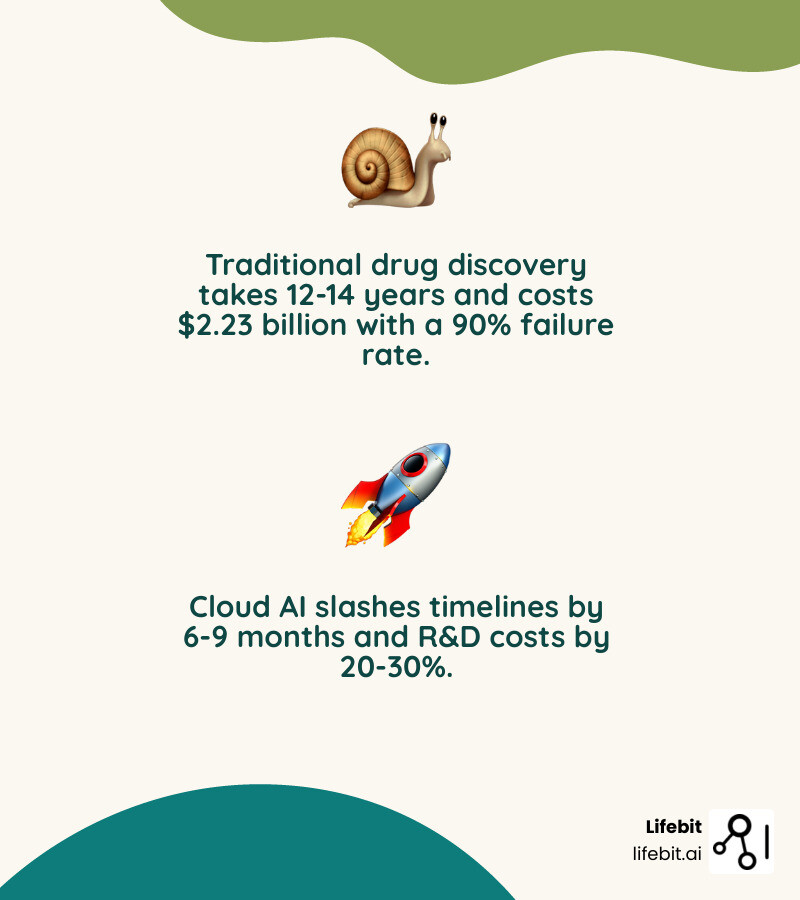
Traditional drug development is broken. It takes 12-14 years and costs $2.23 billion to bring a single drug to market, and over 90% of them fail. Cloud AI is fixing this by slashing timelines by 6-9 months, cutting R&D costs by 20-30%, and open uping insights from massive multi-omics datasets that were previously impossible to analyze.
Here’s how cloud AI platforms are powering drug findy right now:
- Target Identification: AI analyzes genomics, proteomics, and metabolomics data to uncover new disease targets faster.
- Lead Findy: Machine learning and generative AI screen billions of compounds virtually and design novel molecules.
- Clinical Trials: AI predicts outcomes, stratifies patients, and identifies biomarkers to run smarter, faster trials.
- Data Management: Cloud platforms integrate siloed datasets and enable secure, compliant collaboration across global teams.
The urgency is real. Over $200 billion in pharmaceutical revenue is at risk by 2030 due to the patent cliff. The AI-based drug findy market is growing at 25% annually, with over 200 companies now offering specialized tools. Cloud AI platforms provide the scalable infrastructure, advanced algorithms, and secure data environments that make this acceleration possible—without the massive capital investment of on-premises HPC systems.
I’m Maria Chatzou Dunford, CEO of Lifebit. We built a federated data platform to help organizations securely analyze distributed biomedical data. My 15 years in this field have shown me the biggest barrier isn’t the science—it’s accessing and analyzing the right data at scale.
The $200B Countdown: Why Pharma Must Reinvent Drug Findy Before the Patent Cliff Hits
The traditional drug findy model is unsustainable. With a 90% failure rate, a twelve-to-fourteen-year timeline, and a $2.23 billion average cost per drug, the process is too slow, too expensive, and too risky. It’s a financial crisis in the making.
The process is broken by fragmented data silos that scatter critical information across research institutions and labs. The sheer volume of biological data—from multi-omics to patient records—overwhelms the outdated tools and manual processes pharma has relied on for decades. Every bottleneck costs time, and every delay costs money.
This inefficiency is colliding with a financial deadline: the patent cliff. Between now and 2030, the pharmaceutical industry faces over $200 billion in annual revenue at risk as patents on blockbuster drugs expire. If pharma can’t accelerate its R&D pipeline to replace those losses, the financial impact will be devastating.
The math is stark: companies cannot afford to keep doing drug findy the old way. The twelve-to-fourteen year slog has to shrink, the $2.23 billion price tag has to drop, and the 90% failure rate has to improve.
This is where How Cloud AI Platforms Are Powering Drug Findy in 2025 becomes a survival strategy. Cloud AI breaks down data silos, analyzes massive datasets in hours instead of months, and predicts which drug candidates will succeed before companies waste billions on dead ends. The question isn’t whether pharma will reinvent drug findy—it’s whether they’ll do it fast enough.
How Cloud AI Platforms Are Slashing Timelines and Costs in Drug Findy—From Target to Trial
Cloud AI is delivering measurable results today, cutting drug development timelines by 6-9 months and R&D costs by 20-30%. This means treatments reach patients faster while saving companies hundreds of millions per drug. It’s about working smarter, giving researchers the power to analyze previously unmanageable datasets and find patterns humans would miss. The entire drug findy pipeline is being reimagined.
Stage 1: Target Identification and Validation
Finding the right biological target is the critical first step, one that traditionally took years of lab work. Cloud AI changes this by analyzing multi-omics data—genomics, proteomics, and metabolomics—from thousands of patients in hours. The petabytes of data generated by genomic sequencing and tools like AlphaFold2 require the low-latency access and power of cloud infrastructure.
AI uncovers new disease targets by identifying patterns in how genes, proteins, and metabolites interact. Instead of testing targets one by one, researchers can predict which are most likely to work before starting expensive lab experiments. Scientific research on system biology-based target identification highlights how this systems-level approach is advancing our understanding of complex diseases. At Lifebit, our federated platform is built to handle this analysis, integrating distributed datasets while keeping them secure.
Stage 2: Lead Findy and Optimization with Advanced AI
Once a target is identified, AI accelerates the search for a molecule to hit it. AI-powered virtual screening evaluates billions of compounds against a target in a fraction of the time of physical testing. Machine learning models predict which molecules will bind effectively and forecast their binding affinity.
Even more exciting is de novo drug design, where AI generates entirely new molecular structures, exploring vast chemical spaces beyond existing libraries. AI also excels at predicting ADMET properties (absorption, distribution, metabolism, excretion, toxicity), catching safety issues early and reducing late-stage failures. Large Language Models (LLMs) are also contributing by processing millions of scientific papers to suggest new research directions.
Stage 3: Accelerating Preclinical and Clinical Trials
This is the most expensive and failure-prone stage of drug development. Cloud AI platforms make trials smarter by predicting trial outcomes based on historical data and using patient stratification to identify subgroups most likely to respond to a treatment. This increases success rates and makes trials more efficient.
AI-powered biomarker findy helps monitor drug efficacy and safety in real time. Real-world evidence (RWE) analysis examines how drugs perform outside controlled settings, providing valuable data for regulatory submissions. AI applications include smarter trial design, accelerated patient recruitment, real-time monitoring, and faster data analysis, all of which reduce the risk of costly late-stage failures. Our R.E.A.L. (Real-time Evidence & Analytics Layer) at Lifebit enables this secure, real-time analysis of clinical and real-world data across distributed sources.
Cloud vs. On-Premises: Why Scalable AI Infrastructure Wins Every Time
Running AI on-premises versus the cloud is like comparing a horse-drawn carriage to a sports car. Traditional servers require massive upfront capital expenditures, plus ongoing costs for power, cooling, and maintenance. Worse, you’re stuck with fixed capacity, making it impossible to scale for demanding AI workloads without months of procurement delays. For drug findy, these limitations are deal-breakers.
Best Scalability and Performance
Cloud platforms provide on-demand access to specialized GPUs and High-Performance Computing (HPC) environments essential for modern AI. Whether you’re predicting protein structures with AlphaFold2 or running complex molecular simulations on petabyte-scale datasets, the cloud delivers the necessary computing muscle instantly. The performance gains are measurable; high-performance cloud computing for pharma has been shown to accelerate drug design by integrating massive datasets.
At Lifebit, we’ve seen customers achieve 68% faster drug findy timelines and reduce R&D costs by up to 90% by leveraging cloud-based HPC environments. This isn’t an incremental improvement—it’s a change.
Cost-Efficiency and Global Collaboration Open uped
The pay-as-you-go model of cloud computing converts heavy capital expenditures into manageable operational costs. This levels the playing field, giving startups and mid-sized biotechs access to the same powerful infrastructure as pharmaceutical giants. Beyond cost, cloud platforms break down data silos and enable seamless collaboration across global teams. As shown in cloud computing for global healthcare clinical trials, centralized, secure access lets diverse teams work together without geographic barriers, accelerating innovation.
Hybrid Cloud and AI-Ready Data Centers: The Future of R&D
The smartest organizations are embracing hybrid cloud strategies, keeping sensitive data in private environments while tapping into public cloud resources for burstable AI workloads. AI-ready data centers are purpose-built for these demands, with the power, cooling, and low-latency connectivity AI requires. One customer working with AI-ready data centers achieved a 90% reduction in R&D costs by optimizing their infrastructure for AI.
Our federated AI platform is built for this hybrid reality, enabling secure access to distributed datasets so you can collaborate globally while maintaining security and compliance.
Taming the Data Beast: Secure, Collaborative Data Management in the Cloud
Modern drug findy generates a tsunami of data from multi-omics, clinical trials, and real-world evidence. Buried in these petabytes are breakthrough insights, but they are useless without the right infrastructure. Cloud AI platforms provide the solution, enabling secure, collaborative analysis of this data beast.
Data Integration and Harmonization Made Easy
The biggest data logistic is overcoming silos. Datasets are often fragmented across institutions in different formats. Trying to analyze them together is nearly impossible with traditional methods. Cloud platforms provide the tools to bring these disparate datasets together, but storage isn’t enough. Data standardization and harmonization are critical to turn raw, messy data into analysis-ready formats for AI models. As proven by cloud computing for big multi-omics data analytics, this approach overcomes data quality challenges that previously stalled research.
At Lifebit, our Trusted Data Lakehouse (TDL) is built for this challenge, harmonizing fragmented datasets into a unified, high-quality resource so researchers can focus on making findies.
Security and Compliance: No Compromises
Drug findy deals with highly sensitive patient data, so security and compliance with regulations like GDPR and HIPAA are non-negotiable. Federated learning is a powerful tool that allows AI models to be trained across multiple institutions without the data ever leaving its secure location. The model learns from all the data, but privacy is preserved.
Trusted Research Environments (TREs) provide secure, audited digital workspaces where researchers can analyze sensitive datasets under strict controls. At Lifebit, our platform’s federated governance and TREs are designed for this level of security. We enable privacy-aware cloud auditing for GDPR compliance verification in online healthcare, ensuring that research meets regulatory requirements. When researchers know their data is protected, the pace of findy accelerates dramatically.
The Future Is Now: 2025 Trends and Challenges in Cloud AI Drug Findy

How Cloud AI Platforms Are Powering Drug Findy in 2025 is a reality. The AI-based drug findy market is projected to grow at 25% annually, and partnerships in the space have grown at over 60% since 2018. With more than 200 companies offering specialized AI tools, this is a fundamental shift in how medicines are finded.
What’s Next: Personalized Medicine and Quantum Computing
The next wave of innovation includes personalized medicine, where AI analyzes patient data to tailor treatments to an individual’s genetic makeup, as detailed in research on genomics in precision medicine. AI is also optimizing CRISPR gene-editing, predicting off-target effects to improve safety. On the horizon, quantum computing promises to simulate molecular interactions at an atomic level, a task impossible for today’s computers. Cloud platforms will be key to providing access to these future technologies.
The Roadblocks: What’s Holding Cloud AI Back in Drug Findy?
Despite its promise, cloud AI faces real challenges:
- Data privacy: Protecting sensitive patient and research data across global collaborations is paramount.
- Regulatory landscape: Evolving rules for AI in drug development create uncertainty.
- The “black box” problem: The lack of transparency in some AI models raises concerns about trust.
- AI bias: Models trained on biased data can perpetuate health inequities.
- Implementation costs: Building and scaling AI pipelines requires significant investment.
- Talent shortage: Demand for experts in both AI and life sciences far outstrips supply.
The Outlook: Human + AI = The New R&D Superpower
The future of drug findy isn’t about AI replacing scientists; it’s about creating a human-AI partnership. Cloud AI platforms act as a research co-pilot, handling the repetitive data work so scientists can focus on creative thinking, hypothesis generation, and complex problem-solving. At Lifebit, our platform is designed to amplify scientific capabilities, not automate them away.
The machine learning life cycle in the cloud continues to evolve, and combined with scalable cloud infrastructure, this human-AI collaboration is creating a genuine R&D superpower. It’s accelerating research into rare diseases and helping us understand complex conditions like Alzheimer’s and cancer at a molecular level. The scientists aren’t being replaced—they’re being augmented.
Frequently Asked Questions about Cloud AI in Drug Findy
How much faster can Cloud AI make drug findy?
Cloud AI cuts drug development timelines by 6-9 months on average, with some stages running up to 68% faster. This translates to 20-30% R&D cost reductions and, most importantly, gets life-saving treatments to patients sooner.
What’s the biggest challenge for Cloud AI in drug findy?
The biggest challenge is data. Integrating and securing massive, diverse datasets (genomics, clinical records) across institutions while complying with regulations like GDPR and HIPAA is a monumental task. Federated data platforms that analyze data without moving it are the essential solution to this problem.
Will Cloud AI replace scientists in drug findy?
No. Cloud AI augments human expertise, it doesn’t replace it. AI handles the repetitive, data-intensive work, freeing scientists to focus on creative problem-solving, hypothesis generation, and innovation. The future is a human-AI partnership, and that’s How Cloud AI Platforms Are Powering Drug Findy in 2025.
Conclusion: Cloud AI Is the Shortcut to Tomorrow’s Cures—And It’s Here Now
The change in drug findy is here. How Cloud AI Platforms Are Powering Drug Findy in 2025 is the answer to the industry’s biggest problems: the crushing $2.23 billion cost, 12-14 year timelines, and 90% failure rate. By bringing speed, precision, and cost-efficiency to every stage, AI is fundamentally changing what’s possible, with reported savings of 6-9 months in development time and 20-30% in R&D costs.
The scalability of cloud infrastructure makes this accessible to all, while federated platforms enable global collaboration without compromising security. At Lifebit, our federated AI platform is built to make this a reality. Our Trusted Research Environment (TRE), Trusted Data Lakehouse (TDL), and R.E.A.L. (Real-time Evidence & Analytics Layer) enable secure, compliant, and collaborative research on a global scale. We help organizations turn massive biomedical datasets into life-saving treatments.
The urgency is real. With the patent cliff looming and patients waiting, we can’t afford outdated processes. Cloud AI empowers scientists, augmenting their expertise to push the boundaries of medicine. Life-saving treatments are reaching patients faster because of this technology, and that’s what matters most.
See how Lifebit’s platform can accelerate your drug discovery pipeline