
How Genomics is Revolutionizing Public Health

Population Health Genomics: Stop Guessing and Save Millions of Lives
Population health genomics is the large-scale application of genomic science to improve health outcomes across entire communities — not just individual patients. It represents a fundamental shift in how we approach public health, moving from a reactive model that treats disease after it appears to a proactive model that identifies risk before symptoms ever manifest.
Here is a quick overview of what it covers:
| Concept | What It Means |
|---|---|
| What it is | Using genomic data, alongside lifestyle and environmental factors, to guide population-wide health decisions |
| Why it matters | Thousands of inherited genetic disorders affect millions of people — most go undetected until disease has already struck |
| How it works | Combines whole-genome sequencing, big data, AI, and social determinants of health to target the right interventions at the right populations |
| Who benefits | Everyone — but especially underserved communities historically excluded from genomic research |
| The scale today | 38+ nations now have national genomics initiatives, with over 13 million participants enrolled globally |
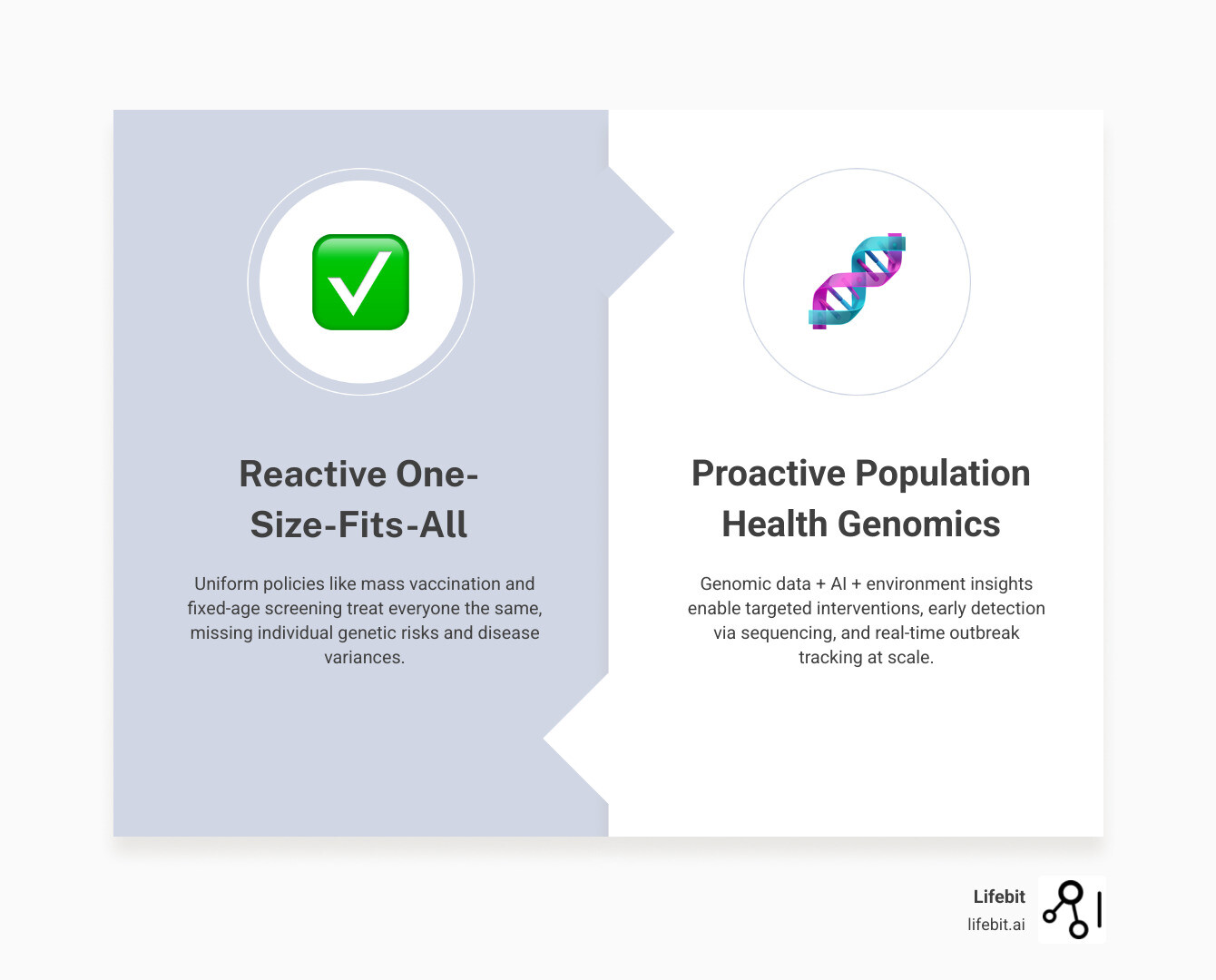
For decades, public health operated on a simple idea: one policy for everyone. Vaccinate the population. Screen at a fixed age. Treat symptoms when they appear. This “one-size-fits-all” approach was the hallmark of the 20th century, and it was undeniably successful. It eradicated smallpox, nearly eliminated polio, and significantly reduced the burden of infectious diseases. However, as the global health burden shifted toward chronic, non-communicable diseases like cancer, diabetes, and heart disease, the limitations of this model became clear.
We now know that two people with identical lifestyles can face vastly different disease risks — because their DNA, their environment, and their biology interact in ways a population average can never capture. A person carrying a hereditary breast cancer gene variant may look perfectly healthy at 35, yet their risk profile is fundamentally different from their neighbor’s. A community with elevated genomic risk for cardiovascular disease may receive the same generic prevention messaging as everyone else, leading to missed opportunities for life-saving interventions.
That gap — between what we know is possible and what most health systems actually do — is exactly what population health genomics is closing.
The Three Pillars of Population Health Genomics
To understand the scale of this transformation, we must look at the three pillars that support it:
- Genomic Screening for Tier 1 Conditions: The CDC identifies certain genetic conditions—such as Hereditary Breast and Ovarian Cancer (HBOC), Lynch syndrome, and Familial Hypercholesterolemia (FH)—as “Tier 1.” These are conditions where early identification and intervention significantly reduce morbidity and mortality. Population health genomics aims to screen entire populations for these variants, rather than waiting for a family tragedy to trigger a test.
- Pathogen Surveillance: Genomics isn’t just about human DNA. It’s about the DNA of the pathogens that surround us. Genomic surveillance systems tracked SARS-CoV-2 variants in real time during the pandemic, allowing for targeted public health responses. This same technology is now being applied to seasonal flu, foodborne illnesses, and antibiotic-resistant bacteria.
- Environmental and Social Integration: Genomic data does not exist in a vacuum. By integrating genetic risk scores with Social Determinants of Health (SDOH)—such as air quality, access to healthy food, and socioeconomic status—health systems can create a 360-degree view of community health.
I’m Maria Chatzou Dunford, CEO and Co-founder of Lifebit, with over 15 years of experience in computational biology, AI, and federated data infrastructure powering population health genomics programs worldwide. In this guide, I’ll walk you through how genomics is reshaping public health — and what it takes to make that transformation equitable, scalable, and sustainable.
Population health genomics terms at a glance:
At its core, population health genomics is the bridge between the high-tech world of the laboratory and the everyday reality of community clinics. While traditional public health looks at broad trends—like smoking rates or average cholesterol levels—and precision medicine looks at a single patient’s unique makeup, population health genomics combines the two. It asks: How can we use what we know about genetics to protect an entire city or nation?
This field is often called Precision Public Health (PPH). It is defined by the interplay between genetics, lifestyle, and the environment to deliver the right interventions to the right populations at the right time. Research published in Nature Medicine highlights that PPH is the evolution of public health into the era of big data. It moves beyond the “average” to understand the “variance,” ensuring that those at the highest risk are not left behind by policies designed for the middle of the curve.
| Feature | Traditional Public Health | Precision Medicine | Precision Public Health |
|---|---|---|---|
| Focus | Entire population (averages) | Individual patient | Sub-populations at high risk |
| Data Used | Surveys, census, vital stats | Clinical tests, personal DNA | Genomics + SDOH + Environment |
| Goal | Universal prevention | Personalized treatment | Targeted, proactive prevention |
Why does this matter now? Because we finally have the tools to do it. The Human Genome Project initially estimated we had 140,000 genes; we now know it’s closer to 20,500. More importantly, we’ve learned that genetic variation in complex diseases rarely acts alone. It is the conversation between our DNA and our environment—what we eat, the air we breathe, and where we live—that determines our health. The cost of sequencing a human genome has plummeted from billions of dollars to just a few hundred, making it feasible to sequence millions of people for the first time in history.
From Blunt Instruments to Surgical Precision: The PPH Evolution
The journey started over 25 years ago. The CDC’s Division of Blood Disorders and Public Health Genomics (DBDPHG) has been a pioneer in this space, moving from simple genetic screening to a lifespan approach to health promotion. Their mission is to reduce health inequities for the millions of Americans affected by inherited disorders. In the early days, this meant newborn screening for conditions like PKU. Today, it means using polygenic risk scores to predict a person’s lifetime risk of developing Type 2 diabetes or coronary artery disease.
In the past, public health “surveillance” meant waiting for a doctor to report a case of a specific disease. Today, molecular epidemiology allows us to track the specific “fingerprint” of a pathogen as it moves through a community. We have moved from the blunt instrument of mass quarantine to the surgical precision of genomic tracking. This allows public health officials to identify the exact source of a foodborne illness outbreak or the specific transmission chain of a respiratory virus, saving lives and preventing economic disruption.
Move From “Sick Care” to “Well Care” in Primary Clinics
One of the biggest hurdles in medicine is that “precision” usually stays locked inside expensive university hospitals. Initiatives like Genomes2People are working to change that by bringing population health genomics into primary care. The goal is to empower family doctors with genomic insights that can guide routine care.
Most primary care teams are overburdened and lack formal genomics training. However, by using “econogenomics”—the study of the economics of genomics—we can show that proactive screening saves money by preventing expensive hospitalizations later. For example, identifying a patient with Familial Hypercholesterolemia early allows for the use of statins to prevent a heart attack at age 40. The cost of the genetic test and the medication is a fraction of the cost of an emergency bypass surgery and long-term disability. When we move from reactive “sick care” to proactive “well care,” everyone wins. You can explore more real-world use cases for population genomics here.
Beyond DNA: Build a Scalable Precision Public Health Strategy with AI
A successful PPH strategy isn’t just about DNA. It’s about “phenomics”—the physical expression of our traits over time. According to Nature Reviews Genetics, the transition from simple genomics to longitudinal phenomics is what will truly personalize population health. This means tracking how a person’s health changes over decades, influenced by their genetic predispositions and their life experiences.
Core components of a modern strategy include:
- Multi-omics: Looking at the proteome (proteins), metabolome (metabolites), and microbiome (gut health) alongside DNA. While DNA is the “blueprint,” these other layers represent the “construction” and “maintenance” of the body, providing a real-time snapshot of health.
- Social Determinants of Health (SDOH): Acknowledging that your zip code is often as important as your genetic code. Factors like housing stability, education, and access to clean water can amplify or mitigate genetic risks.
- Environmental Factors: Tracking exposure to toxins, pollutants, and climate factors. For instance, a genetic predisposition to asthma is far more dangerous in a city with high levels of particulate matter.
- Behavioral Data: Integrating data from wearables and mobile health apps to understand how physical activity and sleep patterns interact with genomic risk.
Find Patterns Humans Miss: AI for Population Health
We are drowning in data but starving for insights. A single human genome generates roughly 200 gigabytes of raw data. When you multiply that by a population of millions, the scale becomes unfathomable for traditional analytical methods. This is where AI comes in. AI for population health allows us to process billions of data points to find patterns humans would miss.
Machine learning algorithms can scan through millions of electronic health records (EHRs) to identify “phenotypic clusters”—groups of people who share similar symptoms and genetic markers. This can lead to the discovery of new disease subtypes and more targeted treatments. In the realm of infectious disease, AI can predict the next “variant of concern” by analyzing the mutation patterns of viruses in real-time.
Take pathogen genomics as an example. Systems like PulseNet have transformed how we track foodborne illness by using molecular subtyping to find the source of an outbreak in hours rather than weeks. During the COVID-19 pandemic, wastewater surveillance became a literal early-warning system. By using AI to analyze the genomic fragments of the virus in a city’s sewage, officials could detect a surge in cases days before clinical tests were even administered. This “passive surveillance” is now being expanded to track antimicrobial resistance (AMR), one of the greatest threats to global health in the 21st century.
Close the Genomic Divide: Why Diversity is Non-Negotiable
For too long, genomic data has been “Eurocentric.” In 2015, the vast majority of participants in genomic studies were of European descent. This lack of diversity isn’t just an ethical failure; it’s a scientific one. Genetic variants that are common in African, Asian, or Hispanic populations may be rare or non-existent in European cohorts, meaning that the “precision” of precision medicine has historically only applied to a fraction of the global population.
We are finally seeing a shift, with a 4-fold increase in non-European participation since then. Initiatives like the “All of Us” Research Program in the US and the H3Africa consortium are working to ensure that the benefits of genomics are shared by all. True equity requires an “antiracism lens.” It means ensuring that polygenic risk scores (which predict disease risk based on thousands of tiny genetic variations) work just as well for someone in Lagos or Singapore as they do in London.
This is why federated technology is so vital. In many countries, strict data sovereignty laws prevent genomic data from leaving national borders. Federated technology allows researchers to study diverse datasets globally without the data ever leaving its home country. Instead of moving the data to the algorithm, we move the algorithm to the data. This respects local privacy and ownership laws while enabling the global collaboration necessary to close the genomic divide.
Population Health Genomics: How Biobanks Deliver 21% Actionable Results
The theory of population health genomics is great, but the results are even better. Around the world, massive “biobanks” are proving that large-scale sequencing works. These biobanks are more than just repositories of DNA; they are living laboratories that combine genetic data with decades of clinical history, imaging data, and lifestyle surveys.
A landmark study, the Geno4ME Study, implemented whole-genome sequencing (WGS) in a large healthcare system. They found that 21.4% of participants had actionable genetic findings—meaning a doctor could actually do something to prevent or treat a disease based on the results. This is a staggering number. It means that one in five people walking into a clinic has a genetic “time bomb” or a hidden opportunity for better health that traditional medicine would have missed.
Interestingly, 52% of those with dangerous variants had no family history that would have triggered a traditional test. This debunked the long-held belief that family history is a sufficient proxy for genetic risk. In a mobile, modern society, many people don’t know their full family medical history, making universal genomic screening a necessary tool for modern public health.
5 Million Genomes: The Titan Projects Leading the Way
Several “titan” projects are leading the way, setting the standard for how population-scale genomics should be conducted:
- UK Biobank: This is perhaps the most famous example. It has recruited 500,000 individuals and recently released whole-genome data for the entire cohort. The UK Biobank has become the gold standard for open-access science, enabling thousands of discoveries about the genetic basis of disease. Learn more in our UK Biobank complete guide.
- Genomics England: Started with the 100,000 Genomes Project, focusing on rare diseases and cancer. It proved that WGS could be integrated into a national health system (the NHS). It is now expanding toward a goal of 5 million genomes. See the Genomics England guide for more details.
- Generation Study: A bold plan to sequence 100,000 babies in the UK to detect over 200 rare conditions where early intervention can change the course of the child’s life. This is the future of newborn screening.
- Our Future Health: The UK’s largest ever health research program, aiming to recruit 5 million volunteers to create one of the most detailed pictures ever of people’s health.
- Global Reach: From Singapore’s PRECISE initiative, which is sequencing 100,000 diverse Asian genomes, to the Genome of Europe, over 38 nations are now all-in on genomics. These projects are not just about research; they are about building the infrastructure for the future of healthcare.
Track Pathogens in Hours: The New Era of Outbreak Response
It’s not just about human DNA; it’s about the DNA of the things that try to kill us. Pathogen genomics has moved from a niche research tool to a frontline public health weapon.
- Wastewater monitoring: By sequencing the viral and bacterial DNA in sewage, cities can detect outbreaks of Polio, Norovirus, or SARS-CoV-2 before they show up in hospitals. This allows for real-time community action, such as targeted vaccination clinics or public health warnings.
- FluNet: A global web-based tool for influenza monitoring that uses genomic data to help the WHO decide which strains to include in the annual flu vaccine.
- Salmonella surveillance: WGS now allows for near-instant traceability in food contamination events. In the past, it might take weeks to link a cluster of illnesses to a specific farm. Now, it can be done in hours, preventing thousands of additional infections.
- Antimicrobial Resistance (AMR): Genomics allows us to see the specific genes that make bacteria resistant to antibiotics. This helps doctors choose the right drug for a patient and helps public health officials track the spread of “superbugs” across the globe.
Stop Data Silos: How to Scale Population Health Genomics Safely
If population health genomics is so effective, why isn’t it everywhere? The transition from a research project to a standard of care is fraught with challenges. To scale this technology to billions of people, we must address three critical bottlenecks:
- Data Infrastructure: Handling petabytes of genomic data requires massive, secure computing power. A single project sequencing 1 million people will generate exabytes of data. Traditional cloud storage and processing are often too expensive or too slow for this scale.
- Workforce Training: We have a massive shortage of genetic counselors and “genomically literate” primary care doctors. If a patient receives a report saying they have a 15% higher risk for a rare heart condition, they need a professional who can explain what that actually means for their life.
- ELSI (Ethical, Legal, and Social Implications): Public trust is the currency of population genomics. If people fear their data will be used against them by insurance companies or employers, they won’t participate. Ethical frameworks must be at the forefront to maintain this trust.
Bring Analysis to the Data: Solving the Silo Bottleneck
The biggest bottleneck in research is often the “data silo”—valuable information locked away in a single hospital, university, or country. Historically, researchers had to download massive datasets to their own local servers to analyze them. This is not only slow and expensive, but it also creates massive security risks. Once data is downloaded, the original owner loses control over how it is used.
Lifebit solves this through federated governance and Trusted Research Environments (TRE). Instead of moving sensitive data, we bring the analysis to the data. This “FAIR” approach (Findable, Accessible, Interoperable, Reusable) is how projects like the Hong Kong Genome Project are scaling their impact. By using a TRE, the data stays behind the provider’s firewall, and researchers only see the results of their analysis, not the raw personal data. This ensures the highest level of security while enabling global collaboration.
“Just In Time” Genomics: Fixing the Primary Care Gap
Primary care providers are already stretched thin, often having only 15 minutes per patient. They cannot be expected to become experts in every rare genetic variant. Integrating genomics requires “Just In Time” resources—clinical decision support tools that pop up in the Electronic Health Record (EHR) exactly when a doctor needs them.
For example, if a doctor is about to prescribe a specific medication, a genomic alert could pop up saying, “This patient has a genetic variant that makes them likely to have a severe reaction to this drug. Consider an alternative.” This is pharmacogenomics in action, and it is one of the most immediate ways population health genomics can save lives. Telehealth genetic counseling is also proving to be a game-changer, allowing patients to get expert advice from home, reducing the burden on local clinics and ensuring that even rural populations have access to specialists.
The Economics of Prevention
Finally, we must address the cost. While the price of sequencing is falling, the cost of implementing a national program is still high. However, we must look at the “cost of inaction.” The economic burden of late-stage cancer, heart disease, and rare undiagnosed conditions is trillions of dollars globally. By investing in population health genomics today, we are building a more sustainable health system for tomorrow. Implementation science is key here—studying not just the biology, but the best ways to integrate these tools into the messy, real-world workflows of hospitals and clinics.
Population Health Genomics: 3 Critical Questions Answered
How does population health genomics differ from precision medicine?
While the terms are often used interchangeably, they have different goals and scales. Precision medicine focuses on treating the individual patient—think of it as a tailor-made suit for one person. It is often reactive, occurring after a patient has been diagnosed with a disease like cancer. Population health genomics applies these same genomic insights to entire groups to improve community-wide prevention. It’s like designing a better sizing system for an entire population so everyone gets a better fit, automatically. It is proactive, seeking to identify risk in healthy populations to prevent disease from ever occurring. Precision medicine is about the right treatment for the right person; precision public health is about the right intervention for the right population.
What is the role of the CDC in public health genomics?
The CDC’s Division of Blood Disorders and Public Health Genomics (DBDPHG) serves as the regulatory and scientific compass for the field in the United States. They work to reduce health inequities and promote health across the lifespan by providing evidence-based guidelines. One of their most important roles is evaluating the “validity and utility” of new genomic tests. Not every genetic marker is useful for public health; some may cause unnecessary anxiety without offering a clear path for intervention. The CDC ensures that genomic tools actually help people before they are recommended for widespread use. They also manage the Public Health Genomics Knowledge Base (PHGKB), a vital resource for researchers and clinicians worldwide.
Can genomic screening be equitable for all ancestries?
Yes, but only if we are intentional and proactive. If we continue to rely on data from European populations, we will inadvertently create a “genomic divide” where the benefits of science only reach the wealthy and the well-represented. To prevent this, we must:
- Diversify Biobanks: Actively recruit participants from underrepresented racial and ethnic groups.
- Improve Algorithms: Ensure that AI models and polygenic risk scores are trained and validated on diverse datasets.
- Address SDOH: Recognize that genetic risk is only one part of the story and that social and environmental factors must be addressed to achieve true health equity.
- Global Collaboration: Use federated technology to include data from low- and middle-income countries without compromising their data sovereignty. Equity is not just a moral goal; it is a scientific necessity for the accuracy of genomic medicine.
The End of Reactive Medicine: Build Your Genomic Future Today
The era of “one-size-fits-all” public health is ending. We are entering a time where your healthcare is as unique as your thumbprint, yet as accessible as a standard flu shot. The transition from reactive medicine to proactive, genomics-informed public health is not just a technological shift; it is a cultural one. It requires us to rethink how we collect data, how we share insights, and how we define “wellness.”
At Lifebit, we are proud to power this revolution. Our federated AI platform enables secure, real-time access to global biomedical data, breaking down silos while protecting privacy. We believe that the most valuable data in the world should not be the most difficult to access. By bringing the analysis to the data, we enable researchers to unlock the secrets of the human genome while respecting the rights of the individuals who provided it.
By combining implementation science with cutting-edge technology, we can build a world where disease is caught before it starts, where treatments are tailored to our biology, and where wellness is a proactive choice, not a reactive hope. The challenges are significant—from data infrastructure to ethical safeguards—but the potential reward is the greatest achievement in the history of medicine: the ability to predict and prevent disease at a global scale.
The future of public health is here. It is genomic, it is data-driven, and most importantly, it is for everyone. We invite you to join us in this journey toward a healthier, more equitable world.
Learn more about the Lifebit platform and how we power population health genomics