

Mastering the Art of the Data Harmonization Process
Data Harmonization Process: Unlock 88,000+ Patient Insights by Ending Data Silos
The data harmonization process is the systematic method of integrating diverse datasets—from different formats, sources, and structures—into a unified, comparable framework that enables meaningful analysis. If you’re working with fragmented health records, genomic data, or multi-site clinical trials, understanding this process is essential for unlocking insights that would otherwise remain hidden in data silos. In the modern landscape of biomedical research, the “data explosion” has created a paradox: we have more information than ever, yet the lack of interoperability makes it increasingly difficult to draw cross-study conclusions.
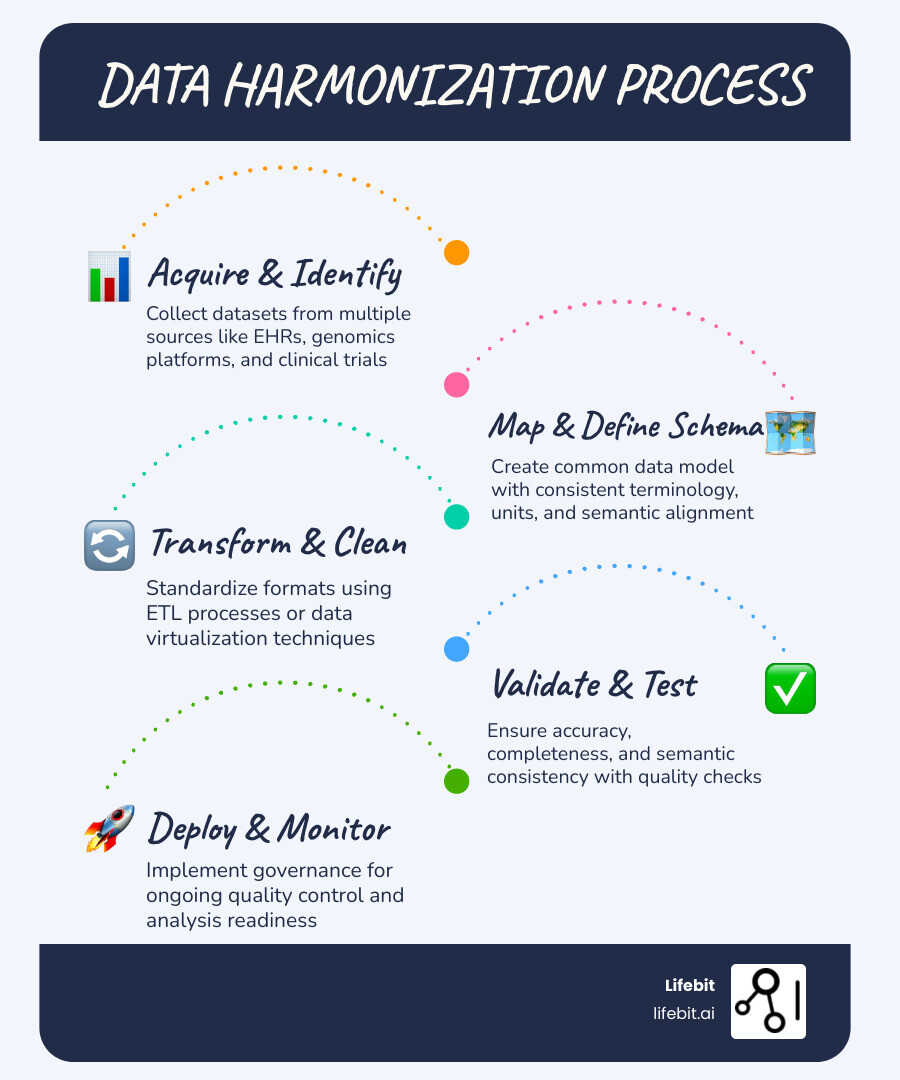
Quick Overview: The Data Harmonization Process in 5 Steps
- Acquire and identify data sources – Collect datasets from multiple systems (EHRs, claims, genomics platforms) and perform initial data profiling to understand the “shape” of the incoming information.
- Map and define schema – Create a common data model (CDM) with consistent terminology, units, and ontologies (such as SNOMED CT or LOINC) to ensure semantic alignment.
- Transform and clean – Apply ETL (Extract, Transform, Load) processes or data virtualization to standardize formats, handle missing values, and normalize units of measure.
- Validate and test – Check for accuracy, completeness, and semantic consistency using automated validation rules and statistical checks for inferential equivalence.
- Deploy and monitor – Implement governance frameworks for ongoing quality control, ensuring that as new data flows in, the harmonized environment remains stable and reliable.
Why does this matter? Without harmonization, organizations waste time reconciling incompatible data formats, miss critical patterns across datasets, and struggle to meet regulatory requirements. Research shows that harmonized datasets enable analysis of over 88,000 participants across studies—sample sizes impossible with isolated data sources. This scale is critical for identifying rare genetic variants or understanding long-term outcomes in chronic diseases. The CHANCES project successfully harmonized 287 variables on health and aging, while projects like CEDAR unified Dutch census data spanning nearly two centuries, providing a longitudinal view of societal evolution that was previously impossible to track.
The challenge is real. Global pharmaceutical companies manage data from hundreds of clinical sites using different protocols. Public health agencies need to compare outcomes across regions with inconsistent reporting standards. Regulatory bodies like the FDA require real-time access to diverse datasets without compromising patient privacy. Traditional approaches—manually reconciling spreadsheets or building rigid ETL pipelines—can’t scale to meet these demands. The manual effort required to map just a few dozen variables across ten studies can take months, leading to “analysis paralysis” where the data becomes obsolete before it is even ready for use.
I’m Maria Chatzou Dunford, CEO and Co-founder of Lifebit, where I’ve spent over 15 years building platforms that power the data harmonization process for genomic medicine and federated biomedical research. My work on Nextflow and at the Centre for Genomic Regulation has focused on making complex multi-omic and clinical datasets interoperable across secure, compliant environments. We have seen firsthand how moving from manual data cleaning to automated harmonization can reduce research timelines from years to weeks.
Data Harmonization Process: Stop Drowning in Data and Start Scaling Intelligence
In the current era of Big Data, we aren’t just swimming in information; we are often drowning in it. For modern businesses and research institutions, the problem isn’t a lack of data—it’s the fact that this data is scattered across different “languages.” One department might record dates as MM/DD/YYYY, while another uses YYYY-MM-DD. A clinical trial in London might measure weight in kilograms, while a partner site in New York uses pounds. These discrepancies, while seemingly minor, create a “semantic gap” that prevents automated systems from processing information at scale.
The data harmonization process is the bridge that connects these islands of information. It ensures that data from various sources is consistent, compatible, and ready for high-level analysis. Without it, your business intelligence is limited to small, isolated views rather than a comprehensive, global perspective. In the context of Artificial Intelligence and Machine Learning, harmonization is the prerequisite for training models that are robust and generalizable across different populations.
Why is this essential?
- Improved Data Quality: By identifying and resolving errors, duplicates, and inconsistencies early, we ensure that the insights derived are actually reliable. High-quality data is the foundation of “evidence-based” decision-making.
- Global Collaboration: For organizations operating across the UK, USA, Canada, and Europe, harmonization allows teams to work on the same “single source of truth.” This is particularly vital in international consortia where data sovereignty laws (like GDPR) require data to remain in its country of origin while still being accessible for joint analysis.
- Policy and Decision Making: Policymakers and executives need a cohesive framework to extract meaningful insights. For instance, scientific research on data integration and genomic medicine highlights how integrating disparate datasets is the only way to move toward truly personalized healthcare, where treatments are tailored to an individual’s unique genetic makeup and lifestyle.
- Strategic Growth: Harmonized data allows for predictive analytics that can spot market trends or patient outcomes that are invisible in fragmented sets. It enables “longitudinal tracking,” allowing organizations to see how variables change over decades rather than just months.
- Regulatory Compliance: In highly regulated industries like finance and healthcare, the ability to demonstrate data lineage and consistency is a legal requirement. Harmonization provides the audit trail necessary to prove that data has been handled correctly from source to report.

Data Harmonization vs. Integration and Standardization
We often hear these terms used interchangeably, but in data engineering, they represent different levels of maturity. Understanding these structural differences is key to mastering the data harmonization process. Integration is the physical act of bringing data together; standardization is the act of making it look the same; harmonization is the act of making it mean the same.
| Feature | Data Integration | Data Standardization | Data Harmonization |
|---|---|---|---|
| Primary Goal | Combining data from different sources. | Ensuring data follows a specific format (e.g., ISO dates). | Reconciling semantic and structural differences for comparability. |
| Focus | Technical connectivity and movement. | Uniformity of fields and values. | Semantic consistency and metadata alignment. |
| Result | A single repository (like a data lake). | Consistent formats within a single dataset. | A cohesive framework where diverse datasets “speak” to each other. |
| Complexity | Low to Medium | Medium | High |
| Example | Moving SQL and NoSQL data into one AWS bucket. | Converting all dates to YYYY-MM-DD. | Mapping “Myocardial Infarction” and “Heart Attack” to a single clinical code. |
While integration moves the data into one room, and standardization makes sure everyone is wearing the same uniform, harmonization ensures everyone can actually understand each other’s conversation. It goes beyond the surface level to align the meaning (semantics) of the data, which is essential for complex fields like oncology or rare disease research where terminology can vary wildly between specialists.
5-Step Data Harmonization Process: Create AI-Ready Assets Without Manual Errors
To achieve a truly “AI-ready” dataset, we follow a rigorous workflow. This ensures that the final output isn’t just a pile of data, but a structured asset. We often look to established frameworks, such as the Maelstrom research guidelines for rigorous retrospective data harmonization, which emphasize that transparency and quality control are non-negotiable. A well-executed process reduces the risk of “garbage in, garbage out,” which is the primary cause of failure in large-scale data projects.
Step 1: Data Selection and Source Identification
The first step in the data harmonization process is knowing what you have and what you need. We start by evaluating disparate fields across our available sources. This involves:
- Evaluation: Which datasets actually address our research question? We must assess the “provenance” of the data—where did it come from, and how was it collected?
- Variable Selection: Identifying which variables (e.g., age, blood pressure, genomic variants) need to be compared. This often involves a “gap analysis” to see what data is missing across different sources.
- Contextual Metadata: Understanding the “who, what, where, and when” of the data collection. For example, knowing that a dataset from 1850 uses different social classifications than one from 2024 is critical for historical census work. We also look at the “precision” of the data—was blood pressure measured manually or with a digital device?
Step 2: Defining the Harmonization Schema
Once we have the data, we need a blueprint. This is where we define the target variables and the common format they will live in. This is often referred to as a “Target Data Model.” We must reconcile different dimensions:
- Syntax: Resolving file formats (CSV vs. JSON vs. Parquet). This is the technical layer of the schema.
- Structure: Aligning the conceptual schema (how data tables relate to one another). For instance, deciding whether to use a “flat” table or a relational “star schema.”
- Semantics: This is the hardest part. If one study defines “young adult” as 18–25 and another as 18–30, we must create a mapping rule to make them comparable. We use “cross-walking” techniques to map local codes to international standards like ICD-10 or MedDRA.
Resources like the standardisation and harmonisation of socio-demographic variables provide essential templates for this stage, ensuring that common fields like education level or occupation are mapped correctly across international borders.
Step 3: Change and Cleaning
This is the “engine room” of the data harmonization process. We use either traditional ETL (Extract, Transform, Load) or more modern data virtualization techniques. Data virtualization is increasingly popular because it allows us to harmonize data without physically moving it, which is essential for sensitive health data.
- Cleaning: Correcting misspelled names, handling missing values through statistical imputation, and removing duplicates. We also look for “outliers” that might indicate data entry errors.
- Normalization: Converting all units to a standard (e.g., converting all currency to USD or all distances to kilometers). This also includes “text normalization,” such as converting all entries to lowercase or removing special characters.
- Practicality vs. Purity: Sometimes we must combine similar categories (like “girls” and “women” into “female”) to make the data usable, even if it loses some original granularity. This is a strategic decision that must be documented in the data lineage.
Step 4: Validation and Testing
We don’t just hope the data is right; we prove it. This stage involves rigorous quality control (QC). We apply validation rules to ensure that the change didn’t introduce errors. For example, if a patient’s age suddenly becomes 250 years after a change, our system flags it.
- Inferential Equivalence: We check ensuring that the harmonized variable still accurately represents the concept it’s supposed to measure. If we harmonized “income” from ten different countries, does the final variable still allow for a valid comparison of purchasing power?
- Automated Testing: We use unit tests and integration tests to verify that the transformation logic is working as expected across millions of rows of data.
Step 5: Deployment and Monitoring
Finally, the harmonized data is moved into a Trusted Data Lakehouse or a federated AI platform. But the work doesn’t stop there. As new data sources emerge, we must maintain the harmonization.
- Data Governance: This requires ongoing governance and regular audits to ensure the “single source of truth” doesn’t drift back into chaos.
- Versioning: Just like software, harmonized datasets should be versioned. If a mapping rule changes in 2025, researchers need to know which version of the data was used for their 2024 analysis to ensure reproducibility.
Data Harmonization Process in Action: How Global Leaders Solve Multi-Omic Complexity
The data harmonization process isn’t just a theoretical exercise for data scientists; it’s solving massive problems in the real world across diverse industries. From tracking climate change to optimizing global retail, the ability to unify data is a competitive necessity.
- Education: Universities harmonize data from Learning Management Systems (LMS), student records, and financial aid databases to identify at-risk students across different campuses. This allows for personalized learning paths and early intervention strategies that improve graduation rates.
- Supply Chain and Retail: Global manufacturers standardize data across hundreds of factories and thousands of suppliers to optimize inventory. If one factory calls a part “Bolt-A” and another calls it “B-001,” harmonization ensures the system knows they are the same item. In retail, “omnichannel” harmonization allows a company to see a single view of a customer whether they shop online, via an app, or in a physical store.
- Public Health: During the pandemic, researchers had to act fast. Research on harmonizing government responses to COVID-19 across eight disparate datasets was crucial for understanding which policies (like travel bans or school closures) actually worked. Without this, comparing the efficacy of a lockdown in Italy versus one in South Korea would have been impossible.
- Urban Analytics and Smart Cities: Cities use ontology-based spatial data harmonization to combine traffic, zoning, and economic data for better urban planning. This helps in predicting where new infrastructure is needed based on real-time population shifts.
Solving the Multi-Omic Data Harmonization Process
In biomedical research, the stakes are even higher. Multi-omics involves combining genomics (DNA), proteomics (proteins), and transcriptomics (RNA) data. Because this data is incredibly complex and high-volume, manual harmonization is impossible. A single human genome generates roughly 200GB of raw data; multiplying that by thousands of participants creates a data management challenge of epic proportions.
We use advanced tools like the user-friendly multi-omics data harmonization R pipeline to suppress cross-platform bias. This allows researchers to see the full picture of a patient’s health, leading to better clinical trials and improved patient outcomes. For instance, the OMOP Common Data Model has become a gold standard for us at Lifebit, allowing us to map disparate electronic health records into a single framework for global research. This enables “federated analytics,” where researchers can run queries across multiple international databases without the data ever leaving its secure home.
Harmonizing Global Census and Population Data
History provides some of our most fragmented data. The University of Minnesota’s Population Center (IPUMS) has done heroic work harmonizing U.S. census data from 1850 to the present. Similarly, the CEDAR dataset in the Netherlands harmonized census data from 1795 to 1971.
These projects allow us to study long-term trends, such as the changing lives of working mothers over 200 years or the impact of industrialization on family structures. By creating global spatio-temporally harmonised datasets, we can produce high-resolution maps of population distribution that are essential for disaster management, resource allocation, and understanding the long-term effects of climate migration.
Stop Measurement Errors: Avoid These 3 Data Harmonization Process Pitfalls
The data harmonization process is fraught with potential missteps that can compromise the integrity of your results. One of the biggest risks is “measurement error propagation.” If the original data was faulty or biased, harmonization can sometimes amplify that error rather than fix it, leading to “statistically significant” but entirely false conclusions.
- Missing Data and Imputation Bias: This is the bane of every researcher. While we use statistical methods like imputation to fill gaps, we must be transparent about where “synthetic” data was used. If 40% of a variable is imputed, the resulting analysis may reflect the imputation algorithm more than the actual biological or social reality. We must use sensitivity analysis to ensure our results aren’t overly dependent on these filled-in values.
- Batch Effects and Technical Noise: In proteomics and genomics, data can vary simply because it was processed on different days, by different technicians, or by different machines. We follow diagnostics and correction of batch effects in large-scale proteomic studies to remove this “noise.” Without this correction, a researcher might mistake a difference in machine calibration for a breakthrough biological discovery.
- Privacy, Ethics, and Sovereignty: Harmonizing data often means moving it across borders, which triggers complex legal requirements like GDPR in Europe or HIPAA in the US. At Lifebit, we address this by using a federated approach. Instead of moving data to a central server, the data stays where it is, and the AI/analysis tools come to the data. This addresses ethical considerations and patient consent while still allowing for the large-scale analysis required for modern medicine.
Avoiding Common Pitfalls in the Data Harmonization Process
Many organizations fail because they treat harmonization as a one-time project rather than a continuous process. Common pitfalls include:
- The “Lowest Common Denominator” Trap: Standardizing data so much that you lose the rich, granular detail that made it valuable in the first place. For example, if one study records specific cancer stages (1a, 1b, 2a) and another just says “early stage,” harmonizing everything to “early stage” loses the detail needed for precision medicine.
- Manual Errors and Scalability: Relying on humans to sort through millions of rows of data leads to fatigue and mistakes. Automated tools and machine learning-assisted mapping are essential for scalability. Human experts should be used for “overseeing” the process rather than performing the manual entry.
- Lack of Documentation and Metadata: If you don’t record why you mapped “Variable A” to “Variable B,” future researchers won’t be able to trust or replicate your results. A “data dictionary” that explains every transformation is a mandatory deliverable of any harmonization project.
- Over-Harmonization: Sometimes, datasets are simply too different to be combined. Forcing them into a single schema can create a “Frankenstein dataset” that doesn’t represent any real-world population accurately. Knowing when not to harmonize is just as important as knowing how to do it.
Following established guidelines for cleaning and harmonization of survey data can help maintain the rigor and reproducibility required for peer-reviewed research and regulatory approval.
Data Harmonization Process FAQ: Solve Your Toughest Integration Challenges
Who typically uses harmonized data in an organization?
It’s not just for the IT department! While data scientists and analysts do the heavy lifting of the data harmonization process, the outputs are used by policymakers to design interventions, researchers to find new treatments, and executive leadership to make data-driven strategic investments. In biopharma, it’s the foundation for pharmacovigilance and safety surveillance, where signals of adverse drug reactions must be spotted across global populations.
How do you handle missing data during harmonization?
We use a combination of statistical imputation (like MICE – Multivariate Imputation by Chained Equations) and validation checks. Tools like Harmonizr are specifically designed to handle missing values in complex datasets like proteomics without introducing bias. However, the golden rule is transparency: always document the percentage of missing data and the specific methods used to address it.
What tools are used for automated data harmonization?
Modern stacks use AI-driven platforms (like Lifebit’s federated AI), ETL tools (like Apache NiFi or Informatica), and specialized R and Python pipelines. Open-source tools like DataHarmonizer (for genomics) and Phenopolis (for phenotypic data) are also widely used in the scientific community to speed up the validation and aggregation of contextual information. Knowledge graphs are also becoming a popular way to manage the complex relationships between harmonized variables.
Does harmonization impact data privacy?
If done correctly, it can actually enhance privacy. By standardizing data into a common model, you can more easily apply de-identification and anonymization techniques consistently across all sources. Furthermore, using a federated data harmonization process ensures that the raw, sensitive data never leaves its original secure environment, significantly reducing the risk of data breaches.
How long does the data harmonization process take?
The timeline varies based on the number of sources and the complexity of the variables. A small project with three datasets might take a few weeks, while a global initiative involving hundreds of clinical sites can take months or even years of ongoing effort. Automation and the use of pre-existing Common Data Models (CDMs) are the best ways to accelerate this timeline.
Master the Data Harmonization Process to Accelerate Your Next Breakthrough
The data harmonization process is no longer optional. As we move toward a world of federated AI and real-time evidence, the ability to unify disparate datasets is what separates the leaders from the laggards. Whether you are analyzing 600 years of land-use transitions or predicting the next viral outbreak, the quality of your insights depends entirely on the harmony of your data.
At Lifebit, we believe that data should be a bridge, not a barrier. Our Trusted Data Lakehouse and federated AI platform are built to automate the heavy lifting of harmonization, allowing you to focus on what matters most: the breakthroughs. By maintaining ongoing harmonization as new data sources emerge, we ensure that your research remains scalable, compliant, and—most importantly—impactful.
Ready to turn your data chaos into clarity? Learn more about how Lifebit can accelerate your research.