

Mastering the Maze: DHA’s Data Catalog for Enhanced Transparency

Enterprise Data Catalog DHA: Unify 1 Petabyte of Siloed Records to Save Lives
Enterprise data catalog DHA is changing how the Defense Health Agency unifies 30 years of military health records across 100+ facilities without centralizing sensitive data. Here’s what you need to know:
Key Implementation Steps:
- Establish federated governance – Keep data in domains while making it findable enterprise-wide
- Apply VAULTIS framework – Ensure data is Visible, Accessible, Understandable, Linked, Trusted, Interoperable, and Secure
- Deploy metadata management – Use the 10 baseline DoD metadata fields for cataloging
- Enable domain stewardship – Assign data owners at the source to maintain quality and compliance
- Integrate with MHS Common Data Model – Standardize definitions across clinical and operational systems
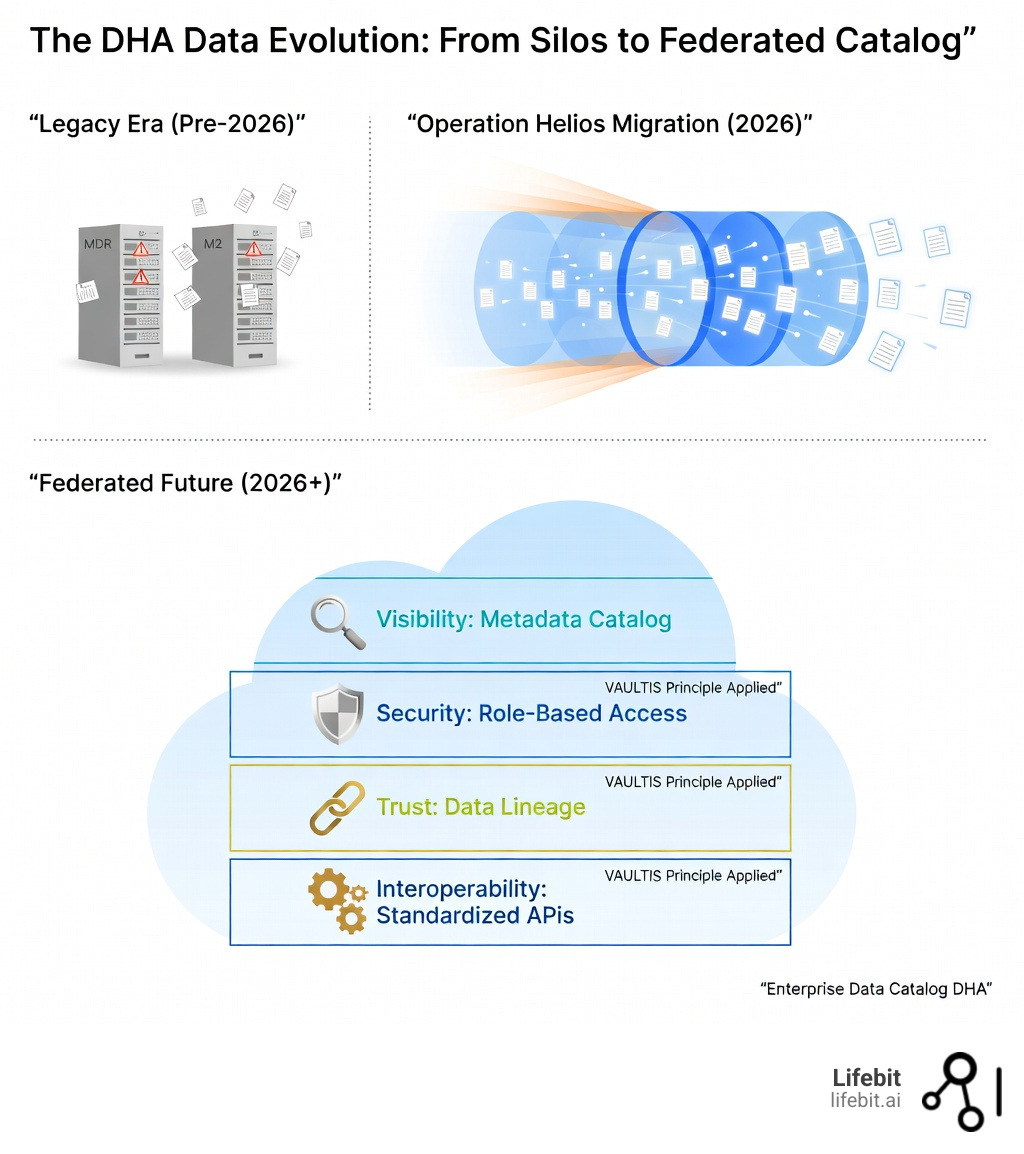
The Defense Health Agency faces a critical challenge: over 1 petabyte of health data scattered across disparate legacy systems, processing 60 billion records annually. Operation Helios recently completed the largest data migration in DHA history, moving three decades of records from MDR and M2 warehouses into the MHS Information Platform. Yet migration alone doesn’t solve the core problem—data silos still prevent clinicians, researchers, and commanders from finding and trusting the information they need when lives are on the line.
DHA’s new Chief Data and Analytics Officer has made data maturity the top priority, launching an enterprise data catalog initiative aligned with the Department of Defense’s VAULTIS strategy. Unlike traditional centralized approaches that create security bottlenecks and compliance nightmares with sensitive PHI data, DHA is building a federated data mesh architecture. This model keeps data where it belongs—with domain experts—while making it findable, understandable, and usable across the entire Military Health System.
The upcoming solicitation HT0011-25-RFI-0222 (starting September 2025) will shape how DHA implements this change. The stakes are high: battlefield medics need real-time access to patient allergies, researchers require longitudinal health records for TBI studies, and AI/ML systems need clean, standardized data to predict medical supply needs during deployments.
I’m Maria Chatzou Dunford, CEO and Co-founder of Lifebit, where we’ve built federated genomics and biomedical data platforms that enable secure analysis across distributed health records without moving data—principles directly applicable to the enterprise data catalog DHA is building. Over 15 years working in computational biology, AI, and health-tech entrepreneurship have shown me that the future of sensitive health data isn’t centralization—it’s intelligent federation.
Enterprise data catalog dha helpful reading:
- Defense Health Agency Data Platform
- DHA Data Governance
- DHA Data Harmonization OMOP
Stop Data Silos: Why Enterprise Data Catalog DHA Moves Beyond Centralization
For decades, the Military Health System (MHS) has operated as a collection of islands. While individual hospitals and research labs collected vital information, the ability to see the “big picture” of a service member’s health journey was often obscured by technical barriers. We have seen this “data silos” problem across global health systems, but in a military context, these silos aren’t just an administrative headache—they are a threat to military readiness.
The current landscape involves over 60 billion records processed annually from more than 35 disparate sources. When data is trapped in these silos, it cannot be easily used for predictive analytics, population health surveillance, or real-time clinical decision support. This is why the DHA’s new Chief Data and Analytics Officer (CDAO), Dr. Jesus Caban, has deemed data maturity a top priority.
To achieve this maturity, the DHA is leveraging the MHS Common Data Model to standardize enterprise metrics. By aligning data owners and stewards to their respective sources, we can ensure that a “medically ready” soldier is defined the same way in Singapore as they are in New York. This standardization is the first step in moving from chaos to a structured, usable ecosystem.
Stop the Petabyte Bottleneck: Why Legacy Warehouses Fail
Historically, the DHA relied on the MHS Data Repository (MDR) and the MHS Help Desk (M2). These legacy warehouses served their purpose for years, but as the volume of data grew to a petabyte scale, they became bottlenecks. Moving data into a single central warehouse is like trying to put the entire ocean into one tank—it’s expensive, slow, and creates a single point of failure.
Operation Helios was the DHA’s answer to this bottleneck. By migrating 30 years of data into the MHS Information Platform (MIP), the agency successfully consolidated its historical records. However, the lesson we have learned at Lifebit—and one the DHA is now championing—is that migration is only half the battle. To truly leverage this data, you need an enterprise data catalog dha that provides a map to these resources, ensuring that even if data is stored in the cloud or on-premise, it remains findable and actionable.
Enterprise Data Catalog DHA: The 7-Step VAULTIS Blueprint for Data-Centricity
The Department of Defense (DoD) doesn’t just want data; it wants “data-centricity.” This goal is codified in the VAULTIS framework. For the DHA, an enterprise data catalog dha is the primary tool for achieving these seven core goals:
- Visible: Users can find the data they need through a master catalog.
- Accessible: Data can be retrieved through secure, authorized channels.
- Understandable: Metadata provides context, so users know what the data represents.
- Linked: Disparate sources are connected to show a longitudinal health record.
- Trusted: Data quality is monitored and verified.
- Interoperable: Data follows standards like FHIR and HL7.
- Secure: Granular access controls protect sensitive PHI and PII.
Implementing this framework requires a shift in mindset. As outlined in the DoD Data Strategy, data must be treated as a strategic asset. The catalog acts as the “librarian” for this asset, ensuring that every record is tagged, indexed, and ready for use.
Metadata Management: The Foundation of Enterprise Data Catalog DHA
A functional catalog is more than just a list of files. It is a complex system of metadata management, data dictionaries, and lineage tracking. Within the DHA, we are seeing a focus on ten baseline metadata fields, including identifiers, security classifications, and handling restrictions.
By following a DHA Data Governance Complete Guide, the agency is establishing roles like Data Stewards and Subject Matter Experts who are responsible for the “health” of the data. This ensures that when a researcher looks for “Traumatic Brain Injury” datasets, they aren’t just getting a list of files—they are getting documented, high-quality data products with a clear history of where that data came from.
Find Existing Tools Faster: Stop Duplicative Analytics Spending
One of the biggest frustrations for DHA users is the inability to find existing analytics tools or dashboards, leading to expensive duplicative efforts. The enterprise data catalog dha initiative includes a full inventory of AI/ML resources and analytics tools.
This inventory, supported by the Revolutionary FAR Overhaul (RFO), aims to streamline procurement and ensure that the MHS is leveraging existing assets before buying new ones. When a commander in the field needs a logistics dashboard, the catalog should point them to an existing, trusted tool rather than requiring a new one to be built from scratch.
Why Centralized Warehouses Fail: Secure 100+ Facilities with Enterprise Data Catalog DHA
At Lifebit, we have long advocated for federated architectures, and it is encouraging to see the DHA adopting a federated data mesh. In a centralized model, you move all data to one place. In a mesh model, the data stays in its “domain”—such as a specific military hospital or a research lab—but is connected via a central governance layer.
This is the only viable path for modern defense healthcare for three reasons:
- Data Sovereignty: Sensitive health records often have strict legal and ethical requirements that make moving them risky.
- Agility: Domain experts (like clinicians) understand their data better than a central IT department ever could.
- Security: A decentralized model reduces the “blast radius” of a potential breach.
The Defense Health Agency Data Platform Guide highlights how this architecture allows the DHA to unify disparate systems without the massive overhead of total centralization.
Zero-Trust Security: Protect PHI Without Moving a Single Byte
Security is the non-negotiable foundation of military health. By using a federated approach, the DHA can enforce Zero-Trust principles. Instead of granting broad access to a database, the enterprise data catalog dha enables Attribute-Based Access Control (ABAC).
This means a battlefield medic might see a soldier’s blood type and allergies, but not their behavioral health history, unless specifically authorized. This level of granular protection is essential for HIPAA compliance and the protection of Protected Health Information (PHI). Our work in implementing OMOP for DHA shows that you can harmonize data for research while maintaining these strict security boundaries.
HT0011-25-RFI-0222: How Enterprise Data Catalog DHA Powers Battlefield AI
The upcoming solicitation HT0011-25-RFI-0222 is a signal to the industry that the DHA is ready to mature its data mesh prototype. This isn’t just about organizing files; it’s about AI/ML readiness.
With an organized catalog, the DHA can deploy:
- Predictive Logistics: Forecasting medical supply needs based on deployment data.
- Population Health: Using Natural Language Processing (NLP) to scan clinical notes for early signs of disease outbreaks.
- Clinical Decision Support: Providing doctors with real-time, AI-driven insights at the point of care.
The Revolutionary FAR Overhaul is helping to speed up the acquisition of these advanced technologies, ensuring that the DHA can stay ahead of emerging threats.
Decision Advantage: How Intelligent Governance Saves Lives
The enterprise data catalog dha is about people, not just bits and bytes. “Decision advantage” on the battlefield means having the right information at the right time. Whether it’s precision medicine for a veteran with a rare condition or rapid response to a new virus, intelligent data governance is the engine that drives better clinical outcomes.
Enterprise Data Catalog DHA: 3 Critical Questions Answered
What is the timeline for the DHA data catalog implementation?
The DHA is currently in a market research phase. The solicitation HT0011-25-RFI-0222 is anticipated to result in a 12-month base period starting around September 30, 2025. This phase will focus on maturing the data management and governance structure, including the master data catalog.
How does the federated model protect patient privacy?
Unlike centralized databases, the federated model keeps data at the source. The catalog only stores “metadata” (information about the data), not the actual patient records. Access is granted through secure, role-based protocols, ensuring that sensitive PHI never moves unless absolutely necessary and authorized.
What role does the MHS Common Data Model play?
The MHS Common Data Model (CDM) acts as a “universal translator.” It standardizes how different systems define clinical and operational terms. This ensures that data from a Navy hospital can be easily compared and linked with data from an Army clinic, which is vital for enterprise-wide analytics and military readiness.
The Future is Federated: Scale Your Enterprise Data Catalog DHA Today
The journey from fragmented silos to a unified enterprise data catalog dha is a marathon, not a sprint. By embracing federated governance and the VAULTIS framework, the Defense Health Agency is setting a new standard for how large-scale health systems should manage sensitive data.
At Lifebit, we are proud to support this vision of secure, real-time access to global biomedical data. Whether it’s through our Trusted Research Environments (TRE) or our AI-driven analytics layers, we believe that the key to open uping the power of health data lies in connecting it, not collecting it. As the DHA moves forward with its 2025 initiatives, the focus on transparency and interoperability will undoubtedly save lives and ensure that our military remains ready for any challenge.
Learn more about how we support solutions for government and public health agencies across the globe.