
OMOP CDM: The Standard That Makes Healthcare Data Actually Usable
A researcher at a major hospital wants to study diabetes outcomes. Simple enough—until they realize their institution’s data lives in one format, the partnering academic medical center uses another, and the regional health system speaks an entirely different language. Same disease, same country, completely incompatible data structures.
Multiply this problem across thousands of healthcare organizations worldwide, and you understand why groundbreaking research takes years instead of months. Why drug safety signals hide in plain sight. Why precision medicine programs struggle to get off the ground.
OMOP CDM (Observational Medical Outcomes Partnership Common Data Model) exists to solve exactly this problem. It’s a universal translator for healthcare data—a standardized way to organize clinical information so that a query written once works everywhere. No custom integrations. No months spent reconciling terminology differences. Just clean, comparable data ready for analysis.
This isn’t theoretical infrastructure. National health agencies are building precision medicine programs on OMOP. Pharmaceutical companies are using it for regulatory submissions. Research networks spanning hundreds of institutions run coordinated studies without ever moving patient data across organizational boundaries.
Here’s what you need to know: what OMOP CDM actually is, how it transforms fragmented healthcare data into a research-ready resource, and why organizations serious about large-scale observational research are standardizing on this model.
The Data Babel Problem OMOP CDM Was Built to Solve
Healthcare data fragmentation isn’t just inconvenient. It’s a structural barrier to progress.
Every electronic health record system stores data differently. Epic uses one schema. Cerner uses another. Homegrown systems at academic medical centers use dozens of variations. Claims databases follow their own logic. Disease registries maintain custom formats optimized for specific conditions.
The terminology chaos runs even deeper. One hospital codes pneumonia using ICD-10. Another uses SNOMED CT. A third maintains local codes that mean something only to their clinicians. The same diagnosis exists in three incompatible formats across three systems—and that’s just for one condition.
Traditional integration approaches don’t scale. Point-to-point connections work when you’re linking two systems. But connect ten data sources, and you’re suddenly managing forty-five potential mappings. Each integration requires custom development. Each terminology difference demands manual reconciliation. Each new data source multiplies the complexity.
The real cost shows up in delayed research timelines. A multi-site study that should take months consumes years in data harmonization. Analysts spend more time wrangling formats than analyzing outcomes. Insights that could save lives remain trapped in institutional silos because combining the data is simply too hard.
Drug safety surveillance faces the same barrier. A concerning pattern might exist across multiple health systems, but fragmented data structures prevent anyone from seeing it. By the time manual data reconciliation reveals the signal, months have passed.
Precision medicine programs hit this wall immediately. You can’t build national genomic databases when clinical data from different institutions can’t talk to each other. You can’t train AI models on healthcare data when every dataset requires custom preprocessing pipelines.
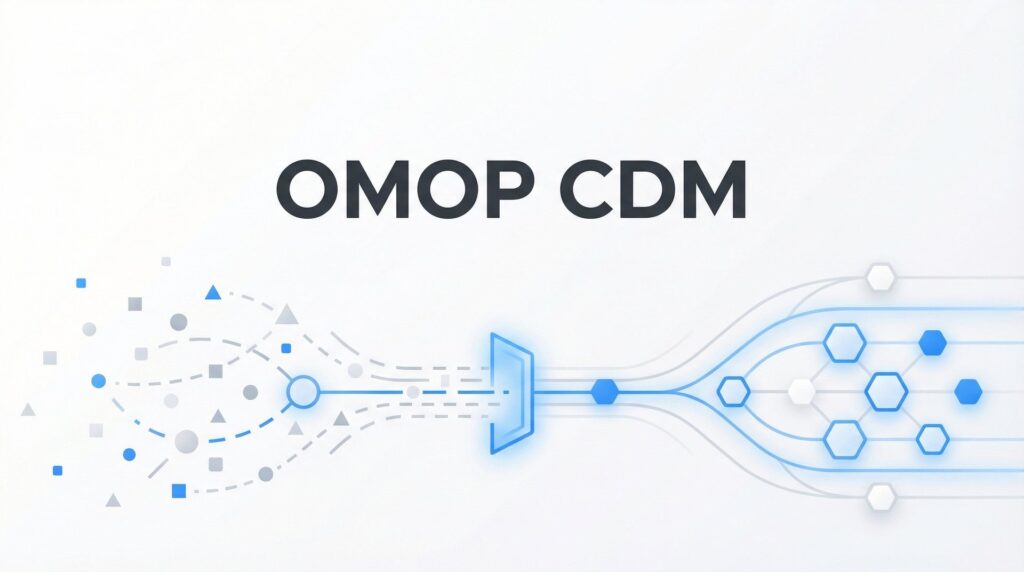
This is the problem OMOP CDM was designed to eliminate. Not by forcing every organization to abandon their source systems, but by creating a common target model that everyone can transform their data into. One standardized structure. One set of vocabularies. Queries that work everywhere.
How OMOP CDM Actually Works
OMOP CDM is fundamentally person-centric. Every piece of clinical information—diagnoses, medications, procedures, lab results—connects to an individual patient record. This differs from encounter-based models that organize data around visits or transactions.
The model uses standardized tables with specific purposes. The Person table holds demographics. Condition_Occurrence captures diagnoses. Drug_Exposure tracks medications. Procedure_Occurrence records interventions. Measurement stores lab results and vital signs. Observation holds clinical facts that don’t fit other categories. Visit_Occurrence documents encounters.
This structure stays consistent regardless of source data. Whether you’re transforming Epic data, Cerner records, or claims files, everything maps to the same tables with the same field definitions.
But the real power lies in the vocabulary system. OMOP doesn’t just standardize structure—it standardizes meaning.
Every clinical concept gets a unique OMOP concept ID. “Type 2 diabetes mellitus” has one concept ID regardless of whether the source system coded it in ICD-10, SNOMED CT, or a local terminology. When you query for diabetes, you’re querying the concept, not wrestling with dozens of code variations.
The vocabulary tables map source codes to standard concepts. ICD-10 code E11.9 maps to SNOMED concept 44054006. RxNorm code 860975 for metformin maps to a standard drug ingredient concept. LOINC code 2339-0 for glucose measurement maps to a standard measurement concept.
This semantic layer enables true interoperability. A researcher writes a cohort definition using standard OMOP concepts. That exact definition works on any OMOP database—regardless of whether the underlying source data came from Epic, Cerner, claims, or registries. The vocabulary mappings handle the translation automatically.
Getting data into OMOP format requires ETL (Extract, Transform, Load) processes. Extract pulls data from source systems. Transform applies vocabulary mappings and restructures information to match OMOP tables. Load populates the OMOP database.
The transformation step is where complexity lives. Source data rarely maps cleanly to OMOP conventions. Local codes need vocabulary lookups. Dates require standardization. Clinical logic sometimes needs interpretation—deciding whether a pharmacy claim represents a new prescription or a refill, for example.
Data quality becomes visible in OMOP format. Missing mappings surface immediately. Inconsistent coding patterns stand out. The standardized structure makes it obvious when source data has problems that need addressing.
Once data lives in OMOP format, analysis becomes dramatically simpler. Cohort definitions, outcome measures, and analytical queries work across any OMOP database without modification. The investment in transformation pays dividends in every subsequent analysis.
The OHDSI Ecosystem: More Than Just a Data Model
OMOP CDM exists within a broader ecosystem maintained by OHDSI—the Observational Health Data Sciences and Informatics collaborative. This open-science community includes researchers, clinicians, and data scientists from hundreds of institutions worldwide.
OHDSI isn’t a vendor. It’s a collaborative that develops and maintains open-source tools, methodologies, and best practices for observational research. The community continuously evolves OMOP CDM based on real-world implementation experience.
ATLAS is the flagship tool—a web-based application for designing studies on OMOP data. Researchers use ATLAS to define cohorts (populations of interest), specify outcome measures, and design analyses without writing code. A clinician can build a cohort definition by clicking through clinical concepts rather than wrestling with SQL queries.
These cohort definitions become portable. Define “patients with newly diagnosed heart failure” in ATLAS, and that exact definition works on any OMOP database. Share the definition with collaborators, and they run the identical logic on their data. No ambiguity about inclusion criteria. No reconciling different interpretations.
ACHILLES (Automated Characterization of Health Information at Large-scale Longitudinal Evidence Systems) provides automated data quality assessment. Point ACHILLES at an OMOP database, and it generates comprehensive characterization reports—demographic distributions, code frequency, temporal patterns, potential quality issues.
This matters because data quality problems that hide in source systems become obvious in OMOP format. ACHILLES surfaces them systematically rather than letting them sabotage analyses later.
The R package ecosystem extends OMOP’s analytical capabilities. PatientLevelPrediction builds machine learning models on OMOP data. CohortMethod performs population-level causal inference. FeatureExtraction creates standardized covariates for statistical analyses.
But the most powerful concept OHDSI enables is the network study model. Researchers design a study protocol using OHDSI tools. Participating institutions run the exact same analysis on their local OMOP data. Only aggregate results get shared—patient-level data never leaves institutional boundaries.
This approach enables massive-scale research while respecting privacy and governance requirements. A study can include millions of patients across dozens of countries without centralizing sensitive records. Each institution maintains complete control over their data while contributing to collaborative research.
The network study model has produced research that would be impossible through traditional approaches—studies spanning hundreds of institutions, analyzing tens of millions of patient records, completed in weeks rather than years.
Where OMOP CDM Delivers Real ROI
Regulatory agencies increasingly accept OMOP-based real-world evidence. The FDA’s Sentinel Initiative uses a related common data model for post-market drug safety surveillance. European regulators recognize OMOP’s value for generating evidence from routine clinical practice.
Pharmaceutical companies are building regulatory submissions on OMOP data. When you can demonstrate treatment effectiveness or safety across diverse real-world populations using standardized analytical methods, regulatory reviewers can assess the evidence more efficiently. The standardization reduces concerns about methodological inconsistencies across data sources.
Drug safety surveillance transforms with OMOP. Traditional pharmacovigilance requires months to design queries, reconcile data formats, and analyze results across multiple databases. With OMOP, safety teams write queries once and execute them across their entire data network in hours. Organizations implementing real-time pharmacovigilance systems are seeing dramatic improvements in signal detection speed.
When a potential safety signal emerges, rapid validation becomes possible. Define the exposure cohort, specify the outcome of interest, adjust for confounders, and run the analysis across millions of patients before the day ends. Speed matters when patient safety is at stake.
National precision medicine programs are standardizing on OMOP for data harmonization. The NIH All of Us Research Program uses OMOP CDM. Genomics England structures clinical data in OMOP format. Singapore’s National Precision Medicine program built on OMOP infrastructure.
These programs need to integrate genomic data with clinical phenotypes at population scale. OMOP provides the clinical data foundation that connects genetic variants to observable health outcomes. Without standardized clinical data, genomic discoveries remain disconnected from clinical context.
Academic research consortia use OMOP to enable collaboration without data sharing. Multi-institutional studies that previously required years of contract negotiation and data centralization now happen through federated analysis. Each institution transforms their data to OMOP locally, runs distributed queries, and shares only aggregate results.
The ROI calculation is straightforward. Organizations invest once in OMOP transformation. Every subsequent analysis leverages that investment. Cohort definitions become reusable. Analytical methods become portable. Research timelines compress from years to months.
Implementation Realities: What It Actually Takes
OMOP transformation is not a weekend project. Organizations that treat it as a simple technical exercise consistently underestimate the effort required.
The timeline for quality OMOP implementation typically spans months, not weeks. Source data profiling reveals complexity that wasn’t obvious from system documentation. Vocabulary mapping uncovers local codes and custom terminologies that need expert clinical interpretation. ETL development requires iterative refinement as edge cases surface.
Data quality validation is where many implementations stumble. Running ACHILLES and seeing results doesn’t mean the transformation is correct. Clinical informaticists need to validate that mappings preserve semantic meaning, that temporal relationships remain accurate, that clinical logic translates properly from source conventions to OMOP structure.
Vocabulary mapping is consistently the most complex step. Organizations often maintain local code sets that made sense in their source systems but don’t map cleanly to standard terminologies. A diagnosis code that means “suspected pneumonia” in one system might map to a confirmed pneumonia concept in OMOP—changing the clinical meaning.
Missing vocabulary mappings are common. Not every local code has a standard concept equivalent. Deciding how to handle unmapped codes requires clinical judgment. Sometimes you create custom concepts. Sometimes you map to higher-level categories. Sometimes you exclude records that can’t be mapped reliably.
The ongoing maintenance requirement surprises many organizations. OMOP vocabularies update quarterly as standard terminologies evolve. Source systems change. Clinical documentation practices shift. ETL pipelines need continuous monitoring and adjustment to maintain data quality.
Treating OMOP as a one-time project guarantees degrading quality over time. Successful implementations establish processes for regular vocabulary updates, ongoing data quality monitoring, and ETL refinement based on research use cases.
The build versus buy decision matters more than many organizations realize. Building in-house ETL pipelines provides maximum control but requires sustained investment in specialized expertise. Clinical informaticists who understand both OMOP conventions and institutional data quirks are scarce resources.
Platforms with automated harmonization capabilities compress timelines dramatically. Tools that handle vocabulary mapping, apply OMOP conventions, and validate data quality automatically can reduce months of manual work to weeks. Organizations exploring data harmonization services find that the tradeoff is less customization in exchange for faster deployment and lower maintenance burden.
Organizations serious about OMOP need executive commitment beyond initial implementation. Budget for ongoing maintenance. Staff for continuous quality improvement. Plan for vocabulary updates and source system changes. The infrastructure investment pays dividends, but only if you maintain it properly.
Making OMOP CDM Work at Scale
Data governance becomes critical when operating OMOP databases at scale. Maintaining data provenance—knowing exactly which source records contributed to which OMOP records—enables troubleshooting and audit trails. Without provenance tracking, debugging data quality issues becomes nearly impossible.
Vocabulary management requires ongoing attention. OHDSI releases updated vocabularies quarterly. Applying these updates means reprocessing data with new mappings. Organizations need processes to evaluate vocabulary changes, test their impact, and deploy updates without disrupting active research.
Some vocabulary updates change concept relationships in ways that affect existing cohort definitions. A diagnosis concept that previously mapped to one standard term might split into multiple more specific concepts. Cohort definitions using the old concept need review to ensure they still capture the intended population.
The federated analysis model scales OMOP’s value exponentially. Instead of centralizing sensitive data, organizations analyze OMOP databases where they live. Researchers distribute study protocols. Each site executes analyses locally. Only aggregate results flow back to the coordinating center. Understanding federated data platforms is essential for organizations planning multi-site research initiatives.
This approach solves multiple problems simultaneously. Privacy and governance requirements stay manageable because patient data never crosses institutional boundaries. Regulatory compliance remains straightforward because each organization controls their own data. Research velocity increases because you’re not waiting for data sharing agreements and centralized infrastructure.
Federated queries work because OMOP standardization guarantees consistent results. The same cohort definition produces the same population at every site. The same analytical methods generate comparable statistics. Aggregate results can be combined with confidence because the underlying data structure and semantics are identical.
AI and machine learning tools are increasingly built to leverage OMOP’s standardized structure. Training models on OMOP data means they work across any OMOP database without retraining. Feature engineering becomes portable. Model validation across diverse populations becomes straightforward.
The standardized vocabulary system enables semantic AI applications. Natural language processing models can map clinical text to OMOP concepts. Clinical decision support systems can reason over OMOP data using consistent concept relationships. Predictive models can incorporate standardized clinical features without custom preprocessing for each data source. The intersection of generative AI and OMOP is opening new possibilities for automated evidence generation.
Organizations building on OMOP today are positioning themselves for the AI-driven future of healthcare research. Models trained on standardized data generalize better. Analytical pipelines built for OMOP work across expanding data networks. Research infrastructure investments compound as more institutions adopt the same standard.
The network effects are real. As more organizations implement OMOP, collaborative research becomes easier. Study protocols become more portable. Analytical tools improve through community contributions. The ecosystem strengthens with each new implementation.
The Infrastructure Layer for Healthcare Research
OMOP CDM isn’t just another data standard competing for adoption. It’s becoming the infrastructure layer that makes large-scale observational research possible.
The value proposition is clear: semantic interoperability that goes beyond structural standardization, network-scale analytics without centralizing sensitive data, and growing regulatory acceptance for real-world evidence. Organizations that implement OMOP once leverage that investment across every subsequent research question.
The timing matters. Precision medicine programs need standardized clinical data to connect genomics with phenotypes. AI models require consistent data structures to train and validate across diverse populations. Regulatory agencies increasingly expect real-world evidence generated through reproducible, standardized methods.
Organizations still operating on fragmented, institution-specific data structures face mounting disadvantages. Research takes longer. Collaboration requires custom integration work. AI initiatives struggle with data preprocessing pipelines that don’t generalize. The gap between standardized and non-standardized environments widens with each passing year.
The path from raw healthcare data to OMOP-ready research environments has become dramatically more efficient. Modern platforms handle vocabulary mapping, apply OMOP conventions, validate data quality, and maintain ongoing compliance—compressing timelines from months to weeks. Organizations dealing with disparate electronic health records are finding that automated approaches dramatically reduce implementation complexity.
Organizations building on OMOP today are building on infrastructure that scales. The investment in transformation pays dividends across regulatory submissions, safety surveillance, precision medicine initiatives, and collaborative research networks. The standardization enables AI applications that would be impossible on fragmented data.
The future of healthcare research runs on standardized data. OMOP CDM is that standard. Organizations that recognize this reality and act accordingly position themselves at the forefront of evidence generation, regulatory innovation, and AI-driven discovery.
Ready to explore how modern platforms can accelerate your path from fragmented data to OMOP-ready research infrastructure? Get-Started for Free and see how automated harmonization transforms the implementation timeline.