

Real-Time Biomedical Insights: The AI Revolution in Pharmacovigilance

Why AI-Driven Safety Surveillance Is the Only Path Forward for Modern Drug Safety
AI-driven safety surveillance biotech is transforming how pharmaceutical companies, regulatory agencies, and public health organizations detect, assess, and prevent adverse drug reactions in real time. Here’s what you need to know:
What AI-Driven Safety Surveillance Does:
- Automates case processing — Extracts critical data from unstructured reports using Natural Language Processing (NLP), reducing manual workload by up to 80%
- Detects safety signals faster — Identifies adverse event patterns 40-50% faster with fewer false positives through machine learning
- Monitors diverse data sources — Scans millions of social media posts, literature, and electronic health records to catch signals traditional systems miss
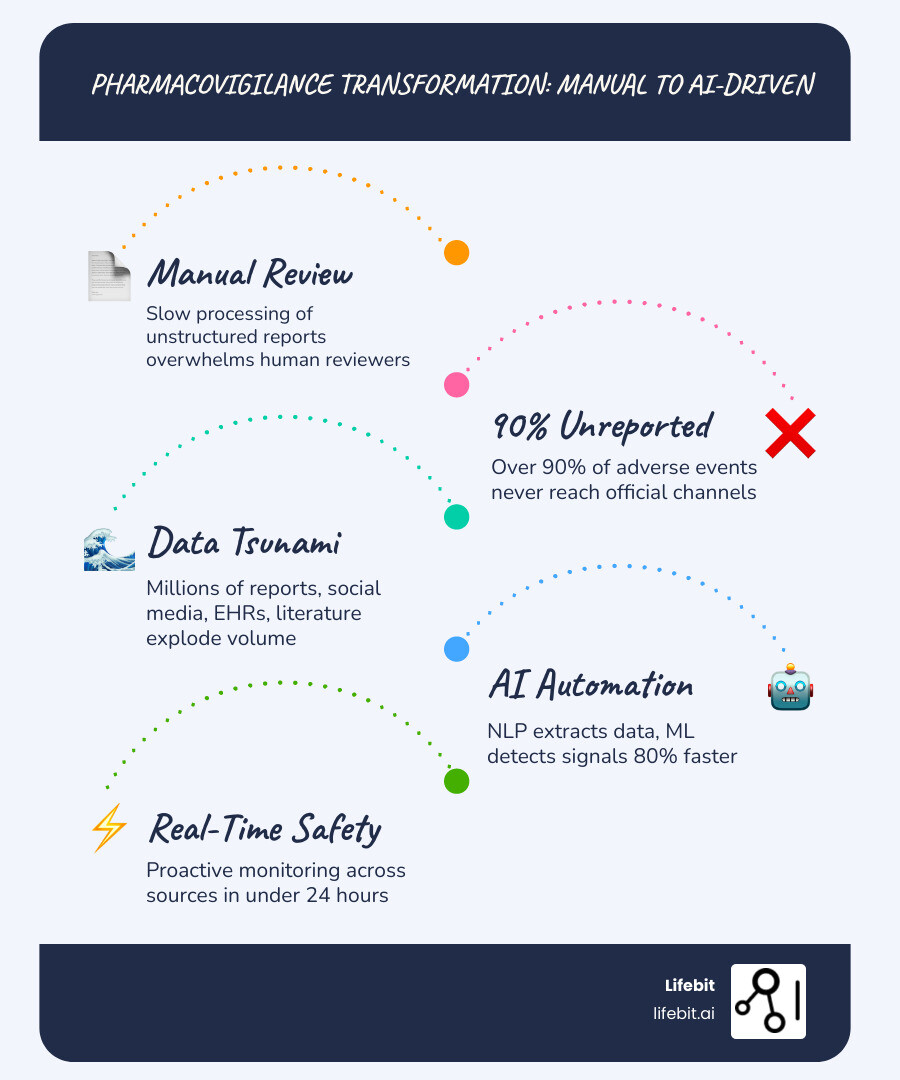
- Enables real-time surveillance — Processes adverse events in under 24 hours instead of days or weeks
- Reduces costs dramatically — Cuts case processing costs by approximately 80% while maintaining 100% audit readiness
Key Technologies Powering It:
- Machine learning for pattern recognition and predictive modeling
- Natural Language Processing (NLP) for extracting data from unstructured text
- Multi-agent AI systems for collaborative, automated workflows
- Federated analytics for secure analysis across distributed datasets without moving sensitive data
The Bottom Line: Over 90% of actual adverse events go unreported through official channels, and manual case processing consumes up to two-thirds of a typical pharmaceutical company’s pharmacovigilance resources. AI-driven safety surveillance biotech addresses both problems — catching more safety signals while dramatically reducing time and cost.
The current state of drug safety monitoring is broken. Pharmaceutical companies face an impossible challenge: regulatory deadlines demand reporting serious adverse reactions within 15 days, yet the sheer volume of data — millions of individual case safety reports, social media posts, scientific papers, and electronic health records — overwhelms manual review processes. The result? Critical safety signals slip through the cracks, costs spiral out of control, and patient safety suffers.
Traditional pharmacovigilance relies heavily on human reviewers to read through unstructured reports, code medical terms, assess causality, and identify patterns. This approach simply cannot scale. When a single safety reviewer must screen hundreds of hours of literature annually, when adverse event reports arrive in dozens of languages and formats, and when less than 5% of actual adverse events reach official reporting channels, the system fails both patients and organizations.
AI-driven safety surveillance biotech offers a fundamentally different approach. Instead of drowning in data, modern platforms use machine learning to identify patterns across millions of records, natural language processing to extract critical information from free-text reports, and federated analytics to analyze distributed datasets without compromising privacy. The technology doesn’t replace human expertise — it amplifies it, letting safety physicians focus on complex decision-making while AI handles the routine processing that consumes most resources.
The business case is equally compelling. Companies implementing AI-driven pharmacovigilance solutions report 80% improvements in case processing efficiency on average. Signal detection platforms have demonstrated 40-50% reductions in false positive signals while accelerating evaluation by 80%. One major pharmaceutical company achieved 100% detection of previously unrecognized adverse events in an audit after implementing AI-based monitoring. These aren’t marginal gains — they represent a complete transformation of how drug safety operates.
But the revolution extends beyond efficiency. AI enables truly proactive safety surveillance. Rather than waiting for spontaneous reports to trickle in, platforms now monitor social media conversations, analyze electronic health records, and screen scientific literature in real time. Machine translation handles hundreds of languages automatically. Advanced algorithms detect subtle signals that human reviewers would miss in the noise. The result is faster identification of safety concerns, more accurate risk assessment, and ultimately better protection for patients.
The regulatory landscape is evolving rapidly to accommodate these advances. The FDA’s Sentinel Initiative uses automated algorithms to proactively monitor safety across massive healthcare databases. The EMA operates centralized AI-assisted medical literature monitoring. While no PV-specific AI regulations exist yet, frameworks like Good Pharmacovigilance Practice (GVP) are adapting, and regulatory sandboxes provide pathways for innovation. Forward-thinking organizations recognize that embracing AI-driven approaches isn’t just about competitive advantage — it’s about meeting regulatory expectations in an era of exponential data growth.
As Maria Chatzou Dunford, CEO and Co-founder of Lifebit, I’ve spent over 15 years building AI and federated data platforms that transform how organizations access and analyze biomedical data. My work focuses specifically on enabling ai-driven safety surveillance biotech through secure, compliant environments that let pharmaceutical companies and regulators generate real-time evidence without moving sensitive data — addressing both the technical challenges of scale and the ethical imperatives of privacy and transparency.
Why Old-School Pharmacovigilance Is Costing You Time, Money, and Patient Safety
Let’s be honest: traditional pharmacovigilance (PV) is like trying to put out a forest fire with a water pistol. According to the European Medicines Agency (EMA), PV is the science and activities related to the detection, assessment, understanding, and prevention of adverse effects. But in the modern era, “detection” is getting harder by the second due to the sheer volume and variety of data generated across the global healthcare ecosystem.
We are currently living through a biological data tsunami. Between electronic health records (EHRs), patient forums, wearable device data, and a relentless stream of scientific literature, the volume of data is exploding at an exponential rate. For most biopharma companies, case processing activities alone consume up to two-thirds of their total PV resources. That is a massive amount of capital spent on manual data entry, administrative overhead, and repetitive tasks rather than actual safety analysis and risk mitigation.
Furthermore, the pressure from regulators is intense and unforgiving. In many jurisdictions, serious and unexpected adverse drug reactions (ADRs) must be reported within a strict 15-day window. Missing these deadlines doesn’t just result in heavy fines and regulatory warnings; it risks patient lives and causes irreparable damage to corporate reputation. When your team is stuck in manual bottlenecks—manually reading PDFs, cross-referencing spreadsheets, and chasing missing data—meeting that “15-day crunch” feels less like a standard process and more like a daily miracle.
The 90% Reporting Gap: The “Iceberg Effect” in Drug Safety
The most terrifying statistic in our industry is this: over 90% of actual adverse events go unreported in official systems. This is often referred to as the “Iceberg Effect.” If you only look at spontaneous reports (the tip of the iceberg), you are seeing less than 10% of the real-world safety picture. The vast majority of safety data remains submerged in unstructured formats.
This gap exists because the patient journey has changed. Patients don’t always call their doctors or the manufacturer when they experience a side effect. They might post about it on a specialized patient forum, mention it in an EHR note that never gets flagged for the safety department, or simply stop taking the medication without explanation. Traditional PV is fundamentally reactive; it waits for someone to fill out a specific form.
By the time a safety signal is manually detected through these traditional channels, thousands of patients may have already been affected. This is why Real-time Adverse Drug Reaction Surveillance is no longer a “nice to have”—it is a clinical, ethical, and operational necessity. Without it, we are essentially flying blind during the most critical phase of a drug’s lifecycle: its use in the general, diverse population.
Inside Lifebit’s AI-Driven Safety Surveillance Biotech: The Core Technologies
To fix a broken system, we need tools that can think, learn, and scale. At Lifebit, we’ve built an ecosystem that moves beyond simple automation into the realm of cognitive intelligence. Our approach to ai-driven safety surveillance biotech leverages a stack of high-end technologies designed to work in concert, creating a seamless pipeline from data ingestion to actionable insight.
| Feature | Manual Pharmacovigilance | Lifebit AI-Driven PV |
|---|---|---|
| Case Intake | Days of manual entry | Minutes via NLP/OCR |
| Signal Detection | Retrospective & slow | Real-time & proactive |
| False Positives | High noise volume | 40-50% reduction |
| Data Reach | Official reports only | Multi-modal (Social, EHR, Multi-omics) |
| Reporting Speed | 15-day struggle | Under 24-hour detection |
| Efficiency | Resource heavy | ~80% efficiency gain |
How Lifebit Automates Case Intake with NLP and ML
The “front door” of PV is case intake, and it is traditionally the most significant bottleneck. Every time an Individual Case Safety Report (ICSR) arrives—whether as a handwritten PDF, a complex email, or a phone transcript—it has to be parsed for the “four pillars” of a valid case: an identifiable patient, an identifiable reporter, a suspect product, and an adverse event.
Our AI for Pharmacovigilance Complete Guide explains how we use Natural Language Processing (NLP) to perform “Named Entity Recognition” (NER). The AI doesn’t just look for keywords; it understands context. It can distinguish between a patient “denying” a symptom and “experiencing” one. It automatically maps these findings to standard MedDRA (Medical Dictionary for Regulatory Activities) codes and WHODrug dictionaries. This doesn’t just save time; it eliminates the human fatigue and error inherent in manual data entry. We’ve seen organizations cut report drafting time from days to mere hours, allowing safety teams to focus on the why rather than the what.
Advanced Signal Detection: Beyond Disproportionality
Once the data is structured, the challenge shifts to finding the “signals” in the noise. Traditional methods rely on “disproportionality analysis”—looking for a statistical spike in reports for a specific drug-event pair compared to the rest of the database. The problem? This method is notoriously noisy, creating a mountain of false positives that require manual adjudication.
Our AI-driven signal detection uses sophisticated pattern recognition that looks at multi-dimensional factors: time-to-onset distributions, patient demographics, co-morbidities, and even genetic markers where available. By integrating Real-world Evidence (RWE), we can see safety signals 40-50% faster than traditional methods. We also employ Bayesian networks and machine learning classifiers to provide a quantitative score for causality, helping safety physicians prioritize the most likely risks first and reducing the time wasted on statistical artifacts.
Real Results: 80% Faster, 80% Cheaper, 100% Audit-Ready
The numbers don’t lie. When we talk about ai-driven safety surveillance biotech, we are talking about a total shift in the ROI of drug safety. Organizations using these advanced solutions have achieved:
- 80% improvement in case processing efficiency, allowing teams to handle volume surges without increasing headcount.
- 94% efficiency gains specifically in processing call center records and unstructured medical notes.
- 100% detection of previously unrecognized adverse events during third-party audits, proving that AI is often more consistent than human review alone.
The Role of the Trusted Data Lakehouse (TDL)
Central to these results is our Trusted Data Lakehouse (TDL) and R.E.A.L. (Real-time Evidence & Analytics Layer). In traditional setups, data is siloed across different departments and countries. Lifebit harmonizes data from disparate sources instantly, creating a single source of truth. This ensures that when an auditor knocks on the door, every piece of data is traceable, standardized, and ready for review. This level of Post-marketing Drug Surveillance turns a compliance headache into a strategic asset, providing a clear audit trail of how every signal was detected and evaluated.
Next-Level Literature and Social Media Monitoring
One of the biggest time-sinks in PV is literature screening. Safety reviewers often spend hundreds of hours manually checking medical journals for mentions of their products. Our AI-driven tools can scan over 8 million social and digital records and filter out roughly 66% of the irrelevant “noise” automatically.
Even more impressive: automated literature screening has been shown to reduce human review volume by over 80% while still capturing 100% of the relevant safety papers. For global companies, our automated machine translation handles hundreds of languages, ensuring that a local medical publication in Singapore or a patient forum in Brazil is monitored just as closely as a major US journal. This global reach is impossible to achieve manually without an army of linguists.
Tackling Ethics and Regulation in AI-Driven Safety Surveillance Biotech
We know the primary concern for safety officers: “Can I trust a black box with patient safety?” The answer is: you shouldn’t. That’s why we prioritize Explainable AI (XAI). Our models don’t just give you a “yes” or “no”; they show their work. They provide the reasoning, the confidence score, and the specific data evidence behind every flagged signal, ensuring that human experts remain the final decision-makers. This “Human-in-the-loop” (HITL) framework is essential for maintaining GxP compliance.
Data privacy is our other “North Star.” With regulations like GDPR and the EU AI Act classifying healthcare AI as “high-risk,” you cannot afford to move sensitive patient data across borders. Lifebit’s federated AI platform allows you to bring the analysis to the data. The data stays securely in its original location (whether in a hospital in Israel, a research center in New York, or a genomic lab in London), while the AI learns from it. This “federated governance” is the only way to scale global safety surveillance while remaining 100% compliant with local data sovereignty laws.
How Regulators Are Shaping the Future of AI-Driven Drug Safety
Regulators are no longer the “brakes” on innovation; they are becoming the “engine.” The FDA and EMA are actively Harnessing AI to Improve Drug Safety and Regulation. We are seeing the rise of “regulatory sandboxes” where companies can test AI models in a safe, collaborative environment with the oversight of health authorities.
The goal is to move toward a future where “Good Pharmacovigilance Practice” (GVP) includes automated, near-real-time monitoring as a standard requirement. By documenting AI model design, inputs, and human oversight now, you are future-proofing your organization for the next decade of regulatory evolution. The shift from “periodic” reporting to “continuous” monitoring is already underway, and AI is the only technology capable of supporting that transition.
What’s Next: Real-Time Surveillance and Multi-Modal Fusion
The future of ai-driven safety surveillance biotech is incredibly exciting and moves beyond simple text analysis. We are moving toward “multi-modal fusion”—the ability to combine ICSRs with EHRs, insurance claims, and even multi-omic data (like genomics and proteomics).
Imagine a system that doesn’t just tell you a drug causes a side effect, but tells you which specific patients are at risk based on their unique genetic makeup or metabolic profile. This is the ultimate goal of Real-time Pharmacovigilance: moving from reactive monitoring to predictive, personalized safety. We are entering an era where we can prevent adverse events before they happen by identifying high-risk phenotypes in the real-world population.
Generative AI and the Future of Safety Reporting
Generative AI will also play a transformative role, not by making autonomous medical decisions, but by automating the drafting of complex, data-heavy documents like Periodic Safety Update Reports (PSURs) and Development Safety Update Reports (DSURs). We’ve already seen AI automate ~70% of the content assembly for these reports, cutting drafting time from weeks to hours. This allows safety physicians to spend their time on the interpretation of the data and the development of risk minimization strategies, rather than the tedious task of document formatting and data aggregation. The result is a more agile, more responsive, and ultimately safer pharmaceutical industry.
Frequently Asked Questions about AI in Drug Safety
How does Lifebit’s AI reduce false positive safety signals?
Traditional methods often flag “noise”—random clusters of events that aren’t actually caused by the drug but appear statistically significant. Our AI-driven Pharmacovigilance Solutions use advanced pattern recognition and Bayesian networks to filter out this noise. By analyzing reporting rates, time-to-onset, patient histories, and confounding factors like concomitant medications, we achieve a 40-50% reduction in false positives compared to traditional disproportionality methods.
Can AI replace human safety physicians in PV?
Absolutely not. We believe in a “human-in-the-loop” model. AI is a force-multiplier; it handles the “heavy lifting” of data processing, filtering, and initial signal detection. This allows human safety physicians to focus their expertise on high-risk, complex causality assessments and strategic risk management. Think of Drug Safety AI as a high-powered microscope—it helps the doctor see better and find things they might have missed, but the doctor still makes the final diagnosis and clinical decision.
What are the main regulatory hurdles for AI-driven PV?
The biggest hurdles are transparency, validation, and data lineage. Regulators need to know exactly how an AI model reached its conclusion. Our AI Pharmacovigilance Guide 2025 emphasizes the importance of using Explainable AI (XAI) and maintaining a clear data lineage. As long as you can demonstrate robust model validation, consistent performance, and rigorous human oversight, you can meet GxP and FDA expectations. The key is to treat the AI as a “validated system” similar to any other software used in clinical trials.
How does federated learning protect patient privacy?
Federated learning allows the AI model to be trained on data without that data ever leaving its original secure environment. Instead of moving sensitive patient records to a central server, the model “travels” to the data, learns the necessary patterns, and then sends only the mathematical insights back to the central system. This ensures 100% compliance with GDPR, HIPAA, and other local privacy laws while still allowing for global-scale safety analysis.
Conclusion
The era of manual, reactive drug safety is coming to an end. To protect patients in a world of complex therapies and massive data, we must embrace ai-driven safety surveillance biotech. By leveraging Lifebit’s federated AI platform, you can access global biomedical data securely, detect risks in real time, and slash your operational costs by up to 80%.
We are here to help you bridge the gap between “data overload” and “actionable insights.” Whether you are a small biotech or a global pharmaceutical giant, the path to proactive safety starts with the right technology.
Ready to transform your pharmacovigilance? Learn more about Lifebit’s regulatory compliance and RWE capabilities and join the revolution in real-time drug safety.