

How to Integrate Siloed Healthcare Data: A Step-by-Step Guide for Data Leaders
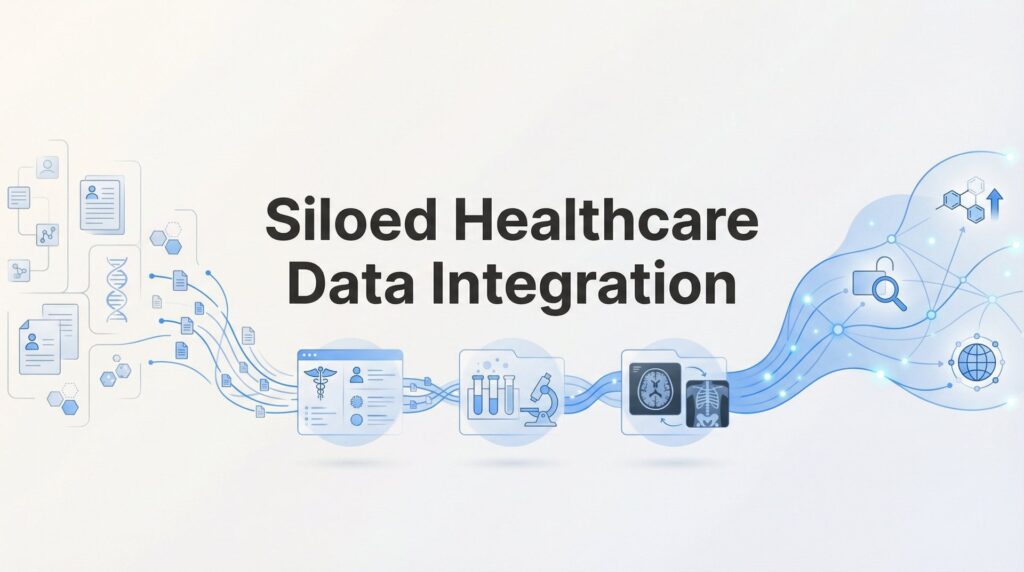
Your genomic data lives in one system. Clinical records sit in another. Real-world evidence is scattered across three departments. Sound familiar?
Siloed healthcare data isn’t just an IT headache. It’s costing you months of research time, millions in duplicate efforts, and potentially life-saving insights that never surface.
The problem runs deeper than inconvenience. When your EHR system can’t talk to your laboratory information system, and neither connects to your imaging archives, you’re essentially flying blind. Researchers spend weeks hunting down data that should be instantly queryable. Clinical teams make decisions without the full patient picture. Drug discovery pipelines stall because the genomic data and clinical outcomes live in separate universes.
Here’s what makes this particularly frustrating: the data exists. It’s sitting in your infrastructure right now. But it might as well be locked in separate vaults with no master key.
This guide walks you through a proven process to integrate siloed healthcare data without moving sensitive information, violating compliance requirements, or rebuilding your entire infrastructure. Whether you’re a Chief Data Officer managing national health records or an R&D leader trying to accelerate drug discovery, these steps work at any scale.
We’re not talking theory here. This is the operational playbook used by organizations managing hundreds of millions of health records across multiple countries and regulatory frameworks.
By the end, you’ll have a clear roadmap to transform fragmented data into a unified, queryable asset while maintaining full regulatory compliance. No hand-waving about “digital transformation.” Just concrete steps you can start implementing this week.
Step 1: Map Your Data Landscape and Identify Integration Priorities
You can’t integrate what you can’t see. The first step is building a complete inventory of every data source in your organization.
Start with the obvious systems: your EHR platforms, laboratory information systems, imaging archives (PACS), and claims databases. But don’t stop there. Research repositories, clinical trial management systems, patient-reported outcomes platforms, and even departmental spreadsheets all contain valuable data.
For each data source, document three critical elements:
Data type and content: Is this genomic sequencing data? Clinical notes? Structured lab results? Radiology images? Claims and billing records? Be specific about what information each system actually contains.
Technical specifications: What format is the data in? Does it use HL7 messaging? FHIR resources? DICOM for imaging? Custom database schemas? Document the standards in use and any proprietary formats you’ll need to handle.
Access controls and sensitivity: Who currently has access? What regulatory frameworks govern this data? Is it HIPAA-protected? Does it fall under GDPR? Are there additional institutional review board restrictions?
Here’s where most organizations make their first mistake: they try to integrate everything at once. Don’t do this. Instead, identify your highest-value integration opportunities.
Ask yourself: where would combining datasets yield immediate research or operational ROI? Maybe linking genomic data with clinical outcomes would accelerate your precision medicine program. Perhaps connecting claims data with clinical records would reveal care quality gaps. Or integrating imaging archives with pathology results could improve diagnostic accuracy.
Prioritize based on three factors: potential impact, technical feasibility, and stakeholder alignment. The sweet spot is high-impact use cases where you already have stakeholder buy-in and the technical complexity is manageable.
Document everything in a data catalog that becomes your single source of truth. This isn’t busy work—it’s the foundation for every integration decision you’ll make.
Your success indicator: You have a complete data map showing all sources, data owners, current formats, quality issues, and a prioritized list of integration targets with clear business justification for each.
Step 2: Establish Your Governance Framework Before Touching Data
This is the step that separates successful integrations from compliance disasters. Governance isn’t paperwork you do after the fact. It’s the foundation you build before touching a single data element.
Start by defining clear data ownership. For every dataset you identified in Step 1, assign a data steward who has authority to make decisions about access and use. This person isn’t necessarily the IT administrator—they’re the domain expert who understands the data’s context and appropriate uses.
Next, create your access policy framework. Who can see what data under which circumstances? This gets complex fast in healthcare because different data types carry different sensitivity levels and regulatory requirements.
Build tiered access levels that align with both data sensitivity and user roles. A researcher studying population health trends needs different access than a clinician treating individual patients. Your governance framework should make these distinctions explicit.
Align with regulatory requirements from day one. If you’re handling US patient data, HIPAA compliance isn’t optional. European data means GDPR applies. Government health agencies need FedRAMP authorization for cloud deployments. Understanding healthcare data compliance requirements is essential before proceeding.
Create clear approval workflows for integrated datasets. When someone wants to combine genomic data with clinical records for a new research project, what’s the approval process? Who signs off? What documentation is required? What happens if the request is denied?
Build audit trail requirements into your framework. You need to know who accessed what data, when, for what purpose, and what they did with it. This isn’t paranoia—it’s regulatory compliance and organizational accountability.
Here’s the critical part: get this documented and approved by all stakeholders before you integrate anything. That means legal, compliance, data owners, IT security, and institutional leadership all sign off.
This process feels slow. It is slow. But skipping it or doing it halfway creates massive problems later. You’ll end up with integrated data nobody can legally access, or worse, compliance violations that shut down your entire program.
Your success indicator: You have a documented governance policy that’s been reviewed and approved by legal, compliance, and all relevant data stakeholders. The policy clearly defines ownership, access controls, approval workflows, and audit requirements.
Step 3: Choose an Integration Architecture That Doesn’t Require Data Movement
Here’s where we challenge the conventional approach to data integration. The traditional model says: copy all your data into a central warehouse, harmonize it there, and let users query the warehouse.
That approach has a fatal flaw when you’re dealing with sensitive healthcare data. The moment you copy patient records out of their secure source system, you’ve multiplied your compliance risk, expanded your attack surface, and created synchronization headaches.
There’s a better way: federated architecture. The data stays exactly where it is. You bring the analysis to the data instead of bringing the data to the analysis.
Think of it like this: instead of photocopying every document in your organization and storing the copies in a central filing room, you create a system that can query documents wherever they live and synthesize the results. The originals never move. This approach enables privacy-preserving statistical analysis across distributed datasets.
For healthcare data, this approach eliminates your biggest integration risks. Genomic data stays in the genomics platform. Clinical records stay in the EHR. Imaging stays in PACS. But authorized users can run queries that span all of them.
Evaluate your infrastructure requirements carefully. Federated architectures need robust network connectivity between data sources. You need compute resources at each data location to process queries locally. You need standardized APIs that allow your federation layer to communicate with each source system.
Consider your cloud deployment options. Can you deploy in your own cloud environment, or are you locked into a vendor’s infrastructure? Organizations handling government health data or operating under strict sovereignty requirements need to maintain control of where and how their infrastructure runs.
Assess vendor lock-in risks honestly. If your integration platform is proprietary and can only run in one vendor’s cloud, you’ve just handed them significant leverage over your most critical infrastructure. Look for solutions you can deploy in your own environment—AWS, Azure, Google Cloud, or on-premises—whatever meets your compliance and operational requirements.
The alternative—centralized integration—can work for less sensitive data or when you have iron-clad compliance infrastructure for a central repository. But for most healthcare organizations dealing with regulated patient data across multiple systems, federated architecture dramatically reduces risk while maintaining analytical capability.
Your success indicator: You’ve documented your architecture decision with clear rationale tied to your compliance requirements, data sensitivity levels, and operational needs. Stakeholders understand why this approach was chosen over alternatives.
Step 4: Harmonize Data Standards Across Sources
You’ve mapped your data. You’ve locked down governance. You’ve chosen your architecture. Now comes the hard part: making data from different systems actually mean the same thing.
This is where most integration projects stall. It’s one thing to connect systems technically. It’s entirely different to ensure that “diagnosis date” in System A means the same thing as “diagnosis date” in System B.
Start by selecting a common data model. For observational health data, OMOP has become the gold standard. It provides standardized schemas for clinical concepts, consistent vocabulary mappings, and a proven framework used by research networks worldwide. Understanding healthcare data integration standards is critical for this phase.
But here’s the reality: mapping your source data to any common model is complex, time-consuming work. You’re not just converting formats—you’re resolving semantic inconsistencies that have accumulated over years.
One system records blood pressure as two separate fields. Another stores it as a single text string. A third uses different units of measurement. They’re all capturing the same clinical concept, but the data looks completely different.
Create detailed mapping specifications for each source system. Every data element in your source needs a corresponding element in your target schema. Document the transformation logic. If you’re converting units, show the formula. If you’re splitting or combining fields, explain the rules.
Address terminology differences systematically. Different systems use different coding systems—ICD-10, SNOMED CT, LOINC, RxNorm. Your common data model needs to handle these variations and map them to standardized vocabularies.
Here’s where automation becomes critical. Manual mapping of large healthcare datasets is measured in months or years. Modern approaches use AI for data harmonization to accelerate this process dramatically—identifying patterns, suggesting mappings, and flagging inconsistencies for human review.
Implement automated quality checks throughout your harmonization process. Test that mapped values fall within expected ranges. Verify that required fields are populated. Check that relationships between data elements remain valid after transformation.
Build validation queries that compare results across previously siloed datasets. If you’re integrating lab results from three different systems, run the same analysis on each source independently, then on the integrated dataset. The results should align.
Your success indicator: Test queries return consistent, accurate results across previously siloed datasets. Your mapping documentation is complete enough that someone could reproduce your harmonization process. Quality metrics show data integrity is maintained through the transformation.
Step 5: Deploy Secure Analysis Environments for Integrated Data Access
You’ve integrated the data. Now you need to give people access without compromising security or compliance. This is where trusted research environments come in.
Think of a trusted research environment as a secure workspace where authorized users can analyze integrated data without ever extracting it. They can run queries, build models, generate visualizations—all within a controlled environment that maintains compliance.
Configure role-based access controls that align with the governance framework you built in Step 2. A principal investigator gets different permissions than a data analyst. A clinician reviewing patient cohorts has different access than a researcher studying population trends.
The key is granular control. Users should access only the data they need for their specific purpose. If someone is studying treatment outcomes for a particular condition, they don’t need access to unrelated patient records. A secure healthcare data platform makes this level of control possible.
Implement automated disclosure controls for anything leaving the secure environment. When a researcher wants to export analysis results, those outputs need to be screened for potential patient re-identification risks. Small cell sizes get suppressed. Direct identifiers get flagged. Aggregate statistics get reviewed.
This is where many organizations struggle. Manual review of every output creates bottlenecks that slow research to a crawl. But automated disclosure control—using AI to identify and mitigate re-identification risks—allows you to maintain security without sacrificing speed.
Enable collaboration tools that work within your security constraints. Researchers need version control for their code. Teams need shared workspaces. Projects need reproducible workflows. All of this can happen inside the secure environment.
Set up monitoring and audit logging for all activities within the environment. Who logged in? What data did they access? What analyses did they run? What outputs did they generate? Your audit trail should answer all of these questions.
Provide clear documentation and training for users. The most secure environment in the world is useless if people can’t figure out how to work in it. Create guides, run training sessions, and establish support channels for users who need help.
Your success indicator: Authorized users can successfully run cross-dataset analyses within the secure environment. Access controls are enforced automatically. Audit logs capture all relevant activities. Users report that the environment supports their work without creating unnecessary friction.
Step 6: Validate Integration Quality and Monitor Ongoing Performance
Integration isn’t a one-time event. It’s an operational capability that requires continuous validation and monitoring.
Start with validation queries that compare integrated results against known benchmarks from your source systems. If you know System A has 10,000 patients with diabetes, and your integrated dataset shows 8,000, something went wrong in the integration process.
Run the same analytical queries on source data and integrated data. Results should match. Discrepancies indicate mapping errors, data loss during transformation, or logical errors in your integration pipeline.
Establish data quality metrics and track them continuously. Completeness: what percentage of expected records made it through integration? Consistency: do related data elements maintain their relationships? Accuracy: do values fall within expected ranges? Timeliness: how fresh is the integrated data compared to sources?
Create monitoring dashboards that surface quality issues quickly. When completeness drops below threshold, you need to know immediately. When consistency checks fail, someone needs to investigate. Automated alerts beat manual checks every time.
Build feedback loops so data stewards can flag and resolve issues. The people who know the data best should have a way to report problems: “This diagnosis code mapping looks wrong” or “These lab values seem out of range.” Capture that feedback and route it to the right people. Implementing AI-enabled data governance can streamline these feedback mechanisms.
Document your entire integration pipeline for reproducibility and regulatory audits. When an auditor asks how you transformed data from System A, you should be able to show them the exact mapping logic, quality checks, and validation results.
Version control your integration code and configurations. When you update a mapping or modify transformation logic, track what changed, why it changed, and who approved the change. This creates an audit trail and allows you to roll back if an update causes problems.
Your success indicator: Quality metrics consistently meet your predefined thresholds. Your audit trail demonstrates compliance with all relevant regulations. Data stewards and end users report confidence in the integrated data. You can reproduce any integration result on demand.
Putting It All Together
Integrating siloed healthcare data isn’t a one-time project. It’s an operational capability you build systematically.
Follow these steps in order: map your landscape, lock down governance, choose the right architecture, harmonize standards, deploy secure environments, and validate continuously. Skip a step or do them out of sequence, and you’ll create problems that are harder to fix later.
Here’s your quick-reference checklist:
Data inventory complete: All sources mapped with priority integration targets identified based on business value.
Governance framework documented and approved: Clear ownership, access policies, approval workflows, and audit requirements in place.
Architecture selected: Federated approach recommended for sensitive healthcare data to eliminate movement risks.
Common data model implemented: OMOP or equivalent standard in place with automated quality checks throughout the harmonization process.
Secure analysis environments deployed: Trusted research environments with proper access controls and automated disclosure protection.
Validation metrics established and monitoring active: Quality dashboards, feedback loops, and audit trails operational.
The organizations seeing the fastest results aren’t waiting for perfect data. They’re building the infrastructure to integrate progressively, starting with their highest-value use cases.
They’re also not doing this alone. The technical complexity, compliance requirements, and operational challenges of healthcare data integration are significant. The right platform handles the heavy lifting—automated harmonization, federated architecture, built-in compliance controls, and secure analysis environments—so you can focus on extracting insights instead of wrestling with infrastructure.
Your siloed data represents untapped potential. Every day it remains fragmented is another day of missed insights, duplicated efforts, and delayed discoveries. The question isn’t whether to integrate—it’s whether you have the right approach to do it securely, compliantly, and at scale.
Get Started for Free and see how modern data integration can transform your fragmented healthcare data into a unified, queryable asset without compromising security or compliance.