

Singapore AI Research Week and Beyond
Why Singapore AI Research Is Setting the Global Standard
Singapore AI research has emerged as a cornerstone of the nation’s change into a global AI powerhouse. In an era where artificial intelligence is redefining the boundaries of economic productivity and scientific discovery, Singapore has positioned itself not merely as a consumer of technology, but as a primary architect of its future. The city-state’s strategy is characterized by a rare blend of aggressive public funding, meticulous regulatory foresight, and a unique “living laboratory” approach that allows for rapid prototyping in a real-world urban environment.
Key highlights of the current ecosystem include:
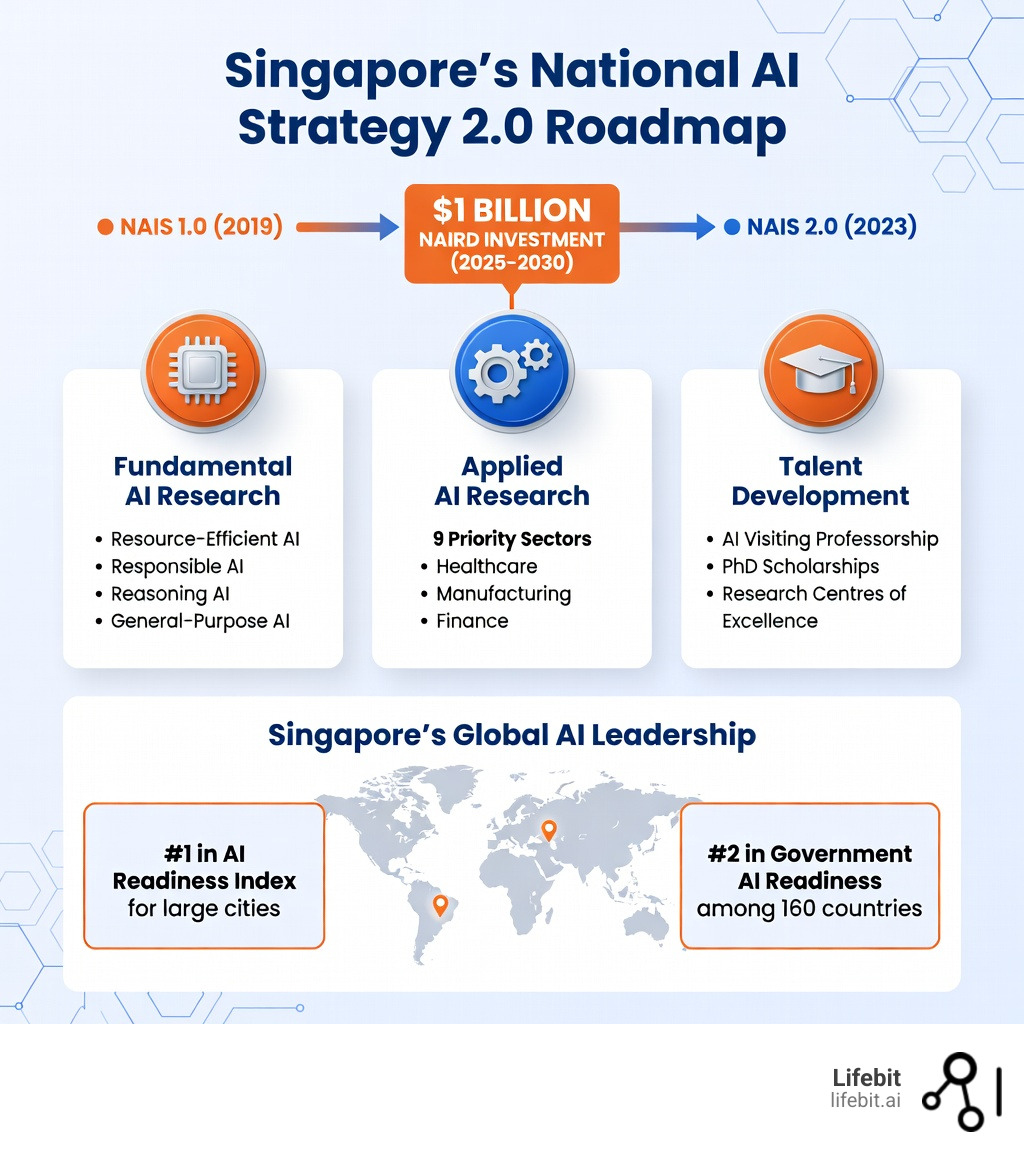
- $1 billion investment over five years (2025-2030) under the National AI Research and Development (NAIRD) Plan, representing a significant increase from previous funding cycles.
- Three core pillars: Fundamental AI Research, Applied AI Research, and Talent Development, ensuring a balanced approach between theoretical breakthroughs and commercial utility.
- 40+ events at Singapore AI Research Week 2026 (January 19-27), running alongside the 40th AAAI Conference, which will bring the world’s leading AI minds to the island.
- 60+ AI Centres of Excellence launched by global tech firms (such as Google, Microsoft, and NVIDIA) in partnership with the Singapore government to co-create industry-specific solutions.
- Nine priority sectors targeted under the National AI Strategy 2.0, including healthcare, finance, manufacturing, and sustainability, ensuring that AI development serves the broader economy.
- #1 ranking in Oliver Wyman Forum’s AI Readiness Index for large cities (2022), reflecting the city’s infrastructure and human capital.
- #2 ranking for government AI readiness among 160 countries (Oxford Insights, 2022), highlighting the efficiency of public sector adoption.
Singapore’s approach is unique. Rather than competing head-to-head with superpowers like the US and China in a “compute arms race,” the city-state has built a comprehensive ecosystem that addresses every stage of AI development—from fundamental research to real-world deployment. The government acts as policymaker, steward, and early adopter, creating demand through public procurement while nurturing talent and mitigating risks through frameworks like the Model AI Governance Framework (MAGF).
The results speak for themselves. Singapore now hosts one of the region’s densest concentrations of data center capacity, has attracted top-tier AI startups and research teams, and has deployed AI across sectors ranging from airport operations at Jewel Changi to precision medicine initiatives analyzing genomic data from multi-ethnic Asian cohorts. This focus on “AI for Public Good” ensures that technological advancement translates into tangible improvements in citizen well-being and national resilience.
I’m Maria Chatzou Dunford, CEO and Co-founder of Lifebit, with over 15 years of experience in computational biology, AI, and health-tech entrepreneurship. I’ve closely followed Singapore AI research developments, particularly in genomics and federated data analysis, where Singapore’s emphasis on secure, privacy-preserving research environments aligns perfectly with the future of global biomedical collaboration. The nation’s ability to harmonize data accessibility with stringent privacy protections is a model for the rest of the world.
Singapore AI research terms to know:
The $1 Billion NAIRD Plan: Scaling Singapore AI Research
Singapore isn’t just participating in the AI race; it is investing heavily to lead it. The Singapore Government has committed an additional investment of over S$1 billion over five years, from 2025 to 2030, under the National AI Research and Development (NAIRD) Plan. This follows an initial public R&D investment of over $500 million between 2019 and 2023, signaling a massive scale-up in ambition. This capital is not just for infrastructure; it is a strategic bet on the intellectual property that will drive the next century of economic growth.

The NAIRD Plan is the engine room of Singapore AI research, designed to propel the nation from a technology adopter to a global innovator. Managed by the National Research Foundation (NRF), the plan focuses on three strategic pillars that address the entire lifecycle of innovation:
- Fundamental AI Research: Establishing world-class Research Centres of Excellence (RCEs) to tackle long-term, high-impact questions. These centers, such as those hosted at the National University of Singapore (NUS) and Nanyang Technological University (NTU), focus on the “hard problems” of AI that may not have immediate commercial payoffs but are essential for long-term sovereignty.
- Applied AI Research: Driving adoption across nine priority sectors, including healthcare, finance, and sustainability. This involves the “AI for Science” initiative, which uses AI to accelerate discoveries in materials science, climate modeling, and drug discovery.
- Talent Development: Building a sustainable pipeline of experts. Singapore aims to triple its AI practitioner pool to 15,000, including researchers, engineers, and data scientists. This includes the “AI Visiting Professorship” and enhanced PhD scholarships to ensure the brightest minds are working on Singapore’s national challenges.
The NAIRD Plan focus areas are specifically chosen to address both global challenges and Singapore’s unique constraints, such as land and resource scarcity. By focusing on public R&D, the government ensures that breakthroughs contribute to the global knowledge commons while securing Singapore’s competitive edge in high-value industries.
Breakthroughs in Singapore AI Research Focus Areas
Within the NAIRD framework, four specific research domains have been prioritized to ensure that Singapore AI research remains at the cutting edge of the global conversation:
- Resource-efficient AI: This is a strategic necessity for Singapore. As a small nation with a high density of data centers, Singapore must develop models that require less compute power, energy, and water. This includes research into “Small Language Models” (SLMs) and neuromorphic computing. Success here benefits not just Singapore, but any organization globally facing ESG (Environmental, Social, and Governance) constraints.
- Responsible AI: Singapore is a global leader in AI ethics. Research here focuses on building AI that is fair, explainable, and safe. This involves technical research into bias detection in multi-ethnic datasets and the development of “guardrails” to prevent the hallucination or malicious use of Large Language Models (LLMs).
- Reasoning AI: Moving beyond simple pattern recognition and statistical correlation, this area explores how AI can perform complex logical reasoning. This is essential for high-stakes decision-making in fields like precision medicine, structural engineering, and autonomous maritime navigation, where a “black box” approach is insufficient.
- General-purpose AI: Research into foundation models that can be adapted for a wide variety of downstream tasks. A prime example is the SEA-LION (Southeast Asian Languages In One Network) model, an LLM specifically trained to understand the linguistic and cultural nuances of Southeast Asia, a region often overlooked by Western-centric models.
For those of us in the biomedical sector, these breakthroughs are particularly exciting when applied to Singapore clinical data. The ability to run reasoning-based AI on resource-efficient architectures allows us to open up insights from massive datasets without the prohibitive costs or environmental impact of traditional “brute-force” computing.
Nurturing Global Talent and Expertise
A research ecosystem is only as strong as its people. Singapore’s talent strategy is a “triple-helix” model involving academia, government, and industry. Key initiatives include:
- AI Visiting Professorship (AIVP): Launched in 2024, this initiative attracts top-tier overseas researchers to collaborate on Singapore’s national AI agenda. These professors spend significant time in Singapore, mentoring local researchers and bridging the gap between global breakthroughs and local applications.
- Research Centres of Excellence (RCEs): These centers provide a stable, multi-year funding environment for teams to pursue “moonshot” research goals. They act as magnets for international talent who want to work on high-impact projects with minimal bureaucratic friction.
- Accelerated PhD Programs: Singapore is doubling down on its domestic talent, providing enhanced scholarships and post-doctoral opportunities. The goal is to create a generation of “AI-native” researchers who can lead both in academia and in the burgeoning private tech sector.
Singapore AI Research Week: A Global Stage for Innovation
If the NAIRD Plan is the engine, Singapore AI Research Week (SGAIRW) is the showcase. From 19 to 27 January 2026, Singapore’s AI ecosystem will host a series of events alongside the prestigious 40th Association for the Advancement of Artificial Intelligence (AAAI) conference. This alignment is intentional, positioning Singapore as the literal center of the global AI conversation and providing a platform for local researchers to engage with the world’s most cited AI scholars.
This isn’t just a series of academic talks; it’s a nationwide mobilization of the tech community. The 2026 lineup features 40 events organized by over 25 partners, including universities, startups, and corporate labs. You can join the 2026 Singapore AI Research Week lineup here to experience everything from deep-dive technical discussions on quantum-classical AI hybrids to tours of state-of-the-art robotics labs in the Jurong Innovation District.
The inaugural SGAIRW in 2025 featured 31 events and attracted thousands of international delegates, proving the immense appetite for a dedicated week of AI-focused collaboration in Asia. By hosting the AAAI conference, Singapore joins the ranks of global tech hubs like New York, London, and San Francisco as a premier destination for AI thought leadership.
Driving Impact Through Singapore AI Research Partnerships
Singapore’s success is built on a “whole-of-government” approach that breaks down silos between departments. The Industry Transformation Maps (ITMs), a $4.5 billion program, provide a systematic framework for integrating AI into 23 different industries. These sectors contribute to a staggering 80% of Singapore’s GDP, making the successful integration of AI a matter of national economic survival.
| Feature | NAIS 1.0 (2019) | NAIS 2.0 (2023) |
|---|---|---|
| Primary Goal | Establish AI foundations and 5 national projects | Scale AI for social and economic impact |
| Focus | Technology adoption in specific sectors | “Triple-helix” collaboration and global leadership |
| Talent Strategy | Building initial local capacity | Attracting global stars and scaling R&D teams |
| Governance | Introducing ethical frameworks (MAGF) | Implementing sector-specific risk mitigation |
| Compute Access | Limited to specific research clusters | National AI Compute Grid for all researchers |
This evolution shows a shift from “how do we use AI?” to “how do we lead the world in AI innovation?” By fostering partnerships between public research and the 60+ AI Centres of Excellence launched by tech firms, Singapore ensures that research doesn’t stay in the lab—it moves into the economy. For example, the AI Trailblazers initiative, a collaboration between the Ministry of Communications and Information (MCI), Digital Industry Singapore (DISG), and Google Cloud, has already helped over 100 organizations develop generative AI solutions in record time.
Furthermore, the Generative AI Sandbox for SMEs allows smaller local businesses to experiment with AI tools without the high upfront costs. This ensures that the benefits of Singapore AI research are distributed across the entire economy, from multinational corporations to the “mom-and-pop” shops that form the backbone of the local community.
Governing the Machine: Risk Mitigation and Ethical Frameworks
In Singapore, innovation does not come at the expense of safety. The nation has pioneered some of the world’s most respected governance frameworks to ensure that Singapore AI research is trustworthy, responsible, and human-centric. This “pro-innovation, pro-safety” stance has made Singapore a preferred destination for companies looking to deploy AI in highly regulated sectors like finance and healthcare.
The Model AI Governance Framework (MAGF), first introduced in 2019 and updated for Generative AI in 2024, provides detailed, ready-to-implement guidance for organizations to address ethical issues. Unlike rigid regulations that can stifle innovation, the MAGF is a “living document” that evolves alongside the technology. This is complemented by the FEAT Principles (Fairness, Ethics, Accountability, and Transparency) specifically designed for the financial sector, ensuring that AI-driven credit scoring or trading algorithms do not introduce systemic bias.
Our commitment to safety is legally backed by the Cybersecurity Act (2018), which identifies 11 critical information infrastructure sectors, and the Personal Data Protection Act (PDPA). For those working in the sensitive intersection of technology and health, understanding AI healthcare in Singapore requires navigating these robust layers of protection. Singapore has also launched AI Verify, the world’s first AI governance testing framework and software toolkit, which allows developers to conduct self-assessments on their AI models to ensure they meet international standards of fairness and transparency.
Addressing Social and Security Risks
Singapore’s risk governance is pragmatic and proactive, addressing the “dark side” of AI before it becomes a crisis. We address several key dimensions of risk:
- Social Risks: To combat “frictional unemployment” caused by AI automation, the government has redesigned the SkillsFuture program. This includes the “SkillsFuture Level-Up Programme” for mid-career individuals, providing clearer AI learning pathways and substantial subsidies for training. We also provide tax deductions under the Enterprise Innovation Scheme, capped at S$50,000 per year for AI expenditures in 2027 and 2028, encouraging companies to invest in their workers’ AI literacy.
- Technological Risks: The AI Verify Foundation was established to harness the collective expertise of the global open-source community. By making testing tools open-source, Singapore is helping to set global standards for bias detection and explainability.
- Security Risks: Systems like the Risk Assessment and Horizon Scanning (RAHS) have been used since 2014 for public security threat assessment. More recently, the Singapore Maritime Crisis Centre has deployed AI for real-time ship threat detection, analyzing thousands of data points to identify anomalous behavior in one of the world’s busiest shipping lanes.
- Information Integrity: With the rise of deepfakes, Singapore is investing in research to detect AI-generated content. The National Research Foundation has funded projects specifically aimed at identifying manipulated media to protect the integrity of public discourse and democratic processes.
By balancing these risks, Singapore avoids the “wild west” of unregulated AI while steering clear of the stifling effects of over-regulation. This balanced approach is why many global firms choose Singapore as their regional headquarters for AI deployment.
Real-World Applications: From Smart Airports to Precision Medicine
The ultimate proof of Singapore AI research lies in its applications. Walk through Changi Airport, and you’ll see AI in action—from automated baggage handling systems that predict potential jams to security robots at Jewel that use computer vision to monitor for suspicious activity. But some of the most profound impacts are happening in the field of human health, where AI is literally saving lives.
The SingHealth public healthcare group has partnered with global leaders to accelerate the genetic understanding of diseases. One standout project is the HELIOS Study, a population cohort study led by NTU’s Lee Kong Chian School of Medicine. This study forms part of the SG100K project, which aims to sequence the genomes of 100,000 Singaporeans. This is one of the most ambitious genomic projects in Asia, providing a high-resolution map of the genetic diversity of the region.
Accessing and analyzing Singapore biomedical data is critical for identifying why certain diseases affect Asian populations differently. Because Asian real-world data is historically under-represented in global research (which has been 80% focused on European-ancestry populations), Singapore’s cohorts are goldmines for precision medicine. Researchers are using AI to sift through this data to find genetic markers for conditions like Asian-specific cancers and cardiovascular diseases.
Changing Healthcare with Genomic Insights
Precision medicine is no longer a futuristic concept in Singapore; it is a current reality being integrated into the public health system. By leveraging multi-ethnic cohorts, researchers can develop:
- Predictive Care: Identifying individuals at high risk for chronic conditions like diabetes or heart disease years before symptoms appear. AI models can analyze a combination of genetic, lifestyle, and clinical data to provide a personalized “risk score.”
- Pharmacogenomics: Tailoring drug treatments based on a patient’s genetic profile. This ensures that patients receive the most effective medication at the correct dosage, minimizing the risk of adverse drug reactions, which are a leading cause of hospitalizations.
- AI-Driven Diagnostics: In Singapore’s polyclinics, AI is being used to screen for diabetic retinopathy by analyzing retinal images. This allows for early intervention and prevents blindness, while freeing up specialists to focus on more complex cases.
Finding the right partners is essential for this work. You can find AI healthcare companies in Singapore that specialize in genomic data to see how this research is being commercialized. At Lifebit, we believe the future of this research lies in federated AI, where researchers can analyze data securely without it ever leaving its host environment. This model perfectly complements Singapore’s strict data sovereignty and security standards, allowing for global collaboration without compromising the privacy of Singaporean citizens.
Beyond Healthcare: AI in the Maritime and Urban Sectors
Singapore’s AI ambitions extend to its status as a global maritime hub. The Maritime and Port Authority of Singapore (MPA) uses AI to optimize vessel traffic management, reducing wait times and fuel consumption for the thousands of ships that pass through the Singapore Strait. Similarly, in the urban sector, AI is used to optimize the cooling systems of HDB (Housing and Development Board) blocks, a critical application in a tropical climate where air conditioning accounts for a significant portion of energy use. These applications demonstrate that Singapore AI research is deeply rooted in the practical needs of a modern, sustainable city-state.
Frequently Asked Questions about Singapore AI Research
What is the National AI Research and Development (NAIRD) Plan?
The NAIRD Plan is a strategic government initiative investing over S$1 billion from 2025 to 2030 to boost Singapore’s public AI research capabilities. It focuses on fundamental research (like resource-efficient AI), applied AI for industry adoption, and nurturing global talent through initiatives like the AI Visiting Professorship.
How does Singapore manage the ethical risks of AI?
Singapore uses a “soft law” approach centered on the Model AI Governance Framework (MAGF) and the FEAT Principles. These provide guidelines for fairness, accountability, and transparency. This is supported by the AI Verify toolkit for technical testing and hard regulations like the PDPA and the Cybersecurity Act to ensure data privacy and system security.
When is the next Singapore AI Research Week?
The next major Singapore AI Research Week is scheduled for 19 to 27 January 2026. It will run alongside the 40th Association for the Advancement of Artificial Intelligence (AAAI) conference and feature over 40 ecosystem events, including workshops, lab tours, and startup showcases.
What is the SEA-LION model?
SEA-LION (Southeast Asian Languages In One Network) is a family of Large Language Models (LLMs) developed by AI Singapore. It is specifically designed to be smaller, more efficient, and better at understanding the diverse languages and cultural contexts of Southeast Asia compared to Western-centric models like GPT-4.
How can international researchers collaborate with Singapore?
International researchers can collaborate through the AI Visiting Professorship, by joining one of the Research Centres of Excellence, or by participating in the AI Trailblazers program. Singapore also encourages partnerships through its various grant schemes managed by the National Research Foundation (NRF) and the Infocomm Media Development Authority (IMDA).
Conclusion: The Future of Federated Innovation
Singapore has successfully positioned itself as a “Smart Nation” not by outspending the giants, but by out-thinking them. Through the S$1 billion NAIRD Plan, a robust governance framework that prioritizes trust, and world-class events like Singapore AI Research Week, the nation has created a trusted, vibrant ecosystem for Singapore AI research. This ecosystem is designed to be resilient, sustainable, and, most importantly, useful to the people it serves.
As we look toward the future, the focus is shifting toward Smart Nation 2.0, where AI is not just a tool for efficiency but a catalyst for social cohesion and national identity. For global biopharma and research institutions, Singapore represents a unique opportunity: a gateway to high-quality Asian multi-ethnic data protected by world-leading security standards. However, the challenge remains—how do we collaborate across borders while respecting these strict data laws and maintaining the highest ethical standards?
This is where federated technology becomes the “glue” for global innovation. By bringing the analysis to the data, rather than moving the data to the analysis, we can open up the secrets of the SG100K project and other massive datasets without compromising patient privacy or data sovereignty. This approach allows Singapore to remain a “closed loop” for data security while being an “open door” for scientific discovery.
At Lifebit, we are proud to support this vision. Our federated biomedical data platform is designed to thrive in high-security environments like Singapore, enabling researchers to gain real-time insights from global data while maintaining absolute compliance. The future of AI research isn’t just about the complexity of the algorithms we build; it’s about the strength of the trust we establish between researchers, governments, and the public. Singapore is proving that when you lead with trust and ethical clarity, world-class innovation naturally follows. As the nation moves toward 2030, its role as a global “AI lighthouse” will only continue to brighten.