

Stop the Tug of War with a Federated Data Governance Model
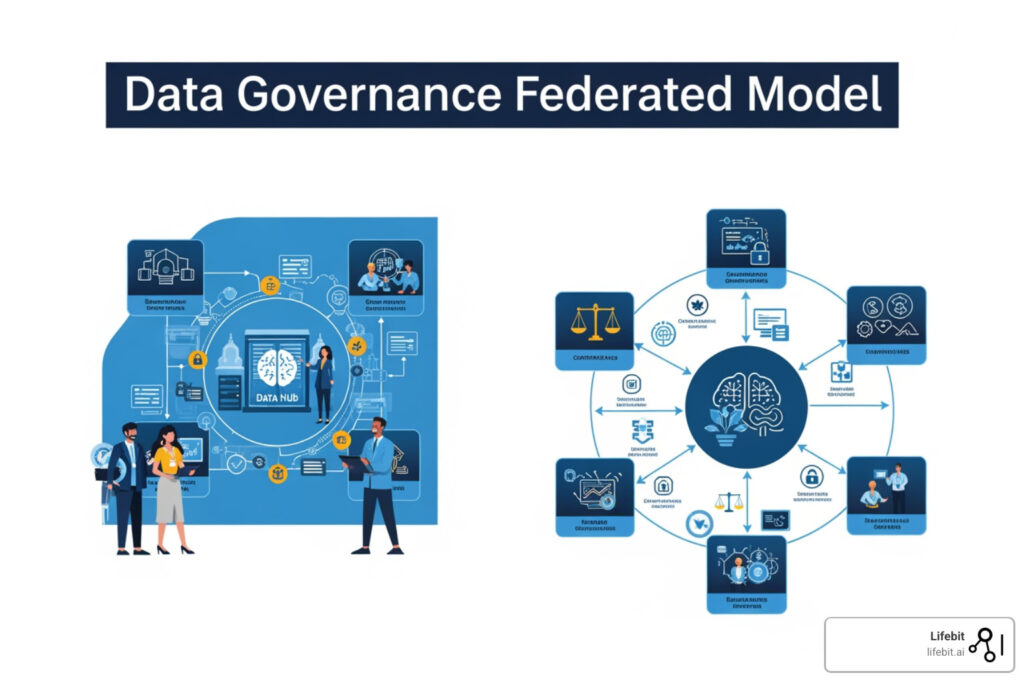
Why Data Silos Are Killing Your Research Speed—And What’s Replacing Them
A data governance federated model is a hybrid approach that sets centralized policies for security, compliance, and interoperability while giving domain teams the autonomy to manage and execute their own data operations. Here’s what you need to know:
- Central standards, local execution: A governance council defines global rules (like privacy, quality, and access policies), while individual domains (finance, clinical, genomics) implement them in their own environments.
- Balances control and agility: Unlike centralized models that create bottlenecks, or decentralized models that risk chaos, federated governance provides both oversight and flexibility.
- Enables data mesh and AI: By treating data as a product and using policy-as-code, federated models support modern architectures like data mesh and secure, distributed AI.
- Best for complex organizations: It’s ideal for large enterprises, multinationals, regulated industries (healthcare, pharma, finance), and organizations with siloed legacy systems.
The problem: Most organizations still rely on centralized data governance, where a single team controls all data access and policies. This creates delays, frustration, and missed insights. Domain teams know their data best—but they’re forced to wait for approval, leading to workarounds, shadow IT, and compliance risks.
The shift: Over 60% of large enterprises relied on centralized models as of 2021, but that’s changing fast. Organizations are adopting federated governance to unlock dark data, scale AI initiatives, and meet regulatory demands without sacrificing speed.
The stakes: Without a scalable governance model, you can’t democratize data access, maintain compliance across borders, or support self-service analytics. You’re stuck in a tug of war between security and agility—and both sides lose.
I’m Maria Chatzou Dunford, CEO and Co-founder of Lifebit, where I’ve spent over 15 years building federated biomedical data platforms that enable secure, compliant research at scale. I’ve seen how a data governance federated model transforms organizations from reactive gatekeepers to proactive enablers—powering everything from multi-omic drug discovery to real-time pharmacovigilance across 275M+ patient records. Let me show you how it works.
What is a Data Governance Federated Model?
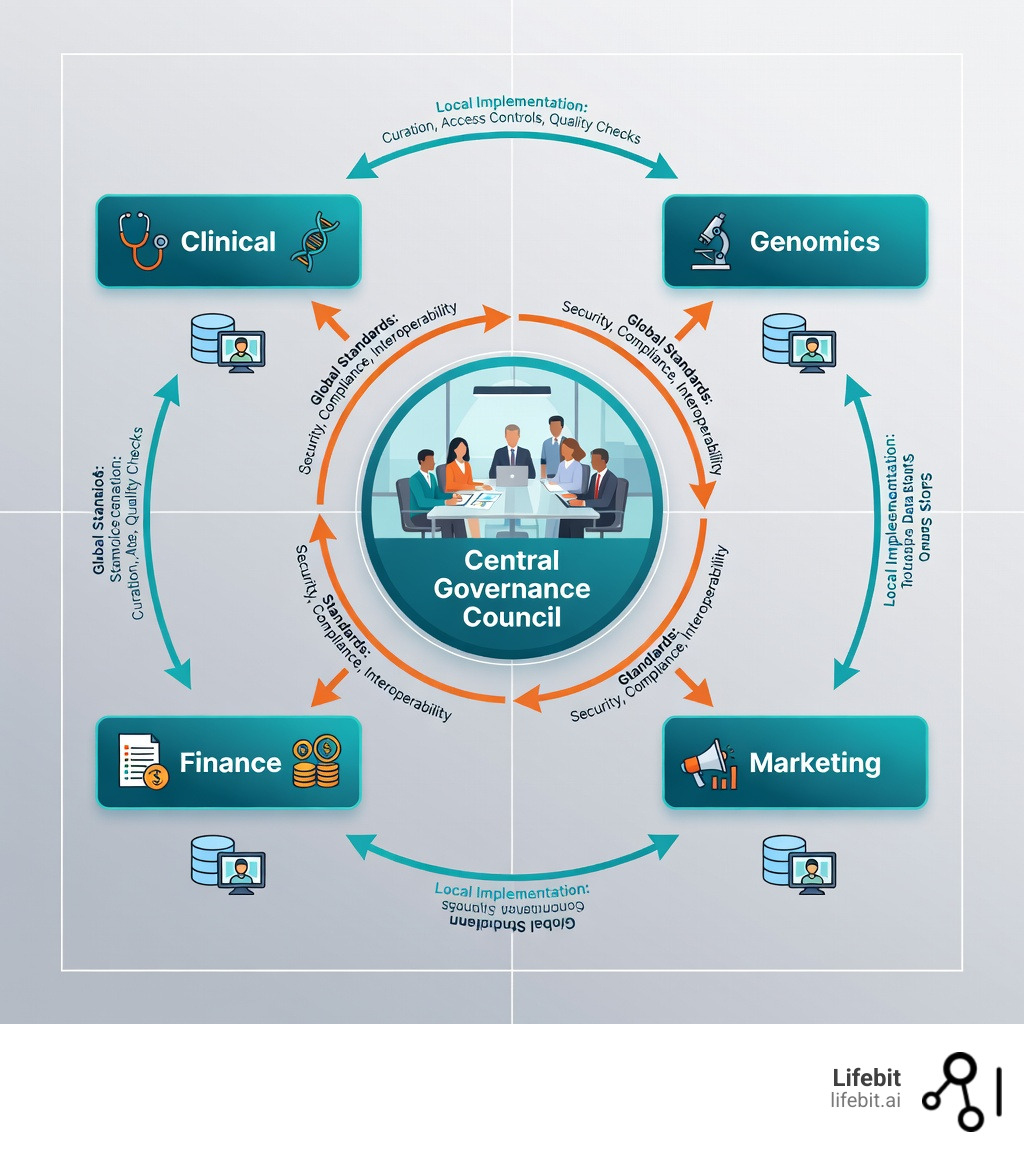
Think of a data governance federated model as a “hub-and-spoke” system. In this setup, a central body—often a data committee or council—defines the non-negotiable global standards. These standards typically cover high-level security, privacy (like GDPR or HIPAA), and how data should be formatted so different systems can talk to each other (interoperability). This central hub acts as the “constitutional” body of the organization, ensuring that no matter where data lives, it adheres to the same ethical and legal requirements.
However, the “execution” of these rules is pushed out to the “spokes”—your individual business domains. Whether it is a genomics lab in London or a clinical trial team in New York, these teams get the autonomy to manage their own data products. They decide who gets access to specific tables, how they clean and harmonize their data, and which tools they use, provided they stay within the central guardrails. This is a fundamental shift from the “command and control” style of traditional IT, moving toward a model of empowered accountability.
The Philosophy of Domain-Driven Design
This approach is heavily rooted in domain-driven design (DDD). It acknowledges that the people closest to the data—the subject matter experts (SMEs) in finance, R&D, or marketing—are the ones best equipped to manage its quality and value. In a centralized model, a data engineer who doesn’t understand the nuances of a “biomarker” might be tasked with cleaning that data, leading to errors. In a federated model, the domain team owns the data lifecycle. By providing self-service access, you remove the “IT bottleneck” that plagues traditional organizations. For a deeper dive into how this looks in practice, check out our Federated Data Governance Complete Guide.
How the Federated Approach Works
The “magic” of the federated model lies in what experts like Adam Bellemare call “sorting out the decisions that should remain at the local level from those that must be made globally.”
- Bounded Context: Each domain operates within its own “bounded context”—a specific area of the business with its own unique language and rules. For example, a “customer” might mean something different to the marketing team (a lead) than it does to the legal department (a contract holder). Federated governance allows these definitions to coexist without causing system-wide errors.
- Global Policies: The central federation sets “global rules” that apply to everyone. This includes data classification (what is PII?), encryption standards (AES-256), and audit requirements. These are often implemented as “Policy-as-Code” to ensure they are automatically enforced across all domains.
- Local Implementation: Domain owners decide how to meet those standards. They maintain data sovereignty, meaning the data stays within their controlled environment (important for cross-border research), but they provide a “governed” interface for others to use it. This might involve local data masking or specific anonymization techniques tailored to their dataset.
- Interoperability and Metadata: The central team ensures that even though data is managed locally, it remains discoverable. This is achieved through a unified metadata layer. Every domain must publish their data’s “schema” and “lineage” to a central catalog, allowing a researcher in one department to find and request access to data in another.
Core Roles in a Data Governance Federated Model
To make this work, you need more than just software; you need the right people in the right seats. In our experience, these roles are essential:
- Governance Council: A cross-functional group (including the CDO, CISO, and domain leads) that defines the global “constitution.” They meet quarterly to resolve conflicts between domains and update standards based on new regulations.
- Domain Owners: High-level leaders (e.g., Head of Clinical Operations) accountable for a specific data domain’s value, quality, and compliance. They treat data as a product, not a byproduct.
- Data Stewards: The “boots on the ground” within each domain who handle day-to-day data quality, metadata tagging, and access request approvals. They are the bridge between the business and the technical teams.
- Data Custodians: Technical experts responsible for the physical storage, backup, and security of the data within the domain’s infrastructure.
- AI-Enabled Governance: Increasingly, we see organizations using AI to automate the boring parts—like tagging sensitive data or detecting quality anomalies. You can read more about this in our guide to AI-Enabled Data Governance.
Federated vs. Centralized: Choosing the Right Data Governance Federated Model
Choosing a governance model is often a choice between “speed” and “safety.” But as we’ve seen at Lifebit, the data governance federated model allows you to have both. In a centralized model, the central team becomes a “gatekeeper,” often overwhelmed by requests. In a decentralized model, you have “data anarchy,” where every team does their own thing, leading to massive compliance risks.
| Feature | Centralized Model | Federated Model | Decentralized Model |
|---|---|---|---|
| Ownership | Single central team | Shared (Central + Domain) | Individual teams |
| Flexibility | Low (Rigid) | High (Adaptive) | Very High (Chaotic) |
| Compliance | Strong but slow | Strong and agile | Inconsistent |
| Scalability | Poor (Bottlenecks) | Excellent | Good (but siloed) |
| Risk | Bottleneck risk | Minimal | “Data Anarchy” risk |
The Danger of “Data Anarchy”
The “Data Anarchy” mentioned above happens when you have no central oversight. Teams start creating their own definitions of metrics (e.g., “What is a monthly active user?”), leading to a “tug of war” where nobody trusts the numbers in the boardroom. Federated governance stops this by providing a “single source of truth” for policies and definitions, even if the data itself is spread out across different clouds or regions. For a forward-looking view, see our post on Centralized vs. Decentralized Governance in 2025.
When to Use a Centralized Model
We’ll be honest: federated governance isn’t for everyone immediately. Centralized models are often better for:
- Small organizations: If you only have one data team and fewer than 50 employees, you don’t need a federation. The overhead of setting up a council would outweigh the benefits.
- Low maturity: If your data is currently a mess—no catalogs, no security standards, no clear ownership—you might need a central “Cleanup Crew” to establish foundational capabilities for 6-12 months before you can trust domains to self-govern.
- Strictly local risk: If all your data is in one jurisdiction, one database, and one cloud provider, centralization is simpler and more cost-effective.
Transitioning to a Data Governance Federated Model
Moving from a “Data Monarchy” (centralized) to a “Data Federation” is a journey that requires cultural change as much as technical change. According to the BCG DACAMA survey, organizations that focus on building foundational governance capabilities see a 15% improvement in their overall data management index.
The transition usually involves a hybrid funding model. The central organization funds the “platform” (the tools, catalogs, and security infrastructure), while the individual domains fund their own data curation, cleaning, and product development. This ensures everyone has “skin in the game.” If the central team pays for everything, domains have no incentive to be efficient. If domains pay for everything, they will bypass central standards to save money. The hybrid model creates a partnership. If you’re ready to make the move, our Guide to Decentralized Data Governance provides a roadmap.
Why Your Organization Needs a Data Governance Federated Model Now
The world is no longer centralized. Between multi-cloud environments, remote teams, and global regulations like the EU AI Act, your data is already “federated”—your governance just hasn’t caught up yet.
Unlocking “Dark Data” for AI
One of the biggest drivers for this model is dark data. Gartner defines this as the information assets organizations collect but fail to use for analytics. In large pharma or healthcare organizations, this could be 80% of all data. A federated model empowers domain teams to shine a light on this data, classifying it and making it usable for AI and ML initiatives.
When data is locked in a central silo, the central team rarely has the bandwidth to understand the value of a niche dataset from a 2015 clinical trial. But the domain team knows exactly what’s in there. By giving them the tools to govern it locally, that data becomes available for training Large Language Models (LLMs) or running predictive analytics. This leads to a much faster “time-to-insight.” Instead of waiting six months for a central team to approve a project, a domain team can launch a pilot in weeks using tools like Lifebit’s R.E.A.L. (Real-time Evidence & Analytics Layer). Discover how to leverage this through Federated Analytics.
How a Data Governance Federated Model Powers Data Mesh
If you’ve heard of Data Mesh, you’ve heard of federated governance. It is the “fourth pillar” of the data mesh philosophy (alongside domain ownership, data as a product, and self-serve platforms). In this context, we talk about computational governance.
This means instead of a human checking a spreadsheet to see if you’re allowed to access data, the rules are written as policy-as-code. When a researcher tries to join two datasets—say, genomic data from the UK and clinical data from Germany—a “policy engine” automatically checks if it violates GDPR, the specific patient consent forms, or a data contract. If it does, the pipeline stops or the data is automatically masked. This treats “data as a product,” ensuring it is always discoverable, secure, and trustworthy. We explore this further in our article on Data Lakehouse Governance.
Overcoming Implementation Challenges
It’s not all sunshine and rainbows. Implementing a data governance federated model comes with hurdles that require proactive management:
- Operational Complexity: You’re managing more moving parts and more people. Communication becomes your most important tool.
- Performance Overhead: Federated queries (searching across multiple databases without moving data) can be slower if not optimized. You need a high-performance execution engine like Lifebit’s to handle this at scale.
- Security Fragmentation: If one domain has weak local controls, it can put the whole federation at risk. This is why “Global Standards” must be non-negotiable and audited automatically.
- Conflict Resolution: What happens when the Finance domain and the Sales domain disagree on the definition of “Revenue”? You need a pre-defined process for “checks and balances” within the Governance Council.
To learn how industry leaders handle these issues, you can explore our Federated Data Governance Complete Guide.
7 Steps to Implement a Data Governance Federated Model Successfully
Ready to stop the tug of war? Follow this rollout plan, which we’ve refined over years of helping global biopharma and government agencies. For a tool-specific perspective, see our Data Governance Platform Guide.
- Assign Roles and Accountability: Don’t just pick names; pick champions. You need a Central Governance Council to set the “Global Constitution” and Domain Owners who are actually accountable for their data’s ROI. Pro-tip: Tie data quality metrics to the Domain Owner’s annual performance review.
- Define Scope and Start Small: Don’t try to “boil the ocean” by governing every piece of data at once. Start with a “high-value, low-complexity” pilot—like a specific clinical trial or a marketing region—and prove the model works there first. Use the success of the pilot to secure buy-in for the next phase.
- Create the Governance Framework: Establish the “Golden Rules.” What are your mandatory security tiers? What metadata must every file have? This framework should be a living document that evolves as your organization grows.
- Develop Standards as Code: Move toward automation. Use policy-as-code to embed your rules directly into your data pipelines. If a dataset doesn’t meet the “Global Quality Standard,” it shouldn’t even be allowed into the catalog.
- Choose a Federated Data Catalog: You need a “Google for your data.” A modern data catalog allows researchers to find what they need across the entire federation without seeing the actual sensitive data until they are authorized. It should support automated discovery and sensitive data tagging.
- Establish Communication Channels: Federated models live or die on collaboration. Use shared Slack channels, regular “Town Halls,” and documentation hubs to keep everyone aligned. Create a “Community of Practice” where data stewards from different domains can share tips and tricks.
- Train and Incentivize Your Team: Governance is a culture, not just a set of rules. We love the idea of “gamifying” governance—like the financial services company Zip, which launched their glossary with an “Easter Egg Hunt” to get people using the tools. Provide clear training on why governance matters, not just how to do it.
Common Pitfalls to Avoid
- The “Paper Tiger” Council: A council that meets but has no power to enforce rules. Ensure the council has executive backing.
- Over-Standardization: Trying to force every domain to use the exact same tools. Focus on the outcomes (security, quality) rather than the tools.
- Ignoring the Culture: Thinking this is just a technical problem. Federated governance is 80% people and process, 20% technology.
Measuring Success: Metrics for Your Data Governance Federated Model
How do you know if your data governance federated model is actually working? You can’t just track “number of tables governed.” You need to look at business impact and the “velocity” of your data operations. Here are the key performance indicators (KPIs) we recommend:
1. Time-to-Access (Velocity)
In a centralized model, getting access to a new dataset can take 3-6 months due to legal and IT reviews. In a mature federated model, this should drop to days or even hours. Track the time from the initial request to the moment the researcher can run their first query.
2. Data Quality Scores (Reliability)
Are the domains actually cleaning their data? You should track:
- Null rates: Percentage of missing values in critical fields.
- Schema violations: How often data fails to meet the defined format.
- Metadata completeness: Percentage of datasets with full descriptions and lineage.
3. ROI of Data Products (Value)
How many decisions or insights were generated from a specific domain’s data? Track the number of active users per data product and the number of downstream applications, AI-driven safety surveillance models, or research projects that rely on that data. If a domain’s data isn’t being used, it’s not a “product.”
4. Compliance and Security (Risk)
- Audit readiness: How long does it take to generate a compliance report for a specific dataset?
- Policy violations: Number of times a domain attempted to bypass global security guardrails (and was caught by the automated policy engine).
The Federated Governance Maturity Curve
Most organizations move through four stages:
- Ad-hoc: No formal governance; data is shared via email and spreadsheets.
- Centralized: A single team tries to control everything; bottlenecks are frequent.
- Federated (Emerging): Roles are defined, but automation is low. Manual approvals are still common.
- Computational Federation: Policies are code; access is automated; domains are fully autonomous within guardrails.
In our Federated Data Platform Ultimate Guide, we share how one organization scaled to 60 domain teams using this model, effectively eliminating their data backlog and accelerating their research cycle by 400%.
Frequently Asked Questions about a Data Governance Federated Model
What is the difference between federated governance and data federation?
This is a common point of confusion!
- Federated Data Governance is an organizational model. It’s about who makes decisions, who owns the data, and how policies are set. It’s a human and process framework.
- Data Federation (and data virtualization) is a technical approach. It’s the software that allows you to run one query that pulls data from three different databases without moving the data. You can have governance without technical federation, but at Lifebit, we believe they work best together. Technical federation provides the “enforcement layer” for your governance policies. Read more on Federated Data Analysis.
How does federated governance ensure HIPAA or GDPR compliance?
By using “Global Policies, Local Implementation.” The central council sets the rule: “All patient data must be masked for external researchers.” The local domain team then uses Attribute-Based Access Control (ABAC) to enforce this. This means a researcher’s access is automatically limited based on their role, their location, and the specific trial they are assigned to. Because the data never leaves its original jurisdiction (data residency), it is much easier to comply with strict laws like GDPR. This is critical for Clinical Data Governance.
Can small organizations benefit from a federated model?
Yes, especially if they are growing fast. Adopting a “federated mindset” early prevents the creation of massive, unmanageable silos later. It builds agility into your DNA. Even if you only have two “domains” (e.g., R&D and Operations), setting clear ownership now will save you years of technical debt later. For smaller healthcare entities, our DHA Data Governance Guide offers tailored advice.
How do you handle “Data Sovereignty” in a federated model?
Data sovereignty is the idea that data is subject to the laws of the country in which it is located. In a federated model, the data stays in its home environment (e.g., a hospital’s local cloud). The governance model allows researchers to send queries to the data, rather than moving the data to the researcher. This ensures that the data never leaves its legal jurisdiction, satisfying both local regulators and global security standards.
What tools are needed for a federated model?
You typically need three layers:
- The Catalog Layer: For discovery and metadata management.
- The Policy Layer: For defining and enforcing access rules (Policy-as-Code).
- The Execution Layer: A federated query engine that can process data across different environments without moving it.
Conclusion
The “tug of war” between central control and departmental speed is a relic of the past. By adopting a data governance federated model, you empower your experts to move fast while ensuring your organization remains secure and compliant.
At Lifebit, we’ve built our next-generation federated AI platform to be the foundation for this exact model. Whether you are managing multi-omic data for drug discovery or public health data across five continents, our platform provides the Trusted Research Environment (TRE) and Trusted Data Lakehouse (TDL) you need to make secure, real-time research a reality.
Don’t let rigid governance stall your innovation. Embrace the federation. Explore the Lifebit Federated Biomedical Data Platform today and see how we can help you unlock the power of your data.