

The A to Z of Data Governance Frameworks: Everything You Need to Know

Stop Flawed Decisions: How a Data Governance Framework Prevents Costly Compliance Failures
What is a data governance framework and why should you care? Here’s the quick answer:
A data governance framework is a structured system of policies, standards, roles, and processes that defines how an organization manages, protects, and uses its data assets. It ensures:
- Clear ownership and accountability for data across the organization
- Consistent rules for data quality, security, and access
- Compliance with regulations like GDPR, HIPAA, and CCPA
- Trusted data that supports accurate decision-making
- Scalable processes that work across departments and systems
Think of it as the blueprint for treating data as a strategic asset rather than a chaotic liability.
Right now, most organizations struggle with data chaos. Datasets are scattered across systems, teams can’t find what they need, and security risks multiply. Organizations cannot make effective business decisions if those decisions are based on flawed data.
A well-defined framework brings order to this chaos. It establishes clear processes for data collection, storage, and use that lead to improved efficiency and data accuracy. When marketing, sales, and service teams follow the same rules for customer records, there are fewer missed handoffs. When IT teams define who can access payment data, security risks shrink. When data stewards track lineage, errors get caught before they influence strategy.
The stakes are particularly high in healthcare and life sciences. Data sovereignty laws may require that data needs to be stored and processed locally. Regulatory bodies demand proof of data integrity. Research depends on trustworthy, harmonized datasets across multiple institutions. Without a framework, these requirements become impossible to meet at scale.
I’m Maria Chatzou Dunford, CEO and Co-founder of Lifebit, where we’ve spent years helping global pharma and public sector organizations define what a data governance framework should look like for federated biomedical data. My background in computational biology and AI has shown me how the right framework transforms data from a compliance burden into a competitive advantage.
Word guide:
- data privacy regulations
- Cloud data management
- The Future of Data Governance: Centralized vs Decentralized (Who Wins in 2025?)
100% Compliance: How a Data Governance Framework Secures Your Most Sensitive Assets
At its heart, a data governance framework is a comprehensive system designed to ensure that an organization’s data assets are managed effectively, securely, and in compliance with all relevant regulations. Its primary purpose is to transform raw data into a reliable resource for strategic decision-making. This means establishing order and laying the foundation for trusted data, ensuring that data integrity, accuracy, and consistency are always maintained.
The Data-Decision Gap and the Cost of Inaction
Many organizations suffer from what we call the “Data-Decision Gap.” This occurs when leadership has access to massive amounts of data but lacks the confidence to use it for high-stakes decisions because the source, accuracy, or lineage of that data is unknown. Without a framework, data becomes a “wilderness”—a chaotic environment where silos prevent collaboration and duplicate records lead to conflicting reports.
The cost of inaction is not just theoretical. In the era of GDPR, HIPAA, and CCPA, a single data breach or compliance failure can result in fines totaling millions of dollars, not to mention the irreparable damage to brand reputation. A robust framework acts as a shield, protecting data assets across the UK, USA, Europe, Singapore, Canada, and Israel by ensuring that every byte of data is accounted for and protected.
How a data governance framework differs from simple policies
Think of it this way: a data governance framework is the entire blueprint for building a house, while data governance policies are the specific building codes. The framework is the overarching structure that integrates all elements necessary for effective data management, including policies, processes, roles, technologies, and metrics. Without a framework, policies lack the infrastructure for implementation and enforcement. They become “shelfware”—documents that exist but are never actually followed.
Policies are the specific rules that translate high-level objectives into actionable directives. For example, a data retention policy dictates how long data types should be stored. These policies only become effective when embedded within a comprehensive framework that defines how they are created and who is responsible for upholding them. For a deeper dive, explore our Data Governance Platform Complete Guide.
Building a data governance framework for security and compliance
In today’s regulatory landscape, building a framework that prioritizes security isn’t just a best practice—it’s a necessity. Regulations like GDPR and HIPAA make it imperative to know exactly how data is collected and used. Furthermore, data sovereignty laws may require that data needs to be stored and processed locally.
Our framework ensures adherence to these regulations by setting clear processes:
- Data Classification: Categorizing data based on sensitivity (e.g., PII, PHI) to apply appropriate security measures. This involves identifying which data is public, internal, confidential, or highly restricted.
- Access Controls: Defining who has access to sensitive systems to minimize risk. This includes implementing the “Principle of Least Privilege,” where users only have access to the data necessary for their specific role.
- Auditing: Regularly tracking data access to identify overentitled users and protect against breaches. Automated logs should show who accessed what data and when.
- Automated Consent Management: Streamlining the process of obtaining user consent, vital for GDPR. This ensures that if a user withdraws consent, their data is automatically flagged for restricted use or deletion.
- Privacy Policy Enforcement: Ensuring Data Privacy Regulations are consistently applied across all departments, from marketing to R&D.
- Data Masking: Implementing techniques to protect sensitive data while allowing for analysis, crucial for GDPR Compliant Data and HIPAA Compliant Data Analytics.
The Core Pillars: 10 Essential Components of a Data Governance Framework
To understand what is a data governance framework, it’s crucial to identify its foundational elements. The Data Governance Institute (DGI) lists 10 essential components that support the entire structure, ensuring data is managed effectively from end-to-end.
Deep Dive into the 10 Pillars
- Vision and Strategy: This is the “North Star.” It aligns data governance with overall organizational goals, ensuring that data initiatives support business growth and innovation.
- Guiding Principles: These are the core beliefs, such as transparency, accountability, and privacy, that underpin every data-related activity and decision.
- Data Stewardship: This involves assigning specific individuals the responsibility for maintaining data quality and ensuring that data standards are met on a daily basis.
- Data Quality Management: This pillar focuses on the processes for validation, cleansing, and enrichment to ensure data is accurate, complete, and timely.
- Data Management Processes: This defines the entire lifecycle of data—how it is created, stored, shared, archived, and eventually destroyed.
- Policies and Standards: These are the codified rules for data classification, retention, and security that everyone in the organization must follow.
- Roles and Responsibilities: This clarifies who owns the data, who manages it, and who is accountable for its integrity, preventing the “not my job” syndrome.
- Data Compliance and Risk Management: This ensures the organization stays ahead of regulations like GDPR, HIPAA, and CCPA, while identifying and mitigating potential data risks.
- Metrics and KPIs: You cannot manage what you cannot measure. This pillar identifies the specific metrics used to track the success and ROI of the governance program.
- Technology Infrastructure: This provides the tools—such as data catalogs, security systems, and lineage trackers—that make governance possible at scale.
Metadata management as a core component
Metadata management is often called “data about data.” It tracks what data we have, where it lives, and who can access it. Without robust metadata management, a data catalog is just a list of names. It provides:
- Technical details: Information about database schemas, storage locations, and file formats.
- Business context: Definitions, business rules, and ownership, supported by Business Glossaries, Data Dictionaries, and Data Catalogs Learning Plan.
- Operational insights: Details about data lineage (where the data came from) and usage patterns (how often it is accessed).
By managing metadata, we make data findable and trustworthy, aiding in Data Harmonization Meaning: Complete Guide and our Data Harmonization Services.
Technology infrastructure and automation
Technology operationalizes the framework, providing the scaffolding for scalable governance. In a global organization, manual governance is impossible. Key technologies include:
- Data Catalogs: Searchable indexes that allow users to find the data they need quickly.
- Data Quality Tools: Automated systems that monitor data for accuracy, completeness, and freshness, flagging errors in real-time.
- Data Lineage Tools: Providing an end-to-end view of how data flows from source to destination, which is essential for audit readiness.
- Security Systems: Implementing automated access controls, encryption, and data masking.
The rise of AI is also changing governance. Our AI-Enabled Data Governance Ultimate Guide shows how AI can automate tasks like data classification and anomaly detection, making governance efforts more proactive rather than reactive.
Roles and Responsibilities: Who Owns Your Data?
A fundamental aspect of any framework is clearly defining who is responsible for what. Without assigned ownership and accountability, even the best policies will fall flat. In many organizations, data is “everyone’s responsibility,” which often means it is “no one’s responsibility.”
Key Governance Roles
- Data Owners: Usually senior leaders or department heads who are responsible for the data within their specific domain (e.g., the VP of Sales owns customer data). They have the authority to approve access and define how the data should be used.
- Data Stewards: These are the “boots on the ground.” They are business-unit experts who ensure that data standards are followed daily. They bridge the gap between the business and IT. We offer a How to Be a Data Steward Learning Plan for this role.
- Data Custodians: Typically found in IT or engineering teams, custodians are responsible for the technical management, storage, and security of the data. They implement the rules defined by the Data Owners.
- Executive Sponsors: Senior leaders (like a CDO or CIO) who champion the initiative, secure the necessary budget, and ensure governance remains a priority at the board level.
- Data Governance Committee: A cross-functional group that meets regularly to resolve data-related conflicts, approve new policies, and monitor the progress of the governance program.
Centralized vs Decentralized Models
Choosing the right organizational model is critical for the success of your framework:
- Top-Down (Centralized): A single central authority sets all rules and standards. This ensures high consistency but can be slow to react to the needs of individual departments.
- Bottom-Up (Decentralized): Individual departments manage their own data. This is fast and flexible but often leads to data silos and inconsistent standards across the company.
- Federated (Hybrid): This is the model we often recommend for large, global organizations. Business units manage their own data within a set of centrally defined guidelines. This allows for local agility while maintaining global compliance. For more, see our guides on Centralized vs Decentralized Data Governance and the Federated Governance Complete Guide.
The Data Governance Office (DGO)
Some organizations create a dedicated Data Governance Office (DGO) to lead the initiative. The DGO acts as the central hub, ensuring stakeholder alignment, communicating policies, maintaining documentation, and tracking KPIs to measure effectiveness. It serves as the “connective tissue” between the executive sponsors and the data stewards.
7 Steps to Build a Sturdy Framework from Scratch
Building a data governance framework is a marathon, not a sprint. It requires careful planning and a solid foundation. Here are the seven fundamental steps we recommend for a successful implementation:
- Define Objectives and Scope: Articulate exactly what the framework aims to achieve. Is it regulatory compliance? AI enablement? Better customer insights? Start with high-impact, manageable areas rather than trying to govern everything at once.
- Secure Executive Sponsorship: Without support from the top, governance initiatives often fail when they encounter organizational resistance. Leadership support is essential for securing budget and driving cultural change.
- Assign Roles and Responsibilities: Identify your data owners, stewards, and custodians. Matching existing skills with governance needs is crucial for long-term sustainability.
- Develop Policies and Standards: Translate your high-level objectives into actionable rules. This includes defining standards for data classification, retention, and Data Integrity in Health Information Systems.
- Deploy Governance Tools: Implement the necessary technology, such as data catalogs and quality monitoring tools, to automate the framework. See our Developing a Data Quality Program Learning Plan.
- Train Teams and Build Data Literacy: Governance is as much about people as it is about technology. Ensure teams across global offices understand their roles and the importance of data quality through ongoing training and communication.
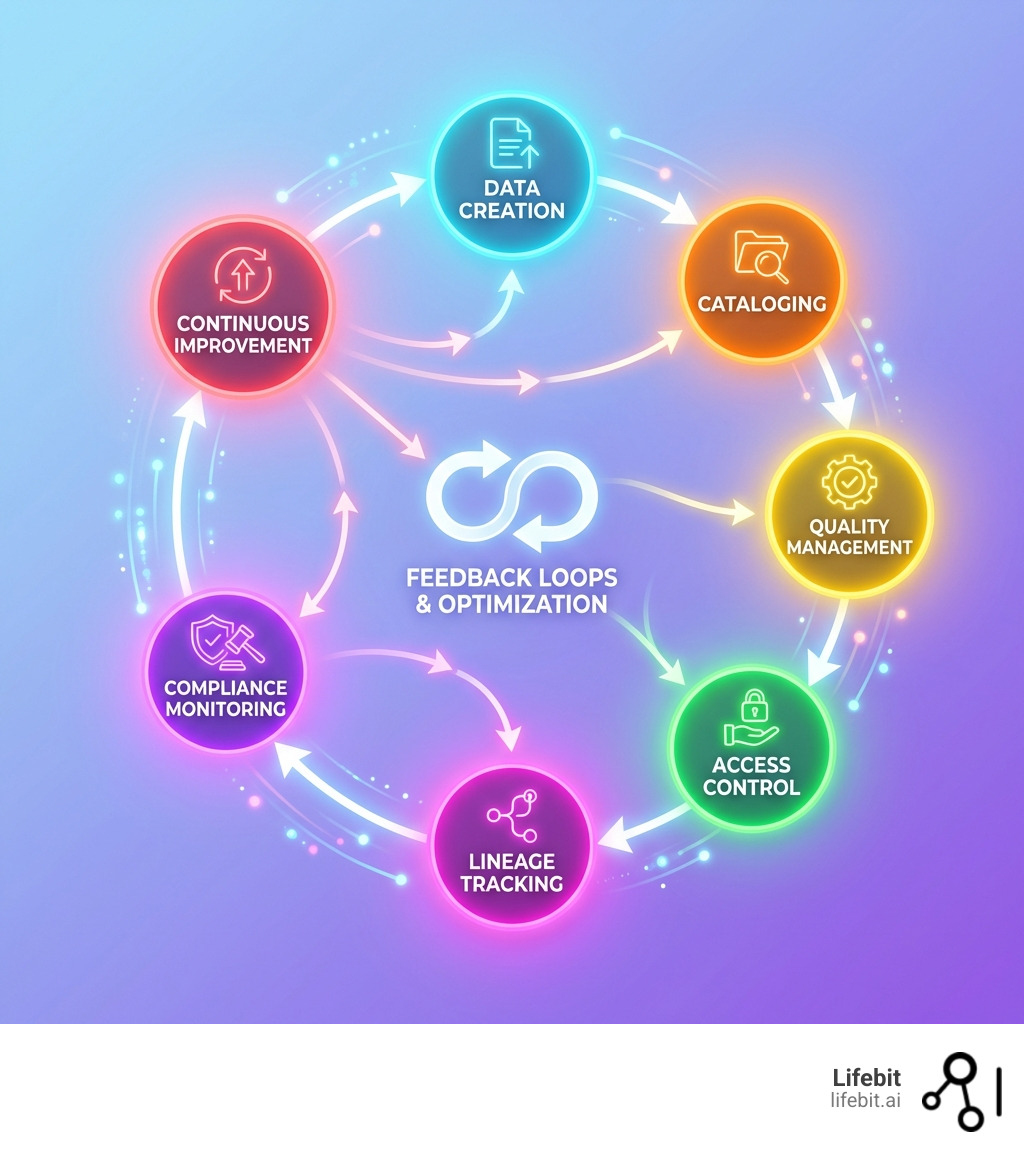
- Monitor, Audit, and Iterate: Establish a continuous feedback loop. Regularly audit your processes to ensure compliance and adjust the framework as business needs or regulations change.
Measuring Success and ROI
To maintain executive support, you must demonstrate the value of the framework. We measure success through Key Performance Indicators (KPIs) and tangible business outcomes:
- Data Quality Metrics: Tracking the reduction in duplicate records, the increase in data completeness, and the speed of error resolution.
- Compliance Metrics: Monitoring adherence to GDPR and HIPAA. The Quartz case study shows how consolidation streamlines compliance and reduces the risk of fines.
- Audit Readiness: Measuring the time and effort required to produce documentation for regulatory bodies. A good framework should make this process nearly instantaneous.
- Operational Efficiency: Tracking the reduction in time spent by data scientists and analysts on data cleansing and discovery.
Overcoming Implementation Challenges
Common challenges include a lack of executive buy-in, resistance to change from employees who see governance as “extra work,” and the technical difficulty of integrating siloed data systems. To overcome these, emphasize clear communication, start small with high-impact pilot projects, and celebrate quick wins to build momentum. Resources like Getting Started Governing Data provide valuable guidance for those in the early stages.
Frequently Asked Questions about Data Governance
What is the primary purpose of a data governance framework?
The primary purpose of a data governance framework is to establish a structured system for managing, protecting, and leveraging an organization’s data assets. It aims to ensure data quality, security, and compliance, ultimately changing data into a reliable and trustworthy resource for informed decision-making and operational efficiency. It moves an organization from a state of “data chaos” to “data mastery.”
How does a framework ensure regulatory compliance?
A data governance framework ensures regulatory compliance by defining clear policies, processes, and responsibilities for handling data in accordance with laws like GDPR (Europe, UK), HIPAA (USA), and data sovereignty requirements (e.g., Canada, Singapore, Israel). It includes mechanisms for data classification, access control, auditing, consent management, and data masking, all designed to meet specific legal obligations and avoid heavy penalties.
What role does AI play in modern data governance?
AI plays an increasingly significant role in modern data governance by automating and enhancing various processes. AI tools can assist with automated data classification, metadata tagging, anomaly detection for data quality issues, and predictive analytics for compliance risks. Furthermore, AI agent systems benefit from robust data governance by providing role-based access controls, audit trails, policy enforcement, and continuous quality monitoring, ensuring that AI operates on trusted and compliant data.
What is the difference between Data Governance and Data Management?
While often used interchangeably, they are different. Data Governance is the strategy and oversight—it defines the rules, roles, and policies. Data Management is the execution—it is the technical implementation of those rules, such as database administration, data architecture, and storage. Governance tells you what to do; management does it.
Can a small organization benefit from a data governance framework?
Absolutely. While a small organization may not need a dedicated Data Governance Office, they still need a framework. For smaller teams, the framework might be simpler, focusing on key areas like data security, basic quality standards, and clear ownership. Establishing these habits early makes it much easier to scale as the organization grows.
Conclusion
Understanding what is a data governance framework is the first step toward changing your organization’s relationship with data. It’s a strategic imperative that ensures data assets are treated with rigor, safeguarding information, ensuring compliance, and empowering better decision-making across all operations.
For Lifebit, robust data governance is embedded in our mission. Our federated AI platform enables secure, real-time access to global biomedical data. With built-in capabilities for harmonization and federated governance, we power large-scale, compliant research across biopharma and government agencies. This alignment future-proofs our data strategy, allowing us to leverage data for scientific findy and patient benefit.
Find how our platform can revolutionize your data strategy. Explore the Lifebit Federated Biomedical Data Platform today.