

The Data Intelligence Doppelganger Guide

Stop Wasting Millions on BI: Why Data Intelligence Similar Platforms Win
Data Intelligence similar platforms are not just fancier dashboards. They are a fundamentally different category of technology — and confusing them with Business Intelligence (BI) or Data Analytics tools is a costly mistake that leads to massive technical debt and missed opportunities in the AI era. For decades, organizations have relied on Business Intelligence to look in the rearview mirror. BI was designed for a world where data was structured, static, and lived in a single warehouse. But today, data is decentralized, unstructured, and growing at an exponential rate. In this environment, traditional BI tools act as a bottleneck rather than an enabler. They require manual data cleaning, rigid schema definitions, and constant human intervention to produce even the simplest reports.
The hidden cost of legacy BI lies in “Data Gravity.” As datasets grow into the petabyte scale, moving them to a central BI server becomes physically and financially impossible. This leads to “Data Silos,” where different departments have different versions of the truth. Data Intelligence platforms solve this by bringing the intelligence to the data, rather than the other way around. They utilize a “Zero-ETL” (Extract, Transform, Load) approach that allows for real-time reasoning without the latency and cost of traditional data movement pipelines.
Here is a quick breakdown of the key terms people search when comparing this space:
| Term | What It Does | Looks Backward or Forward? |
|---|---|---|
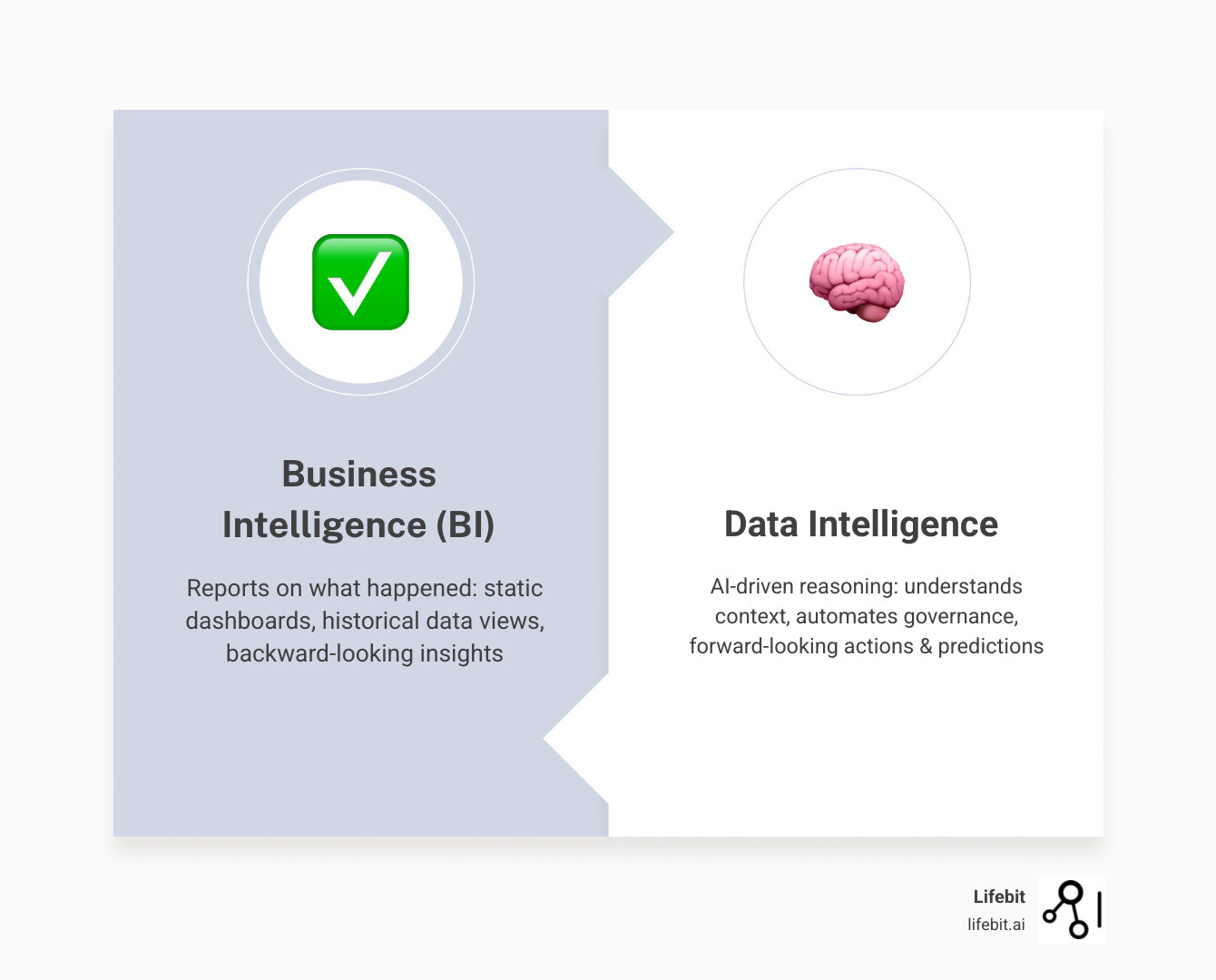
| Business Intelligence (BI) | Reports on what happened | Backward |
| Data Analytics | Explains why it happened and predicts trends | Both |
| Data Intelligence | Reasons with data using AI, automates governance, enables natural language queries | Forward |
| Data Fabric | Connects and unifies siloed data sources into one logical view | Infrastructure layer |
| Semantic Graph | Maps relationships between data assets and business concepts | Context layer |
The core difference is this:
- BI tools show you a 15% drop in sales last month. They are descriptive, providing a snapshot of historical performance without the context needed to drive immediate action. They rely on human analysts to interpret the “why.”
- Data Analytics tools tell you it was caused by a pricing change in one region. They are diagnostic and predictive, using statistical models to identify correlations and forecast future outcomes. However, they still require significant manual data preparation.
- Data Intelligence platforms tell you what to do next — and automate the governance, access, and AI pipelines to make it happen. They are prescriptive and cognitive, using machine learning to understand the underlying meaning of data across disparate systems. They don’t just visualize data; they reason with it.
For organizations in pharma, public health, or regulated research, the stakes are even higher. A BI tool cannot query federated genomic datasets across institutions. It cannot flag a pharmacovigilance signal in real time by scanning millions of unstructured clinical notes. It cannot learn your organization’s specific data semantics and surface the right cohort for a clinical trial — automatically. Traditional tools fail because they lack the “intelligence” to understand the data they are visualizing. They treat a DNA sequence the same way they treat a sales figure: as a simple string or number, missing the biological context entirely.
That gap is exactly what this guide addresses. We are moving from an era of “data visualization” to an era of “data reasoning.” This shift is driven by the need for “Data Sovereignty,” where data must remain in its original jurisdiction while still being accessible for global research.
I’m Dr. Maria Chatzou Dunford, CEO and Co-founder of Lifebit, and I’ve spent over 15 years building AI and computational biology platforms that sit squarely in the Data Intelligence similar space — from federated biomedical data infrastructure to AI-powered evidence generation for global health institutions. In the sections that follow, I’ll cut through the jargon and show you exactly how these platforms compare, what capabilities actually matter, and how to evaluate them for high-stakes, regulated environments where data security and compliance are non-negotiable.
Why Your Dashboards Are Failing: The Data Intelligence Similar Advantage
If you feel like you are drowning in data but starving for actual wisdom, you aren’t alone. Traditional Business Intelligence (BI) was designed for a world where data lived in neat, structured rows in a single warehouse. But today, “software is eating the world,” and AI is about to eat all software. In this new era, simply having a dashboard isn’t enough. You need context, semantics, and active metadata to make sense of the petabytes of information generated every day. Legacy systems are essentially “blind” to the meaning of the data they process, leading to the “Garbage In, Garbage Out” syndrome that plagues modern enterprises.
Modern Data Intelligence similar platforms differ from legacy tools because they don’t just store data; they understand it. While a BI tool treats a column titled “Patient_ID” as just a string of numbers, a Data Intelligence platform uses a semantic layer to understand that this ID links to genomic files, clinical notes, and real-world evidence across a global data fabric. It understands the relationship between a patient’s genetic markers and their response to a specific drug, even if that data is stored in different formats across different countries. This “contextual awareness” is what allows AI models to generate accurate insights rather than hallucinations.
The Evolution of Data Intelligence Similar Terms
The market is currently flooded with overlapping terminology, which can make vendor selection a nightmare. To find the right fit, you must distinguish between these three pillars of modern data architecture:
- Semantic Mapping: This is the process of automatically connecting physical data (like a database table) to business terms. It ensures that when a researcher asks for “Stage IV Oncology results,” the system knows exactly which files to pull, regardless of how they are named in the backend. This removes the need for users to understand complex database schemas or SQL. It creates a “Universal Language” for data that bridges the gap between IT and the business.
- Data Fabric: Think of this as the “plumbing” for the modern enterprise. It is an architecture that unifies disparate data sources into a single logical view, automating integration so you don’t have to move data manually. A data fabric allows for real-time access to data wherever it resides—on-premises, in the cloud, or at the edge. Unlike a Data Lake, which is a destination, a Data Fabric is a connective tissue that enables a “Data Mesh” strategy where different teams own their own data products.
- Knowledge Assets: In a Data Intelligence ecosystem, data is transformed into “governed knowledge.” This means unstructured data—like clinical PDF reports, physician notes, or emails—is processed by AI to become searchable and AI-ready. It turns raw information into a structured asset that can be used to train Large Language Models (LLMs) or drive automated decision-making. This process, often called “Data Enrichment,” adds layers of metadata that describe the quality, sensitivity, and lineage of the information.
Why Traditional BI Fails the AI Test
We often see organizations try to force legacy visualization tools to do the heavy lifting of AI governance. It rarely works, and the results are often disastrous for data integrity. Traditional BI suffers from three fatal flaws in the age of AI:
- Static Reporting: BI tells you what happened yesterday. It is a snapshot in time. It cannot reason or tell you that a critical piece of lab equipment is 80% likely to fail in the next 48 hours based on real-time sensor data. It lacks the predictive and prescriptive power required for modern operations. In the fast-paced world of drug discovery, waiting for a weekly report is the difference between a breakthrough and a failure.
- Data Silos: BI usually requires data to be centralized in a single warehouse or lake. For those of us in the UK, USA, or Canada working with sensitive biomedical data, moving data is often illegal due to GDPR or HIPAA, or technically impossible due to the sheer volume of genomic files. Data Intelligence platforms solve this by bringing the analysis to the data, maintaining “Data Residency” while allowing for global collaboration.
- Manual Tuning: Legacy systems require constant human intervention to update schemas, clean data, and build new reports. This creates a massive backlog for IT teams. Data Intelligence platforms use AI to “self-tune” and optimize data layouts based on how users actually query the system, significantly reducing the total cost of ownership. They utilize “Active Metadata” to observe usage patterns and automatically suggest optimizations.
| Capability | Business Intelligence (BI) | Data Analytics (DA) | Data Intelligence (DI) |
|---|---|---|---|
| Primary Goal | Performance Monitoring | Trend Prediction | AI-Driven Reasoning |
| Data Type | Structured | Structured/Semi-structured | All (Inc. Unstructured) |
| User Type | Business Managers | Data Scientists | Entire Organization |
| Governance | Manual/Static | Project-based | Automated/Federated |
| Scalability | Limited by Centralization | High (Cloud-native) | Infinite (Federated) |
Learn more about the core differences in our guide to data intelligence.
3 Must-Have Features for a Data Intelligence Similar Ecosystem
To move beyond basic analytics and enter the realm of true intelligence, you need a platform that acts as a “context and control engine.” This isn’t just about pretty charts; it’s about creating a semantic graph that maps every piece of data to its real-world meaning, ensuring that every insight is grounded in truth and compliance. Without these features, your data strategy will remain reactive rather than proactive.
Must-Have Features for Data Intelligence Similar Tools
If you are evaluating Data Intelligence similar platforms, look for these three non-negotiables that separate the leaders from the legacy pretenders:
- Secure Federated Querying: In industries like healthcare and defense, data cannot leave its home. A true DI platform sends the analysis to the data, rather than moving the data to the analysis. This allows researchers to query datasets across multiple institutions or jurisdictions simultaneously without ever exposing raw patient data. This is the cornerstone of our work at Lifebit, enabling global collaboration while maintaining 100% data residency. It utilizes “Trusted Research Environments” (TREs) to ensure that only the results of the query leave the secure perimeter, never the raw data itself.
- AI-Ready Data Curation: The platform should automatically tag, enrich, and structure data as it is ingested. If your system can’t turn a thousand clinical trial PDFs into a structured dataset for a Large Language Model (LLM) or a machine learning pipeline, it’s not a Data Intelligence platform. It should use Natural Language Processing (NLP) to extract entities, relationships, and sentiments from unstructured text, making it as searchable as a spreadsheet. This includes “Entity Resolution,” which identifies that “John Doe” in one database is the same person as “J. Doe” in another, even without a shared unique identifier.
- Collaborative Analytics and Natural Language Interaction: Modern DI allows non-technical users to “talk” to their data using natural language. Instead of writing complex SQL or waiting weeks for a data scientist to build a report, a researcher should be able to ask: “Show me female patients over 50 with the BRCA1 mutation who responded to the new treatment in the last six months.” The system should understand the intent, find the data, and present the answer instantly. This democratizes data access, moving it out of the hands of a few “gatekeepers” and into the hands of the people who actually need to make decisions.
AI-Powered Governance and Active Metadata
Governance is no longer just a “check-the-box” activity for compliance; it is the engine of AI productivity. Gartner notes that radical data democratization is only possible when trust is built into the system. Without automated governance, democratizing data access leads to security breaches and “hallucinating” AI models. Traditional governance was “passive”—a set of rules written in a PDF that no one read. Modern governance is “active”—it is embedded directly into the data pipelines.
Active metadata is the secret sauce here. Unlike a static data catalog that just lists what you have (and is often out of date the moment it’s created), active metadata learns. It observes how data is used, identifies sensitive information automatically (like PII or PHI), and flags quality issues before they ruin your analysis. For regulated industries, this means automated compliance and “always-on” audit trails that track exactly where every byte of data has been, who accessed it, and what analysis was performed. This level of transparency is essential for building trust in AI-driven decisions.
Furthermore, active metadata enables “data observability.” It can alert you if a data pipeline breaks or if the distribution of data changes in a way that might cause an AI model to drift. This proactive approach to data health is what allows organizations to scale their AI initiatives with confidence. It also supports “Differential Privacy,” a technique that adds mathematical noise to query results to ensure that no individual’s data can be re-identified, even in large-scale aggregate studies.
Read our ultimate guide to data intelligence platforms for a deeper dive into these features.
484% ROI: The Massive Impact of Data Intelligence Similar Solutions
Adopting a Data Intelligence similar platform isn’t just a technical upgrade; it’s a massive financial win that transforms the bottom line. Organizations that move from fragmented, siloed tools to a unified intelligence layer see staggering returns on investment by reducing operational friction and accelerating time-to-insight. In a world where “Time is Money,” the ability to query global data in seconds rather than months is a massive competitive advantage.
Driving 484% ROI with Data Intelligence Similar Solutions
The numbers speak for themselves. According to industry research and our own internal benchmarks, enterprises adopting advanced Data Intelligence solutions realize:
- 484% 3-year ROI on their platform investment, driven by cost savings and new revenue opportunities. This is achieved by consolidating multiple legacy tools into a single, more efficient intelligence layer.
- $9.1M per year in total business benefits through improved decision-making and operational efficiency. This includes the reduction of “Data Waste”—the cost of storing and managing data that is never used.
- 28% higher productivity for data governance teams, as manual tagging and auditing are replaced by AI automation. This allows governance officers to focus on strategy rather than manual data entry.
- 13% higher productivity for data analytics teams, who no longer have to spend the majority of their time on data preparation. This translates to more models deployed and more insights generated per year.
These gains come from eliminating the “data hunt.” In a typical organization, data scientists spend 80% of their time cleaning and finding data, and only 20% actually analyzing it. Data Intelligence flips this ratio. Instead of spending months negotiating data access and cleaning messy files, your teams spend 100% of their time generating insights. For a global biopharma company, this could mean getting a life-saving drug to market months earlier, which translates to hundreds of millions in additional revenue and, more importantly, thousands of lives saved. The “Cost of Inaction” (COI) is often far higher than the cost of implementing a modern DI platform.
Explore more statistics in our complete guide to data intelligence terms.
Accelerating Research in Regulated Industries
In healthcare and life sciences, the impact is literal and profound. We use Data Intelligence to power:
- Real-time Pharmacovigilance: Traditionally, detecting adverse drug reactions (ADRs) takes months of manual review of clinical reports and social media. With Data Intelligence, we can automatically detect signals across global datasets, including social media, clinical notes, and EHRs, to ensure patient safety in real time. This “Early Warning System” can prevent thousands of hospitalizations.
- Multi-omic Research: Unifying genomic, proteomic, and clinical data is a massive technical challenge. DI platforms create a unified semantic layer that allows researchers to find new therapeutic targets by analyzing how genetic variations correlate with clinical outcomes across diverse populations. This enables “Precision Medicine,” where treatments are tailored to an individual’s specific genetic makeup.
- Federated Cohort Discovery: This is a game-changer for rare disease research. It allows researchers in New York, London, and Tokyo to collaborate on a single study to find enough patients for a statistically significant trial, without ever sharing raw patient files or violating local data sovereignty laws. This maintains total data security while enabling global-scale science. By breaking down the barriers to collaboration, we can solve diseases that were previously considered “unsearchable” due to small sample sizes in any single location.
Stop Looking Back: How to Move from BI to Data Intelligence
Ready to stop looking in the rearview mirror? Moving from BI to Data Intelligence is a journey, not a flip of a switch. It requires a shift toward a cloud-native, data fabric architecture that prioritizes accessibility and intelligence over centralization and control. This transition is as much about culture as it is about technology. It requires moving away from a “Gatekeeper” mentality to a “Data Democratization” mindset where every employee is empowered to use data.
Overcoming Limitations of Legacy Analytics
Legacy reporting systems are powerful for basic analytics, but they struggle with the scale and variety of modern data. They often hit a “performance wall” when dealing with petabyte-scale genomic data or real-time streaming IoT sensors. Furthermore, they lack the ability to handle unstructured data, which makes up 80% of all enterprise information. Data Intelligence platforms address this by using AI-driven automated management to optimize storage and compute resources on the fly, ensuring that performance remains high even as data volumes explode. They also provide “Data Lineage,” which allows users to trace an insight back to its raw source, ensuring accountability and transparency.
Steps to Modernize Your Data Stack
- Data Discovery and Inventory: Use AI-powered discovery tools to scan your entire ecosystem (on-prem, multi-cloud, and edge) to see what you actually have. You can’t govern or analyze what you can’t see. This step often reveals “dark data” that has been sitting unused for years, costing money without providing value. This inventory should include metadata about data quality and sensitivity.
- Implement Federated Governance: Instead of trying to centralize everything into a single lake—which is often a recipe for a “data swamp”—set up a governance layer that works across your existing “hybrid” ecosystem. This allows you to enforce policies and track lineage without moving the data. This is essential for complying with global regulations like GDPR, CCPA, and HIPAA simultaneously.
- Build a Semantic Layer: Map your technical data to business concepts. This is the bridge that allows non-technical users to interact with the data. It ensures that “Revenue” means the same thing to the finance team as it does to the sales team. This layer should be dynamic, updating automatically as new data sources are added.
- Enable Natural Language Interaction: Deploy tools that allow your business users to ask questions of the data directly. This removes the “IT bottleneck,” democratizes insights, and allows your data scientists to focus on high-value modeling rather than building basic reports. This shift increases the “Data Literacy” of the entire organization.
- Iterate and Scale: Start with a high-impact use case, such as customer churn or clinical trial recruitment, and prove the value of the DI approach before scaling it across the entire organization. Success in one department creates the internal momentum needed for a full-scale digital transformation.
The Role of Change Management
Modernizing your data stack is not just about installing new software; it’s about changing how people work. This requires a robust change management strategy that includes training, clear communication of benefits, and the appointment of “Data Champions” within each department. These champions act as the bridge between the technical implementation team and the end-users, ensuring that the platform meets real-world business needs. Without this human element, even the most advanced Data Intelligence platform will fail to gain adoption.
Frequently Asked Questions about Data Intelligence
What is the main difference between Data Intelligence and BI?
Business Intelligence tells you what happened (historical reporting). It is descriptive and often relies on static dashboards. Data Intelligence uses AI to explain why it happened, what will happen next, and what actions you should take. It is prescriptive and predictive. Furthermore, Data Intelligence automates the “grunt work” of data management, such as cleaning, tagging, and governance, which BI tools require humans to do manually. This automation is what allows DI to scale to petabyte-level datasets that would overwhelm a traditional BI team.
How does Data Intelligence support AI Governance?
It provides the “context” and “provenance” that AI needs to be accurate and unbiased. By using a semantic graph and active metadata, it ensures that your AI models are trained on high-quality, governed data. It also tracks data lineage so you can explain exactly how an AI arrived at a specific conclusion, which is a requirement for regulatory compliance in many industries. This “Explainable AI” (XAI) is critical for building trust with both regulators and end-users.
Can small businesses afford Data Intelligence platforms?
Yes. While the Fortune 500 were the early adopters, cloud-native DI platforms have democratized access through consumption-based pricing. Small and medium-sized businesses can now use “self-service” AI tools to solve specific problems like customer churn, inventory waste, or personalized marketing without needing a massive team of data scientists or a multi-million dollar infrastructure budget. The ROI for small businesses is often even higher because they can be more agile in implementing the insights generated.
Does Data Intelligence replace my existing Data Lake?
No, it sits on top of it. Data Intelligence acts as the “brain” that makes your data lake or data warehouse more useful. It provides the semantic layer and governance that turns a raw data lake into a structured, searchable, and actionable knowledge base. Think of the Data Lake as the library and Data Intelligence as the expert librarian who knows exactly where every book is and can summarize the contents for you.
How long does it take to implement a Data Intelligence platform?
While a full enterprise-wide rollout can take months, most organizations can see value from a specific use case within 4 to 8 weeks. Because modern DI platforms are cloud-native and use AI to automate data discovery, the initial setup is significantly faster than traditional BI implementations. The key is to start small, prove value, and then expand.
Is Data Intelligence the same as a Data Catalog?
A data catalog is a component of Data Intelligence, but it is passive. A catalog tells you what data you have, like a phone book. Data Intelligence is active; it tells you what the data means, how it’s being used, and how it can be applied to solve business problems using AI. It doesn’t just list the data; it understands the relationships between different data points.
What is the relationship between Data Intelligence and Data Mesh?
Data Mesh is an organizational strategy that decentralizes data ownership to specific business domains. Data Intelligence is the technology that enables this strategy. It provides the federated governance and semantic layer needed to ensure that while data is owned by different teams, it can still be discovered and used by the entire organization in a consistent way.
Conclusion: The Road to Data Confidence
The era of the “static dashboard” is ending. To compete in 2026 and beyond, organizations must move toward Data Intelligence similar ecosystems that reason, learn, and protect. The complexity of modern data requires more than just human oversight; it requires an intelligent layer that can operate at machine speed. This transition is not just about efficiency; it’s about survival in an increasingly AI-driven marketplace.
At Lifebit, we are leading this charge for the world’s most sensitive data. Our federated AI platform enables biopharma companies, governments, and public health agencies to access global biomedical and multi-omic data in real time—without compromising security or compliance. Whether you are building a Trusted Research Environment (TRE) or looking for real-time insights through our R.E.A.L. (Real-time Evidence & Analytics Layer), we provide the intelligence layer that turns raw data into life-saving discoveries. We believe that by making data more accessible and intelligent, we can solve the world’s most complex health challenges.
Stop reporting on the past. Start reasoning with the future. The transition from Business Intelligence to Data Intelligence is not just a technical shift; it is a strategic imperative for any organization that wants to thrive in the age of AI. By building a foundation of “Data Confidence,” you empower your teams to innovate faster, make better decisions, and ultimately drive more value for your stakeholders. The future of data is not just about having more of it; it’s about being smarter with what you have.
Explore the Lifebit Platform and see how we power the next generation of research