

The Future is Now: 6 Must-Have AI Tools for Deep Research

From Months to Minutes—The AI Research Revolution
AI platform for research is changing how scientists analyze data, find insights, and bring breakthrough treatments to patients. Here’s what you need to know:
What is an AI Platform for Research?
- A unified system that combines data access, analytics, and AI tools in one secure environment
- Enables natural language queries across complex datasets (genomics, clinical, multi-omics)
- Cuts query turnaround times from weeks to minutes
- Provides federated governance for secure, compliant collaboration
- Powers everything from literature reviews to pharmacovigilance
Top Benefits:
- Speed: Reduce data analysis time from months to minutes
- Scale: Analyze millions of records without moving data
- Security: HIPAA, GDPR, and SOC 2 compliant environments
- Accessibility: Non-technical users can query complex datasets in plain English
- Collaboration: Break down silos across institutions and partners
If you’re managing EHR data, genomic datasets, or multi-modal research projects, you’re likely stuck in a familiar loop: weeks waiting for data teams to clean pipelines, months to answer simple cohort queries, and endless back-and-forth just to access the insights you need. The problem isn’t your team—it’s the infrastructure.
AI research platforms are changing this reality. Some platforms host vast collections of interconnected research data, with over 70% of publications fully indexed. Advanced literature review tools can craft search logic to pinpoint research frontiers in just 20 minutes and process 1000+ papers into 40,000-word comprehensive reviews in 6 hours. The right platform enables teams to cut query turnaround times from weeks to minutes.
This isn’t about replacing researchers—it’s about eliminating the bottlenecks that keep them from doing their best work.
I’m Maria Chatzou Dunford, CEO and Co-founder of Lifebit, where we’ve built a federated AI platform for research that powers secure, compliant analysis across biomedical datasets for global pharma, regulatory agencies, and research institutions. Over the past 15 years in computational biology and health-tech, I’ve seen how the right infrastructure can transform research velocity—and how the wrong setup can paralyze even the most brilliant teams.
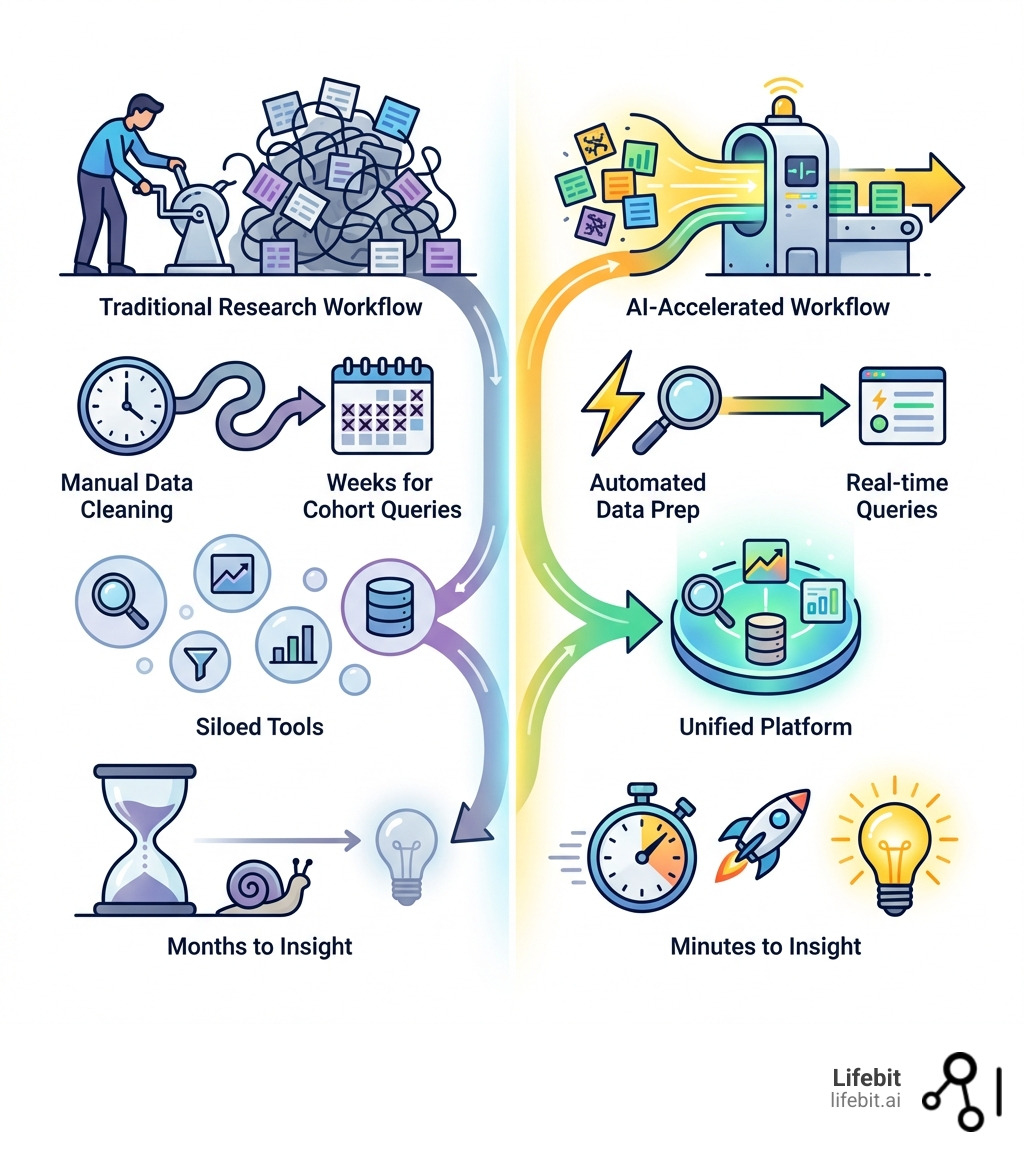
Why Your Lab Can’t Afford to Ignore AI: The Core Benefits
The landscape of scientific discovery is evolving at an unprecedented pace. In this environment, relying on traditional methods is no longer enough. An advanced AI platform for research is now a necessity for staying competitive, acting as a force multiplier for human intelligence.
Time Efficiency and Throughput
AI cuts data analysis time from months to minutes and generates literature reviews in hours. Some tools process over 1,000 papers into a 40,000-word review in just 6 hours. This speed allows researchers to iterate faster and accelerate discovery. Beyond simple speed, it increases throughput; a single lab can manage dozens of concurrent projects that would have previously required a massive increase in headcount.
Deeper Insights through Multi-modal Integration
AI identifies subtle patterns invisible to the human eye. Leading platforms host large collections of interconnected research data, using visualizations to speed up interpretation. Modern research requires the integration of multi-modal data—combining genomic sequences with clinical imaging (like MRIs) and longitudinal electronic health records (EHR). An AI platform for research can find correlations across these disparate data types that traditional statistical methods often miss, such as identifying a specific genetic variant that correlates with a subtle change in cardiac imaging over a ten-year period.
Improved Accuracy and Reduced Error
Human error is inevitable in complex processes, especially during data cleaning and normalization. AI tools minimize this by automating repetitive tasks and performing intricate calculations. From automated data handling to literature extraction, AI ensures a higher standard of scientific rigor. In fields like life sciences, where a single decimal point error can derail a multi-million dollar clinical trial, the reliability of automated AI pipelines is invaluable.
Improved Collaboration and Data Democratization
An AI platform for research facilitates seamless collaboration via a unified environment for data access and sharing. Platforms with federated governance enable secure, compliant data sharing across different entities, ensuring sensitive data remains protected while accessible for collaborative projects. This democratizes insights, empowering a wider range of researchers—including bench scientists without coding backgrounds—to ask sophisticated questions using natural language. This shift breaks down the traditional bottleneck where every query had to pass through a small, overworked team of bioinformaticians.
Accelerating Innovation in Drug Discovery
By streamlining workflows and uncovering deeper insights, AI platforms act as engines for innovation. In drug discovery, AI can predict protein-ligand binding affinities or simulate how a molecule will interact with a target before a single wet-lab experiment is conducted. Some platforms integrate hundreds of scientific tools and professional models, orchestrating complex tasks to push the boundaries of what’s possible in precision medicine.
Identifying Research Gaps and Frontiers
AI-powered analysis can reveal uncharted territories. By analyzing vast bodies of literature, AI can pinpoint areas where research is lacking or where two disparate fields are beginning to converge. Some tools visualize citation networks, making it easier to identify emerging trends, novel research questions, and the “white space” where a new patent or breakthrough is most likely to occur.
Boost Your Literature Review Process
The literature review is dramatically transformed by AI:
- Automated Search: AI scans thousands of papers for relevant information more intelligently than traditional keyword-based databases by understanding semantic context.
- Extracting Key Findings: AI quickly extracts methodologies, dosages, and conclusions from a large volume of research, presenting them in structured tables.
- Summarization: AI-powered tools condense complex studies into concise takeaways tailored to the researcher’s specific area of interest.
- Citation Visualization: Tools visualize citation networks to identify seminal papers and track how a specific topic has evolved over decades.
Open up Insights from Massive Datasets
From multi-omic data to electronic health records (EHRs), an AI platform for research excels where traditional methods struggle:
- Pattern Recognition: AI identifies intricate patterns within massive datasets, fundamental for uncovering new biomarkers for early disease detection.
- Predictive Analytics: Machine learning models forecast patient outcomes and guide experimental design, reducing the risk of trial failure.
- Handling Complex Data: Platforms like Lifebit are designed for multi-omic (genomic, proteomic, transcriptomic) and clinical data, providing the specialized infrastructure needed for high-dimensional analysis.
- Real-time Access: Federated AI platforms enable secure, real-time access to global biomedical data without the need for massive, risky data transfers.
- Statistical Automation: AI automates complex statistical analyses, ensuring rigor while reducing the burden on researchers to manually select and run tests.
The 6 Must-Have AI Tool Categories for Your Next Breakthrough
To accelerate research, we need to leverage AI across the entire research lifecycle, from the initial hypothesis to the final publication.

1. AI Literature Review & Discovery Engines
These tools help steer the ocean of scientific publications using advanced Natural Language Processing (NLP):
- Semantic Search: Moves beyond keywords to understand the intent behind a query, finding relevant papers even if they use different terminology.
- Retrieval-Augmented Generation (RAG): This technology allows AI to answer questions by looking specifically at a provided set of papers, significantly reducing the risk of “hallucinations” or false information.
- Recommendations: Uses machine learning to suggest papers based on your reading history and project goals.
- Frontier Identification: Uses graph theory to pinpoint emerging research areas that are gaining momentum but haven’t yet reached peak saturation.
2. AI-Powered Data Analysis & Visualization Tools
These tools extract the insights that drive discovery from raw data:
- Natural Language Queries (NLQ): Ask questions like “Which patients with the BRCA1 mutation responded best to this treatment?” in plain English to get biologically grounded answers.
- Automated Statistics: The platform can automatically suggest the most robust statistical models (e.g., Cox Proportional Hazards or Random Forests) based on the data distribution.
- Low-Code Machine Learning: Build and deploy predictive models with drag-and-drop interfaces, making advanced AI accessible to biologists and clinicians.
- Genomic Analysis at Scale: Specialized tools for handling Whole Genome Sequencing (WGS) data, allowing for the analysis of thousands of genomes in parallel.
3. AI Writing & Editing Assistants
Communicating findings clearly is essential for peer review success and impact:
- Academic-Specific Grammar: Tools like Paperpal or specialized LLM prompts improve the clarity of academic manuscripts, focusing on formal scientific tone.
- Contextual Paraphrasing: Rewrites complex sentences to improve flow while ensuring that technical terminology remains accurate.
- Journal Alignment: Some tools can automatically format citations and adjust the writing style to match the specific requirements of high-impact journals like Nature or Science.
4. Custom AI Agents & Models
Transformative research often requires AI customized to unique, proprietary data:
- Proprietary Training: Train small, efficient models on your lab’s specific data to create a “digital twin” of your experimental environment.
- Workflow Automation Agents: AI agents that can trigger actions, such as automatically starting a data cleaning pipeline the moment new sequencing data is uploaded to the platform.
- Domain Expertise Imbuement: Customizing LLMs with specialized ontologies (like the Gene Ontology or SNOMED CT) to ensure the AI understands the specific language of your field.
5. Secure Collaborative Environments
An AI platform for research must enable efficient teamwork across borders:
- Cross-institution Collaboration: Securely connects researchers at different universities or pharma companies without the need to move sensitive data.
- Shared Data Foundations: Creates a “single source of truth” where all collaborators can see the same version of the data and the same analysis history.
- Audit Trails: Automatically logs every action taken on a dataset, which is essential for reproducibility and regulatory compliance.
6. The Ultimate AI platform for research: Federated & Secure Platforms
For sensitive, large-scale data, robust security is non-negotiable. Solutions like Lifebit address these unique challenges:
- Federated Governance: This is a “data-to-code” model. Instead of moving data to the analysis tool, the AI platform brings the analysis to where the data resides. This is crucial for international research where data residency laws (like GDPR) prevent data from leaving a specific country.
- Trusted Research Environments (TRE): These are highly secure, “walled garden” spaces where sensitive data is analyzed. Researchers can see the results of their analysis, but they cannot export the raw, individual-level patient data.
- Pharmacovigilance (R.E.A.L.): AI-driven surveillance that monitors real-world data to identify adverse drug reactions much faster than traditional reporting systems.
How to Choose the Right AI Research Platform for Your Needs
Selecting an AI platform for research is a strategic decision that will impact your lab’s productivity for years. Consider these key factors to ensure alignment with your goals:
- Data Security and Privacy: Investigate the security architecture. Prioritize platforms with end-to-end encryption, multi-factor authentication, and comprehensive audit logs. Consider federated models or Trusted Research Environments (TRE) to ensure raw data stays secure and compliant with local laws.
- Integration Capabilities: The platform should augment, not replace, your existing workflow. Look for robust APIs for data streaming and seamless integration with Laboratory Information Management Systems (LIMS) or electronic lab notebooks (ELN). The ability to use custom Python or R scripts within the platform prevents vendor lock-in.
- Scalability and Performance: Scientific data is growing exponentially. Choose a cloud-native architecture that can scale from a few gigabytes to petabytes of data without a drop in performance. Ask for benchmarks regarding how the platform handles high-concurrency environments where dozens of researchers are running queries simultaneously.
- Interoperability and Open Standards: Ensure the platform adheres to international standards like GA4GH (Global Alliance for Genomics and Health). This ensures data portability and allows the scientific community to replicate your analysis using different tools if necessary. Support for common data models like OMOP or HL7 FHIR is also critical for clinical data integration.
- User Interface and Accessibility: An intuitive interface drives adoption. Look for natural language query capabilities that allow both bench scientists and bioinformaticians to be productive. A platform that requires a PhD in computer science just to log in will likely see low adoption rates.
- Data Type Compatibility: Ensure the platform can harmonize diverse data types. Many generic AI platforms struggle with the specific file formats used in biology (like FASTQ, BAM, or VCF). A specialized AI platform for research should handle these natively.
- Total Cost of Ownership (TCO): Beyond the initial license fee, consider long-term costs for storage, egress fees, and the human cost of maintenance. A platform that automates DevOps tasks can significantly reduce the need for expensive internal engineering support.
- Compliance Standards: Verify certifications for SOC 2 Type II, HIPAA, and GDPR. This protects your organization from legal risks and ensures an ethically sound foundation for research, especially when dealing with patient-identifiable information.
The Hidden Risks: Limitations and Ethical Problems of AI in Research
While the benefits of an AI platform for research are immense, human oversight remains indispensable for responsible innovation. Understanding the limitations is the first step toward mitigating them.
- Algorithmic Bias and Data Diversity: AI models reflect the data they are trained on. If the training data lacks diversity—for example, if a genomic model is trained primarily on data from individuals of European ancestry—the outputs will be skewed and potentially harmful when applied to other populations. Continuous auditing for fairness and the use of diverse datasets are required to prevent amplifying systemic inequalities.
- Data Privacy and Sovereignty: Aggregating patient data raises significant privacy concerns. Federated learning is a key solution, allowing models to be trained across multiple sites without moving sensitive information across borders. This respects data sovereignty while still allowing for large-scale meta-analyses.
- The “Hallucination” Problem: Large Language Models can sometimes generate confident-sounding but entirely false information, including fake citations. Researchers must use platforms that employ RAG (Retrieval-Augmented Generation) to ground AI responses in verified scientific literature.
- Lack of Human Critical Thinking: AI excels at pattern recognition but lacks intuition, abstract reasoning, and the ability to understand “why” something is happening. It cannot replace the creative spark or domain expertise required to interpret unexpected findings in a broader biological context.
- Over-reliance and Skill Atrophy: Excessive dependence on AI can reduce human analytical skills. It is vital that the next generation of researchers understands the underlying principles of the tools they use. Researchers must treat AI as a sophisticated assistant, not an infallible oracle, and maintain a healthy skepticism of all automated outputs.
- The “Black Box” and Explainability: Deep neural networks can be opaque, making it difficult to understand how a specific conclusion was reached. Explainable AI (XAI) is essential in research to ensure that AI-driven discoveries are transparent, reproducible, and scientifically defensible. If you can’t explain how the AI found a biomarker, it is difficult to justify a clinical trial based on it.
- Model Drift and Reproducibility: AI outputs can change over time as models are updated or as the underlying data evolves. Platforms must implement rigorous versioning of both data and models to ensure that a study conducted today can be replicated exactly five years from now.
- Ethical Implications of Authorship: AI-generated text raises questions of authorship and integrity. The scientific community is still grappling with how to credit AI in publications. Researchers must be transparent about their use of AI and remain fully accountable for the final work product, ensuring that all AI-assisted findings are manually verified.
Conclusion: Build Your Future Research on an AI Foundation
The world of research is at an inflection point. Traditional methods are no longer equipped to handle the scale and complexity of today’s scientific challenges. An advanced AI platform for research isn’t just an upgrade; it’s the essential infrastructure for the next era of scientific discovery. By integrating these tools, organizations can move from reactive data management to proactive, insight-driven science.
By leveraging AI, we can transform the entire research journey: from rapidly sifting through millions of papers to analyzing vast, multi-omic datasets in minutes. We can empower every researcher to ask complex questions in natural language, collaborate securely across institutions, and communicate findings with unparalleled clarity. This shift allows for a more inclusive research environment where the barrier to entry for complex data analysis is lowered, enabling a broader range of experts to contribute to global health solutions.
This isn’t about AI replacing human brilliance; it’s about amplifying it. It’s about freeing scientists from manual data management to focus on what they do best: thinking, hypothesizing, and innovating. The future of research is collaborative, data-driven, and AI-accelerated. By embracing a robust AI platform for research, we are not just keeping pace, but actively shaping the future of medicine, technology, and human understanding. The goal is a “human-in-the-loop” system where technology handles the heavy lifting of data processing while humans provide the essential context and ethical guidance.
At Lifebit, we’re proud to be at the forefront of this revolution, building the next-generation federated AI platform for research that empowers leading organizations to unlock life-changing insights from complex biomedical data. We invite you to join us in building a faster, more secure, and more impactful scientific future.