

The Top AI Security Tools for 2026 and Beyond
Why AI Safety Surveillance Tools Are Replacing Manual Safety Checks
AI safety surveillance tools are sophisticated platforms that leverage computer vision, machine learning, and edge computing to monitor workplaces, schools, and industrial facilities in real time. Unlike traditional CCTV, which merely records events for later review, these tools act as an active participant in safety management—detecting hazards, unsafe behaviors, and medical emergencies before they escalate into injuries or fatalities. In the modern industrial landscape, where complexity is increasing and the margin for error is shrinking, these tools have become indispensable. Here’s a breakdown of their core capabilities:
- Real-time hazard detection: These systems monitor for PPE violations (such as missing helmets or vests), forklift-pedestrian proximity risks, and unauthorized restricted zone access 24/7, providing instant feedback to supervisors.
- Medical emergency response: Advanced algorithms can detect specific physical signatures of falls, seizures, and unconsciousness, triggering alerts to emergency responders in as little as 15 seconds.
- Incident prevention: By identifying “near-misses” that human observers often miss, these tools help organizations cut workplace injuries by up to 75% through proactive, data-driven interventions.
- Privacy compliance: Modern tools are built with privacy-by-design, utilizing real-time face blurring and data anonymization to meet stringent GDPR and EU AI Act standards.
- Existing camera integration: Most platforms are software-agnostic, working with 95% of existing digital camera infrastructure (IP cameras) without requiring expensive hardware overhauls.
Physical security incidents and workplace accidents cost global companies over $1 trillion in lost revenue in 2022 alone. This figure includes direct costs like medical expenses and legal fees, as well as indirect costs such as lost productivity, equipment downtime, and reputational damage. Despite these stakes, more than 8 out of 10 security professionals report feeling less prepared than ever to handle emerging threats. Traditional manual audits and paper-based checklists simply cannot keep pace with the speed of modern operations; they rely on historical data, are subject to human bias, and fail to provide the real-time visibility required to prevent accidents in high-stakes environments.
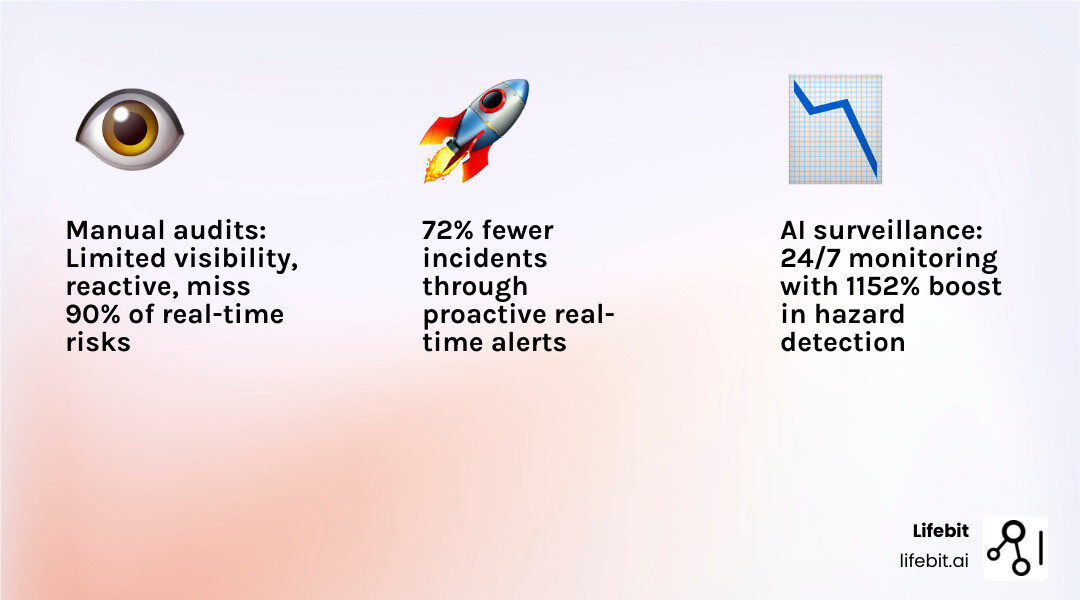
AI safety surveillance tools are bridging this “visibility gap.” These systems process billions of video frames daily, scoring risk in real time and alerting safety teams the moment a hazard appears. Organizations using these tools report 1152% more visibility into unsafe behaviors that were previously invisible to management. This leads to a 72% reduction in total incidents and a 25% reduction in Lost Time Injury Rate (LTIR). For example, the energy giant Orlen reported a 75% decrease in safety incidents after deploying AI-powered surveillance across its high-risk facilities.
The shift from reactive audits to proactive AI monitoring represents a paradigm shift in Environmental Health and Safety (EHS). It is no longer about documenting what went wrong; it is about ensuring nothing goes wrong in the first place. Whether it is detecting a brandished firearm in 2-3 seconds, identifying a forklift collision risk in a crowded warehouse, or alerting staff to a medical emergency in under 15 seconds, these tools turn existing cameras into intelligent safety sentinels.
I’m Dr. Maria Chatzou Dunford, CEO and Co-founder of Lifebit. My career has been dedicated to building platforms that transform global healthcare through federated data analysis. With over 15 years of expertise in AI, high-performance computing, and health-tech, I have witnessed firsthand how ai safety surveillance tools can revolutionize not just workplace safety, but also pharmacovigilance and real-time health monitoring. In this comprehensive guide, we will explore the top AI safety surveillance tools for 2026 and beyond—covering everything from SIF prevention to privacy compliance and the measurable ROI of intelligent monitoring.
Why Manual Audits Fail — And How AI Safety Surveillance Tools Fix It
For decades, Environmental Health and Safety (EHS) teams have relied on manual walk-throughs, paper checklists, and “lagging indicators”—essentially looking at what went wrong after an accident occurred. This approach is fundamentally flawed because it is reactive. The problem is simple: humans cannot be everywhere at once. In unoptimized facilities, injury frequency and severity remain stubbornly high, largely because critical risks are invisible to the naked eye during a once-a-week audit. This is often referred to as the “Observer Effect” or the “Hawthorne Effect,” where employees behave safely only when they know they are being watched by a supervisor, returning to unsafe habits the moment the auditor leaves the floor.
Traditional methods are proving insufficient against escalating physical threats and the increasing pace of industrial automation. When we look at the data, the contrast is staggering. While a human supervisor might catch a handful of safety violations in a shift, ai safety surveillance tools process over 22 billion frames daily across thousands of cameras simultaneously. This level of situational awareness provides an extraordinary 1152% increase in unsafe behavior detection. By capturing every “near-miss,” these tools provide a wealth of “leading indicators” that allow safety managers to address root causes before an actual injury occurs.
By shifting to a proactive safety culture, we move away from “hoping for the best” to “knowing the risk.” These tools identify Serious Injury and Fatality (SIF) precursors—such as a worker missing a harness at height, a forklift speeding in a pedestrian zone, or a spill that hasn’t been cleaned up—and trigger an alert in milliseconds. This real-time validation allows for immediate intervention, effectively stopping a tragedy before it starts. Furthermore, the data collected by these systems allows for “heat mapping” of risk, showing management exactly where infrastructure changes (like better lighting or physical barriers) are needed most.
In the context of the “Swiss Cheese Model” of accident causation—where an accident occurs when the holes in multiple layers of defense align—AI safety surveillance acts as a dynamic, ever-present layer that fills those holes in real time. It compensates for human fatigue, distraction, and the physical impossibility of monitoring every square inch of a facility simultaneously.
Top Categories of AI Safety Surveillance Tools for Industry and Institutions
The landscape of ai safety surveillance tools has expanded far beyond simple motion detection. Today, specialized sensors and algorithms are customized to specific environments, from heavy manufacturing plants in the UK to high-security biomedical labs in the USA and Singapore. The integration of multi-modal AI—combining visual, thermal, and acoustic data—has created a comprehensive safety net that operates across the electromagnetic spectrum. This multi-layered approach ensures that if one sensor is obstructed (e.g., a camera blocked by a pallet), another sensor (e.g., an acoustic or thermal sensor) can still detect the hazard.
| Sensor Type | Primary Function | Key Benefit |
|---|---|---|
| Vision (CCTV) | Behavioral analysis & PPE monitoring | 1152% boost in hazard detection |
| Thermal | Heat hazard & fire detection | Sub-50ms response for fire safety |
| Acoustic | Gunshot & aggression detection | 2-3 second weapon identification |
| Biometric | Secure access control | Prevents unauthorized entry |
| Lidar | 3D spatial awareness | Precise forklift-pedestrian distancing |
Real-time Vision and AI Safety Surveillance Tools for SIF Prevention
Most organizations already have the hardware they need. Modern ai safety surveillance tools seamlessly integrate with 95% of existing digital camera infrastructure. This “plug-and-play” capability means facilities can be protected in minutes rather than months. The software acts as an intelligent overlay, analyzing the video stream in real-time without the need for constant human monitoring.
In industrial settings, these tools focus on high-risk zones where vehicles and pedestrians interact. They monitor:
- Forklift Safety: Detecting near-misses, speeding, and improper load handling. AI can even trigger automatic speed limiters on the vehicles themselves if a pedestrian is detected nearby.
- PPE Compliance: Ensuring helmets, high-visibility vests, and gloves are worn in required areas. The system can deny access to a zone if the correct gear isn’t detected.
- Restricted Access: Alerting when unauthorized personnel enter dangerous zones, such as high-voltage areas or chemical storage rooms.
- Fall Detection: Identifying slips or trips in real-time to ensure rapid medical assistance, which is critical in “lone worker” scenarios where an injured person might not be found for hours.
Lidar (Light Detection and Ranging) has emerged as a game-changer for 3D spatial awareness. Unlike 2D cameras, Lidar creates high-resolution point clouds that allow the AI to calculate the exact distance between a forklift and a worker down to the centimeter. This eliminates the “perspective errors” common in standard video, where a person standing far behind a vehicle might appear to be right next to it. Furthermore, Lidar is unaffected by lighting conditions, making it ideal for dimly lit warehouses or outdoor yards at night.
For those in the life sciences sector, this technology mirrors the precision we use in Real-time Adverse Drug Reaction Surveillance, where monitoring for safety signals must be constant and immediate to protect patient health. Just as we monitor for digital signals of drug toxicity, AI surveillance monitors for physical signals of workplace danger.
Advanced AI Safety Surveillance Tools for High-Risk Zones
Beyond standard video, specialized devices improve safety in extreme environments. Thermal monitoring systems provide sub-50ms response times for detecting overheating equipment or early-stage fires, which is critical in chemical and power plants where a fire can become catastrophic in seconds. These systems can “see” heat signatures through smoke or in total darkness, providing a level of protection that human guards cannot match.
In institutional settings like schools and hospitals, medical emergency detection has proven response times as fast as 15 seconds for seizures or falls. Furthermore, AI weapon detection technology, such as ZeroEyes, can identify brandished firearms in 2-3 seconds. By identifying the threat before a shot is fired, these systems can immediately alert law enforcement and trigger automated lockdown procedures, potentially saving lives during active shooter incidents. This proactive approach is a significant advancement over traditional acoustic gunshot detection, which only alerts authorities after the violence has begun.
Acoustic and Environmental AI
Acoustic AI tools are now being used to detect the “sound of failure” in machinery or the sound of glass breaking and aggressive shouting in public spaces. By training neural networks on specific sound profiles, these tools can distinguish between a normal industrial bang and the sound of a structural failure, providing an extra layer of safety that visual-only systems might miss. When combined with environmental sensors that detect gas leaks or air quality changes, AI safety surveillance becomes a holistic “digital nervous system” for the facility. The concept of the “Digital Twin” is also being integrated into these surveillance tools. By mapping the physical facility into a virtual model, AI can simulate “what-if” scenarios—such as the impact of changing a traffic lane—before any physical changes are made. This predictive capability moves safety from real-time detection to proactive infrastructure optimization.
Maximize ROI: Measurable Benefits of AI-Driven Safety
Implementing ai safety surveillance tools isn’t just an ethical choice; it’s a financial imperative. In 2022, global companies crossed the $1 trillion threshold in lost revenue due to physical security incidents. The Return on Investment (ROI) of AI-driven safety is seen in several key areas, both direct and indirect:
- Incident Reduction: Organizations like Orlen have used these tools to cut incidents by 75%. Fewer incidents mean lower medical costs, fewer legal settlements, and less time spent on accident investigations.
- Lower LTIR: Customers typically see a 25% reduction in Lost Time Injury Rates. This keeps the workforce healthy and productive, avoiding the high costs of hiring and training temporary replacements or permanent new hires.
- Operational Efficiency: Automated reporting replaces hours of manual data entry. Instead of EHS managers spending 40% of their time filling out forms, they can focus on high-level strategy and employee training. AI systems automatically generate compliance reports that are more accurate and detailed than manual logs.
- Insurance Savings: Insurance providers are increasingly offering lower premiums to companies that can demonstrate proactive risk mitigation. By providing a digital audit trail of safety compliance, companies can negotiate significantly better rates. Some insurers now offer “performance-based” premiums where rates are adjusted quarterly based on the AI-verified safety score of the facility.
- Total Cost of Risk (TCOR): AI tools help reduce the TCOR by identifying systemic issues. For example, if the AI detects frequent near-misses at a specific intersection, the company can redesign the floor plan, preventing a million-dollar accident before it happens.
Beyond the balance sheet, there is the “Social License to Operate.” In an era of high corporate transparency, a single viral video of a workplace accident can destroy a brand’s reputation overnight. AI safety surveillance tools provide a verifiable record of a company’s commitment to worker welfare. This transparency is increasingly important for ESG (Environmental, Social, and Governance) reporting. Investors are no longer satisfied with “zero accident” goals; they want to see the technological systems in place that make those goals achievable. By documenting thousands of proactive safety interventions, companies can prove to regulators, insurers, and the public that they are leaders in industrial safety.
For organizations managing complex data, such as those using our Pharmacovigilance Platform, the ability to automate safety monitoring ensures that no signal—physical or digital—is missed. The cost of a single missed safety signal in the pharmaceutical industry can be billions in fines and lost market cap; the same logic applies to the factory floor or the corporate campus. Proactive monitoring is the only way to protect the bottom line in an era of extreme accountability.
Solving the Privacy Puzzle: GDPR and EU AI Act Compliance
A common concern with surveillance is the “Big Brother” effect—the fear that employees are being constantly judged or that their personal data is being mishandled. However, modern ai safety surveillance tools are built with privacy-by-design at their core. To comply with strict regulations like GDPR and the EU AI Act, these systems use several layers of protection:
- Automated Anonymization: Faces and identifying features are blurred in real-time at the “edge” (on the camera or a local server). The AI focuses on the behavior (e.g., “is that person wearing a helmet?”) rather than the identity of the individual.
- PII Filters: Personally Identifiable Information is stripped from data logs before they are stored. This ensures that even if a data breach were to occur, no individual could be identified from the safety logs.
- Audit Logs and Transparency: Every interaction with the system is recorded, ensuring traceable and accountable governance. Employees can be shown exactly what the AI is looking for, which helps build trust and a shared culture of safety.
- Edge Processing: Data can be processed locally on-premise, meaning sensitive video never has to leave the facility or be uploaded to the cloud. This is a critical requirement for high-security biomedical labs and government contractors.
The EU AI Act, in particular, classifies certain types of surveillance as “High Risk,” requiring rigorous documentation and human oversight. Modern AI safety tools are designed to meet these requirements by providing “Human-in-the-loop” (HITL) features, where the AI flags a potential risk but a human supervisor makes the final decision on whether to intervene. This prevents “algorithmic bias” and ensures that safety decisions are always grounded in human judgment.
At Lifebit, we apply similar rigorous standards to biomedical data through our AI-driven Pharmacovigilance Solutions, ensuring that while we gain life-saving insights, individual privacy remains uncompromised. Whether it’s a genomic sequence or a video feed of a warehouse, the principle is the same: data must be used to protect people, not to exploit them.
Deployment Strategies for Modern AI Safety Surveillance Tools
Choosing the right deployment model is crucial for performance, security, and scalability. Organizations must balance the need for real-time speed with the requirements of data sovereignty. There are three main options:
- Cloud-Based: Best for multi-site visibility and rapid scaling. This model allows a global head of safety to see risk trends across 50 different factories from a single dashboard. It requires a robust internet connection but offers the most powerful analytical tools.
- On-Premise: Ideal for facilities with limited internet connectivity or extreme data privacy requirements. All processing happens on local servers, ensuring that video data never leaves the building. This is often the preferred choice for the defense and energy sectors.
- Hybrid: Combines the local speed of on-premise processing (for immediate alerts like fire or falls) with the centralized management of the cloud (for long-term trend analysis). This is becoming the industry standard for large enterprises.
The technical architecture of these deployments often relies on Multi-access Edge Computing (MEC). By processing data at the “edge” of the network—often within the facility’s own 5G private network—latency is reduced to single-digit milliseconds. This is the difference between a machine stopping before contact and stopping after contact. For global enterprises, this edge-first approach also solves the “Data Sovereignty” challenge. In jurisdictions like Germany or Switzerland, where labor laws strictly govern the movement of employee data, keeping the video processing local ensures compliance while still allowing anonymized metadata (like “number of near-misses per hour”) to be sent to a central global dashboard for trend analysis.
Managing “Shadow AI” and Security Risks
As organizations adopt more AI, they often face the challenge of “Shadow AI”—AI tools and browser extensions used by employees without official IT approval. Research shows most organizations use up to 5x more AI tools than they realize. This creates a massive security hole, as sensitive safety data could be fed into unauthorized LLMs or third-party apps. Tools like the WitnessAI catalog can detect over 4,000 AI applications, providing 100% visibility into every interaction and ensuring that only approved ai safety surveillance tools are in use.
Furthermore, as AI becomes central to software development, 1 in 5 organizations have suffered a serious incident linked to AI-generated code. This makes AI security tools essential for protecting the digital infrastructure that powers physical safety systems. If the code running your safety cameras is vulnerable, your physical safety is also at risk. Platforms like CrowdStrike Falcon and SentinelOne are now critical components of a holistic safety strategy, protecting the AI models themselves from “adversarial attacks” or data poisoning.
The Role of 5G and IoT
The rollout of 5G technology is a major catalyst for AI safety surveillance. The ultra-low latency of 5G allows for more complex AI models to be run at the edge, enabling even faster response times. When combined with the Internet of Things (IoT)—where sensors on machines, wearable devices on workers, and AI cameras all communicate—we see the emergence of “Connected Safety.” In this ecosystem, an AI camera detecting a gas leak can automatically shut down machinery and send an evacuation route to every worker’s smartwatch simultaneously. This level of integration requires a robust “AI Safety Stack” consisting of high-performance hardware, secure middleware for data orchestration, and the application layer where the safety logic resides.
Frequently Asked Questions
How do AI safety surveillance tools integrate with existing cameras?
These systems are designed for maximum compatibility, integrating with 95% of digital camera infrastructure. They typically connect via standard IP protocols (like ONVIF or RTSP), meaning you don’t need to buy new hardware. Deployment can often be completed in minutes by connecting the AI software to your existing CCTV network. The software simply “reads” the video stream that is already being produced.
Can these tools detect medical emergencies like seizures or falls?
Yes. Specialized ai safety surveillance tools are trained on thousands of hours of footage to recognize the specific biomechanical patterns of a fall, a seizure, or an individual becoming unconscious. Unlike simple motion sensors, they can distinguish between someone bending over to pick up a tool and someone collapsing. In real-world scenarios, these systems have demonstrated response times as fast as 15 seconds, alerting medical staff or school nurses immediately.
How do organizations manage “Shadow AI” risks?
Organizations can use tools like WitnessAI to scan their entire network for third-party AI applications and agents. This provides 100% visibility into AI adoption, allowing teams to create smarter, intent-based policies that prevent data leaks or unauthorized AI use. It ensures that the only AI interacting with your safety data is the AI you have vetted and approved.
How do these tools integrate with existing EHS management software?
Most modern AI safety platforms offer robust API integrations with industry-standard EHS software like VelocityEHS, Enablon, or Cority. Instead of safety managers manually entering “near-miss” data into their systems, the AI automatically pushes the event log, including a timestamped, anonymized video clip, directly into the incident management module. This creates a “single source of truth” for safety data, ensuring that audits are backed by objective video evidence rather than subjective witness accounts. This automation can reduce the administrative burden on safety teams by up to 40%.
What about false positives? Does the AI cry wolf?
Early AI systems were prone to false positives, but modern “deep learning” models are significantly more accurate. Most systems allow for “sensitivity tuning,” where the AI can be calibrated to the specific environment. Furthermore, many platforms use a “human-in-the-loop” verification process for high-stakes alerts, ensuring that emergency services are only called when a genuine threat exists.
Is the data used to train these tools biased?
Bias is a concern in any AI system. Leading AI safety providers use diverse datasets to ensure their algorithms work across different ethnicities, body types, and clothing styles. Continuous monitoring and regular “bias audits” are now standard practice for top-tier AI safety vendors to ensure equitable protection for all employees.
Conclusion: The Future of Safety is Federated and Intelligent
The transition to ai safety surveillance tools represents a fundamental shift in how we protect people and assets. By moving away from reactive, manual processes toward real-time, AI-driven oversight, organizations can finally close the visibility gap that leads to tragic accidents. We are moving toward a future of “Autonomous Safety,” where the environment itself is intelligent enough to prevent harm.
At Lifebit, we believe that safety and security are the foundations of innovation. Our next-generation federated AI platform enables secure, real-time access to global biomedical and multi-omic data, powering large-scale research and Real-time Pharmacovigilance. Just as AI sentinels protect the factory floor by identifying physical hazards, our Trusted Research Environment (TRE) and R.E.A.L. layer protect the world’s most sensitive health data from digital threats and misuse.
The convergence of physical and digital safety is inevitable. As our workplaces become more automated and our data becomes more complex, the need for intelligent, real-time surveillance will only grow. Whether you are securing a warehouse, a school, or a global drug safety database, the message is clear: the most dangerous risk is the one you can’t see. AI gives us the eyes to see those risks and the power to act before they become tragedies.
Ready to modernize your safety strategy? Explore our AI Pharmacovigilance Guide 2025 or learn more about our Drug Safety AI capabilities to see how Lifebit is leading the charge in secure, real-time surveillance across the physical and digital realms.