

Why Health Data Science is More Than Just Numbers

Health Data Science: Turn 2,314 Exabytes of Data Into Life-Saving Insights
Health data science is the specialized field that combines biostatistics, epidemiology, machine learning, and computer science to transform massive volumes of medical information into actionable insights that improve patient care, accelerate drug discovery, and shape public health policy.
Quick Overview: What You Need to Know About Health Data Science
- What it is: The application of advanced analytics, AI, and statistical methods to healthcare and biomedical data
- Key data sources: Electronic health records (EHRs), genomic sequences, wearable devices, medical imaging, and clinical trials
- Core applications: Predicting patient readmission, personalizing treatment plans, discovering new drug targets, and monitoring disease outbreaks
- Essential skills: Programming (Python, R, SQL), machine learning, biostatistics, and domain knowledge in medicine or public health
- Main challenges: Data quality issues, privacy regulations (HIPAA, GDPR), algorithmic bias, and integrating siloed datasets
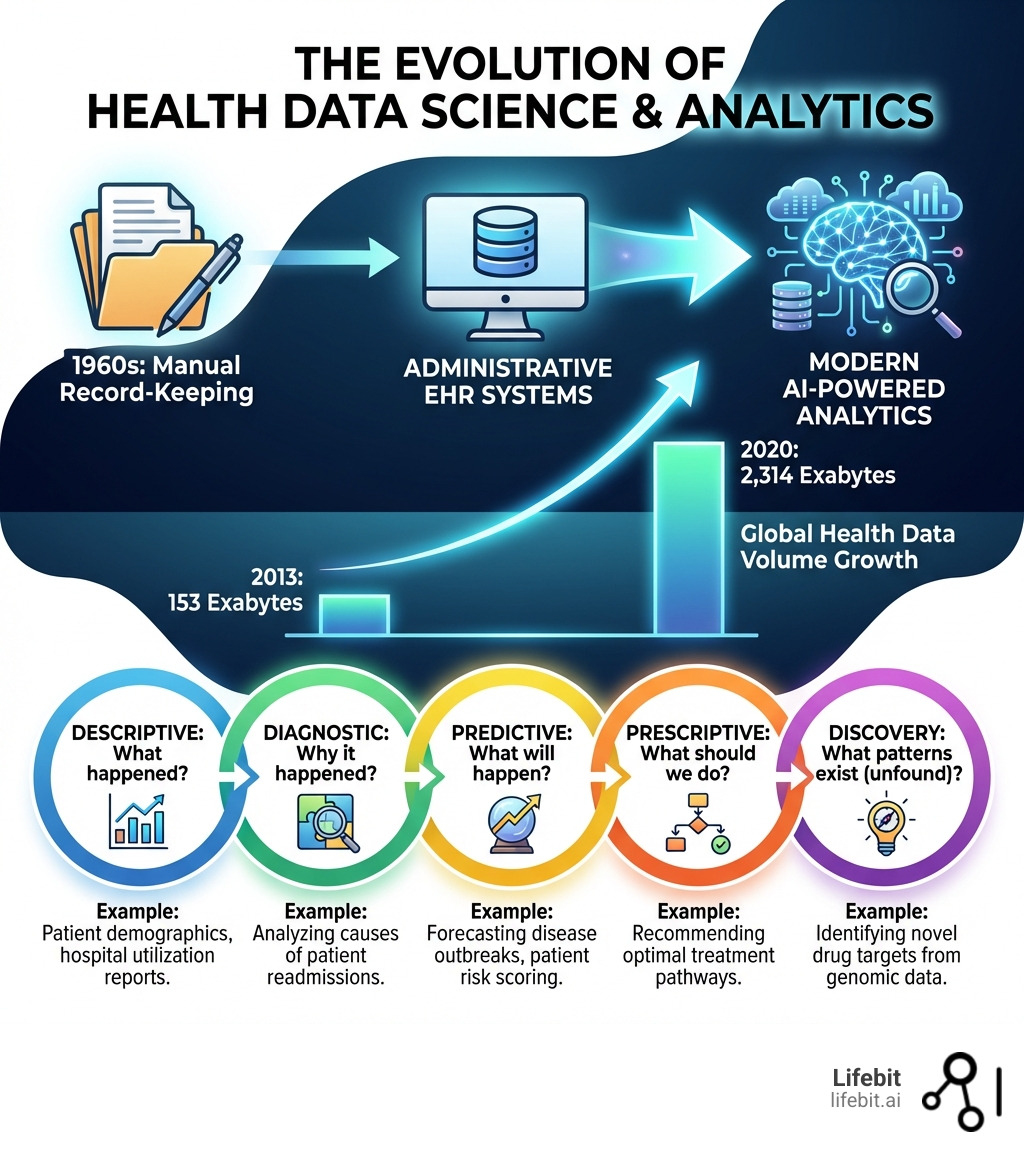
The numbers tell a staggering story. An estimated 2,314 exabytes of health data were produced worldwide in 2020—up from just 153 exabytes in 2013. To put that in perspective, five exabytes is roughly equal to all the words ever spoken by humanity.
This data deluge represents both an enormous opportunity and a formidable challenge. Healthcare organizations now capture petabytes of information across EHRs, genomic sequences, and IoT devices. Yet many struggle with slow data onboarding, poor data quality, and regulatory bottlenecks that prevent them from turning this information into real-time insights.
The field has evolved dramatically from manual data cataloging in the 1960s to today’s AI-powered predictive systems. Healthcare analytics now encompasses five distinct types: descriptive (what happened), diagnostic (why it happened), predictive (what will happen), prescriptive (what should we do), and discovery (what patterns exist that we haven’t found yet).
I’m Dr. Maria Chatzou Dunford, CEO and Co-founder of Lifebit, where I’ve spent over 15 years working at the intersection of computational biology, AI, and health-tech entrepreneurship to make Health data science more accessible through federated analysis platforms. My background spans a PhD in Biomedicine, an MSc in Bioinformatics, and hands-on experience building tools that enable precision medicine across secure, compliant environments.
Health data science terms to learn:
Stop Guessing: How Health Data Science Predicts Patient Risks
In the past, a doctor’s intuition and a few pages of handwritten notes were the primary tools for diagnosis. Today, Health data science serves as the invisible nervous system of the modern hospital. It isn’t just about crunching numbers; it’s about making sense of the “data deluge” to ensure that every patient receives the right treatment at the right time.
While general data science might focus on optimizing ad clicks or predicting which movie you’ll watch next, Health data science deals with much higher stakes. If an e-commerce algorithm fails, you see a bad recommendation. If a clinical algorithm fails, patient safety is at risk. This is why the field requires a unique blend of clinical informatics and rigorous statistical principles.

The history of this field is longer than many realize. Electronic health records (EHRs) were first used for administrative functions as early as the 1960s. Pioneering work published in PubMed: 14442625 explored new concepts in the clinical use of electronic digital computers over sixty years ago. Since then, the focus has shifted from simple storage to generating insights for new scientific discoveries and health policies.
To understand why this field is unique, let’s look at how it differs from traditional data roles:
| Feature | General Data Science | Health Data Science |
|---|---|---|
| Primary Goal | Business ROI / User Engagement | Patient Outcomes / Public Health |
| Data Quality | Often clean, structured logs | “Filthy,” inconsistent, siloed |
| Regulation | GDPR / CCPA | HIPAA / GDPR / GxP / Clinical Ethics |
| Common Tools | Python, SQL, Tableau | Python, R, SAS, SQL, Bio-conductors |
| Stakeholders | Marketing, Product, Finance | Clinicians, Researchers, Patients |
For a deeper dive into how these analytics are applied, check out our Health data analytics complete guide.
The 5 Pillars of Healthcare Analytics
Understanding Health data science requires breaking down the five key types of analytics that drive decision-making. These aren’t just academic categories; they represent the lifecycle of a medical insight.
- Descriptive Analytics: This answers “What happened?” It involves summarizing historical data, such as calculating the average length of stay in a hospital or tracking the number of patients vaccinated during a flu season.
- Diagnostic Analytics: This digs into “Why did it happen?” By using techniques like root cause analysis, researchers can identify why certain populations have higher rates of hospital-acquired infections.
- Predictive Analytics: This is where the magic happens—predicting “What will happen?” We use machine learning to forecast patient readmission risks or identify individuals at high risk for chronic conditions like heart failure.
- Prescriptive Analytics: This answers “What should we do?” It provides specific recommendations, such as clinical decision support systems that suggest the most effective antibiotic based on a patient’s unique biomarkers.
- Discovery Analytics: As highlighted in PubMed: 29968621, this involves exploring data without a predefined hypothesis to uncover novel patterns, such as identifying a new drug target or a previously unknown symptom of a rare disease.
Real-World Impact on Patient Outcomes
The ultimate goal of Health data science is to move from “average” medicine to precision medicine. For example, AI in healthcare solutions are now being used to assist radiologists by identifying key features in CT scans to diagnose lung diseases faster and more accurately.
We see this impact in operational efficiency too. By analyzing massive databases, hospitals can optimize staffing levels based on predicted patient demand, reducing wait times and improving the quality of care. In the pharmaceutical world, data science is used to identify patient cohorts for clinical trials in minutes rather than months, bringing life-saving treatments to market faster.
Standardize ‘Filthy’ Health Data: Turn Siloed EHRs Into Precision Medicine
The sheer variety of data in healthcare is enough to make any data scientist’s head spin. We aren’t just looking at spreadsheets; we are looking at a multi-modal mix of human life.
- Electronic Health Records (EHRs): These contain clinical notes, lab results, and medication history.
- Genomics and Multi-omics: High-throughput sequencing provides a comprehensive picture of an individual’s genome, which can be integrated with proteomic and transcriptomic data. Research in PubMed: 27740470 highlights how this “big data” is essential for precision medicine.
- Wearables and IoT: Devices like smartwatches provide real-time data on heart rate, sleep patterns, and physical activity.
- Medical Imaging: X-rays, MRIs, and CT scans provide high-resolution data that requires advanced computer vision techniques to analyze.
Managing this variety requires a solid understanding of Real-world data complete guide.
Overcoming the “Filthy Data” Challenge in Health Data Science
Ask any health data scientist about their biggest headache, and they’ll likely say “data quality.” Healthcare data is notoriously “filthy.” It’s often locked in silos, formatted in inconsistent standards, and filled with missing values.
A data professional in this industry might pull from tables with over 1 billion rows and 100+ fields, only to find that “Date of Birth” is recorded in five different formats across three different systems. This is why Health data standardisation and Health data interoperability are so critical. Without standardized data, scaling AI models across different hospitals becomes nearly impossible.
Advanced Analytical Methods and Tools
To tackle these massive datasets, health data scientists rely on a robust toolkit. While Excel might be fine for a small clinic, the heavy lifting is done with:
- Programming Languages: Python and R are the gold standards for statistical modeling and machine learning. SQL is indispensable for querying the massive databases that house EHR data.
- Machine Learning (ML): Supervised learning helps us classify diseases, while unsupervised learning can identify hidden patterns in unlabeled data that humans might miss.
- Statistical Modeling: Classical statistics remain the bedrock of the field, ensuring that the conclusions we draw from data are scientifically rigorous.
For those looking to master these techniques, our Advanced analytics ultimate guide provides a comprehensive roadmap.
Secure Medical AI: Stop Bias and Protect Privacy with Federated Learning
As we integrate AI more deeply into healthcare, we must also build robust ethical guardrails. The potential for Health data science to improve lives is matched by the risk of exacerbating disparities if not managed properly.
Ethics, Privacy, and the Future of Health Data Science
One major concern is algorithmic bias. If an AI model is trained on data that isn’t representative of the entire population, it can produce biased results. For example, pulse oximeters were found to be less accurate on patients with darker skin tones during the COVID-19 pandemic.
Institutions like the Ethox Centre and the Wellcome Centre for Ethics and Humanities are dedicated to researching these ethical, legal, and social implications. The NIH has even launched a $74.5 million initiative to support research in this area.
Key ethical principles include:
- Data Minimization: Only collecting the data that is absolutely necessary for the research.
- Patient Consent: Ensuring patients understand how their data will be used.
- Algorithmic Fairness: Regularly auditing models for bias to ensure equitable outcomes.
Learn more about how we generate AI-driven insights while maintaining the highest ethical standards.
The Role of Federated Learning and Secure Access
How do we analyze global data without compromising privacy? The answer lies in Federated Learning. Instead of moving sensitive patient data to a central server, the AI model “travels” to the data. This allows for global collaboration across hybrid data ecosystems while keeping the data securely behind the hospital’s firewall.
This is the core of a modern Health data science platform. By using a Trusted Research Environment (TRE), researchers can access the data they need to perform Data science in precision medicine without the data ever leaving its secure home.
Health Data Science Careers: Get the Skills for a High-Impact Job
With the explosion of health data, the demand for skilled professionals is soaring. If you’re looking to enter this field, you’ll need a mix of technical prowess and domain expertise.
Academic Pathways and Professional Development
Several world-class institutions have developed programs specifically for this field:
- UCLA Master of Data Science in Health (MDSH): A 20-month program designed for working professionals, requiring five additional credits in computer science. You can Register for an Information Session to learn more.
- Oxford EPSRC CDT in Healthcare Data Science: This doctoral program includes a training year with intensive modules and two ten-week research projects. DPhil students typically submit their thesis within four years.
- UCSF Master’s in Health Data Science: A 2-year program requiring 36 units of coursework, including DATASCI 220. A unique feature is the requirement for students to gain instructional experience, helping them learn to explain complex concepts to non-technical team members.
According to the UCSF Graduate Program Health Data Science Bylaws, students also complete a longitudinal capstone project, which includes preparing a peer-reviewed manuscript and an online code portfolio.
Career Paths in Hospitals, Pharma, and Government
The career opportunities are as diverse as the data itself. You might find yourself:
- In Pharma: Designing clinical trials or using multi-omics to find new drug targets.
- In Hospitals: Building predictive models to reduce patient wait times or prevent sepsis.
- In Government/Public Health: Using data to track disease outbreaks or inform health policy.
For a broader look at the landscape, see our Big data analytics complete guide.
Health Data Science FAQ: Solve the ‘Three S’s’ of Medical Data
How does Health Data Science differ from general Data Science?
While general data science focuses on business metrics, Health data science focuses on clinical outcomes. It requires deep domain knowledge in medicine, biology, or public health, and must adhere to much stricter regulatory and ethical standards like HIPAA and GDPR.
What are the most common challenges with healthcare data?
The “Three S’s”: Silos, Standards, and Security. Data is often locked in disconnected systems, lacks consistent formatting, and requires extreme security measures to protect patient privacy.
What educational background is required for this field?
Most roles require at least a Master’s degree in a quantitative field like Biostatistics, Epidemiology, Computer Science, or a dedicated Health Data Science program. Strong programming skills in Python or R and an understanding of clinical workflows are essential.
Start Your Data-Driven Research with Lifebit Today
At Lifebit, we believe that the future of medicine is data-driven. Our next-generation federated AI platform enables secure, real-time access to global biomedical and multi-omic data, powering large-scale research for biopharma, governments, and public health agencies.
By providing tools like the Trusted Research Environment (TRE) and our Trusted Data Lakehouse (TDL), we help researchers overcome the traditional bottlenecks of data access and harmonization. We aren’t just looking at numbers; we’re looking at the insights that will define the next century of human health.
Transform your research with Lifebit and join us in making Health data science the most impactful field of our time.