

Why trauma registry software is a lifesaver

Stop Losing $500k: Why Your Trauma Center Needs Modern Trauma Registry Software Now
Trauma registry software is a specialized platform that collects, manages, and analyzes patient data from emergency and trauma injuries to improve clinical outcomes and meet national reporting standards. When you’re evaluating trauma data solutions, here’s what you need to know:
Key capabilities to look for:
- Automated data capture from EHR systems via HL7 and FHIR integration
- Built-in compliance with NTDB, TQIP, and ABA standards
- Real-time reporting and performance improvement dashboards
- Injury scoring automation (AIS, ISS, GCS)
- Claim reconciliation to identify missed revenue
The Historical Context and the Cost of Inaction
The concept of the trauma registry dates back to the late 1960s, following the landmark white paper “Accidental Death and Disability: The Neglected Disease of Modern Society.” This document highlighted the need for systematic data collection to understand injury patterns. Today, the stakes are even higher. Research shows these systems reduce disability and death rates from traumatic injuries while helping hospitals recover hundreds of thousands in uncaptured revenue. The National Trauma Data Bank—the largest collection of U.S. trauma data—relies on standardized registry software to aggregate information from trauma centers nationwide.
Every day without proper trauma registry software means manual data entry, compliance gaps, and missed opportunities to save lives. Traditional registries focus only on data capture and reporting, ignoring the full spectrum of data management—leading to wasted effort reconciling information across disconnected systems. For a Level I or Level II trauma center, the administrative burden of manual abstraction can cost upwards of $200,000 annually in labor alone, not including the potential for lost clinical revenue.
Modern trauma centers need platforms that unify data collection, coding, quality improvement, and financial integrity in one place. These systems automatically import hundreds of data points from your hospital’s EHR, flag compliance issues before submission, and generate insights that drive better patient outcomes. By automating the “drudge work” of data entry, trauma registrars can transition into data analysts, focusing on identifying trends that lead to better surgical interventions and faster recovery times.
I’m Dr. Maria Chatzou Dunford, CEO and Co-founder of Lifebit, where we’ve spent over 15 years building platforms that transform how healthcare organizations manage complex biomedical data. While trauma registry software addresses critical point-of-care data needs, the same principles of secure, federated data integration apply across all healthcare research and clinical excellence initiatives.
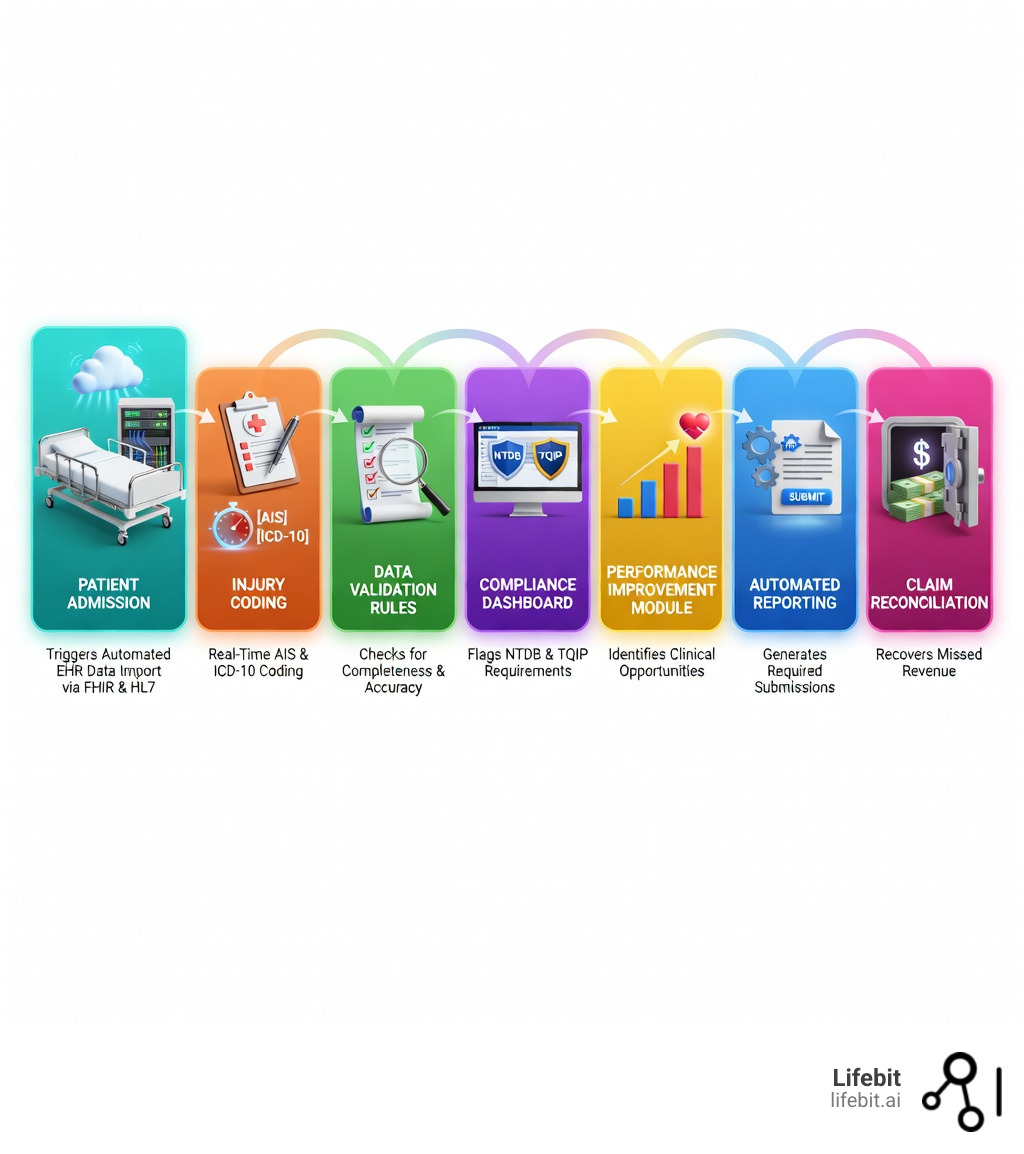
Trauma registry software vocab to learn:
What is Trauma Registry Software and Why Your Center Can’t Afford to Wait
At its heart, trauma registry software is an injury surveillance powerhouse. It doesn’t just store names and dates; it gathers, evaluates, and monitors specific patient data related to traumatic brain injuries (TBI), spinal cord damage, and major vehicular crashes. For healthcare facilities in the USA, Canada, and Europe, these registries are the clinical backbone of a verified trauma center. Without a robust registry, a center cannot maintain its accreditation from the American College of Surgeons (ACS) or state-level regulatory bodies.
We’ve seen that centers using these systems experience a significant decrease in the rate of disability and death. Why? Because the software provides immediate insight into which clinical practices are working and which aren’t. Without it, you’re essentially flying blind, relying on retrospective paper audits that might be months out of date. For instance, if a specific protocol for managing intracranial pressure is failing, a modern registry will flag the trend in weeks, not years.
| Feature | Manual/Legacy Registries | Modern Trauma Registry Software |
|---|---|---|
| Data Entry | Manual abstraction (hours per chart) | Automated EHR/EMS import (minutes) |
| Coding | Manual lookup of AIS/ICD-10 | Integrated, auto-suggested coding |
| Compliance | Periodic manual checks | Real-time validation rules |
| PI/QI | Disconnected spreadsheets | Fully integrated loop closure |
| Reporting | Static, delayed reports | Dynamic, real-time dashboards |
Essential Features Every Trauma Registry Software Must Have
If we’re going to build a high-performing trauma program, we need tools that do the heavy lifting. The best trauma registry software solutions include:
- Standardized Coding Support: Seamless integration with the Abbreviated Injury Scale (AIS)—originally developed by the Association for the Advancement of Automotive Medicine (AAAM) in the 1970s—and the latest ICD-10-CM/PCS codes. The software should support the transition between different AIS versions (e.g., AIS 2005 vs. AIS 2015) to ensure longitudinal research remains valid.
- Automated Scoring: The software should automatically calculate the Injury Severity Score (ISS), an internationally accepted method for assessing patients with multiple injuries. It should also handle the Revised Trauma Score (RTS) and the TRISS methodology for calculating the probability of survival.
- Customization on the Fly: You shouldn’t need a computer science degree to add a custom field. Modern platforms allow us to configure tabs, reports, and dashboards to track specific research projects, such as the efficacy of a new massive transfusion protocol (MTP) or local QI initiatives.
- Inter-rater Reliability (IRR): To ensure data integrity, the software must support IRR validation. This allows multiple users to grade the same record independently, with the system highlighting discrepancies. This is a critical requirement for ACS verification.
Real-Time Data That Improves Patient Survival
The “Golden Hour” in trauma care isn’t just about surgery; it’s about data. Using the Glasgow Coma Scale (GCS) within the registry allows for a reliable, objective way of recording the conscious state of a person. When this data is captured concurrently—meaning while the patient is still in the hospital—clinical teams can identify performance improvement (PI) opportunities immediately.
For example, if a registry rule flags that an open fracture didn’t reach the OR within the required six-hour window, an automated event is generated. This allows the trauma coordinator to address the delay while the details are fresh, rather than months later during a quarterly meeting. This “concurrent abstraction” is the gold standard for modern trauma centers, as it allows for “just-in-time” education for the clinical staff.
Automating Compliance: Meet National Trauma Data Standards Without the Headache
Compliance is often the biggest “headache” for trauma registrars. In the USA, we must align with the National Trauma Data Bank (NTDB) and the Trauma Quality Improvement Program (TQIP). In Canada, the Ontario Trauma Registry and CIHI standards dictate how data is handled. These standards are not static; they evolve annually, requiring software that can adapt without requiring a total system overhaul.
Modern trauma registry software acts as a filter. It applies hundreds of validation rules in the background to prevent invalid entries. This means when it’s time to submit data to national major trauma registries (like the NMTR in England or state registries in the US), the data is already “clean.” The software should include a “Data Dictionary” that maps local hospital terms to the National Trauma Data Standard (NTDS) definitions, ensuring that a “complication” in your hospital means the same thing as a “complication” in the national database.
Required national datasets typically include:
- Demographics and injury details: Age, gender, race, and the mechanism of injury (e.g., fall, motor vehicle crash, penetrating wound).
- Pre-hospital EMS data: Arrival times, initial vitals, and interventions performed in the field.
- Emergency Department (ED) and acute care processes: Time to CT scan, time to first incision, and ventilator management.
- Complications and hospital outcomes: Surgical site infections, pneumonia, and discharge disposition (e.g., home, rehab, or morgue).
- Injury severity scores: Automated calculation of AIS, ISS, and GCS.
Seamless Integration with EHR and EMS Systems
The days of “double entry” are over. We now use Fast Healthcare Interoperability Resources (FHIR) and HL7 ADT (Admission, Discharge, Transfer) feeds to sync patient encounters automatically. This integration is vital because it eliminates the transcription errors that occur when a registrar manually copies blood pressure readings or lab results from one screen to another.

By mapping FHIR data directly to registry definitions, modern trauma registry platforms can import hundreds of data points from systems like Epic and Cerner. This saves thousands of hours of manual abstraction and ensures that pre-hospital data from EMS (often via NEMSIS standards) is visible to the hospital team before the patient even arrives. This interoperability is the foundation of a truly integrated trauma system.
Data Quality and Validation: The Backbone of Registry Integrity
You’ve heard the phrase “garbage in, garbage out.” In trauma care, “garbage data” can lead to poor clinical decisions and failed accreditation. High-quality trauma registry software includes built-in audit trails and real-time validation. If a registrar enters a blood pressure that is physiologically impossible, the system flags it instantly. This level of integrity is what makes the NTDB—the largest aggregation of U.S. trauma data—so valuable for national benchmarking. It allows a Level III center in rural Iowa to compare its outcomes for geriatric falls against similar centers nationwide, adjusted for injury severity.
Boosting Financial Integrity and Program Sustainability
A trauma center is a massive financial undertaking, often operating on thin margins. One of the most overlooked benefits of trauma registry software is its role in financial health. Advanced registry solutions use validated registry data to identify uncaptured revenue that standard billing systems often miss.
In one documented instance, a facility identified over $508,000 in uncaptured revenue in just 30 days by reconciling registry data with hospital billing. The registry often contains more detailed information about procedures, ventilator days, and ICU stays than the standard billing software. For example, a registrar might document a complex bedside procedure that a physician forgot to charge for. By cross-referencing the registry with the billing log, the hospital can validate every charge and identify missed opportunities for reimbursement, particularly in the realm of “trauma activation fees.”
Supporting Performance Improvement (PI) and Research
Performance Improvement (PI) shouldn’t be an afterthought; it is the primary reason the registry exists. Modern registries have integrated PI modules that allow us to:
- Identify Opportunities: Automatically flag events based on custom rules (e.g., “Time to CT scan > 30 mins” or “GCS < 8 without secured airway").
- Loop Closure: Document the assessment, action plan, and monitoring to “close the loop” on clinical issues. This is a key requirement for ACS verification. If a delay in care is identified, the software tracks the corrective action (e.g., a change in staffing or a new equipment purchase) and monitors for future occurrences.
- Research Support: Access de-identified datasets for published research. For example, the Pennsylvania Trauma Systems Foundation (PTSF) has accumulated over a million records over 35 years, facilitating massive epidemiological studies on everything from helmet laws to the efficacy of tranexamic acid (TXA).
The Role of the Trauma Registrar
It is important to acknowledge that the software is a tool for the Trauma Registrar. These professionals are highly trained specialists who must understand anatomy, physiology, and complex coding rules. Modern software empowers them by removing the mundane tasks of data entry, allowing them to focus on data validation and trend analysis. A center with high-quality software and a certified registrar (CSTR) is far more likely to achieve “deficiency-free” status during an accreditation site visit.
The Future of Trauma Registry Software: AI and Federated Data
As we look toward 2026 and beyond, the role of trauma registry software is expanding. We are moving beyond simple data collection into the field of predictive analytics and multi-omic integration. The next generation of software will not just tell us what happened to the patient, but what is likely to happen next.
At Lifebit, we believe the future lies in federated AI. Instead of moving sensitive trauma data into a central silo—which creates security risks and regulatory hurdles—we bring the analysis to the data. This allows trauma researchers in Singapore, London, and New York to collaborate on global injury trends without ever compromising patient privacy. Imagine a registry that doesn’t just tell you what happened, but uses AI to predict which patients are at the highest risk for sepsis or secondary complications based on their multi-omic profile (genomics, proteomics, etc.) combined with their clinical registry data.
Overcoming Implementation Challenges in Trauma Data Management
Transitioning to a new registry system can be daunting for any hospital IT department. Common problems include:
- Data Silos: Information trapped in old, proprietary formats that are difficult to export.
- Manual Abstraction Burden: The sheer volume of historical data to migrate. A center with 20 years of data needs a vendor that can handle complex data mapping and migration without losing record integrity.
- Staff Training: Ensuring registrars are comfortable with new AIS 2015 or ICD-10 coding standards. The software should have built-in training modules and “help” features that reference the official coding manuals.
To overcome these, we recommend choosing a vendor with a dedicated transition team and a “yes mentality” toward customer support. Look for web-based, cloud-native systems that receive automatic updates. This eliminates the need for manual software patches and downtime, ensuring that the registry is always available when the trauma team needs it. Furthermore, cloud-native solutions offer better scalability, allowing a hospital system to manage multiple trauma centers under a single, unified registry umbrella.
Predictive Analytics in the Trauma Bay
In the near future, trauma registry software will integrate with real-time monitors in the ED. By applying machine learning algorithms to the registry’s historical data, the software could provide real-time decision support. For example, it could alert a surgeon that a patient’s physiological profile closely matches previous cases that required an immediate exploratory laparotomy, potentially shaving minutes off the time to surgery. This is the ultimate goal of trauma data: turning retrospective records into prospective life-saving insights.
Frequently Asked Questions about Trauma Registry Software
What are the core data types collected in a trauma registry?
The registry collects a comprehensive set of data including patient demographics, pre-hospital care (EMS), injury mechanisms, acute care processes (ED and surgery), clinical outcomes, complications, and payor class. It also includes specialized scores like the Glasgow Coma Scale (GCS), the Injury Severity Score (ISS), and the Revised Trauma Score (RTS). Modern registries also track “process measures” like the time to first antibiotic for open fractures.
How does registry software help with hospital accreditation?
Accreditation bodies (like the American College of Surgeons in the US or provincial foundations in Canada) require trauma centers to demonstrate active performance improvement and high-quality data submission. Registry software provides the real-time dashboards, compliance tracking, and automated reporting necessary to prove your center meets these rigorous standards. It also generates the “Pre-Review Questionnaire” (PRQ) required before an ACS site visit.
Can trauma registry software integrate with my existing EHR?
Yes. Modern solutions use HL7 ADT feeds and FHIR (Fast Healthcare Interoperability Resources) to map data from EHRs like Epic, Cerner, and Meditech directly into the registry. This reduces manual data entry by up to 50% and ensures that the registry is always in sync with the patient’s medical record. It can also pull data from EMS systems like ImageTrend or ESO.
What is the difference between a trauma registry and a general hospital registry?
A general hospital registry might track all admissions for administrative purposes. A trauma registry is highly specialized, focusing specifically on injury mechanisms and severity. It requires specialized coding (AIS) that general registries do not use. It is also a regulatory requirement for trauma center designation, whereas general registries are often optional.
How often should data be submitted to national databases?
Most national databases, like the NTDB, require annual submissions. However, many state registries and the TQIP program require quarterly submissions. Modern software automates this process, allowing for “one-click” submissions once the data has passed all validation checks.
Conclusion
Trauma registry software is no longer just a digital filing cabinet; it is a critical clinical tool that saves lives, ensures compliance, and protects the financial health of trauma centers. By moving from fragmented, manual processes to an integrated, automated platform, healthcare facilities can focus on what truly matters: delivering world-class care to the most critically injured patients. The transition from retrospective data collection to real-time, predictive analytics represents the next great leap in trauma surgery and emergency medicine.
At Lifebit, we are proud to support this mission by providing the next-generation federated AI platform that enables secure, real-time access to global biomedical data. Whether you are managing a Level I trauma center in New York or a national research initiative in the UK, our platform ensures that your data is harmonized, compliant, and ready to power the next breakthrough in trauma care. By leveraging the power of data, we can ensure that every trauma patient receives the right care at the right time, every time.