

All About Biopharma’s Digital Leap

Cut Drug R&D Time 30% and Costs 60%—Or Get Left Behind
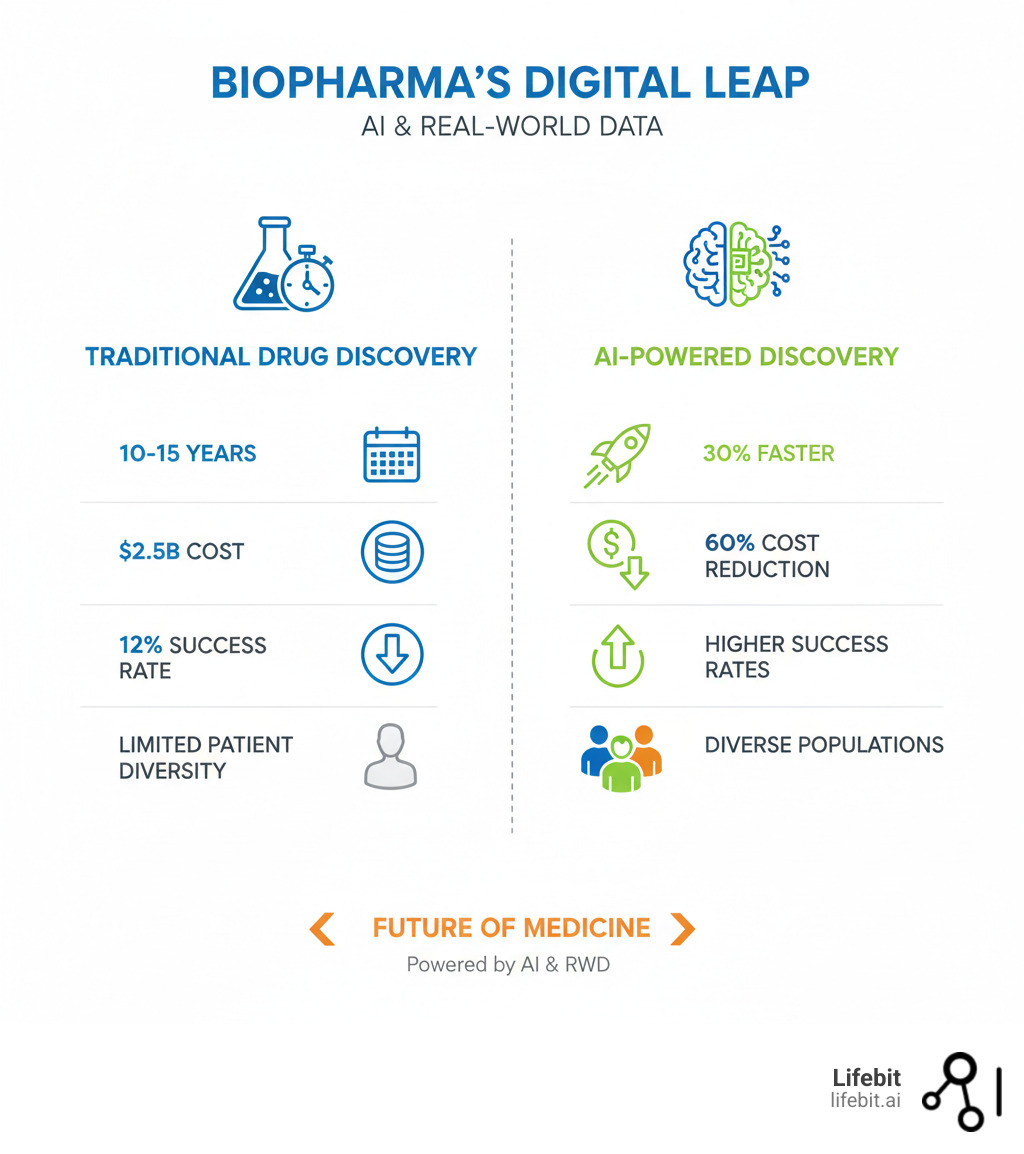
Slash Trial Timelines by 30% and Costs by 60%: AI + Real-World Data Is Your Edge is fundamentally changing how new medicines reach patients. Here’s what you need to know:
Key Changes:
- Speed: Drug development timelines can be cut by up to 30%, potentially saving years
- Cost: Companies can reduce development costs by up to 60%, saving billions
- Success: AI-improved programs achieve higher success rates than traditional methods
- Inclusivity: Real-world data captures diverse patient populations beyond clinical trials
- Evidence: AI analyzes massive datasets from EHRs, wearables, and insurance claims to generate actionable insights
The Challenge:
Traditional drug development takes 10-15 years and costs over $2.5 billion, with less than 12% of candidates reaching market. Clinical trials account for roughly 40% of research budgets, yet 90% of programs still fail.
The Solution:
Artificial intelligence and real-world data are breaking this cycle. AI can predict clinical trial outcomes with 80% accuracy, identify drug candidates in weeks instead of years, and analyze billions of data points to spot patterns humans would miss. Real-world evidence from millions of patients provides more generalizable insights than traditional trials restricted to narrow populations.
Yet most companies remain stuck. More than one-third of the biopharma industry is still in early exploration phases of digital change. Only 9% consider their real-world evidence programs extremely successful. The gap between AI’s potential and actual implementation remains wide.
The bottom line: Companies that successfully harness AI and real-world data gain massive competitive advantages. Those that don’t risk falling behind permanently.
I’m Dr. Maria Chatzou Dunford, CEO and Co-founder of Lifebit, where I’ve spent over 15 years helping organizations steer Biopharma’s Digital Leap: How AI and Real-World Data Are Shaping Evidence Generation through secure, federated data platforms. Before founding Lifebit, I built breakthrough tools at the Centre for Genomic Regulation and contributed to Nextflow, now used worldwide in genomic data analysis.
Biopharmas Digital Leap: How AI and Real-World Data Are Shaping Evidence Generation terms to remember:
- AI-driven drug development
- artificial intelligence (AI) enabled data repository services and informatics tools and capabilities
Turn 2,314 Exabytes into Answers: How AI Converts RWD into Results
The biopharma industry is experiencing Biopharma’s Digital Leap: How AI and Real-World Data Are Shaping Evidence Generation right now. This isn’t just incremental improvementit’s a fundamental shift in how we understand drug effectiveness and patient outcomes.
What is Real-World Data (RWD)?
Think of Real-World Data as the treasure trove of medical information generated outside traditional clinical trials. It’s the digital footprint of healthcare as it actually happens. Electronic Health Records (EHRs) capture every doctor’s visit, diagnosis, and prescription. Wearables track heart rates, sleep patterns, and activity levels around the clock. Insurance claims document what treatments patients receive and what conditions they’re managing.
The scale is mind-boggling. Healthcare data worldwide totals an estimated 2,314 exabytesthat’s more information than you could process in several lifetimes. This massive pool offers an unprecedented window into how patients fare in everyday settings, not just in the controlled environment of a clinical trial.
But here’s the catch: raw data alone doesn’t tell us much. A pile of medical records is just thata pile. The magic happens when we transform RWD into Real-World Evidence (RWE), and that’s where artificial intelligence becomes indispensable.
Turning data into evidence with AI
AI models can analyze billions of data points to spot patterns invisible to the human eye. They extract meaningful insights about drug effectiveness and safety that reflect the true diversity of patient populations. We’re not just getting more datawe’re getting better understanding.
One of the most exciting developments is multimodal AI, which integrates different types of informationgenomic sequences, clinical histories, and medical imaginginto a single, comprehensive view. Imagine combining a patient’s genetic profile with their medical history and diagnostic scans. Suddenly, you’re not looking at isolated data points but at a complete picture of their unique biology.
This capability powers precision medicine in action. AI can improve gene editing techniques like CRISPR by predicting which therapeutic targets will work best. It can forecast the probability of success in clinical trials, helping companies allocate resources more wisely. And it’s finding novel biomarkers that identify disease subtypes or predict treatment responses, opening doors to truly personalized therapies. For a deeper dive into these advances, check out this scientific research on AI in drug discovery.
Opening Up Insights with NLP and Machine Learning
The real power behind changing RWD into RWE comes from specialized AI techniques that each solve different pieces of the puzzle.
Natural Language Processing (NLP) tackles one of healthcare’s thorniest problems: unstructured clinical notes. When a doctor types observations into a patient record, they’re not filling out a standardized form. They’re writing narrativesdetailed, nuanced, and full of medical insights buried in free text.
NLP algorithms can read these notes like a highly trained medical professional, extracting critical information that would otherwise remain locked away. Tools leveraging advanced language models can pull safety and efficacy details from thousands of clinical trial abstracts, consolidating information that would take human researchers months to compile.
Machine learning (ML) goes beyond reading to predicting. By training on vast datasets, ML models can forecast patient outcomes, identify subtle treatment effects, and even anticipate a drug’s efficacy and safety profile before extensive testing. These models learn from millions of patient experiences to spot patterns that inform better treatment decisions.
Generative AI is revolutionizing drug design itself. Instead of testing existing compounds, generative AI can propose entirely new molecular structureschemical architectures that human chemists might never consider. This “accelerated evolution” explores vast chemical spaces efficiently. By 2025, experts project that over 30% of new drugs will be systematically finded using generative AI techniques, up dramatically from today. Researchers have already used these models to design potent kinase inhibitors, proving the concept works in practice.
Meanwhile, deep learning is boosting diagnostic accuracy, particularly in medical imaging. Convolutional Neural Networks can detect lesions and segment tumors with speed and precision that often surpasses human radiologists. They’re not replacing doctorsthey’re giving them superhuman tools.
Why AI-Generated RWE Is More Inclusive and Generalizable
Here’s where Biopharma’s Digital Leap: How AI and Real-World Data Are Shaping Evidence Generation really shines: it breaks free from the limitations that have constrained drug development for decades.
Traditional Randomized Controlled Trials (RCTs) are the gold standard for proving a drug works. But they come with a significant caveat. RCTs typically involve carefully selected patients under tightly controlled conditions. Participants often fit narrow criteriathey can’t have certain comorbidities, they must be within specific age ranges, and they need to follow strict protocols.
This creates a problem: the patients in trials don’t always reflect the diverse populations who’ll actually use the drug. Real-world patients are messier. They have multiple health conditions. They forget to take pills. They come from different genetic backgrounds.
AI-generated RWE captures this diversity. By analyzing RWD from millions of patients across various demographics, ages, and health conditions, we gain a broader, more representative understanding of how treatments perform in actual practice. This isn’t theoretical75% of drugs in clinical development don’t adequately address the needs of historically underserved groups. AI can analyze unstructured data from EHRs, claims, and patient advocacy groups to identify and include these diverse populations in evidence generation.
The result? We can measure true treatment effectiveness as it happens in the real world, not just in controlled settings. We can track long-term outcomes beyond the typical short duration of clinical trials. And we can understand how drugs work across the full spectrum of human diversitydifferent ages, ethnicities, genetic backgrounds, and health conditions.
This more inclusive approach doesn’t just improve science. It makes medicine more equitable, ensuring that treatments work for everyone, not just those who fit neatly into trial criteria.
Save Up to 60% and Launch 30% Faster: The New Playbook Regulators Accept
The financial impact of Biopharma’s Digital Leap: How AI and Real-World Data Are Shaping Evidence Generation is staggering. For an industry where bringing a single drug to market can cost over $2.5 billion and take more than a decade, AI and RWD represent a fundamental shift in economics.
Companies effectively deploying these technologies could slash drug development costs by up to 60%. We’re not talking about marginal improvements here. AI alone has the potential to deliver over US$70 billion in savings for drug findy by 2028. That’s real money that can be redirected toward more research, more candidates, and ultimately more treatments reaching patients.
The cost difference becomes crystal clear when you look at the numbers. A traditional Phase 3 trial averages around $19 million, while RWD and AI analyses typically run between $150,000 and $1 million. That’s not just a reductionit’s a complete reimagining of how evidence generation can work.
But the benefits extend far beyond the balance sheet. Time is perhaps even more valuable than money when patients are waiting for life-saving treatments. AI and RWD are accelerating time-to-market, helping drugs reach patients up to 30% faster. We’ve witnessed this dramatic acceleration firsthand: AI-driven drug findy compressed COVID-19 vaccine development from the typical decade-long process to under a year. In one remarkable case, researchers identified a liver cancer drug candidate in just 30 days.
Clinical trials themselves are becoming smarter and more efficient. AI tools are revolutionizing how trials are conceived, planned, and executed, giving researchers unprecedented foresight into patient selection, enrollment criteria, and potential bottlenecks. Instead of spending months manually combing through records to find eligible patients, AI algorithms can rapidly identify candidate pools from vast databases. Generative AI optimizes trial design, improves feasibility assessments, and improves site selectionoverhauling clinical operations while automating tedious data analysis tasks.
The COPILOT-HF study demonstrated just how powerful this approach can be. A custom Generative AI application identified eligible patients with 100% accuracy, outperforming traditional manual methods in both speed and cost. Perhaps most impressively, it reduced screening costs to just $0.11 per patient. When you’re recruiting hundreds or thousands of participants, those savings add up fast.
AI is even enabling the use of synthetic control armscomputationally generated comparison groups that can reduce or eliminate the need for placebo groups in certain trials. This not only speeds up recruitment but also addresses ethical concerns about withholding potentially beneficial treatments.
On the regulatory front, momentum is building rapidly. Both the FDA and EMA are increasingly embracing RWE as a legitimate source of evidence for drug approvals. The FDA has established a Center for Clinical Trial Innovation (C3TI) specifically to investigate how RWD can be incorporated into the regulatory process. You can explore more about the FDA’s stance on Real-World Evidence to understand their vision for this change.
In Europe, the European Health Data Space initiative aims to simplify patient consent for data collection and increase transparency around data usage. Meanwhile, the EU’s proposed AI Act categorizes AI risk levels and updates liability rules for manufacturers, creating a clearer regulatory pathway for AI-driven evidence generation. The FDA’s AI Council now oversees artificial intelligence applications, including their use in regulatory decision-making.
This regulatory acceptance is critical. It signals that health authorities recognize the value and validity of AI-generated RWE, paving the way for more companies to confidently invest in these approaches. The economic case is compelling, the regulatory environment is supportive, and the technology is proven. The question is no longer whether to adopt AI and RWD, but how quickly companies can implement them effectively.
Stuck in Pilots? Fix Data, Skills, and Bias—or Watch Competitors Pass You
The promise of Biopharma’s Digital Leap: How AI and Real-World Data Are Shaping Evidence Generation is undeniable. But here’s the uncomfortable truth: most companies aren’t there yet. Despite all the excitement and potential, more than one-third of the industry remains stuck in early exploration or pilot phases. Even more striking, 68% of firms haven’t moved beyond pilots or active exploration. They’re testing the waters, running small experiments, but not diving in.
This creates a frustrating paradox. The technology is racing ahead, but adoption is crawling. We have the tools to revolutionize drug development, yet the majority of organizations haven’t figured out how to use them at scale.

What’s holding everyone back? The roadblocks start with the data itself. Data quality, standardization, privacy, and security are the foundational challenges that trip up even the most ambitious AI initiatives. You’ve probably heard the phrase “garbage in, garbage out.” It’s especially true here. In practice, this means dealing with incompatible coding standards (e.g., ICD-9 vs. ICD-10), different measurement units, and non-standard phrasing in clinician notes. If your input data is messy, incomplete, or inconsistent, your AI models will produce faulty analyses. Missing values alone can cripple model performance. This is why standardizing data using frameworks like the OMOP Common Data Model is so critical—they create a common language for disparate datasets. And here’s a sobering statistic: researchers spend up to 80% of their time just integrating and preparing data for analysis. That’s not innovation. That’s digital housekeeping.
Then there are the internal problems that organizations face. Integration with legacy systems tops the list, cited by 37% of respondents as a major barrier. These older systems weren’t built for today’s data-hungry AI tools, and retrofitting them is expensive and complex. Speaking of expensive, high implementation costs are a concern for 32% of companies. And even when budget isn’t the issue, expertise often is. A lack of internal skills holds back 26% of organizations. This isn’t just about hiring data scientists; it’s about upskilling biologists, chemists, and clinicians to work with data in new ways. Nearly half of survey respondents admitted their workforce simply isn’t prepared for digital change. Only 5% felt highly prepared. That workforce skills gap is a silent killer of AI initiatives.
Beyond the technical and organizational problems, there’s an ethical challenge we can’t ignore. Algorithmic bias is real. If AI models are trained on unrepresentative datasets, they can perpetuate or even amplify inequities in healthcare outcomes. For example, a diagnostic algorithm for skin cancer trained on images of light-skinned individuals may fail to detect melanoma in patients with darker skin. A risk-prediction model might also use a patient’s zip code as a proxy for socioeconomic status, leading to biased resource allocation. The “black-box” nature of many AI algorithms makes this even more concerning. How do you validate a model when you can’t fully explain its conclusion? This is why explainable AI (XAI) and transparency are non-negotiable, providing insights into how a model reaches its predictions.
Data privacy regulations like GDPR and HIPAA add another layer of complexity. These rules exist for good reason, but they require careful navigation. Every AI deployment must balance innovation with accountability and human oversight. For a deeper look at these challenges and how organizations are addressing them, check out insights on overcoming AI implementation challenges.
Fixing Data Quality with Machine Learning
Here’s where it gets interesting. Machine learning isn’t just part of the solution for drug development; it’s also part of the solution for fixing the data problems that hold back drug development. ML technologies can proactively identify and address issues like variable outliers and missing values in real-world data before they derail your analysis.
Think of ML as a quality control system for your data pipeline. These models can spot anomalies, fill gaps, and ensure reliable inputs for downstream AI analyses, often before patient-centric studies even begin. They’re getting smarter at data cleansing, turning messy, incomplete datasets into something actually usable.
But let’s be clear: AI isn’t meant to work alone. The human-in-the-loop approach is critical. This means combining AI’s speed and analytical horsepower with human expertise and judgment. In practice, this creates a powerful feedback cycle. An AI might screen millions of molecules and propose 100 potential drug targets. A team of human scientists then reviews this list, filtering it based on biological plausibility, “druggability,” and potential off-target effects. This expert-curated list is then fed back to the AI, which refines its next round of analysis. This collaborative process ensures that the AI’s computational power is guided by real-world scientific wisdom. Human scientists bring irreplaceable value. They can recognize when an AI prediction is biologically implausible. They spot patterns that suggest entirely new mechanisms. They provide the vision to connect molecular findies to real therapeutic needs. And perhaps most importantly, they offer the wisdom that comes from failure, from years of trial and error that no algorithm can replicate.
AI is a powerful tool, but it’s still a tool. It requires human input for decision-making in ambiguous situations. It needs human oversight for ethical considerations. The best results come when humans and AI work together, each doing what they do best.
The State of Biopharma’s Digital Leap: Scaling AI and RWD for Real Results
Moving beyond pilots to full-scale adoption is where the rubber meets the road for Biopharma’s Digital Leap: How AI and Real-World Data Are Shaping Evidence Generation. The economic case is crystal clear. Efficiency and cost savings motivate nearly two-thirds of firms pursuing digital change. In an industry where R&D budgets are under constant pressure, the need to “do more with less” isn’t just a catchphrase. It’s survival.
But there’s something even more powerful than cost savings driving this change: competitive urgency. A gap is widening in pharmaceutical R&D between companies that are successfully integrating AI and those clinging to traditional approaches. And that gap is turning into a chasm.
Companies that master AI and real-world data will move faster, spend less, and bring more effective treatments to market. Companies that don’t will find themselves at a severe disadvantage, watching from the sidelines as competitors race ahead. The question isn’t whether AI will transform drug findy anymore. The question is whether your organization will help define that change or become irrelevant trying to resist it.
The time for pilots and exploration is ending. The time for real, scaled implementation is now.
From Lab to Human in Under a Year: AI Results You Can Copy Today
The theoretical benefits of Biopharmas Digital Leap: How AI and Real-World Data Are Shaping Evidence Generation are compelling, but real-world examples truly underscore its impact. Across London, New York, the United Kingdom, USA, Israel, Singapore, Canada, Europe, and indeed, five continents, we see digital change in action.
AI-driven drug findy is accelerating candidate identification at an unprecedented pace. Consider a novel target for idiopathic pulmonary fibrosis. Using a generative AI platform, researchers analyzed biological datasets to identify an unknown disease pathway and design new small molecules to modulate it. Within 18 months—a fraction of the typical timeline—a lead candidate was identified and advanced into clinical development. This process integrated AI-powered molecule design, automated synthesis planning, and predictive analytics, dramatically compressing the discovery cycle.
RWE in clinical research is expanding evidence with real-world data, offering invaluable insights. In oncology, RWE is used to create ‘digital twins’ of patients for in-silico trials. By modeling a patient using their genomic data, imaging, and treatment history, researchers can simulate responses to new therapies. This allows for rapid hypothesis testing and personalized trial designs. Similarly, during the COVID-19 pandemic, collaborative efforts connected real-world patient data to provide rapid insights into risk factors and treatment effectiveness that would have been impossible to gather through traditional trials in that timeframe.
Beyond drug findy, AI is revolutionizing manufacturing, quality assurance, and supply chain optimization. For instance, a biopharma company implemented a ‘digital twin’ for a manufacturing facility. This virtual model, fed by real-time sensor data, allowed them to simulate process changes without risking a batch. The AI identified an optimal cell culture feeding strategy that increased yield by over 15% and reduced process variability. In the supply chain, AI algorithms analyze dozens of variables to improve demand forecasting accuracy to over 95%, preventing stockouts of critical medicines.
Finally, AI is making strides in workforce training and operational efficiency. Workforce training is a top area for digital adoption (52.6%), as is quality assurance/control (47.3%). In the lab, AI-driven automation is eliminating bottlenecks. Robotic Process Automation (RPA) bots, guided by machine learning, now manage routine data entry and analysis tasks. This frees highly skilled scientists from hours of manual work, allowing them to focus on experimental design and interpreting complex results. One lab reported a 70% reduction in manual data handling time, allowing them to increase their screening capacity by 40% without additional headcount. This is not about replacing scientists, but augmenting their capabilities and accelerating the pace of innovation.
Move Now: Federated AI Lets You Scale Evidence Generation Without Data Leaks
Biopharma’s Digital Leap: How AI and Real-World Data Are Shaping Evidence Generation represents far more than a passing trend. It’s a fundamental reimagining of how we find, develop, and deliver medicines that change lives. Throughout this exploration, we’ve witnessed how AI and RWD are rewriting the rules on speed, slashing costs, and opening doors to more inclusive drug development. The opportunity to bring therapies to patients faster and more efficiently has never been more tangible.
Yet opportunity alone isn’t enough. The path forward demands that we confront persistent barriers head-on: the thorny issues of data quality, the inertia of legacy systems, and the very real skills gaps holding organizations back. Success will require strategic partnerships and a genuine commitment to embracing advanced technology, not just in pilot programs, but at scale.
A critical piece of this puzzle is the adoption of secure, federated platforms. These platforms solve a problem that has long plagued medical research: how do you enable global collaboration while keeping sensitive patient data locked down tight? Federated platforms allow researchers to access and analyze vast, diverse datasets from around the world, all while ensuring that private patient information never leaves its original, secure environment. It’s the best of both worlds: powerful insights without compromising privacy.
This is where Lifebit steps in. Our next-generation federated AI platform provides secure, real-time access to global biomedical and multi-omic data across the UK, USA, Canada, Europe, Israel, Singapore, and beyond spanning five continents. We’ve built in everything you need: harmonization capabilities that make disparate datasets speak the same language, advanced AI/ML analytics that turn raw data into actionable intelligence, and federated governance that keeps everything compliant and secure.
Our platform includes specialized components designed for real-world impact. The Trusted Research Environment (TRE) creates secure spaces for sensitive data analysis. The Trusted Data Lakehouse (TDL) brings together data from multiple sources while maintaining security and governance. And R.E.A.L. (Real-time Evidence & Analytics Layer) delivers the real-time insights, AI-driven safety surveillance, and secure collaboration that biopharma, governments, and public health agencies need to make faster, better decisions across hybrid data ecosystems.
We’re not just building technology. We’re powering the next generation of evidence generation with secure, global data access, ensuring that the promise of digital change becomes reality for patients everywhere.
Learn more about federated data solutions.