

From Lab to Life: AI’s Game-Changing Role in Medical Research

The AI Revolution in Medicine is Here
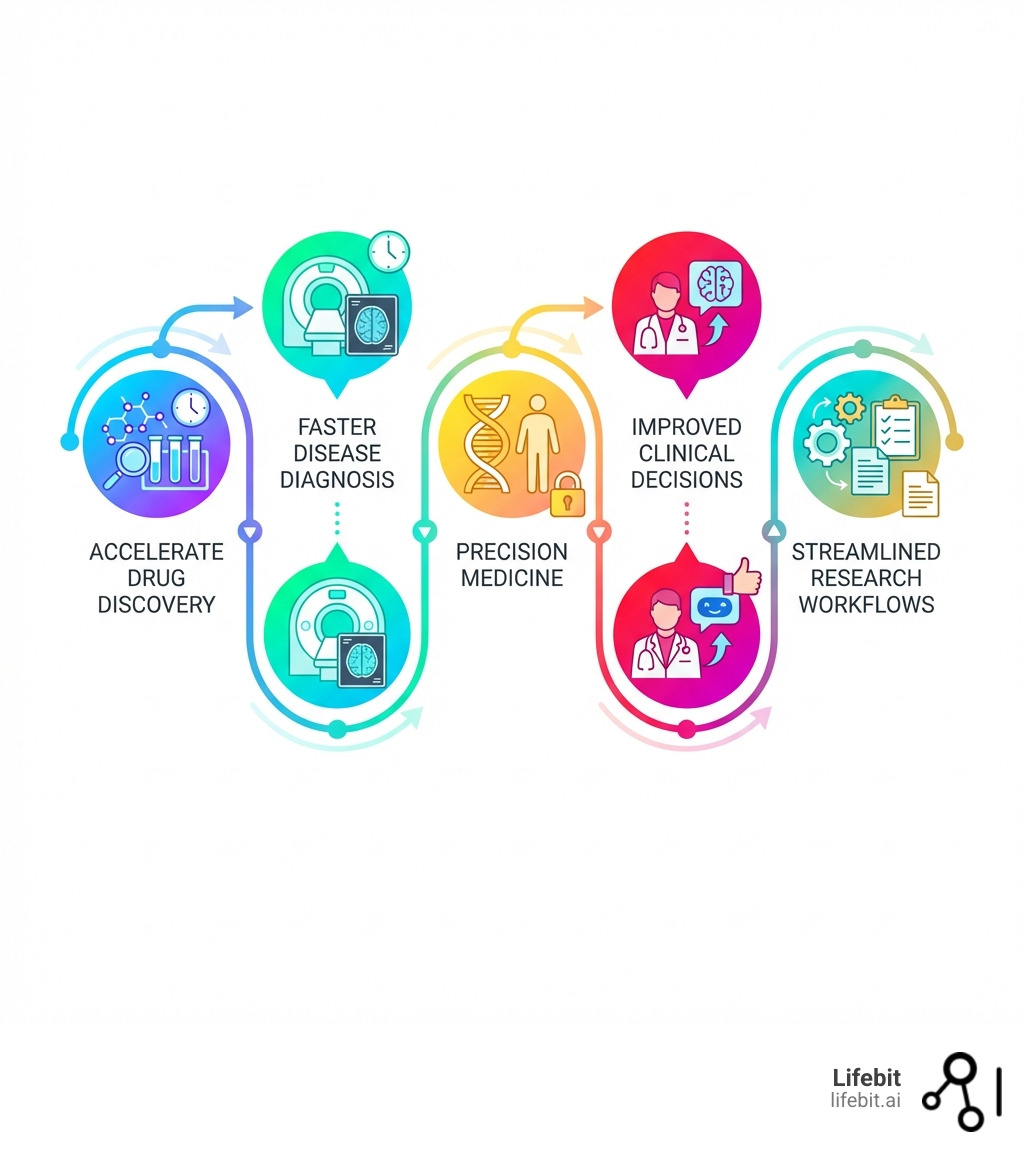
AI-powered medical research is changing healthcare at every level. From finding diseases faster to finding new drugs in months instead of years, artificial intelligence is accelerating medical breakthroughs that save lives. Here’s what AI does for medical research today:
- Speeds up diagnosis – AI analyzes medical images and patient data to detect diseases like cancer earlier than traditional methods
- Accelerates drug findy – Machine learning identifies promising drug compounds and predicts their effectiveness, cutting years from development time
- Improves precision medicine – AI matches patients to personalized treatments based on their unique genetic and clinical profiles
- Streamlines research workflows – From writing manuscripts to analyzing massive datasets, AI handles time-consuming tasks so researchers can focus on findy
- Improves clinical decisions – AI acts as a co-pilot for doctors, suggesting diagnoses and flagging potential issues while the human expert makes the final call
The impact is real and measurable. Studies show that physicians using AI diagnostic tools achieve 76% accuracy compared to 74% working alone, while AI alone scores 16 percentage points higher than physicians without assistance. In Germany, radiologists using AI detected more breast cancers without increasing false alarms. In Kenya, an AI system reduced diagnostic and treatment errors across tens of thousands of patients.
But this revolution comes with hard questions. How do we prevent AI from amplifying existing healthcare biases? What happens when algorithms trained on data from wealthy Western populations are applied to underserved communities? Who owns the intellectual property when AI generates new medical insights? And how do we balance the massive energy costs of AI implementation with the urgent need for sustainable healthcare?
As Dr. Maria Chatzou Dunford, CEO and Co-founder of Lifebit, I’ve spent over 15 years at the intersection of computational biology, genomics, and AI-powered medical research, building platforms that enable secure, federated data analysis for global pharmaceutical and public health institutions. My work focuses on solving the core challenge facing modern medical research: how to open up insights from massive, siloed datasets while maintaining patient privacy and regulatory compliance.
Basic AI-powered medical research vocab:
Slash Diagnosis Time: How AI Finds Disease Faster Than Ever
One of the most immediate and profound impacts of AI-powered medical research is its ability to accelerate disease diagnosis and improve prognosis. Imagine a world where critical conditions are identified earlier, giving patients a better chance at successful treatment. Thanks to AI, this isn’t science fiction; it’s our rapidly approaching reality.

AI is already playing key roles in this change. For instance, it has been extensively used in developing applications for the direct or indirect identification of individuals suffering from heart failure (HF). More broadly, AI is revolutionizing cancer detection, enabling earlier identification of potential cancer growth. This early detection is a game-changer, moving us from reactive treatment to proactive intervention. The goal is to catch diseases when they are most treatable, minimizing suffering and improving patient outcomes.
AI as a Digital Microscope: Revolutionizing Medical Imaging
Medical imaging is a cornerstone of modern diagnosis, but interpreting complex scans like X-rays, MRIs, and CTs can be time-consuming and challenging for even the most experienced radiologists. This is where AI steps in as a powerful “digital microscope,” enhancing human capabilities.
AI has revolutionized medical imaging by enhancing image interpretation, streamlining processes, optimizing workflow efficiency, reducing operational costs, facilitating population health management, and contributing to innovative clinical trial designs. For example, in Germany, studies have shown that radiologists using AI detected more breast cancers without increasing false alarms, highlighting AI’s potential to improve accuracy without overwhelming clinicians. This enhancement is particularly transformative in specialties like pathology and ophthalmology. In pathology, AI algorithms analyze digital whole-slide images to detect and grade tumors with high consistency, quantifying cellular features that guide treatment decisions and adding objectivity to cancer diagnosis. In ophthalmology, AI systems screen retinal images for signs of diabetic retinopathy or macular degeneration with an accuracy that enables autonomous screening in primary care settings. The FDA has approved such systems, which identify at-risk patients before irreversible vision loss occurs, democratizing access to preventative care.
Consider the precision AI brings to challenging tasks. A study on real-time AI-based diagnosis of neoplastic polyps demonstrated AI’s ability to assist during procedures. For standard visual inspection versus AI-assisted diagnosis (CADx) in polyp diagnosis, sensitivity improved from 88.4% to 90.4%, and high confidence in assessment rose from 74.2% to 92.6%. This means fewer missed polyps and greater certainty for clinicians. Such advancements not only save lives but also make the diagnostic process more efficient and less prone to human error, allowing radiologists and physicians to interpret complex data with unprecedented speed and accuracy.
We leverage AI to analyze vast imaging datasets, identifying subtle patterns that might escape the human eye. Our platforms are designed to integrate seamlessly into existing workflows, providing rapid, AI-driven insights that empower clinicians to make faster, more confident decisions.
Predicting the Future: AI in Disease Prognosis and Personalized Treatment
Beyond diagnosis, AI’s predictive capabilities are shaping the future of disease prognosis and ushering in an era of truly personalized medicine. The most profound benefit AI brings to medical research is in precision medicine. This isn’t just about treating a disease; it’s about treating your disease, custom to your unique biological makeup.
Precision medicine, enabled by AI, means moving beyond a one-size-fits-all approach. It allows for personalized diagnostics, where treatments are targeted precisely to an individual’s genetic profile, lifestyle, and environment. AI analyzes complex datasets, including genomic information, patient history, and real-world outcomes, to predict how a patient will respond to different therapies. This leads to more effective treatments and fewer adverse reactions.
For instance, a predictive model for hormone therapy in prostate cancer uses AI to analyze digital pathology images and clinical data, helping clinicians determine which patients will benefit most from specific treatments. This kind of targeted therapeutic approach ensures that patients receive the most effective care, reducing unnecessary treatments and improving quality of life.
AI also plays a crucial role in predicting health outcomes, particularly in chronic disease management. By identifying individuals at high risk for disease progression or complications, AI enables earlier interventions and proactive health management. Our federated AI platforms are designed to process and analyze these diverse datasets securely, facilitating the development of personalized treatment plans across various conditions, from cancer to chronic metabolic disorders.
The Race for a Cure: How AI is Accelerating Drug Findy
The journey from a promising compound in a lab to a life-saving drug on the market is notoriously long, expensive, and fraught with failure. But AI-powered medical research is dramatically accelerating this process, changing drug findy and development at every stage.
AI contributes significantly to creating novel compounds and evaluating biological activities. It can predict how potential drug molecules will interact with biological targets, design new molecules from scratch, and even identify existing drugs that could be repurposed for new conditions. This drastically reduces the number of compounds that need to be synthesized and tested in the lab, saving years and billions of dollars.
For example, AI models can predict protein structures down to nearly every atom from their amino acid sequence, a task critical for understanding disease mechanisms and designing targeted therapies. With about 20% of human proteins having poorly defined functions and 95% of research focused on just 5,000 well-studied proteins, AI helps us explore uncharted biological territory faster.
Our platforms are at the forefront of this revolution, enabling biopharma companies to leverage AI for more efficient and effective clinical trials, ultimately redefining healthcare delivery. We provide solutions for pharma target identification, accelerating the findy of novel therapeutic targets.
Here are just a few ways AI is changing drug findy and development:
- Target Identification: AI analyzes vast biological datasets, including multi-omics data (genomics, proteomics), to pinpoint disease-causing proteins. By modeling disease biology, it can identify and prioritize novel targets that are not only biologically relevant but also ‘druggable,’ moving beyond well-understood pathways to uncover new therapeutic opportunities.
- Compound Design & Synthesis: Generative AI models design novel molecular structures with desired properties, predicting their efficacy and safety before they’re even made.
- Drug Repurposing: AI sifts through existing drug libraries to find approved compounds that could treat new diseases, shortening development timelines significantly.
- Preclinical Testing: AI predicts drug toxicity and effectiveness in biological systems, reducing the need for extensive animal testing.
- Clinical Trial Optimization: AI helps design more efficient trials by identifying specific patient cohorts from electronic health records who are most likely to respond to a drug. It can also help create ‘synthetic control arms’ using real-world data, potentially reducing the need for placebo groups. This leads to smaller, faster, and more successful trials, accelerating regulatory approval.
- Pharmacovigilance: AI continuously monitors drug safety post-market, identifying adverse events and potential risks faster than traditional methods.
The New Frontier of AI-Powered Medical Research
The impact of AI extends far beyond the clinic and the lab bench. It’s revolutionizing the very fabric of medical research, from how we analyze data to how we write and publish our findings. This new frontier promises to make research more efficient, accurate, and accessible than ever before.

From Data Chaos to Clear Insights: AI’s Impact on Healthcare Analysis
Healthcare generates an unprecedented volume of data – from electronic health records and medical images to genomic sequences and wearable device data. This “big data” holds immense potential, but its sheer scale and complexity can be overwhelming. AI is the key to open uping its insights.
AI impacts the process of data analysis in healthcare by efficiently sifting through these massive datasets, identifying patterns, and extracting meaningful information that would be impossible for humans to discern. This includes tasks like finding fresh sources of data and staying current with advancements in respective domains.
In fields like Obstetrics and Gynecology, AI applications are emerging to analyze patient data, predict pregnancy complications, and personalize prenatal care. In pharmaceutical research, AI is used to analyze clinical trial data, identify patient subgroups that respond best to certain drugs, and monitor real-world drug effectiveness. For instance, a collaboration between Penda Health and OpenAI deployed a background AI system to review urgent care visits, leading to a reduction in diagnostic and treatment errors across tens of thousands of patients. This highlights AI’s ability to bring data to bear more fully on decision-making.
At Lifebit, our federated AI platform is designed precisely for this challenge. We enable secure, real-time access to global biomedical and multi-omic data, with built-in capabilities for harmonization and advanced AI/ML analytics. This allows researchers to perform large-scale, compliant research across diverse datasets without compromising privacy, turning data chaos into clear, actionable insights.
Your New Research Assistant: AI in Scientific Writing and Publishing
The research lifecycle doesn’t end with findy; it culminates in communication. Scientific writing and publishing are critical for disseminating knowledge, but they are also time-consuming and meticulous processes. AI is stepping in as a powerful research assistant, streamlining these crucial steps.
AI facilitates the writing process by generating drafts, offering grammar and style suggestions, and enhancing manuscript quality through advanced models like ChatGPT. This means researchers can spend less time on tedious drafting and more time on the intellectual core of their work. AI tools can also assist researchers in finding fresh sources of data and staying current with advancements in their respective domains, ensuring comprehensive and up-to-date research.
Beyond drafting, AI is changing the publishing process for medical research, including peer review, quality control, and journal matching. AI already plays some key roles in the marketing, distribution, and data-handling aspects of the publishing industry. Before submission, AI can be used by authors to check for plagiarism and statistical errors, with tools such as iThenticate and StatCheck. This helps ensure the integrity and quality of submitted manuscripts.
For publishers, AI can assist in matching manuscripts to suitable reviewers, detecting potential conflicts of interest, and even identifying questionable research practices. The concept of “autonomous LLM-driven research” is emerging, where AI platforms can generate human-verifiable research papers from data, ensuring transparency and traceability. This demonstrates a future where AI not only assists but actively participates in the creation and dissemination of scientific knowledge.
Doctor’s New Superpower: AI as a Clinical Co-Pilot, Not a Replacement
The vision of AI replacing doctors is a common fear, but the reality is far more collaborative and empowering. Instead of taking over, AI is becoming a doctor’s new superpower, acting as a co-pilot that improves their abilities, reduces burnout, and ultimately improves patient care.
Augmenting, Not Replacing: How AI Empowers Clinicians
Across clinical settings, the most consistent benefits are found when AI supports clinicians rather than replaces them. AI can be integrated into clinical settings to support clinicians by increasing efficiency, reducing mistakes, easing the nationwide crunch in primary care, bringing data to bear more fully on decision-making, reducing administrative burdens, and creating space for longer, deeper person-to-person interactions.
Consider the immense administrative burden faced by healthcare professionals. AI tools, such as ambient documentation systems, can listen to patient visits and generate clinical notes in real-time, freeing up valuable time. This allows clinicians to focus more on the human aspects of care, fostering stronger doctor-patient relationships. As one expert observed, “AI works best as a teammate to clinicians, not a replacement.”
In randomized trials, physicians using AI alongside standard medical resources made better treatment decisions than those relying on conventional tools alone. This isn’t about AI making decisions for doctors, but about providing them with improved information and insights to make their own judgments more effectively. AI helps clinicians second-guess themselves, identify potential missed diagnoses, or consider overlooked questions, leading to improved patient care and decision-making.
The Empowered Patient: Benefits and Risks of Direct-to-Patient AI
AI isn’t just for clinicians; it’s increasingly reaching patients directly through various tools and applications. Patient-facing AI provides a new landscape for engagement, offering both exciting benefits and important risks that require careful consideration.
One of the most striking benefits is the ability for patients to seek virtual second opinions. In a widely publicized case, a mother used ChatGPT to analyze her child’s medical notes, which suggested tethered cord syndrome – a condition no doctor had previously mentioned for his recurring pain. This highlights the potential for AI to empower patients with information and even aid in diagnosis.
Patient-facing AI tools can also assist with symptom triage, answer medication queries, and provide chronic disease coaching. This can improve accessibility to health information and support self-management. However, this empowerment comes with risks. There’s a concern about over-trust in AI, where patients might blindly follow AI advice without human oversight. The field needs clearer evidence, stronger escalation pathways, and outcome-focused evaluation frameworks to ensure effective and safe implementation of these tools. We must ensure that these tools genuinely improve health literacy and patient outcomes, rather than just engagement metrics.
Training the Next Generation: Adapting Medical Education for the AI Era
The rapid evolution of AI technology necessitates agility and adaptability in medical education and research practices. The healthcare professionals of tomorrow will need to be fluent in AI, not just as users, but as critical evaluators and innovators.
The challenges and opportunities in training the next generation of healthcare professionals to effectively use AI tools are immense. Medical education must evolve to integrate AI literacy into its core curriculum. This means teaching students how AI models work, their capabilities, and their limitations, as well as the ethical considerations surrounding their use. Courses, PhD tracks, tutor bots, and virtual patients are already being integrated into medical education to prepare students for this rapidly evolving field.
The goal is not to train AI specialists, but to equip every healthcare professional with the knowledge and skills to leverage AI as a powerful tool in their practice. As one expert noted, the question of “How can artificial intelligence transform the training of medical students and physicians?” is key, with the goal being to enable them to focus more on the human aspects of care and making them better critical thinkers. This requires a shift towards lifelong learning, where adaptability and continuous skill development are paramount. We must ensure that while AI assists, it doesn’t shortcut fundamental learning processes, preserving the critical thinking and foundational knowledge essential for medical practice.
The Hard Questions: Tackling AI’s Bias, Cost, and Ethical Risks
As we accept the transformative power of AI-powered medical research, we must also confront the hard questions it raises. Ethical considerations, data privacy, algorithmic bias, equitable access, sustainability, content ownership, and plagiarism are not mere footnotes; they are fundamental challenges that must be addressed to ensure AI serves humanity responsibly.
The Ghost in the Machine: Unpacking AI Bias and Ensuring Equity
One of the most pressing ethical considerations in AI is the potential for bias. AI models are only as good as the data they are trained on, and if that data reflects existing societal biases, the AI will amplify them. This is particularly concerning in medical research, where biased AI could perpetuate or even worsen health disparities.
Current datasets often reflect historical inequities, being disproportionately drawn from wealthy Western nations and predominantly white male subjects. This can lead to AI models performing poorly on diverse populations, exacerbating existing societal biases. Examples include skin cancer detection devices that perform less accurately on pigmented skin or scheduling algorithms that mispredict no-show rates for certain demographic groups.
Ensuring equitable access to AI-driven advancements and mitigating existing societal biases that could be amplified by AI is crucial. This requires training AI on diverse and representative datasets from geographically varied locations, a core principle behind our federated AI approach at Lifebit. Mitigating this requires more than just diverse data. The emerging field of fairness-aware machine learning develops algorithms that actively correct for bias. Techniques include pre-processing data, adding fairness constraints during model training, and post-processing predictions to ensure equitable outcomes. Furthermore, continuous auditing and transparency are essential. AI systems must be rigorously checked for biased performance before and after deployment, and their decision-making processes should be explainable to allow for human oversight and accountability. This multi-pronged defense is crucial as bias can creep in at any stage. Our platform enables secure, compliant research without moving sensitive data, respecting regulations like HIPAA and GDPR, which are critical in protecting patient privacy across the USA, UK, Canada, and Europe. This way, models learn from a wider range of populations, making them more robust and fair. The urgency of environmentally sustainable and socially just deployment of artificial intelligence in health care cannot be overstated.
The Price of Progress: Environmental and Cost Implications of Medical AI
The immense computational power required to train and run sophisticated AI models comes with a significant environmental footprint and substantial cost implications. This is a critical factor in the sustainable advancement of AI-powered medical research.
The energy consumption and carbon emissions associated with large-scale AI training and deployment are considerable. Running powerful AI models requires massive data centers, which consume vast amounts of electricity, often generated from fossil fuels. This contributes to climate change, posing a dilemma for a technology aimed at improving human health.
The cost of implementing AI in healthcare is also a major consideration. Developing, deploying, and maintaining AI systems, especially those processing vast datasets, can be expensive. The high cost of implementation also threatens to create a ‘digital divide’ in healthcare, where well-funded institutions adopt AI while under-resourced hospitals are left behind, worsening care disparities. In response to both cost and environmental concerns, the ‘Green AI’ movement promotes computational efficiency. This involves developing smaller, more powerful models and specialized hardware that consume less energy. The goal is to make powerful AI sustainable and accessible enough to run locally in diverse healthcare settings, not just in massive, energy-intensive data centers. We need to develop frameworks for sustainable advancement that balance the benefits of AI with its environmental and economic costs. This includes optimizing algorithms for energy efficiency, investing in renewable energy sources for data centers, and ensuring that AI solutions are cost-effective and scalable for broader adoption. A decision framework for sustainably advancing health AI is necessary to ensure that our pursuit of medical progress doesn’t come at an unsustainable price.
Who Owns an AI’s Idea? Navigating Plagiarism and Content Ownership
As AI becomes more capable of generating text, images, and even scientific hypotheses, complex questions arise around content ownership, intellectual property, and plagiarism. When an AI generates a new medical insight or assists in writing a research paper, who gets the credit?
The ethical challenges for medical publishing when generating scholarly content with ChatGPT and similar AI tools00019-5) are significant. While AI can draft text, offer grammar suggestions, and improve manuscript quality, its role in authorship is still debated. Most academic guidelines currently state that AI cannot be listed as an author, as it lacks accountability and legal personhood.
This necessitates clear guidelines for acknowledging AI assistance in publications. Furthermore, the use of AI raises concerns about plagiarism. While AI tools can check for plagiarism, the potential for AI to generate content that inadvertently or intentionally mirrors existing work, or to be used to bypass traditional plagiarism detection, is a growing challenge. We need robust frameworks for academic integrity that address the unique capabilities of AI. This includes developing advanced plagiarism detection tools and establishing clear authorship policies that differentiate between human intellect and AI assistance, ensuring that scientific credit is attributed fairly and accurately.
Frequently Asked Questions about AI in Medical Research
Can AI replace doctors or researchers?
AI is a powerful tool designed to augment human expertise, not replace it. It excels at processing vast datasets and identifying patterns, which helps clinicians make faster, more informed decisions and allows researchers to accelerate findy. The goal is a human-AI collaboration that improves patient care and scientific progress.
How does AI help in finding new drugs?
AI dramatically speeds up drug findy by analyzing biological data to identify potential drug targets, predicting how new compounds will behave, and designing novel molecules from scratch. This reduces the time and cost of the initial phases of development, helping to bring new therapies to patients more quickly.
Is my health data safe when used for AI research?
Data security is a top priority. AI research in healthcare operates under strict regulations like HIPAA and GDPR. Technologies like federated learning, used by platforms such as Lifebit, allow AI models to be trained on data where it resides, without moving or exposing sensitive patient information, ensuring both privacy and research progress.
Conclusion: Charting the Future of Health with AI
AI-powered medical research is not a distant dream; it’s a present-day reality that is fundamentally reshaping healthcare. From accelerating drug findy and enabling precision medicine to empowering clinicians and streamlining the entire research lifecycle, AI is the key to open uping unprecedented advancements. By embracing these technologies responsibly and ethically, we can build a future of more personalized, effective, and accessible healthcare for everyone. Discover how federated AI is revolutionizing pharma target identification.