

Beyond the Buzzwords: What is AI/ML Data Analytics and Why It Matters

How AI/ML Data Analytics Cuts Data Processing Costs by 280x
AI/ML data analytics is the use of artificial intelligence and machine learning algorithms to automatically analyze large datasets, uncover hidden patterns, and generate predictive insights—without manual programming for each new query. Here’s what you need to know:
- What it does: Combines AI algorithms with traditional analytics to find patterns, predict outcomes, and automate decisions in real time
- Why it matters: Enables 280-fold cost reductions in data processing while handling datasets too complex for human analysts
- Who uses it: Global pharma, public health agencies, financial institutions, and any organization drowning in siloed data
- Key difference: Traditional analytics tells you what happened; AI/ML analytics predicts what will happen and recommends what to do
If you’re a leader at a pharmaceutical company, regulatory agency, or public health institution, you already know the pain. Your teams are buried under mountains of siloed EHR records, genomics data, and claims files. Data quality is inconsistent. Onboarding takes months. Your analysts can’t access the information they need, and your AI initiatives are stalled by compliance bottlenecks.
The numbers tell the story. In 2024, 78% of companies adopted AI across multiple business functions, with private investment hitting $252.3 billion globally. Organizations that implement AI/ML data analytics report cost reductions up to 280 times compared to manual methods—and they’re processing datasets that were previously impossible to analyze.
But here’s the reality: most analytics platforms weren’t built for this. Legacy tools can’t handle federated data. They require moving sensitive patient records across borders. They force technical teams to spend weeks on data prep instead of findy.
I’m Maria Chatzou Dunford, CEO and Co-founder of Lifebit, where we’ve built a federated genomics and biomedical data platform that enables AI/ML data analytics across 275 million patient records without moving data. With 15 years in computational biology, AI, and health-tech, I’ve seen how the right approach transforms regulatory review times, clinical trial recruitment, and real-world evidence generation.
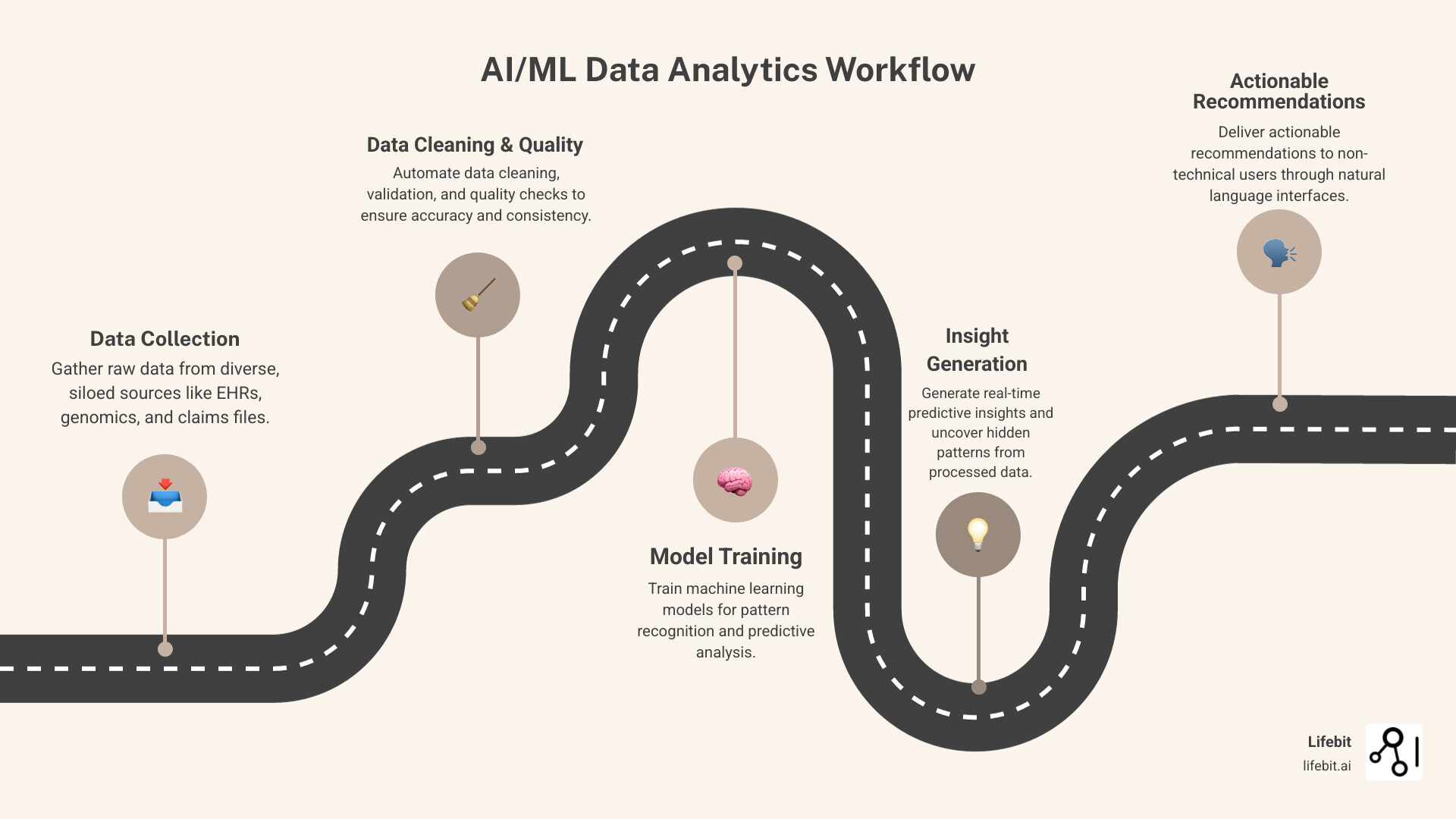
AI/ML data analytics terms simplified:
- Cloud data management
- data privacy regulations
- The Future of Data Governance: Centralized vs Decentralized (Who Wins in 2025?)
Why Traditional Analytics Is Dead—And How AI/ML Data Analytics Replaces It
At its core, AI/ML data analytics is the evolution of how we talk to our data. In the old days (meaning about five years ago), if we wanted to find a correlation between a specific genetic mutation and a drug response, a bioinformatician had to write specific code to look for that exact link. If they missed a variable, the insight stayed hidden.
Today, we use machine learning to let the data speak for itself. Instead of us telling the computer what to look for, we give the computer the data and let it tell us what is interesting. This provides a level of predictive power that manual analysis simply cannot match. It’s the difference between looking through a keyhole and having a 360-degree drone view of the entire landscape.
3 Steps to Turn Messy Data into Breakthrough Insights
The journey from “messy data” to “breakthrough insight” is often where most projects fail. We’ve all heard the phrase “garbage in, garbage out.” To get high-quality AI/ML data analytics results, we follow a rigorous pipeline:
- Data Collection: Gathering multi-omic, clinical, and phenotypic data.
- Cleaning and Harmonization: This is where we spend a lot of our time. Data from a hospital in London might look very different from data in Singapore. We use AI to automate the mapping of these disparate sources into a unified format.
- Processing: Running the models to identify trends.
For a deeper dive into how this looks in practice, check out our piece on AI-Driven Insights.
Why Legacy Dashboards Are Killing Your Productivity
If you are still relying on static PDF reports or Excel dashboards, you are essentially driving a car by looking through the rearview mirror. Traditional analytics is descriptive—it tells you what happened last quarter.
We see organizations moving away from these legacy systems because of:
- The Scalability Wall: Human analysts can’t keep up with the petabytes of data generated by modern genomic sequencing.
- Manual Bottlenecks: Waiting weeks for a data science team to run a query is no longer acceptable in a world where real-time evidence is needed for drug safety.
- Hidden Patterns: Traditional tools often miss non-linear relationships in data that AI/ML data analytics can spot in seconds.
To understand the full scope of this transition, read our AI-Powered Research Ultimate Guide.
3 AI/ML Data Analytics Pillars That Turn Raw Data into Targets
To master AI/ML data analytics, we have to look under the hood. It’s not just one “AI” button; it’s a suite of technologies working in harmony.
We primarily work with three pillars:
- Supervised Learning: We train models on labeled data (e.g., “this genomic profile responded well to this drug”).
- Unsupervised Learning: The model finds clusters and anomalies on its own—perfect for finding new disease subtypes.
- Reinforcement Learning: The system learns through trial and error to optimize specific outcomes, such as clinical trial site selection.
Automate Feature Extraction with Deep Learning
Deep learning is the “heavy lifter” of the AI world. By using neural networks—computational models inspired by the human brain—we can process unstructured data like medical images or raw DNA sequences.
The magic of deep learning in AI/ML data analytics is “automated feature extraction.” In the past, a scientist had to tell the computer which “features” of a cell image were important. Now, the neural network figures out which patterns (often invisible to the human eye) are the most predictive of a patient’s prognosis. You can explore this further in our article, The Brains Behind the Bytes: How Deep Learning Powers Analytics.
Talk to Your Data: NLP for Non-Technical Teams
We believe that you shouldn’t need a PhD in Computer Science to ask a question of your data. This is where Natural Language Processing (NLP) comes in. By using NLU (Understanding) and NLQ (Querying), we allow researchers to type questions in plain English: “Show me all female patients over 50 with BRCA1 mutations who didn’t respond to Treatment X.”
This shift toward Data Analysis in the Era of Generative AI is democratizing research, allowing the people with the clinical expertise to lead the analysis directly.
Stop Wasting R&D: Get Real-Time Insights with AI/ML Data Analytics
Is the investment worth it? In our experience across the UK, USA, Europe, and beyond, the answer is a resounding yes—if implemented correctly.
| Feature | Traditional Analytics | AI/ML Data Analytics |
|---|---|---|
| Speed to Insight | Weeks or Months | Real-time / Hours |
| Data Volume | Limited to structured samples | Petabyte-scale multi-omics |
| Accuracy | Subject to human bias | High-precision pattern recognition |
| Cost per Insight | High (Labor intensive) | Low (Automated at scale) |
Using AI/ML data analytics isn’t just about being “high-tech”; it’s about making informed decisions that save lives and millions of dollars in R&D.
Detect Adverse Events Months Earlier with Predictive Analytics
The most powerful application we see is proactive risk mitigation. In pharmacovigilance, for example, waiting for a side effect to be reported manually is too slow. AI/ML data analytics can scan real-world data to detect “signals” of adverse events months before they would be caught by traditional methods. This is a core part of our AI-Driven Pharmacovigilance Solutions.
3 Best Practices for High-ROI AI/ML Workflows
We’ve seen what works and what doesn’t. To succeed, we recommend:
- Analytics as Code: Ensure your workflows are reproducible and version-controlled.
- Data Quality First: Automated cleaning is a must; you cannot scale manual curation.
- Robust Architecture: Use a platform that can handle the “lifecycle” of a model, from training to deployment.
For a comprehensive roadmap, see our Advanced Analytics Ultimate Guide.
How AI/ML Data Analytics Finds Life-Saving Targets in Hours
The impact of AI/ML data analytics spans across every major industry, though its most profound effects are currently felt in the life sciences.
In e-commerce, it’s about inventory. In finance, it’s about stopping a fraudulent transaction in the milliseconds it takes to swipe a card. But in our world, it’s about finding the right drug for the right patient at the right time. Our AI Healthcare Solutions are designed exactly for this purpose.
Find the Right Drug for the Right Patient with AI/ML
We are currently seeing a total change in how biomarkers are finded. By analyzing thousands of parameters across genomic and clinical datasets simultaneously, researchers are identifying new targets for complex diseases like Alzheimer’s and rare cancers.
This isn’t just theoretical. Using AI/ML data analytics, we can optimize clinical trials by identifying which patient populations are most likely to respond to a candidate drug, potentially saving years of failed trials. Learn more in our AI-Powered Biomarker Discovery Guide 2025.
Stop Fraud in Milliseconds: AI/ML for Finance and Insurance
While we focus on biomedicine, the same principles of AI/ML data analytics apply to our partners in the insurance and financial sectors. Whether it’s processing massive streams of IoT data from wearable devices or using AI for Claims Processing, the goal is the same: move from reactive processing to predictive intelligence.
Secure AI/ML Data Analytics: Analyze Global Data Without Moving It
With great power comes great responsibility. As we deploy AI/ML data analytics globally—from London to Singapore—we must address the “black box” problem.
Stop Algorithmic Bias Before It Starts
Algorithmic bias is a real threat. If a model is trained only on data from one demographic, its insights won’t be valid for a global population. We advocate for AI-Enabled Data Governance that includes rigorous testing for bias and ensures that every AI-driven decision is explainable and compliant with local regulations like GDPR or HIPAA.
Federated Learning: The Gold Standard for Data Privacy
The biggest hurdle to AI/ML data analytics in healthcare is data residency. You cannot simply move patient records from Canada to the USA for analysis.
Our solution is Federated Learning. Instead of moving the data to the model, we move the model to the data. The sensitive information stays securely within its original jurisdiction (like a hospital’s Trusted Research Environment), while the AI “learns” from it and sends only the non-sensitive insights back. This is the gold standard for Privacy-Preserving AI.
2026 Guide: How Augmented AI/ML Data Analytics Automates Discovery
As we look toward 2025 and 2026, the pace of innovation is only accelerating. The Stanford HAI AI Index Report 2025 highlights how multimodal models—those that can understand text, images, and genomic data simultaneously—are becoming the new standard.
Augmented Analytics: The AI Co-Pilot for Researchers
We are moving into the era of “Augmented Analytics.” This means the AI doesn’t just do the math; it suggests the next question you should ask. It acts as a co-pilot for the researcher, automating the tedious parts of data development so humans can focus on the “why.” You can see how this fits into a broader strategy in our Data Intelligence Platform Ultimate Guide.
Run Complex Models On-Site with New Hardware Efficiency
The AI Index Report 2024 shows that compute power is doubling at an incredible rate, but the real breakthrough is in hardware efficiency and open-source collaboration. For us at Lifebit, this means we can run more complex AI/ML data analytics locally on-site at hospitals and research centers, further reducing the need for data transfer and increasing security.
AI/ML Data Analytics: Your Top Questions Answered
What is the difference between AI and traditional data analytics?
Traditional analytics is like a spreadsheet; it calculates what you tell it to. AI/ML data analytics is like a researcher; it looks at the data, finds its own patterns, and makes predictions about the future.
How does machine learning improve predictive accuracy?
Machine learning models improve over time. Every time they are exposed to more data, they refine their “understanding” of the patterns, leading to much higher accuracy than static, human-written formulas.
What are the biggest risks of using AI in data analysis?
The primary risks are data privacy breaches and algorithmic bias. Using a federated approach and robust governance frameworks is essential to mitigate these risks and ensure ethical AI use.
Stop Drowning in Data. Start Finding with AI/ML Data Analytics.
The era of “guessing” is over. Whether you are trying to identify a new drug target or monitor the safety of a global vaccine rollout, AI/ML data analytics is the only way to handle the complexity of the modern world.
At Lifebit, we’ve built the Lifebit Federated Biomedical Data Platform to solve these exact challenges. We provide the secure, real-time access to global multi-omic data that you need to stay competitive. Our platform, including the Trusted Research Environment (TRE) and R.E.A.L. (Real-time Evidence & Analytics Layer), ensures that your research is compliant, secure, and—most importantly—fast.
We are proud to support the world’s leading biopharma companies and public health agencies across 5 continents. If you’re ready to move beyond the buzzwords and start generating real-world evidence, we’re here to help you lead the way.