

The 10 Best UK Biotech ‘Omics Analysis Companies Compared

Stop Wasting Years on Data: Analyze UK Multi-Omics Securely
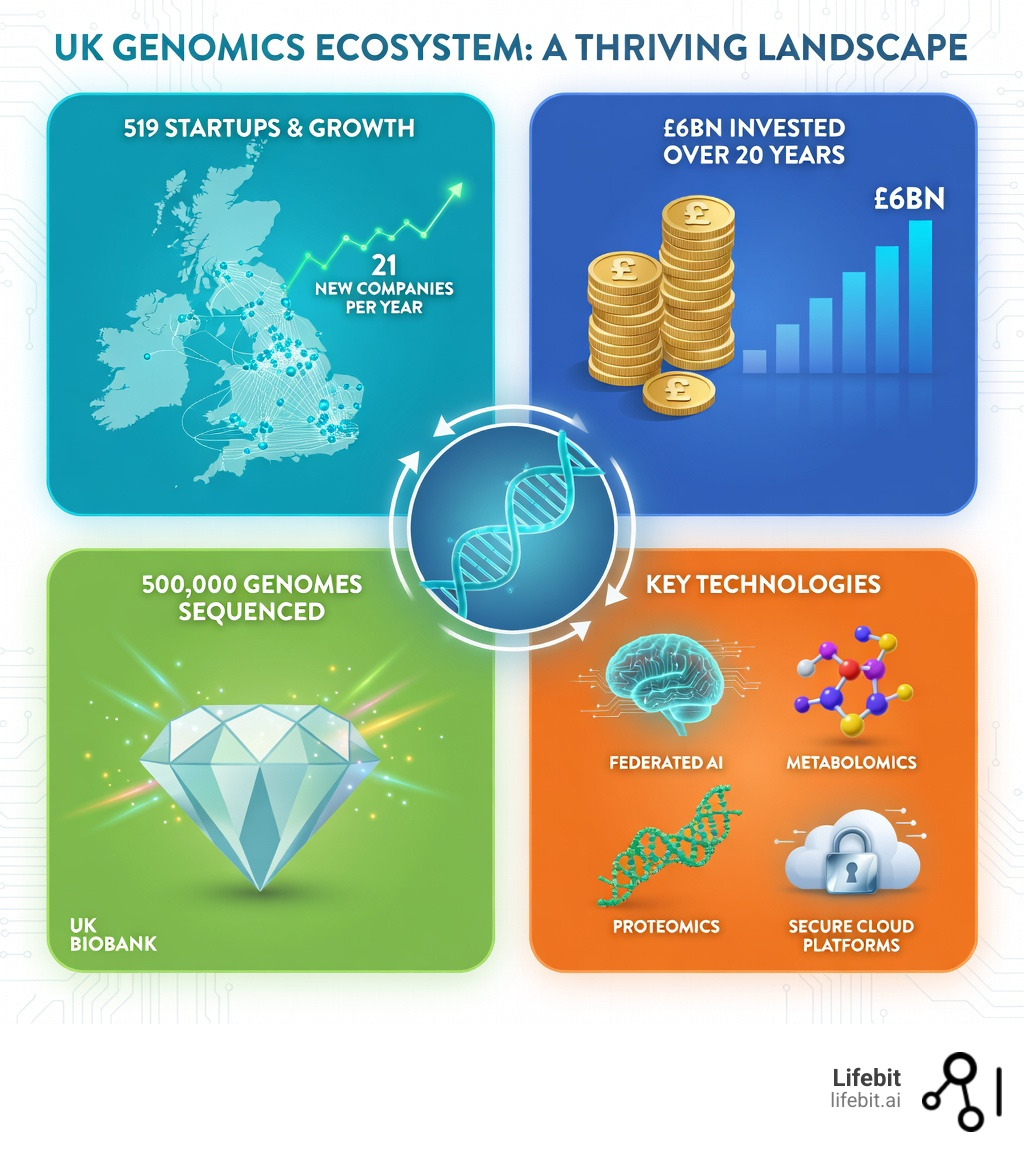
List the top biotech companies in the UK that offer services for analyzing ‘omics data and you’ll find a thriving ecosystem of over 519 genomics startups, with 21 new companies launching annually. The UK has cemented its position as a global leader in multi-omics analysis, combining genomics, proteomics, metabolomics, and transcriptomics to accelerate drug discovery, precision medicine, and population health research. This leadership is anchored by the “Golden Triangle” of London, Oxford, and Cambridge, which houses a concentration of academic excellence and venture capital that is unmatched in Europe.
Lifebit leads this ecosystem by providing a federated AI platform that powers secure, real-time access to global biomedical and multi-omic data. Unlike traditional approaches, Lifebit allows researchers to run analysis where the data resides, reducing the cost, delay, and risk of moving sensitive datasets. This infrastructure supports critical initiatives across the UK ecosystem, helping teams collaborate securely and scale analysis across large cohorts. The UK’s strategy, outlined in the “Genome UK: 2020 to 2030” vision, aims to create the most advanced genomic healthcare system in the world, and companies like Lifebit are the engine room of this transformation.
The UK’s dominance stems from unique advantages: the NHS’s integrated medical records linked to genomic data, government-backed initiatives like the 100,000 Genomes Project and UK Biobank, and R&D tax incentives that attract £26 billion in genomics investment over 20 years. When you combine 500,000 whole genomes from UK Biobank with real-world clinical data, you create a powerful resource for understanding how genes, environment, and lifestyle influence disease. This longitudinal data is the “holy grail” for pharmaceutical companies looking to validate drug targets with human genetic evidence, which has been shown to double the success rate of clinical trials.
But raw data means nothing without the right analysis tools. Multi-omics analysis is computationally intense; for instance, the UK Biobank’s DRAGEN pipeline identified 1.5 billion variants from half a million genomes. The challenge is not just generating data; it’s integrating genomics with proteomics (the study of proteins), metabolomics (the study of small molecules), and clinical phenotypes to uncover actionable insights. That is where federated platforms, automated pipelines, and AI-powered interpretation become critical. The sheer volume of data—often reaching petabyte scale—requires a paradigm shift from “bring data to the code” to “bring code to the data.”
As Maria Chatzou Dunford, CEO and Co-founder of Lifebit, I have spent 15 years building computational biology tools that transform how researchers List the top biotech companies in the UK that offer services for analyzing ‘omics data and access them securely at scale. Through Nextflow, federated AI platforms, and partnerships with the NHS, I have seen how the right infrastructure accelerates discovery, from target identification to clinical trials, without moving sensitive patient data. Our work ensures that the UK remains at the forefront of the “Data Bio” era, where biology is treated as an information science.
List the top biotech companies in the UK that offer services for analyzing ‘omics data. word list:
Why the UK’s £6bn Genomics Infrastructure Is the World’s Best Research Sandbox
The UK isn’t just a participant in the ‘omics revolution; it is the architect. This leadership is built on a foundation of historical breakthroughs—from the discovery of the DNA double helix at King’s College to Fred Sanger’s sequencing methods at the University of Cambridge. Today, that legacy lives on through a unique integration of the National Health Service (NHS) with cutting-edge research, creating a feedback loop between the clinic and the lab that is virtually non-existent in fragmented healthcare systems like that of the United States.
The Genomics England Complete Guide highlights how the 100,000 Genomes Project transformed the UK into the first nation to offer whole-genome sequencing as part of routine clinical care. This project created a massive biodata resource of nearly 150,000 whole genomes, providing a “sandbox” for researchers to develop new diagnostics for rare diseases and cancer. The NHS Genomic Medicine Service (GMS) now builds on this, embedding genomics into the very fabric of healthcare, ensuring that every patient with a rare disease or certain cancers has access to genomic testing.
Furthermore, the UK Biobank stands as a global gold standard. By matching genomic data from 500,000 participants with lifetime medical records, imaging data, and even activity monitor data, it allows scientists to see exactly how genetic variants manifest as real-world health outcomes over decades. This longitudinal aspect is critical for studying late-onset diseases like Alzheimer’s or Parkinson’s. Government-backed Biotech Companies UK benefit from R&D tax credits and schemes like EIS/SEIS, which have fueled over £6 billion in investment over the last two decades. With 245 funded startups and 135 having secured Series A+ funding, the infrastructure for innovation is unparalleled. Additionally, the presence of the European Bioinformatics Institute (EMBL-EBI) and the Wellcome Sanger Institute in Hinxton provides a concentration of bioinformatics expertise that acts as a magnet for global talent.
Analyze 500,000 Genomes Without Moving Data: How Lifebit Solves the ‘Omics Bottleneck

When we List the top biotech companies in the UK that offer services for analyzing ‘omics data, the differentiator is simple: can you run secure, compliant analysis at population scale without moving the data? At Lifebit, we act as the multi-omics hub for global researchers and biopharma teams. The bottleneck today is not access alone; it is executing complex workflows quickly while protecting sensitive patient data. Traditional data sharing involves “data egress”—downloading files from a central repository. For a cohort of 500,000 genomes, this could take months and cost hundreds of thousands of pounds in cloud transfer fees, not to mention the massive security risk of data duplication.
Our platform enables researchers to analyze data where it resides. This matters because moving petabytes of genomic data is slow, expensive, and risky. Using federated AI, teams can run workflows across different biobanks and datasets while keeping governance and access controls in place. This approach supports studies like those featured in Nature Medicine, where Metabolomic profiles predict individual multidisease outcomes. By bringing the analysis to the data, we ensure that the data owner maintains 100% control, which is essential for maintaining public trust in genomic research.
Key Features of Lifebit’s ‘Omics Platform
| Feature | Benefit for Researchers |
|---|---|
| Federated Access | Analyze sensitive data without moving it from its secure home, ensuring GDPR and HIPAA compliance. |
| Data Harmonization | Standardize disparate ‘omics layers (genomics, proteomics, etc.) using OMOP Common Data Models for joint analysis. |
| AI/ML Analytics | Deploy advanced models for target identification, biomarker discovery, and polygenic risk score (PRS) calculation. |
| Regulatory Compliance | Built-in governance that meets NHS, ISO 27001, and international data standards like the “Five Safes” framework. |
| Scalable Workflows | Support for Nextflow and WDL, allowing researchers to run high-throughput pipelines like GATK or DRAGEN seamlessly. |
Lifebit: Secure, Scalable, and Fast ‘Omics Data Analysis
Our core mission is to remove bottlenecks in drug discovery. Our Trusted Research Environment (TRE) and Trusted Data Lakehouse (TDL) provide a secure workspace where teams can collaborate on population-level profiling. The TDL architecture is particularly revolutionary; it combines the performance of a data warehouse with the flexibility of a data lake, allowing for real-time querying of genomic variants alongside clinical notes. Whether you are analyzing single-cell RNA sequencing data or large cohort studies, our R.E.A.L. (Real-time Evidence & Analytics Layer) is designed to turn analysis into usable evidence faster, with controls that support pharmacovigilance and compliant research.
Lifebit and the NHS: Accelerating Clinical-Grade Genomic Interpretation
We are proud to support the ecosystem surrounding the NHS Genomic Medicine Service. By providing the Genomics England Research Environment, we help teams operationalize workflows that support variant prioritization for rare diseases and somatic cancer. This clinical-grade interpretation helps turn genomic data into actionable insights faster, while maintaining governance and auditability. For a clinician, this means the difference between a “variant of unknown significance” and a definitive diagnosis that can guide treatment. Our platform automates the heavy lifting of bioinformatics, allowing clinical scientists to focus on interpretation rather than data engineering.
Lifebit for Complex Disease: Combinatorial Analytics at Scale
Chronic diseases like diabetes, heart disease, and obesity are rarely caused by a single gene. They are the result of high-dimensional, combinatorial interactions between thousands of genetic variants and environmental factors. Our platform is designed for these massive disease population studies. By integrating multi-omics datasets, including the Atlas of plasma NMR biomarkers for health and disease in 118,461 individuals, we help biopharma teams identify novel drug targets that traditional analytics can miss. We enable “PheWAS” (Phenome-Wide Association Studies) that can scan thousands of traits against a specific genetic variant to understand its full biological impact.
Lifebit Connect: Personalized Medicine and Patient-Led Research
Personalized medicine starts with the patient. Patient-led research models are changing how participants engage with studies, moving from passive donors to active partners. At Lifebit, we support this shift by enabling secure collaboration and analysis patterns that can respect participant governance while still enabling life-saving research. Our platform allows for “dynamic consent,” where patients can choose which research projects can access their data in real-time, fostering a more transparent and ethical research ecosystem.
Lifebit Data Management: Handling the ‘Omics Data Explosion
The growth of ‘omics data is explosive, with the amount of genomic data generated doubling every seven months. Lifebit’s platform provides the governance needed to manage this data at scale. Our cloud-based scalability means that whether you are a small startup or a global pharma organization, you have the computing power and controls to process hundreds of thousands of genomes efficiently. We utilize object storage and advanced indexing to ensure that even with petabytes of data, search and retrieval remain instantaneous.
Beyond DNA: How to Map Metabolic Signatures to Genetic Variants in Record Time
The future of ‘omics isn’t just about DNA; it’s about how that DNA is expressed through RNA (transcriptomics), proteins (proteomics), and metabolites (metabolomics). This is why we focus on interdisciplinary solutions that bridge these layers. DNA is the “blueprint,” but the proteome and metabolome are the “functional reality” of the cell. Recent research, such as the Genome-wide characterization of circulating metabolic biomarkers, shows how thousands of genetic associations can be mapped to metabolic signatures, providing a much clearer picture of disease mechanisms.
Lifebit Epigenomics: Unlocking the Epigenome
Epigenetics—the study of how your behaviors and environment cause changes that affect the way your genes work—is the next frontier. Unlike the static genome, the epigenome is dynamic and changes over time. Innovative solutions are delivering products that bring this dynamism into focus, allowing researchers to extract more epigenetic information from a single, low-input sample. We support these advancements by providing the bioinformatics pipelines needed to handle complex DNA methylation and 6-base sequencing data, often discussed at the London Bioinformatics Innovation Conference. This is particularly relevant in oncology, where epigenetic changes often precede the development of tumors.
Lifebit AI: Cardiovascular and Multi-Omics Data at Scale
Cardiovascular disease remains a leading cause of death globally, yet many of its genetic drivers remain poorly understood. By applying AI to large-scale multi-omic data, researchers can develop the next generation of drug targets, such as PCSK9 inhibitors which were discovered through human genetic studies. Our platform supports this by solving relationships across ‘omics layers, helping researchers move from a variant to a validated target in record time. For more on this, check out our Unlocking Innovation: A Guide to London’s Leading Bioengineering Firms. We are also seeing a rise in “Spatial Omics,” which allows researchers to see where genes are expressed within a tissue sample, adding a crucial geographical dimension to molecular data.
How to Choose the Right UK ‘Omics Data Analysis Platform
When you List the top biotech companies in the UK that offer services for analyzing ‘omics data, how do you choose? The market is crowded, but the best platforms are built on four essential pillars:
- Data Integration: Can the platform handle multi-omics (DNA, RNA, proteins, metabolites) in one place? True discovery happens at the intersection of these layers. If your data is siloed, you are missing the full biological context.
- Scalability: Can it handle a cohort of 500,000 as easily as a cohort of 50? Many platforms work well for small academic studies but break down when faced with the industrial-scale data of the UK Biobank.
- Compliance: Does it meet the strict regulatory standards of the UK and EU? With the introduction of the UK-GDPR and the Data Protection Act 2018, the legal requirements for handling health data are higher than ever. Look for platforms with SOC 2 Type II and ISO 27001 certifications.
- Visualization: Are the results presented in a way that biologists—not just coders—can understand? A platform is only useful if it empowers the subject matter experts to make decisions. Look for interactive dashboards, Manhattan plots, and pathway analysis tools that don’t require writing Python or R code.
The UK ‘Omics FAQ: How to Scale Your Research Without Regulatory Risk
What are the primary ‘omics technologies used in the UK?
The UK ecosystem covers the full spectrum of molecular biology:
- Genomics: Whole-genome sequencing (WGS) and whole-exome sequencing (WES) to identify genetic variants.
- Proteomics: Studying the entire set of proteins produced by an organism, often using technologies like Olink or SomaLogic.
- Metabolomics: Analyzing small molecules (metabolites) in cells or fluids, providing a snapshot of physiological state.
- Transcriptomics: Examining RNA levels (RNA-Seq) to see which genes are active in specific tissues or at specific times.
- Epigenomics: Mapping chemical markers like DNA methylation that turn genes on or off without changing the DNA sequence.
- Spatial Biology: A newer field that maps where molecular activity is happening within the architecture of a tissue.
How do UK platforms handle large-scale cohort data?
Most top UK firms use cloud-native infrastructure (AWS, Azure, Google Cloud) combined with automated, containerized pipelines (Docker, Singularity). Solutions like Illumina’s DRAGEN allow for “joint calling,” which means researchers can analyze hundreds of thousands of samples together to find rare variants without having to re-process the entire dataset every time a new sample is added. This is essential for “incremental” biobanks that are constantly growing. Furthermore, the use of “Federated Learning” allows AI models to be trained across multiple datasets without the data ever leaving its original secure location.
Why is the UK a hub for ‘omics data analysis?
It’s a “perfect storm” of factors that have aligned over the last 70 years:
- Historical Discovery: The UK has been at the center of DNA research since the 1950s, creating a deep culture of expertise.
- The NHS: A single-payer system provides a unified source of longitudinal health data, which is much harder to assemble in private insurance markets.
- Biobanks: Resources like the UK Biobank, Genomics England, and the NIHR BioResource provide the world’s largest and most well-characterized datasets.
- Capital: A robust venture capital scene in London and Cambridge specifically for Biotech Companies That Focus on Data Analytics, supported by government grants from Innovate UK.
- Regulation: The UK’s MHRA (Medicines and Healthcare products Regulatory Agency) is known for being forward-thinking regarding AI and digital health.
What is a Trusted Research Environment (TRE)?
A TRE is a secure digital space where researchers can access and analyze sensitive data. Instead of the data being sent to the researcher, the researcher is “invited” into the data’s home. TREs are the standard for the NHS and Genomics England because they provide a full audit trail of who accessed what data and what analysis they performed, ensuring that patient privacy is never compromised.
How much does ‘omics analysis cost in the UK?
Costs vary wildly depending on the scale. Sequencing a single human genome has dropped to under £500, but the analysis of that data can cost significantly more in terms of compute power and expert time. Many UK companies offer “Software as a Service” (SaaS) models where you pay for the amount of data processed, making high-end bioinformatics accessible to smaller startups.
Conclusion: Secure Your Place in the Global ‘Omics Revolution
The UK is undeniably the best place in the world for ‘omics research. From the 519 startups pushing the boundaries of AI to the massive datasets provided by the NHS and UK Biobank, the ingredients for the next medical breakthrough are all here. The shift toward multi-omics integration and federated data access is not just a trend; it is a necessity for the next generation of precision medicine. As we move toward 2030, the ability to link genetic code to clinical outcomes in real-time will become the standard of care.
At Lifebit, we are proud to provide the connective tissue for this ecosystem. Our Federated AI platform, Trusted Research Environment, and Trusted Data Lakehouse ensure that researchers can access the data they need securely and analyze it at a scale that was impossible just a few years ago. By focusing on data harmonization, regulatory compliance, and real-time insights, we help turn the “explosive growth” of ‘omics data into life-saving treatments. The future of medicine is written in the data, and the UK is where that data is being decoded.